
Plastic Extrusion Machine Applications: Water Pipes to Decorative Panels
Plastic Extrusion Machine Applications: Water Pipes to Decorative Panels
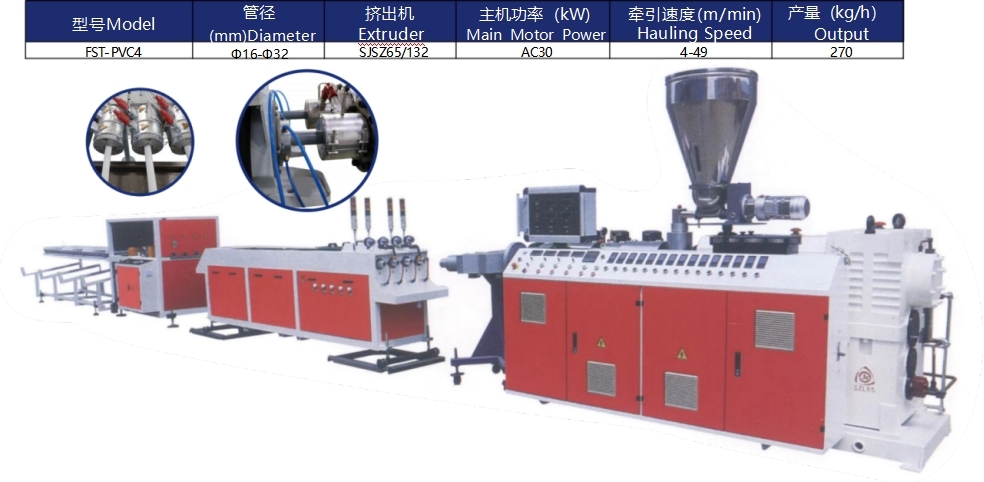
Solid-wall pipe extrusion line. The melting and pumping principle is common across applications, but the die, calibration, haul-off and cutting sections are not. Image: JKS Machinery.
A plastic extrusion machine is defined less by the word plastic than by the product it is engineered to run. The same melt, pump and shape sequence produces a 1,600 mm-class HDPE water main for a municipal network and a hollow PVC ceiling panel for an interior fit-out, yet the two lines share almost none of their downstream hardware. For buyers at the decision stage, application fit - material, product geometry, dimensional tolerance and output target - is what determines line configuration, footprint, tooling scope and payback, and it is the only sound basis on which two quotations can be compared.
Wuxi JKS Machinery Manufacturing Co. Ltd. (JKS) is a Chinese extrusion machinery manufacturer founded in 2013 and based in Wuxi, Jiangsu Province. The company builds custom complete plastic extrusion production lines covering pipe, sheet and SPC flooring, PVC and WPC profile and panel, solid plastic rod, and waste plastic pelletizing, together with standalone single- and twin-screw extruders and auxiliary equipment such as mixers, crushers and pulverizers. JKS reports a 2,000 m² production workshop, an annual output of about 200 units, a six-engineer R&D team and an export share of roughly 50%, with equipment delivered to more than 35 countries across Southeast Asia, Russia, the Middle East, Europe, Central Asia, Africa and South America.
The Procurement Problem: One Category, Many Incompatible Machines
Plastic extrusion machinery is a large category. Grand View Research estimated the global plastic extrusion machinery market at approximately USD 8.93 billion in 2024 and projected USD 11.58 billion by 2030. Within that total, Dataintelo valued the pipe extrusion lines segment alone at USD 4.8 billion in 2025, with PVC the largest single material segment at 38.6%. Published market totals vary widely depending on whether a source counts machinery only or complete processing systems, which is itself a reminder that category-level figures say little about any single purchase decision.
The practical difficulty is that the phrase plastic extrusion machine covers configurations that are not interchangeable. A line built for small-bore irrigation pipe cannot simply be scaled up to run large-diameter pressure pipe, and a pipe line cannot be re-tooled into a panel line without replacing the die head, the calibration section, the haul-off and the cutting unit. When buyers compare quotations from several suppliers on price alone, they are usually comparing non-equivalent scopes: different screw types, different calibration systems, different control levels and different tooling packages. Selecting on application first and price second is the comparison that holds.
What Actually Changes Between a Pipe Line and a Panel Line
The melting stage is broadly common to both product families. The differentiation begins at the die and continues downstream, and it is the downstream scope that usually explains a price gap between two apparently similar quotations.
| Line stage | Solid-wall pipe line | Profile / panel line |
|---|---|---|
| Material form and feeding | Pellets fed through gravimetric or volumetric dosing | Dry blend or pellets; PVC dry blend typically requires high-speed mixing and cooling before extrusion |
| Extruder type | Single-screw machines are common for PE and PP pipe | Conical twin-screw machines are common for PVC dry blend, profiles and panels |
| Die head | Pipe head with mandrel and sizing sleeve | Multi-cavity profile die matched to the panel or profile geometry |
| Calibration and cooling | Vacuum sizing tanks and spray cooling | Calibration plates and controlled cooling to hold profile dimensions |
| Haul-off | Caterpillar or belt haul-off sized to pipe diameter | Dual-belt or roller haul-off matched to profile section |
| Cutting and handling | Planetary or chamfering cutter, pipe stacking | Flying knife or saw with stacking for panels and profiles |
| Control | PLC automatic control, real-time monitoring, overload protection and emergency stop functions are specified across both families in JKS documentation, with pre-shipment testing before delivery | |
Tolerance specification is where the two families separate commercially. JKS publishes wall thickness control of plus or minus 0.05 mm for its pipe lines. On the profile and panel side the comparable specification is dimensional consistency of the profile together with a low reject rate, because a hollow panel is judged on cavity geometry, straightness and surface finish rather than on a single wall measurement. In pipe, wall variation converts directly into pressure performance and material consumption per metre; in decorative panels it converts into visible joint quality at the installation stage.
Application Map: Matching the Line to the Finished Product
The table below summarises how the main end products in this article map onto line families and what actually drives the selection.
| Application | Typical product | Line family / designation | Primary selection criterion | Practical constraint |
|---|---|---|---|---|
| Municipal water supply and gas distribution | HDPE solid-wall pressure pipe | HDPE pipe line, PE110 to PE1600 | Diameter envelope and pressure class | Larger classes require more floor space and heavier material handling |
| Farm irrigation | Small to medium bore HDPE pipe | HDPE pipe line, lower diameter classes | Output matched to seasonal demand | Over-sizing a large line for small-bore pipe raises unit cost |
| Buried power grid and underground cable protection | MPP and PE conduit | MPP and PE power pipe line | Continuous length and wall uniformity | Material choice follows the service conditions of the duct |
| Chemical anti-corrosion and urban pressurized water supply | Steel wire mesh reinforced composite pipe | Steel wire reinforced composite pipe line | Layer concentricity and wire layer placement | Adds process steps and a longer validation cycle versus solid-wall pipe |
| Residential hot and cold water plumbing | PPR pipe | PPR water pipe line, PPR20-75 and PPR20-110 | Outer-diameter range and dimensional consistency | Capacity is small in absolute terms; the line must be sized to the diameter band |
| Wire threading and construction drainage | Single-wall corrugated PE, PP or PVC pipe | Single-wall corrugated pipe line | Corrugation profile and diameter range | Structured double-wall pipe sits outside the documented single-wall configuration |
| Interior wall, ceiling and door panels | PVC hollow wall panel and ceiling panel | PVC hollow wall, ceiling and door panel line | Cavity count, panel width and dimensional consistency | Multi-cavity tooling adds cost and changeover time |
HDPE Water Supply, Gas and Irrigation Pipe (PE110 to PE1600)
Municipal water supply, gas distribution and farm irrigation all use HDPE solid-wall pressure pipe, and all three are produced on the same pipe extrusion platform. What changes is the diameter envelope, the pressure class and the level of downstream automation. JKS designates its HDPE pipe lines by the pipe diameter envelope they are built to run - PE110, PE315, PE630, PE1000 and PE1600 - so the designation itself signals the intended application scale.
For irrigation networks and small-bore distribution, the lower end of the range keeps floor space, cooling length and material handling within manageable limits. Trunk mains for municipal supply and gas distribution move toward the larger classes, where haul-off capacity, cooling length and pipe handling become the binding constraints rather than the extruder itself.
Against basic single-screw pipe extruders and simple two-stage lines, JKS publishes 10 to 15% higher output, wall thickness control of plus or minus 0.05 mm and 5% less material waste for this line family. The initial investment is documented as slightly higher, with the company estimating 30% lower long-term maintenance cost. Those figures are relative to the baseline described and assume a correctly sized line running a stable formulation.
MPP and PE High-Voltage Power Conduit
Burying power cables underground requires conduit that protects the cable over the life of the installation. MPP and PE power pipe extrusion lines produce the conduit used in buried power grid projects and underground cable protection, where continuous length and uniform wall thickness matter more than peak output.
Because the service environment differs from water distribution, material selection drives the line specification. MPP is generally chosen where the duct must tolerate higher service temperatures, while PE remains the common choice for general cable protection. Buyers comparing MPP and PE conduit lines should treat screw configuration, the sizing and cooling section, and the haul-off as the comparison dimensions rather than the headline output figure alone.
Steel Wire Mesh Reinforced Composite Pipe
Chemical anti-corrosion pipelines and urban pressurized water supply frequently specify steel wire mesh reinforced composite pipe, in which a steel wire layer is encapsulated between inner and outer polymer layers. JKS builds a dedicated steel wire reinforced composite pipe line for this product family.
The quality variables that matter in evaluation are the placement and tension of the wire layer, the concentricity of the layers and the adhesion between polymer and steel. These are set by the crosshead design and the process control around it, not by the extruder alone. Because the composite structure adds an operation compared with solid-wall pipe, buyers should plan for a longer commissioning and validation cycle before full output is reached.
PPR Hot and Cold Water Plumbing (PPR20-75 and PPR20-110)
Residential hot and cold water plumbing uses PPR pipe in small diameters, and the lines that make it are configured around a narrow outer-diameter band rather than a wide range. JKS designates its PPR water pipe extrusion lines as PPR20-75 and PPR20-110, reflecting the diameter band each line is built to serve.
For plumbing pipe, dimensional consistency is the practical selection criterion, because the pipe is joined on site and any variation in roundness or wall thickness surfaces as rework during installation. A PPR line is also a smaller-capacity asset than a main pipe line, so buyers should size output to the local plumbing demand they actually expect to serve rather than to the largest figure available.
Corrugated Pipe for Wire Threading and Construction Drainage
Corrugated pipe serves two distinct jobs: flexible conduit for electrical wire threading, and drainage pipe in construction works. JKS builds a single-wall PE, PP and PVC corrugated pipe extrusion line for these applications.
Selection is driven by the corrugation profile, the diameter range and the flexibility the finished pipe must provide, since the corrugated wall carries stiffness and flexibility that a smooth-wall pipe of the same diameter does not. One boundary is worth stating plainly: the documented JKS corrugated configuration is single-wall. Projects that specify a structured double-wall pipe for heavier drainage duty should confirm the available configuration with the supplier rather than assume a single-wall forming section can be adapted without hardware changes.

Steel wire mesh reinforced composite pipe line. Layer placement and wire tension, not extruder output, define product quality in this family. Image: JKS Machinery.
PVC Hollow Wall Panel and Ceiling Extrusion
Interior wall and ceiling systems built from PVC hollow profiles are produced on twin-screw profile lines with multi-cavity dies and calibrated downstream equipment. JKS builds a PVC hollow wall panel, ceiling and door panel extrusion line for this application.
On the profile side, JKS publishes 12 to 18% higher output per line than conventional twin-screw profile extruders and basic calibration lines, together with consistent profile dimensions, a low reject rate and lower tooling cost for custom profiles. Maintenance requirements are documented as reduced through a quick mold change system, a modular design and easy access to key components, and the line is specified with high-efficiency heating for low-noise operation at 6 to 8% lower energy consumption.
Selection here is driven by cavity count and panel geometry rather than by linear output. A multi-cavity line running at moderate speed can produce more saleable square metres per shift than a faster single-cavity line, and the tooling cost and changeover time for multi-cavity dies belong in the comparison. The same profile platform also serves adjacent decorative products such as WPC door frames and PVC decorative strips, which lets a producer serving interior fit-out markets spread tooling and engineering investment across several product lines.
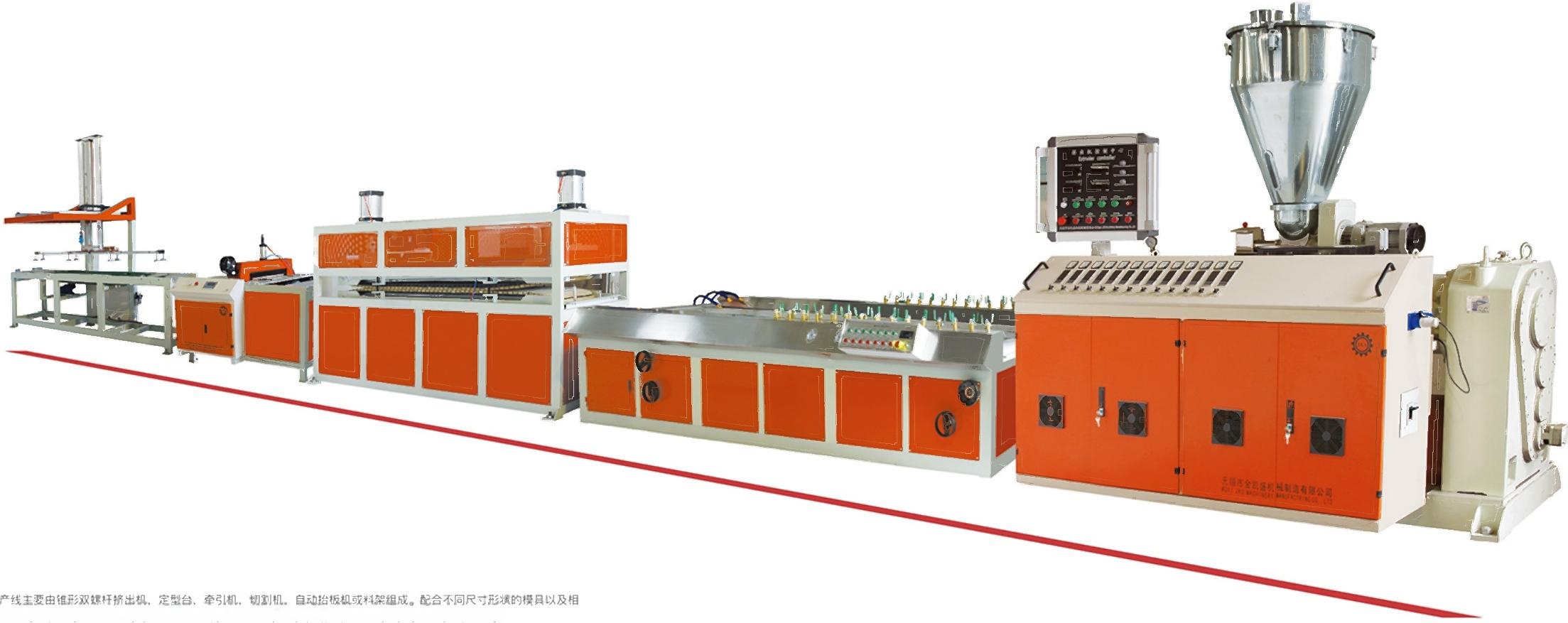
PVC hollow wall, ceiling and door panel extrusion line. Cavity count and calibration quality determine saleable output in decorative panel production. Image: JKS Machinery.
Market Context Behind These Applications
Asia Pacific accounted for 41.5% of global extrusion machinery revenue in 2024, with China the leading contributor in the region, according to Grand View Research. Single-screw extrusion machines held approximately 62.7% of the global market in the same year, a useful reminder that the most widely installed extrusion platform in the world is also the least specialised.
Demand growth on the decorative side is documented separately. Grand View Research projects the Stone Plastic Composite flooring market to grow from USD 6.4 billion in 2026 to USD 10.3 billion by 2033, a 7.2% CAGR. Decorative interior plastic products move with construction and renovation cycles, while pipe demand follows water, gas, power and drainage infrastructure investment. The two demand curves do not peak at the same time, which is one reason manufacturers operating both pipe and profile lines can balance order flow across the year.
Circular economy policy is a third driver. One 2024 market estimate placed waste plastic washing and pelletizing recycling lines at USD 5.502 billion. That figure comes from a single source and should be read as indicative rather than definitive, but the direction of travel - more recycled content in extrusion feedstocks - affects formulation, screw design and downstream quality control for pipe and panel producers alike.
Comparison with Conventional and Generic Alternatives
JKS publishes comparison data for its line families against named baselines, and the baselines matter as much as the numbers. For pipe, the reference point is basic single-screw pipe extruders and simple two-stage lines; for profiles and panels, it is conventional twin-screw profile extruders with basic calibration lines.
| Line family | Comparison baseline | Published difference | Where the difference shows up commercially |
|---|---|---|---|
| Pipe extrusion lines (water supply, gas, power conduit, composite pipe) | Basic single-screw pipe extruders; simple two-stage lines | 10 to 15% higher output; plus or minus 0.05 mm wall thickness control; 5% less material waste; 7 to 10% lower energy use; slightly higher initial investment, 30% lower long-term maintenance cost | Material consumed per metre of pipe, dimensional reject rate, maintenance and spare-part spending, wear-resistant screw and barrel life |
| PVC and WPC profile and panel lines (hollow wall panel, ceiling, door panel) | Conventional twin-screw profile extruders; basic calibration lines | 12 to 18% higher output per line; consistent profile dimensions and low reject rate; lower tooling cost for custom profiles; 6 to 8% lower energy consumption; quick mold change and modular design | Saleable panels or profiles per shift, tooling cost for each new design, changeover time between products |
| Auxiliary and standalone equipment (mixing, crushing, pelletizing, single and twin-screw extruders) | Generic auxiliary equipment and standard extruders | 10 to 15% higher processing capacity; 5% lower energy use; similar initial cost with longer service life | Replacement frequency, spare-part consumption and downtime in the supporting processes around the main line |
Where These Comparisons Stop
Buyers at the decision stage should test each published claim against their own project, because several boundaries apply.
- The published ranges are relative to the baselines named, not absolute performance guarantees. Formulation, cooling conditions, ambient temperature, operator skill and line utilisation all move the real figure, which is why a supplier's baseline should always be stated when a percentage is quoted.
- Pipe line economics begin with a slightly higher initial investment. The lower lifetime maintenance cost only materialises over a sustained operating period, so the case weakens for buyers running short campaigns or intermittent production.
- Extruder type is not a free choice. Single-screw machines dominate global market share, but PVC dry-blend processing and profile and panel production commonly use conical twin-screw machines because of feeding and compounding behaviour. Specifying a single-screw line for a dry-blend PVC product is usually specifying the wrong machine.
- Multi-cavity tooling adds cost, and a quick mold change system reduces but does not eliminate changeover time. Product mixes with frequent colour or profile changes carry a real cost that a per-line output comparison does not capture.
- Large diameter classes have physical consequences: more floor space, heavier pipe handling, longer cooling sections, and greater demands on factory layout and power supply. These are layout and infrastructure costs, not machine costs, and they are easily overlooked at the quotation stage.
- Market entry rules apply to the product, not only to the machine. WPC door panel extrusion machinery, as one documented example, typically requires CE marking for EU market compliance and ISO 9001 certification for quality management. Certification scope should be confirmed before a line is ordered for an export market.
- Composite and multi-layer products add process steps. A steel wire reinforced composite pipe line is not a drop-in substitute for a solid-wall pipe line in terms of commissioning time or process control discipline.
Future Outlook
Three shifts are likely to shape application-level machine selection over the next several years. Energy consumption per kilogram of output is becoming a first-order purchase criterion alongside headline output, which is visible in the efficiency figures manufacturers now publish: 6 to 8% lower energy consumption on profile lines and 7 to 10% on pipe lines against comparable baselines, in JKS documentation. On lines running for years, a few percentage points of power consumption can outweigh a modest difference in purchase price.
Control and diagnostics are moving in the same direction. JKS specifies PLC automatic control with real-time monitoring, overload protection and emergency stop functions, plus pre-shipment testing before delivery, and remote technical support and spare parts supply are documented as part of the after-sales scope. Buyers evaluating suppliers can reasonably ask whether remote diagnostics, on-site troubleshooting and spare parts continuity are included, because these determine downtime cost long after commissioning.
Material change is the third driver. Higher recycled content, heavier filler loadings and multi-layer structures all push additional requirements onto screw geometry, wear resistance and process control - the parts of an extrusion line that are hardest and most expensive to upgrade after installation. Lines specified today for a single formulation may face a very different feedstock mix within a few years, and that risk belongs in the selection decision.
Frequently Asked Questions
What is the main difference between a plastic pipe extrusion line and a profile or panel extrusion line?
The melting stage is broadly similar; the difference sits in the die, calibration and downstream equipment. A pipe line uses a mandrel die with a sizing sleeve, vacuum sizing tanks and a caterpillar or belt haul-off sized to the pipe diameter, and JKS publishes wall thickness control of plus or minus 0.05 mm for this family. A profile or panel line uses a multi-cavity die with calibration plates and a haul-off matched to the profile section, and its quality target is dimensional consistency of the profile with a low reject rate rather than a single wall-thickness figure.
How should a buyer compare extrusion line quotations that have different configurations?
Quotations should be normalised to the same application before price is compared. The relevant dimensions are material form (pellets or PVC dry blend), screw type, product diameter or profile geometry, required tolerance, output target, tooling scope, control level, commissioning support and spare parts scope. Because quoted plastic extrusion machines can differ in all of these, an apparently lower price may reflect a smaller calibration section, a simpler control package or a narrower tooling set rather than a genuine cost advantage.
When is a conical twin-screw extruder used instead of a single-screw extruder?
Single-screw extrusion machines held approximately 62.7% of the global extrusion machinery market in 2024, according to Grand View Research, and are common for PE and PP pipe as well as many sheet applications. Conical twin-screw machines are commonly used where PVC dry blend must be processed and where profile, panel and similar products require the feeding and compounding behaviour that a powder blend needs. The material form, and not the brand of machine, is normally what decides between the two.
What limits the output and efficiency percentages published for extrusion lines?
Published gains are relative to a named baseline. The 10 to 15% output difference published for JKS pipe lines refers to basic single-screw pipe extruders and simple two-stage lines, and the 12 to 18% output difference published for profile and panel lines refers to conventional twin-screw profile extruders with basic calibration lines. Actual results depend on formulation, calibration, cooling, ambient conditions, operator skill and utilisation rate, so these ranges function as comparison indicators rather than as absolute performance promises.
How does the pipe diameter class, for example PE110 compared with PE1600, affect the procurement decision?
Diameter class determines much more than the die. Larger classes require a heavier haul-off, a longer cooling section, more floor space and heavier pipe handling equipment, and the initial investment rises accordingly. The practical approach is to match the diameter envelope to the largest pipe the project actually needs, so that a line sized for large-diameter trunk mains is not installed to serve an irrigation or small-bore distribution workload where the unit cost per metre would be higher than necessary.
Which maintenance and support factors change the long-term cost comparison between extrusion lines?
The documented factors in JKS comparisons are modular design, a quick mold change system, ease of access to key components, a wear-resistant screw and barrel design, PLC control with real-time monitoring, overload protection and emergency stop functions, and pre-shipment testing. After-sales scope covers installation guidance, remote technical support, on-site troubleshooting and spare parts supply. For pipe lines, JKS publishes a slightly higher initial investment alongside 30% lower long-term maintenance cost compared with the stated baseline; for profile and panel lines, the comparison is a similar initial cost with reduced replacement frequency.
Background configuration detail on one specific application - WPC door profiles - is available in the downloadable JKS WPC door project brochure: JKS WPC door project brochure (PDF).