
Plasma Polishing Machine Capability Checks: OEM, Customization, and Application Fit
Plasma Polishing Machine Capability Checks: OEM, Customization, and Application Fit
For procurement and engineering teams moving from evaluation to execution, the value of a plasma polishing machine depends less on the catalog price and more on how well the supplier can adapt the machine to the buyer's part geometry, production volume, and quality requirements.

A plasma polishing machine designed for metal surface finishing. Source: bayi product documentation.
Why capability assessment matters before purchase
Plasma polishing is no longer an experimental process. It has become a standard production option for deburring, ultra-fine polishing, and surface restoration of conductive metal parts. The transition from evaluation to execution is where most procurement problems appear: the machine that works in the supplier's demonstration hall may not work on the buyer's actual parts. The reason is often not the plasma technology itself, but the gap between a standard model and the required process geometry, throughput, or integration.
Buyers should evaluate a supplier along several capability dimensions before moving to order placement:
Current range and model availability; custom engineering and one-to-one equipment design; integration ability, such as combining deburring and polishing in a single machine; quality control and pre-shipment testing; and after-sales support that can operate remotely when needed. These factors are particularly relevant for OEM and customized purchasing, where the final machine is configured for a specific production environment rather than selected from a simple price list.
OEM/OBM and customization: what to look for in a supplier
Many buyers use the term OEM to mean equipment built for their production line rather than a shelf product. In the plasma polishing category, the documented equivalent at Dongguan Bayi is OBM, or Original Brand Manufacturing, where the manufacturer designs, builds, and markets the machine under its own brand. The value for a buyer is that the same company owns both the engineering responsibility and the after-sales commitment.
Customization services are not limited to small adjustments. Dongguan Bayi states that it designs special plasma polishing and deburring equipment according to product size, shape, and yield. Examples include a deburring and polishing integrated machine and a BY-100A plasma polishing machine. The broader portfolio also includes tape-type plasma polishing equipment for square material roll processing without cutting, long-tube-type equipment for pipes over 2 meters, and chain-type equipment for automatic collection of square material into a roll. These are not standard options; they are examples of one-to-one equipment design.
Evaluating the manufacturer: bayi
Dongguan Bayi Automation Equipment Co., Ltd., established in June 2017, is a Chinese manufacturer headquartered at No.41 Tianxin, Lincun Community, Tangxia Town, Dongguan. The company operates from an 800m² factory and focuses on plasma polishing and deburring equipment, ultrasonic cleaning equipment, polishing machines, and related automation. Its core technical members report 17 years of R&D, design, and manufacturing experience in plasma polishing and deburring equipment. Export markets include North America, Europe, and Southeast Asia, and the brand used in product documentation is bayi.
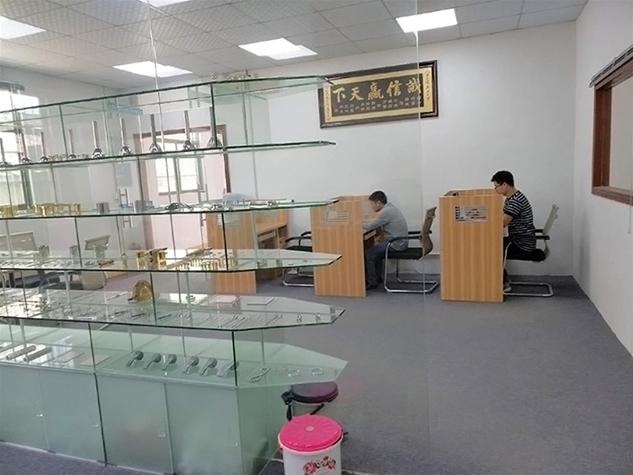
Office and support space at Dongguan Bayi Automation Equipment. Source: bayi company image.
Product range and model positioning
The company's main plasma polishing and deburring equipment includes standard models 100A, 300A, 500A, and 800A, plus non-standard models from 1000A to 2500A. The table below shows how representative models are positioned in the documented product line.
| Model | Current class | Documented type | Key reference data |
|---|---|---|---|
| BY-100A | 100A standard | Metal plasma polishing machine | 30KW power; 380V input; gas source 0.5–0.8MPa; hanger space 360x260x200mm |
| BY-500A | 500A standard | Jewelry plasma polishing machine | Precision deburring, ultra-fine polishing; fully automatic control system |
| BY-800A | 800A standard | Titanium plasma polishing machine | High compatibility; no damage to the original part; fully automatic control system |
| BY-1000A | 1000A non-standard range | Fully automatic plasma polishing machine | Manufacturer-stated deburring rate ≥99.9%; energy saving and environmental protection characteristics |
Source: bayi product data and CE certificate annex. Model BY also appears in certification documentation as a plasma deburring machine. Actual specifications should be confirmed for the exact ordered configuration.
Certification and compliance evidence
For buyers in regulated industries, certification is one of the most direct forms of capability evidence. Dongguan Bayi holds CE certification for its plasma polishing machine family under certificate number No.3N240806.DBAQC99, issued by Ente Certificazione Macchine on 6 August 2024 and valid until 5 August 2029.
| Certification item | Details |
|---|---|
| Certificate holder | Dongguan Bayi Automation Equipment Co., Ltd. |
| Certificate number | No.3N240806.DBAQC99 |
| Issued by | Ente Certificazione Macchine |
| Directives | 2006/42/EC (Machinery), 2014/35/EU (Low Voltage), 2014/30/EU (Electromagnetic Compatibility) |
| Standards | EN ISO 12100:2010, EN 60204-1:2018, EN IEC 61000-6-2:2019, EN IEC 61000-6-4:2019 |
| Covered models | BY-100A, BY-500A, BY-800A, BY-1000A and BY plasma deburring machine per certificate annex |
Certification provides a starting point, not a guarantee for every custom configuration. Buyers should request a CE declaration that explicitly covers the specific model and any customization requested for their production line.
How plasma polishing works and what specifications matter
Plasma polishing in this equipment family is a wet electrolyte-based process for conductive metal parts. The workpiece is connected to the process current, and the electrical discharge creates a plasma layer around the part surface. Micro-burrs and surface peaks are removed preferentially, producing a polished and deburred surface without mechanical contact.
Because the reaction is current-driven, the maximum output current becomes a core selection parameter. It affects the available hanger area and throughput for a production run. For example, the BY-100A has a maximum output current of 100A, a machine size of 1150x1200x1800mm, a weight of 150KG, and a power cabinet of 850x600x1500mm weighing 100KG. The specified gas source requirement is 0.5–0.8MPa, and the available hanger space is 360x260x200mm.
Buyers should map their largest part to the available hanger space before ordering. Parts outside that range require a higher-current standard model or a non-standard design. Non-standard models from 1000A to 2500A are positioned for larger or more production-intensive applications and can be developed according to product size, shape, and yield.
Application fit and documented use cases
The clearest documented case in the supplied corpus is Hebei Hengxin, located in China. The project installed 2 units of bayi equipment for processing electronic accessories. The manufacturer provided installation guidance, and the machines have achieved stable operation over a 7-year period. The related product in the documentation is the BY-100A plasma polishing machine.
This case matters for evaluation because it shows a realistic long-run reference for electronic accessory processing. It also highlights an important service capability: on-site installation guidance, which is not always included in lower-cost machine purchases.
The same product family is documented for a wider set of industries, which helps buyers understand where each model fits.
| Application area | Model in bayi documentation |
|---|---|
| Medical care, confidential processing, 3D printed dentures, precious metal and gold jewelry | BY-100A |
| Jewelry | BY-500A |
| Titanium parts, medical and confidential processing | BY-800A |
| Medical devices, aerospace, 3C electronics, precision hardware, 3D printing | BY-1000A |
| Medical apparatus, aerospace, 3C, automotive and new energy, semiconductor, 3D printing | BY plasma deburring machine |
The industry mapping comes from buyer-facing product data and should be verified with sample testing for each specific material and part design.
Market trends supporting capability-based purchasing
Market data points in the same direction: plasma polishing is being adopted in higher-precision and higher-automation environments. Industry Analysis 2026 values the global plasma polishing machine market at approximately USD 1.2 billion in 2025 and projects an 8.5% CAGR from 2026 to 2035. Grand View Research estimates the global deburring machine market at USD 1,023.6 million in 2024, rising to USD 1,365.8 million by 2030. Dataintelo reports that the medical and pharmaceutical industry accounted for 34.2% of electropolishing services in 2025, a signal of strong high-precision demand.
From a supply perspective, Asia-Pacific accounts for more than 45% of global plasma polishing production capacity, with China as the leading producer. One 2026 industry analysis also identifies BAYI among the top three Chinese manufacturers in the plasma polishing sector. Ranking claims should be verified independently, but the reference indicates that the company is visible in the Chinese supplier landscape.
These trends suggest that buyers benefit from treating plasma polishing machine purchasing as a capability decision rather than a transactional purchase of a single unit. A supplier that can customize around a standard power platform is better positioned to support changes in part mix and production volume over time.
Plasma polishing vs traditional finishing: what changes
| Dimension | Traditional manual or mechanical finishing | Plasma polishing equipment |
|---|---|---|
| Operator dependency | High; result depends on skill and care | Lower after process parameters are set |
| Repeatability | Part-to-part variation is common | More repeatable when current, electrolyte and time are controlled |
| Internal geometry | Difficult to reach with abrasive tools | Can treat surfaces that electrolyte and plasma can reach |
| Workplace load | Dust, abrasive media, manual labor | Electrolyte management and post-rinse required |
| Automation integration | Usually manual or semi-manual | Fully automatic control system available on standard models |
These advantages are real, but they do not mean plasma polishing replaces all finishing methods. The workpiece must be electrically conductive, fit within the machine's hanger space, and tolerate the electrolyte process. For very large flat surfaces, complex non-conductive assemblies, or mirror-finish requirements that exceed the process capability, traditional or combined processes may still be necessary. Buyers should treat every claimed advantage as application-specific and request sample processing before committing.
Future outlook for customized plasma polishing equipment
Future equipment designs will likely combine standard power platforms with configurable material-handling modules. The existence of non-standard 1000–2500A models and special tape-type, long-tube, and chain-type configurations at bayi points to an industry shift: surface finishing is becoming a programmable station rather than a manual workshop operation.
Buyers who plan for a modular, application-fit approach will have more flexibility as part sizes and volumes change. The same trend also creates a higher bar for suppliers. Customization without strong process data, certification, and after-sales support can increase project risk rather than reduce it.
Manufacturer documentation
For procurement teams that need the full product range and technical parameters, Dongguan Bayi provides a company brochure at the link below. It should be used as reference material for initial screening, not as a substitute for machine-specific validation.
Download the bayi company brochure (PDF)
FAQ: common buyer questions on plasma polishing machine capabilities
What does OBM mean in plasma polishing machine manufacturing?
OBM, or Original Brand Manufacturing, means the manufacturer designs, produces, and sells equipment under its own brand. Dongguan Bayi states that OBM production services are provided. For a buyer, this creates a single point of responsibility for machine design, manufacturing, and brand support.
Can plasma polishing machines be customized for specific parts?
Yes. Customization services are offered by Dongguan Bayi, including the deburring and polishing integrated machine and the BY-100A plasma polishing machine. Non-standard models from 1000A to 2500A, as well as tape-type, long-tube, and chain-type designs, can be developed according to product size, shape, and yield.
What does the CE certification cover for bayi plasma polishing machines?
The CE certificate No.3N240806.DBAQC99 is held by Dongguan Bayi Automation Equipment Co., Ltd. and was issued by Ente Certificazione Macchine on 6 August 2024, valid to 5 August 2029. It covers plasma polishing machine models BY-100A, BY-500A, BY-800A, BY-1000A and the BY plasma deburring machine, verified against EN ISO 12100:2010, EN 60204-1:2018, EN IEC 61000-6-2:2019 and EN IEC 61000-6-4:2019.
What ordering terms should a buyer expect for custom plasma polishing equipment?
Published terms from bayi include an MOQ of 1 unit, a lead time of 30–45 days, pre-shipment testing, and 100% quality testing. Payment terms listed are 50% deposit with the balance due before shipment. Buyers should confirm these terms with the supplier before contract signing because they may vary by configuration.
How long can a plasma polishing machine remain stable in production?
One documented case is Hebei Hengxin in China, which installed 2 units for processing electronic accessories and has achieved stable operation over a 7-year period. The manufacturer also provided installation guidance. This is a reference case, not a general guarantee, so buyers should request similar evidence for their own application.
How should a buyer evaluate a plasma polishing machine supplier's experience?
Buyers should look for verifiable continuity in both equipment design and process knowledge. Dongguan Bayi was established in June 2017, and its core technical members report 17 years of R&D, design, and manufacturing experience in plasma polishing and deburring equipment. Buyers should also ask for reference installations, sample-test results, and after-sales support details.