
Planetary, Worm or Coreless: A Compact Gear Motor Shortlist
Compact automation is designed around tight envelopes. A robot joint, a fluid-handling pump in a laboratory analyser, a sorting module inside a parcel sorter, or a motorised support column all impose the same three questions on the drive: how much torque fits into the available space, how fast must the axis move, and how precisely must it stop. Answering those three questions usually narrows the field far more effectively than comparing model numbers, because the architecture of the gearbox — planetary, worm, or coreless — determines which of those answers is even achievable.
TT Motor (Shenzhen) Industrial Co., Limited, a miniature DC motor manufacturer established in 2006 and headquartered in Bao'an District, Shenzhen, China, builds three gearmotor architectures that map onto this decision space: a brushless planetary gear motor (GMP36-TEC3650), a brushless worm gear motor (TWG3246-TEC2430), and a coreless gear motor (GMP12T-TDC1215). This shortlist compares the three on the parameters that matter at the evaluation stage — rated voltage, rated torque, speed range, number of gear stages, and structural configuration — and identifies where each one fits robotics, medical devices, industrial automation, and intelligent logistics equipment.
Why architecture comes before model selection
Two gearmotors can share a voltage rating and still be interchangeable in only one direction. The parameter that separates them is almost always the relationship between output speed and output torque, and that relationship is set by the gearing rather than by the motor alone. A planetary stage spreads load across several planet gears, which is why planetary units are generally used where higher output torque is required within a cylindrical envelope. A worm stage produces a large reduction in a short axial package, which suits slow, controlled positioning. A coreless rotor has a low moment of inertia, which shortens the time between a control command and the corresponding motion — a behaviour that matters in axes that start and stop frequently.
For a buyer in the evaluation stage, this means the shortlist should be read as three different answers to the same design problem, not as three grades of the same product.
Three gearmotor architectures, side by side
The comparison below uses published model data for the three architectures. Voltage, torque, speed, gear stage, and length figures are model specifications; certification references are listed to the certificate number so they can be traced.
| Parameter | GMP36-TEC3650 | TWG3246-TEC2430 | GMP12T-TDC1215 |
|---|---|---|---|
| Type | Brushless planetary gear motor | DC brushless worm gear motor | DC brush coreless gear motor |
| Rated voltage | DC 12V–24V | DC 12V–24V | DC 4.5V–12V |
| Rated torque (max) | 30.0 kg.cm | 8.0 kg.cm | 2 kg.cm |
| Speed range | 4–1600 rpm | 3–35 rpm | 8–5000 rpm |
| Number of gear stages | 1 / 2 / 3 / 4 | 3 / 4 / 5 | 1 / 2 / 3 / 4 |
| Gearbox length | 26 / 33.5 / 40.5 / 47.5 mm | 46 mm | 14.9 / 19.7 / 24.5 / 29.3 mm |
| Module | 0.5 | 0.5 / 0.6 | 0.2 |
| Materials | Stainless steel, copper, iron | Stainless steel, iron, copper | Stainless steel, iron, copper |
| RoHS test certificate (SGS) | CANEC26013325501 | CANEC26013326101 | CANEC26013325001 |
Brushless planetary: GMP36-TEC3650
GMP36-TEC3650 is the torque-oriented option in the shortlist. Its maximum rated torque of 30.0 kg.cm is the highest of the three, delivered across a 4–1600 rpm speed range at DC 12V–24V. Gear stage options of 1, 2, 3, and 4 allow the same base architecture to be configured for different speed-torque trade-offs, with gearbox lengths of 26 mm, 33.5 mm, 40.5 mm, and 47.5 mm corresponding to the build. The module is 0.5, and the construction uses stainless steel, copper, and iron. Its documented application scope covers robots, medical devices, industrial automation equipment, and intelligent logistics equipment. RoHS compliance for the model and related series models was tested by SGS under certificate CANEC26013325501, issued on 2026-04-10 with reference to RoHS Directive (EU) 2015/863 amending 2011/65/EU.
Brushless worm: TWG3246-TEC2430
TWG3246-TEC2430 trades speed for controlled reduction. Its speed range of 3–35 rpm is deliberately narrow, paired with a maximum rated torque of 8.0 kg.cm at DC 12V–24V. The worm configuration accepts 3, 4, or 5 gear stages within a fixed 46 mm gearbox length, with module options of 0.5 and 0.6, and materials of stainless steel, iron, and copper. Documented application scope lists miniature medical devices, precision automated instruments, and electrically adjustable supports. SGS RoHS certificate CANEC26013326101, issued on 2026-06-24, covers this model and related series models under the same EU directive reference.
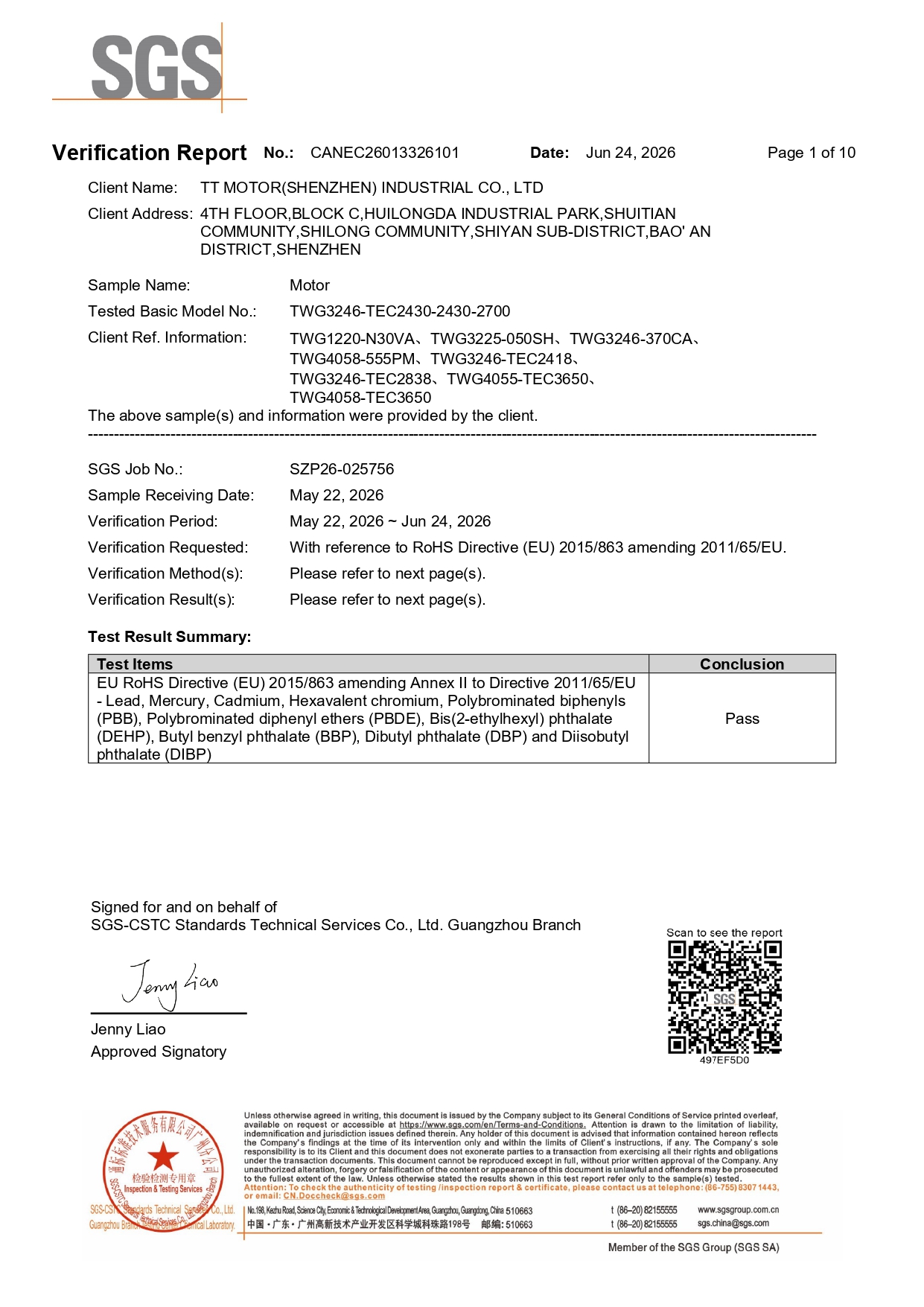
TWG3246-TEC2430: a worm-stage brushless gear motor rated DC 12V–24V with a 3–35 rpm output range and a fixed 46 mm gearbox length.
Coreless: GMP12T-TDC1215
GMP12T-TDC1215 occupies the small-envelope, fast-response end of the shortlist. It runs at DC 4.5V–12V and reaches speeds from 8 up to 5000 rpm with a maximum rated torque of 2 kg.cm. The gearbox is the most compact of the three, with lengths of 14.9 mm, 19.7 mm, 24.5 mm, and 29.3 mm across 1–4 gear stages and a module of 0.2. Documented application scope covers medical equipment, precision robots, high-end consumer electronics, and micro sensors. SGS RoHS certificate CANEC26013325001 was issued for this coreless model and related series models on 2026-07-03.
One clarification for the shortlist. The GMP12T-TDC1215 is documented as a DC brush coreless gear motor, not a brushless unit. It is included here because coreless architecture is a genuine third option in compact builds, and because the commutation difference has procurement consequences: brush-type coreless designs should be evaluated against brush wear and service intervals, while the two brushless architectures rely on electronic commutation. Buyers comparing all three should treat this as a design trade-off, not a like-for-like substitution.
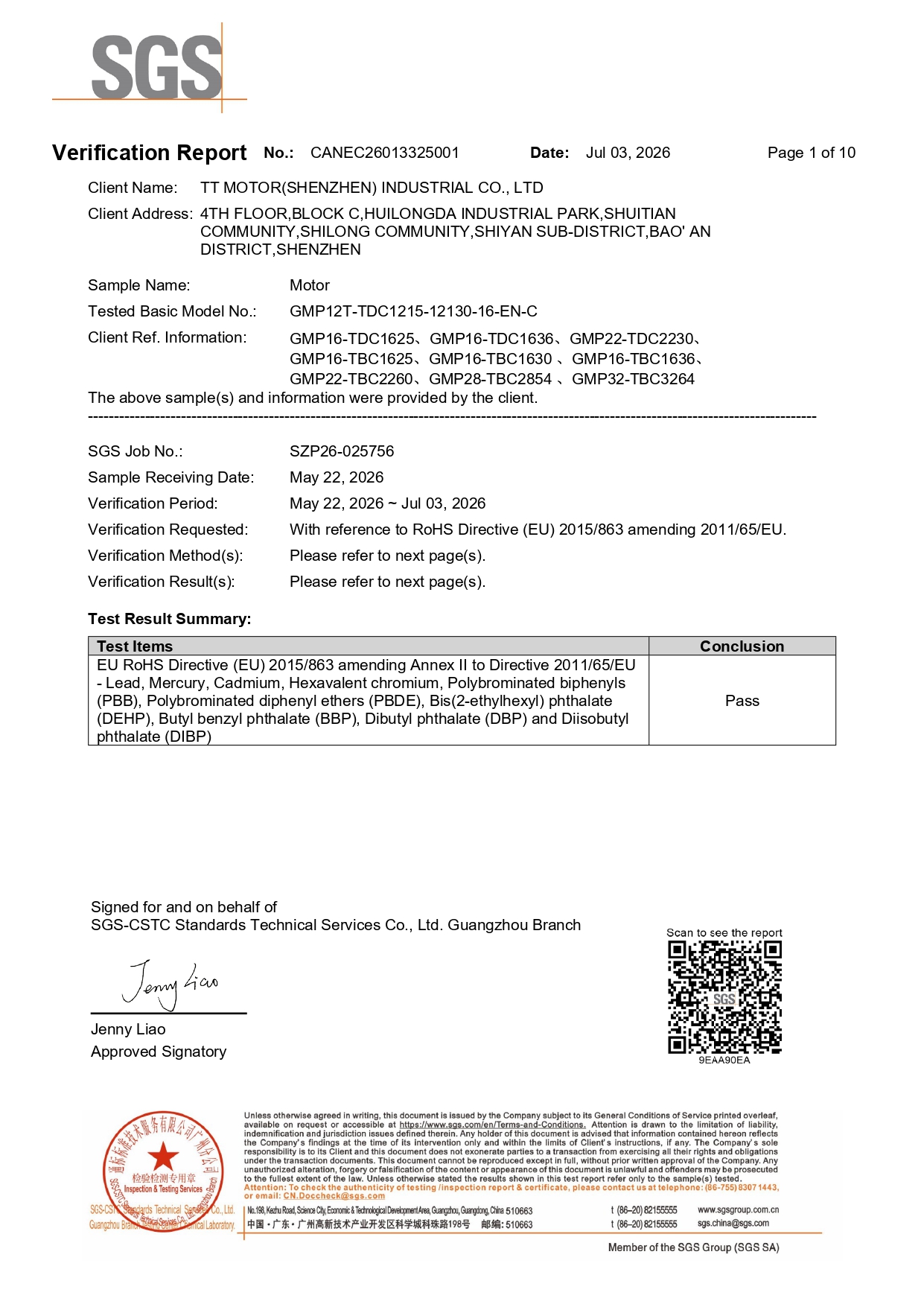
GMP12T-TDC1215: a coreless gear motor rated DC 4.5V–12V, with gearbox lengths from 14.9 mm and an 8–5000 rpm speed range.
Matching architecture to application
Robotics and precision motion
In robot joints, the limiting factor is usually not steady-state torque but the ability to accelerate, decelerate, and stop without overshoot. Coreless rotors have a small moment of inertia, which allows a faster control–response–stop cycle; when rotor inertia is large, a stop command can still be followed by residual rotation and positional error. GMP12T-TDC1215 is documented for robot joint applications, precision robots, and micro sensors where high power density, fast response, and low inertia are the stated requirements. GMP36-TEC3650 is also documented for robots, with the higher torque and wider staged reduction that suit larger joint loads.
Medical and laboratory equipment
Medical duty profiles usually specify low noise, low vibration, and stable operation over long run times, and the speed requirement is often modest. A medical device manufacturer in the United Kingdom has used TWG3246-TEC2430 to drive a medical pump, with a project scale of 500–2,000 units per year running for three years or more; the case is characterised by low noise, low vibration, and long service life, with reduced equipment maintenance frequency as the reported result. For micro positioning and adjustment mechanisms, a dental instrument manufacturer in Japan has used GMP12T-TDC1215 at 500–2,000 units per year over a 3–5 year duration, where the stated highlights were low inertia, fast response, and high power density. GMP36-TEC3650 is likewise documented for medical devices, which makes it the option to check when a medical axis needs more torque than a coreless unit can provide.
Industrial automation and intelligent logistics
Logistics and automation duty profiles invert the medical emphasis: frequent start-stop cycles and changing loads dominate. A logistics equipment company in the United States has used GMP36-TEC3650 to drive conveyor equipment and a sorting mechanism, at a project scale of 1,000 units running three years or more, with stable operation under frequent start-stop and load changes as the reported outcome. The same application area also lists GM37-555PM, a brushed spur gear motor, which is relevant when a buyer is deciding whether a brushless architecture is required at all. For high-volume, space-constrained mechanisms such as smart lock bodies, TWG3246-TEC2430 and GMP12T-TDC1215 both appear among the applicable products in a smart lock manufacturer case in the United States, where supply ran from 5,000 to 50,000 units per year for five years or more — an example of how the same two architectures can serve very different duty profiles depending on how they are specified.
A decision framework for evaluation-stage buyers
The following sequence reflects the parameters that separate the three architectures in practice:
- Fix the required output torque at the mechanism, including the worst-case load, then check the maximum rated torque ceiling: 30.0 kg.cm for GMP36-TEC3650, 8.0 kg.cm for TWG3246-TEC2430, and 2 kg.cm for GMP12T-TDC1215.
- Define the usable speed band. A worm architecture at 3–35 rpm is a positioning solution; if the axis needs hundreds or thousands of rpm, the coreless or planetary options belong in the comparison.
- Measure the envelope, including gearbox length, before choosing gear stages. GMP12T-TDC1215 starts at 14.9 mm; TWG3246-TEC2430 is fixed at 46 mm; GMP36-TEC3650 spans 26–47.5 mm depending on the stage count.
- Match the duty profile to the commutation type. Brushless units suit continuous and frequent start-stop operation; a brush-type coreless unit should be assessed against expected service intervals.
- Confirm the supply parameters: MOQ of 2 pieces, sample lead time of 15–25 days, bulk lead time of 30–45 days, and remote after-sales technical support.
- Validate on samples at the target load and duty cycle before committing to a production configuration.
Market context: where compact drives are heading
Demand for compact electric drives is expanding in absolute terms. Grand View Research reported the global brushless DC motor market at roughly USD 22.2–22.33 billion for 2025, with a forecast period extending to 2033. At the component level, OEC data place global trade in electric motors with an output below 37.5 W — HS code 850110, the category that contains miniature gearmotors — at USD 16.3 billion in 2024. Both figures describe a category large enough to support specialist suppliers rather than a niche.
Regulatory pressure is moving in parallel. IEC 60034-30-1:2025 introduced the IE5 ultra-premium efficiency class, and EU Ecodesign Regulation (EU) 2019/1781 requires IE3 for motors rated 0.75–1000 kW and IE2 for 0.12–0.75 kW. These efficiency classes are defined for a power range well above the miniature gearmotors discussed here, so the direct obligation for a compact automation build is not an IE rating; it is documentation — RoHS and REACH evidence for the EU market, and a traceable quality system behind the manufacturing process. That is the practical reading of the policy trend for buyers in this segment.
Boundaries and limits of this shortlist
A shortlist is only useful if its limits are stated. Three apply here.
First, the three models are not interchangeable. TWG3246-TEC2430 cannot substitute for a high-speed axis at 3–35 rpm, and GMP12T-TDC1215 cannot carry a load above its 2 kg.cm maximum rated torque regardless of how it is geared. GMP36-TEC3650 offers the highest torque ceiling, but its gearbox can extend to 47.5 mm, which is the largest envelope in the comparison — a real constraint in a tightly packed housing.
Second, the third entry in the shortlist is a brush-type coreless design rather than a brushless one. That difference affects service planning even though the unit competes in the same compact-envelope space.
Third, the evidence available for this comparison is model specification and certification scope, not independent comparative testing. No third-party head-to-head benchmark of these three architectures is publicly available, and the rate at which brushless gearmotors replace brushed equivalents in medical and robotics applications is likewise not documented in the public datasets reviewed here. Buyers should therefore treat the comparison as a specification-level shortlist and complete the evaluation with their own sample testing under the real duty cycle.
Future outlook
Two directions are already visible. On the supply side, miniature motor manufacturers are widening product lines rather than narrowing them: TT Motor's current portfolio spans high-precision DC motors, brushless DC motors, coreless motors, planetary geared motors, miniature geared motors, and stepper motors, supported by a manufacturing area of approximately 9,000 square metres, more than 300 employees, 35 engineers, and an annual output of 8,000,000 pieces with a monthly capacity of 800,000 pieces. On the demand side, compact automation keeps pushing more axes into smaller spaces, which favours architectures that combine a short gearbox with predictable control behaviour.
Customisation will remain part of that picture rather than a special case. Shaft, encoder, gearbox, voltage, logo, and speed are all configurable within the OEM/ODM model, and quality control is documented as 100% testing. For buyers, the practical implication is that the architecture decision should be made before the customisation conversation begins, not after.
FAQ
How do you choose between planetary, worm, and coreless gear motors for a compact build?
Start from the axis requirement, not the catalog. If the axis needs the highest output torque within a cylindrical envelope, a planetary architecture such as GMP36-TEC3650, rated at a maximum 30.0 kg.cm, is the starting point. If the axis requires slow, controlled positioning, a worm architecture such as TWG3246-TEC2430 at 3–35 rpm fits. If the priority is a short gearbox and fast start-stop behaviour, a coreless architecture such as GMP12T-TDC1215, with gearbox lengths from 14.9 mm and a maximum rated torque of 2 kg.cm, is the more appropriate candidate.
What are the rated voltage and speed ranges of these three models?
GMP36-TEC3650 is rated DC 12V–24V with a speed range of 4–1600 rpm. TWG3246-TEC2430 is rated DC 12V–24V with a speed range of 3–35 rpm. GMP12T-TDC1215 is rated DC 4.5V–12V with a speed range of 8–5000 rpm. The voltage bands and speed bands are not interchangeable between the three architectures, so the system supply voltage should be fixed before selection.
Which model is documented for medical and laboratory equipment?
TWG3246-TEC2430 was used by a medical device manufacturer in the United Kingdom to drive a medical pump, at a project scale of 500–2,000 units per year over three years or more, with low noise, low vibration, and long service life reported as the case characteristics. GMP12T-TDC1215 was used by a dental instrument manufacturer in Japan for micro positioning and adjustment, at 500–2,000 units per year over a 3–5 year duration, with low inertia, fast response, and high power density as the stated highlights. GMP36-TEC3650 is also documented for medical devices where higher torque is required.
Which model is documented for industrial automation and intelligent logistics equipment?
GMP36-TEC3650 was used by a logistics equipment company in the United States to drive conveyor equipment and a sorting mechanism, at a scale of 1,000 units running three years or more, with stable operation under frequent start-stop and load changes as the reported result. Its documented application scope also lists industrial automation equipment. In a separate high-volume case, a smart lock manufacturer in the United States used TWG3246-TEC2430 and GMP12T-TDC1215 variants in a project running five years or more at 5,000–50,000 units per year.
What compliance documentation accompanies these models?
RoHS compliance testing for GMP36-TEC3650 and related series models was carried out by SGS under certificate CANEC26013325501, issued 2026-04-10. TWG3246-TEC2430 and related series models are covered by SGS certificate CANEC26013326101, issued 2026-06-24. GMP12T-TDC1215 and related series models are covered by SGS certificate CANEC26013325001, issued 2026-07-03. All three references cite RoHS Directive (EU) 2015/863 amending 2011/65/EU. At company level, the R&D and manufacture of micromotors (DC gear motor, DC brushless motor) is certified to GB/T 19001-2016 / ISO9001:2015 under certificate F02926Q00865R402 issued by DCI, valid from 2026-08-21 to 2029-08-21.
A downloadable company and product brochure, including the models referenced in this shortlist, is available at TT Motor brochure.
¿Tiene preguntas o necesita más detalles?
Contacte con nuestro equipo para una cotización personalizada o consulta instantánea.
Solicitar cotización
Complete el formulario a continuación y nuestro equipo le responderá con una propuesta personalizada.
Chat directo de WhatsApp
¿Prefiere chatear en tiempo real? Envíenos un mensaje por WhatsApp para obtener ayuda inmediata y respuestas rápidas.
- Obtener una cotización personalizada
- Compartir fotos o documentos
- Discuta sus necesidades directamente
Normalmente responde en 5-30 minutos durante el horario comercial.