
Pillow Filling Machine Orders: Terms, SGS and Acceptance
Pillow Filling Machine Orders: Terms, SGS and Acceptance
A pillow filling machine order moves from evaluation to execution at one point: when the machine specification, the commercial terms and the acceptance procedure are written down together. Before that point, everything is comparison. After it, everything is contract. The recurring difficulty in bedding-equipment procurement is that the three documents are usually drafted by different people at different times — and the acceptance clause, which decides whether the delivered machine is the machine that was bought, is often the last to be written and the thinnest in detail.
KIVAS (Qingdao Kaiweisi Industry and Trade Co., Ltd.) is a Qingdao-based manufacturer of home-textile and fibre-processing machinery, founded in 2014, with a 3,000 m² factory, 17 employees and a 5-engineer R&D team. Its stated positions on minimum order quantity, delivery terms, payment schedule, testing and acceptance are specific enough to be checked against a buyer's own procurement checklist — which is what this reference does.
It treats four questions in order: what the purchasing terms actually commit each side to; how acceptance is verified through pre-shipment testing and third-party SGS inspection; what the certification file on record does and does not cover; and where customization, capacity and application fit change what a buyer should test before the balance payment is released.
Why acceptance, not price, is the recurring gap in filling machine procurement
In bedding and home-textile filling, the machine is configured around the buyer's product rather than around a catalogue number. Pillow weight, fibre type and denier, down content, voltage and frequency, whether the unit stands alone or anchors a line with fibre opening and compression packaging — all of these are settled after the order is placed. The quotation and the delivered machine are therefore never identical documents.
That gap is closed by acceptance criteria, and it is the point where procurement discipline pays for itself. A buyer who specifies only "one pillow filling machine" receives a machine that meets the manufacturer's standard build. A buyer who specifies the model, the configuration, the material to be run, the target fill weight and tolerance, and the inspection scope receives a machine that can be demonstrated to meet those conditions before it is crated. The difference is not goodwill; it is drafting.
What the purchasing terms cover — and what they leave to the buyer
The stated commercial framework for KIVAS orders is compact: minimum order quantity of 1 unit; delivery under EXW, FOB, CIF, CFR or DDP terms; payment of a 30% T/T deposit before production and a 70% balance by T/T before ex-factory delivery; a lead time of 15–35 days; monthly production capacity of 60–150 units; and acceptance through a pre-shipment test plus third-party inspection by SGS. Each element carries a buyer-side consequence that the term itself does not spell out.
| Term | Stated position | What the buyer still has to settle in writing |
|---|---|---|
| Minimum order quantity | 1 unit | Whether a single unit is ordered as a production machine or as a sample for testing before a line-scale purchase. |
| Delivery terms | EXW / FOB / CIF / CFR / DDP | Where cost and risk transfer, who arranges main carriage and insurance, and who clears import formalities at destination. |
| Payment schedule | 30% T/T deposit before production; 70% T/T before ex-factory delivery | Which documents release the balance, and whether the SGS inspection report is one of them. |
| Lead time | 15–35 days | The start trigger — deposit receipt, approved artwork for logo and colour, or signed specification sheet. |
| Monthly capacity | 60–150 units | Build-slot allocation when a multi-unit line is ordered against a fixed installation date. |
| Quality control | 100% pre-shipment test; third-party inspection (SGS) | The measurable criteria the test and inspection are judged against. |
| After-sales | Remote technical support; 1-year warranty; lifetime after-sales service | Response channel and hours, warranty start date, spare-parts availability, and what routine maintenance is excluded. |
The delivery-term choice matters more than it usually gets credit for. Under EXW the buyer assumes risk at the factory gate and owns the entire export and import chain; under DDP the seller carries cost and risk through to the named destination, including import clearance. FOB, CIF and CFR sit between the two, differing mainly in who pays freight and marine insurance. On a machine of this size, the difference between EXW and DDP is not a line item in the quotation — it changes who is responsible when the equipment is damaged in transit or held at customs, and it should therefore be chosen deliberately rather than inherited from a previous order.
The 30/70 split has a similar implication. Because the balance falls due before ex-factory delivery, the inspection and the payment milestone happen in the same window. Buyers who want the SGS report to be a condition of payment rather than a courtesy copy should say so in the purchase order, not in a later email.
How acceptance is verified: two layers, one record
KIVAS describes acceptance as a procedure rather than a signature: product acceptance is conducted through third-party inspection (SGS) procedures, which include a pre-shipment test. The company's quality-control line states the same structure from the manufacturing side — a 100% pre-shipment test on every unit, plus third-party inspection by SGS.
These are two different instruments and they answer two different questions. The 100% pre-shipment test is the manufacturer's own process control: every machine is run and checked before it is packed, so that a fault found at that stage is corrected at the factory rather than at the buyer's loading dock. The SGS inspection is an external record: an independent party inspects the goods, and the procedure includes a pre-shipment test, giving the buyer evidence that does not originate from the seller.
A workable acceptance annex for a pillow filling machine typically fixes, at minimum, the following:
- Configuration match. Model designation and build against the signed order sheet, including any customized voltage, logo, colour, capacity setting or line configuration.
- Material and product definition. The fibre type and denier, down or feather content, and the pillow weight and tolerance the machine will be judged on.
- Function run. A continuous run at the target output, with filled units weighed and recorded rather than assessed by feel.
- Documentation set. Operating manual, electrical diagram, spare-parts list, warranty terms, and the certificate or declaration applicable to the model supplied.
- Packing and marking. Crating method, moisture protection, and shipping marks consistent with the chosen Incoterm.
The technical baseline an acceptance test should reference
Acceptance criteria need numbers, and the published specification for the KWS6901-2 automatic weighing pillow filling machine supplies a usable baseline: the machine is documented for 0.6D–15D fibre in 32–64 mm staple length, down, feathers and kapok of 10–80 mm, and is rated at approximately ten 500 g pillows per minute. Those figures are the manufacturer's published values, and they are the correct starting point for a test protocol — but they describe 500 g pillows made from the specified materials. A buyer running 800 g pillows, a high-down blend, or a recycled-fibre mix should expect the achievable rate and the fill accuracy to be re-established for that product, and should write the re-established values into the acceptance annex rather than assuming the datasheet figure transfers.

KIVAS reports a multi-unit reference installation in Saudi Arabia — ten units covering pillow, cushion and bedding filling together with fibre opening and pillow compression packaging — that has operated for three years. The reported highlights for that project are roughly 1% filling error, the ability to fill single or mixed batches using two to five raw materials, and reported reductions of 30% in energy consumption, 35% in labour cost and a 40% increase in production capacity. These are the manufacturer's account of one customer's outcome under that customer's operating conditions; they are useful as an indication of what a fully configured line can do, and they are not a performance guarantee for a different product mix, power supply or operator skill level.
What the ISO9000 and CE documentation actually establish
KIVAS states that its products have obtained ISO9000/CE certification. The CE file on record is more specific and can be checked line by line: a Machinery Directive attestation of conformity under CE-MD 2006/42/EC, certificate number M.2024.206.C100562, issued by UDEM for the EU market, covering the scope "Automatic Down Fiber Filling Machine", with reference to EN ISO 12100:2010 and EN 60204-1:2018, issued on 2024-05-09 and valid to 2029-05-08. The models linked to that certificate are the KWS6901-2 and KWS6901-4.
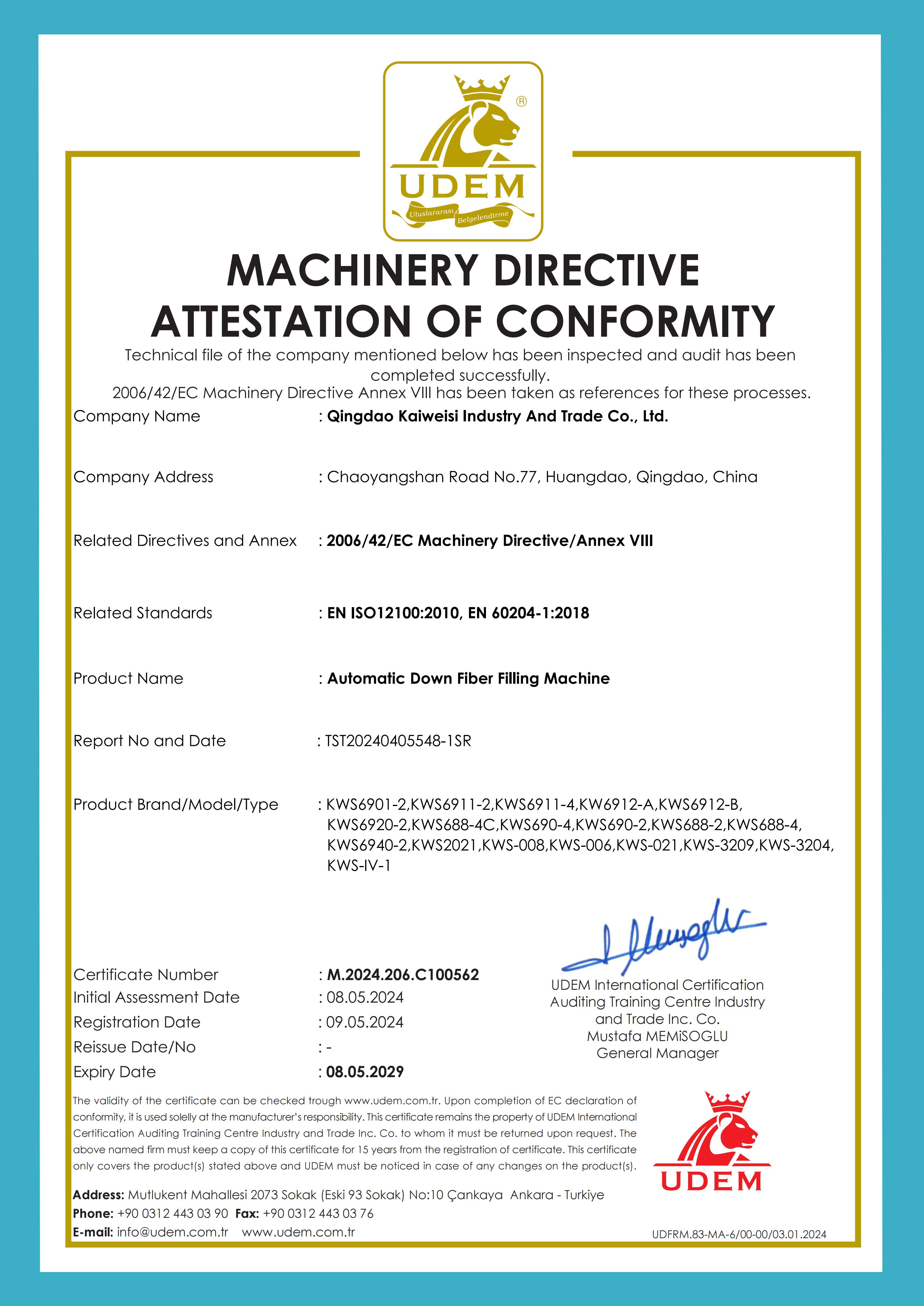
The two marks answer different questions, and buyers who treat them as interchangeable tend to over-read one and under-read the other. ISO9000 concerns a quality management system — the discipline behind how a product is made and controlled. CE-MD concerns machinery safety and market access for the EU: conformity with the essential health and safety requirements expressed through the harmonised standards cited. A CE certificate does not certify filling accuracy or output; an ISO9000 certificate does not certify that a given machine meets a given safety standard.
Three verification steps follow. First, match the certificate number, scope, issuing body and validity period against the exact model being purchased — a certificate valid to 2029 covers a 2026 order but should be re-checked for later ones. Second, request the manufacturer's declaration of conformity for the supplied configuration, particularly where a customized voltage or line integration moves the machine away from the certified build. Third, confirm which standards the electrical and guarding documentation references, since those are the standards the buyer's own safety assessment will be measured against.
Customization and OEM/ODM: what has to be frozen in writing
KIVAS offers OEM, ODM, overseas installation guidance and personalized customization, with the customizable variables stated as voltage, logo, colour, production capacity and specialized production lines. Customization is where the acceptance clause earns its keep, because every variable that moves the machine away from standard build also moves the reference point against which "correct" is judged.
| Customization | What should be documented before production starts |
|---|---|
| Voltage | Voltage, phase and frequency for the destination site, plus plug or terminal arrangement and the electrical documentation that will be supplied with the machine. |
| Logo | Artwork file, placement position, size and application method, with an approved proof signed off before build. |
| Colour | Reference colour code and which surfaces it applies to, so that a delivered machine can be compared against a stated standard rather than a memory. |
| Production capacity | The target hourly or per-minute output at a stated pillow weight and material — the figure the machine will actually be tested against. |
| Specialized production lines | Line layout, the sequence of units (for example fibre opening, filling, compression packaging), interface points between machines, and site services required at the buyer's plant. |
Overseas installation guidance deserves a separate note, because the wording matters. Guidance is advisory support for the buyer's own installation team; it is not the same commitment as an on-site commissioning service, and a purchase order should not assume the latter. The stated after-sales structure — remote technical support, a 1-year warranty and lifetime after-sales service — is the support layer that follows acceptance, and it is worth defining at contract stage what the warranty start date is (shipment, arrival or commissioning), which response channels are included, and how spare parts are supplied.
Application fit: matching the platform to the product
A weighing filling platform is defined less by the machine than by what passes through it. The applications documented for this equipment family include pillow cores, sofa pillows, duvets and outdoor sleeping bags that are filled before quilting, down jackets, plush toys, cushions and fibre balls. The material range documented for the KWS6901-2 — 0.6D–15D fibre, down, feathers and kapok — is broad enough that a single machine can serve several product lines, which is the practical argument for it in a factory running a mixed bedding catalogue.
Breadth of material range is not the same as verified performance on every material in that range. The honest procurement position is that fibre denier, staple length, down cluster content and blend ratio all affect flow behaviour, and therefore fill accuracy and cycle time. A buyer whose product is not represented in the manufacturer's reference installations should ask for the test to be run on their own material, and should treat the pre-shipment test as that opportunity.
Where a single-unit order fits
A minimum order quantity of 1 unit is unusual enough in capital equipment to be worth explaining. Small volume makes a single machine purchasable as a sample for testing rather than only as a production asset — a workshop can validate the filling behaviour on its own materials, and a buyer preparing a multi-unit line can use the first unit to write acceptance criteria that are proven rather than theoretical.
The logic works in both directions. For a first-time buyer, one unit is a low-commitment way to establish whether automated weighing filling suits the product. For a buyer planning a line, the first unit's pre-shipment test record becomes the reference document for every subsequent unit: the same pillow weight, the same tolerance, the same inspection scope. Given monthly capacity of 60–150 units and a 15–35 day lead time, a staged order is a scheduling decision as much as a technical one.
Trade documentation and classification
Filling machinery is generally classified under HS code 8422.30, the heading covering machinery for filling, closing, sealing or labelling according to the FreightAmigo 2025 guidance on filling machinery classification. That is a starting reference, not a ruling: classification depends on the machine's function and on the importing country's tariff schedule, and a customs broker should confirm it before the commercial invoice is issued. Misclassification discovered at destination is an expensive way to learn that the paperwork was never checked.
The documentary set that accompanies a filling machine shipment usually includes the commercial invoice, packing list, bill of lading or airway bill, the applicable certificate or declaration of conformity, the SGS inspection report, and — where the destination or the buyer's own compliance system requires it — a certificate of origin. Which party produces which document follows from the Incoterm chosen, which is one more reason to settle the delivery term early rather than at the end of the negotiation.
Market context, read with care
Commercial research published by Market Research Future in September 2026 projects the pillow packing machine market growing from USD 16.45 billion in 2025 to USD 25.5 billion by 2035, at a compound annual growth rate of 4.48%. The figure is best read as background on a broad equipment category that includes pillow packing and related machinery, not as a demand forecast for a specific machine class, a specific workshop or a specific country. Buyers should use it to understand that the category is expanding, and use their own order book — not a market report — to decide how much capacity to commit to.
Automated weighing fill versus manual filling: where the boundary sits
The comparison that matters at the point of purchase is not between competing machine brands but between automation and the process it replaces. Manual filling ties fill weight to operator judgement: consistency depends on the individual, throughput depends on fatigue, and the record of what was produced depends on paperwork completed after the fact. A weighing filling machine ties fill weight to a setpoint and output to a machine cycle, which is what makes the pre-shipment test meaningful in the first place — there is a number to test against.
The boundary is equally real. Automated filling assumes prepared material: fibre that has been opened and blended to a consistent state, not compressed bales fed directly. It assumes a stable power supply of the specified voltage and frequency. It assumes operators who have been trained and a maintenance routine that is actually performed, which is where the 1-year warranty and lifetime after-sales service become operational questions rather than comfort clauses. And it assumes a defined product — a buyer who has not fixed the pillow specification cannot write an acceptance criterion, and therefore cannot verify what was delivered.
Outlook: documentation as a selection criterion
If there is a direction of travel worth noting for buyers, it is conditional rather than predictive. Where filling equipment is bought as a single unit, the purchasing decision tends to rest on price and headline output. Where it is bought as part of a line, with several units commissioned together and a production date to hit, the criteria that decide whether the project succeeds shift toward documented terms, a defined acceptance procedure and a certification file that can be checked against the exact model supplied. Buyers who build those three items into the purchase order before signing are not buying a better machine; they are buying a machine whose performance can be demonstrated — which, at the point of execution, is the more useful thing.
KIVAS's complete product range, including pillow, duvet, quilt, down-jacket and toy filling machinery, is documented in the downloadable Qingdao Kaiweisi product catalog (PDF). Company information is available at qdkivas.com.
FAQ
What purchasing terms apply to a KIVAS pillow filling machine order?
The stated terms are a minimum order quantity of 1 unit; delivery under EXW, FOB, CIF, CFR or DDP; and payment of a 30% T/T deposit before production with a 70% balance by T/T before ex-factory delivery. Lead time is given as 15–35 days and monthly production capacity as 60–150 units. Which Incoterm applies, and what each party is responsible for under it, is agreed in the order rather than assumed from the quotation.
How is a pillow filling machine accepted before shipment?
Acceptance is conducted through third-party inspection by SGS, and that procedure includes a pre-shipment test. Separately, KIVAS applies a 100% pre-shipment test to every unit as part of its own quality control. The buyer's specification supplies the pass criteria: model and configuration match, material and pillow weight, target output, fill-weight tolerance, documentation set and packing. Without those criteria the inspection verifies condition, not conformity to a defined requirement.
Is SGS inspection the same as the manufacturer's pre-shipment test?
No. The 100% pre-shipment test is the manufacturer's internal control, applied to each machine before packing, and it demonstrates process discipline. SGS inspection is an external, third-party procedure that also includes a pre-shipment test, and it gives the buyer a record originating outside the seller. The two are complementary: the internal test catches faults at the factory, while the third-party inspection gives independent evidence to the buyer and can serve as a condition for releasing the 70% balance payment.
Which certifications are documented for the filling machine models?
KIVAS states that its products have obtained ISO9000/CE certification. The CE file on record is a Machinery Directive attestation of conformity under CE-MD 2006/42/EC, certificate number M.2024.206.C100562, issued by UDEM for the EU market, referencing EN ISO 12100:2010 and EN 60204-1:2018, issued 2024-05-09 and valid to 2029-05-08, with scope covering the Automatic Down Fiber Filling Machine and the KWS6901-2 and KWS6901-4 models. ISO9000 concerns quality management systems; CE-MD concerns machinery safety and EU market access.
What can be customized, and does it affect acceptance?
KIVAS offers OEM, ODM, overseas installation guidance and personalized customization covering voltage, logo, colour, production capacity and specialized production lines. Each of these moves the machine away from standard build and therefore changes what the acceptance test should compare against. Voltage and frequency, logo artwork and placement, colour reference code, the target output at a stated pillow weight, and line layout with interface points should all be documented and approved before production begins.
What after-sales support is included after delivery?
The stated after-sales structure is remote technical support, a 1-year warranty and lifetime after-sales service, alongside overseas installation guidance for the buyer's own installation team. Guidance is advisory support rather than a contractual on-site commissioning service, so buyers who require on-site work should negotiate it separately. It is also worth fixing in the purchase order when the warranty period starts — at shipment, at arrival, or at commissioning — and how spare parts are ordered.
Can a single unit be ordered before committing to a full production line?
Yes. The minimum order quantity is 1 unit, and a single unit can serve as a sample for testing before a larger commitment. For a first-time buyer this validates whether automated weighing filling suits the product and material. For a buyer planning a line, the first unit's pre-shipment test record provides a proven reference — the same pillow weight, tolerance and inspection scope — for the units that follow.
¿Tiene preguntas o necesita más detalles?
Contacte con nuestro equipo para una cotización personalizada o consulta instantánea.
Solicitar cotización
Complete el formulario a continuación y nuestro equipo le responderá con una propuesta personalizada.
Chat directo de WhatsApp
¿Prefiere chatear en tiempo real? Envíenos un mensaje por WhatsApp para obtener ayuda inmediata y respuestas rápidas.
- Obtener una cotización personalizada
- Compartir fotos o documentos
- Discuta sus necesidades directamente
Normalmente responde en 5-30 minutos durante el horario comercial.