
Pillow Block Bearings and Mounted Units: A Buyer's Reference
Industry reference — mounted bearings and pillow blocks
Pillow Block Bearings and Mounted Units: A Buyer's Reference
Pillow block bearings belong to a wider family the industry calls mounted bearings or bearing units. In a mounted unit, a bearing insert is pre-fitted into a housing that bolts directly onto a machine frame, so the shaft does not need a separately machined seat. The pillow block is the most widely recognised housing form in that family: it holds the shaft parallel to the mounting base and is normally fixed with two or four bolts.
For a buyer or design engineer in the research stage, the practical question is rarely “what is a pillow block bearing”. It is which combination of housing material, insert locking and sealing will survive a specific operating environment — and what that combination costs in maintenance access, shaft range and load duty. This reference sets out how the category is structured, how the main housing families differ, and where the real trade-offs sit.
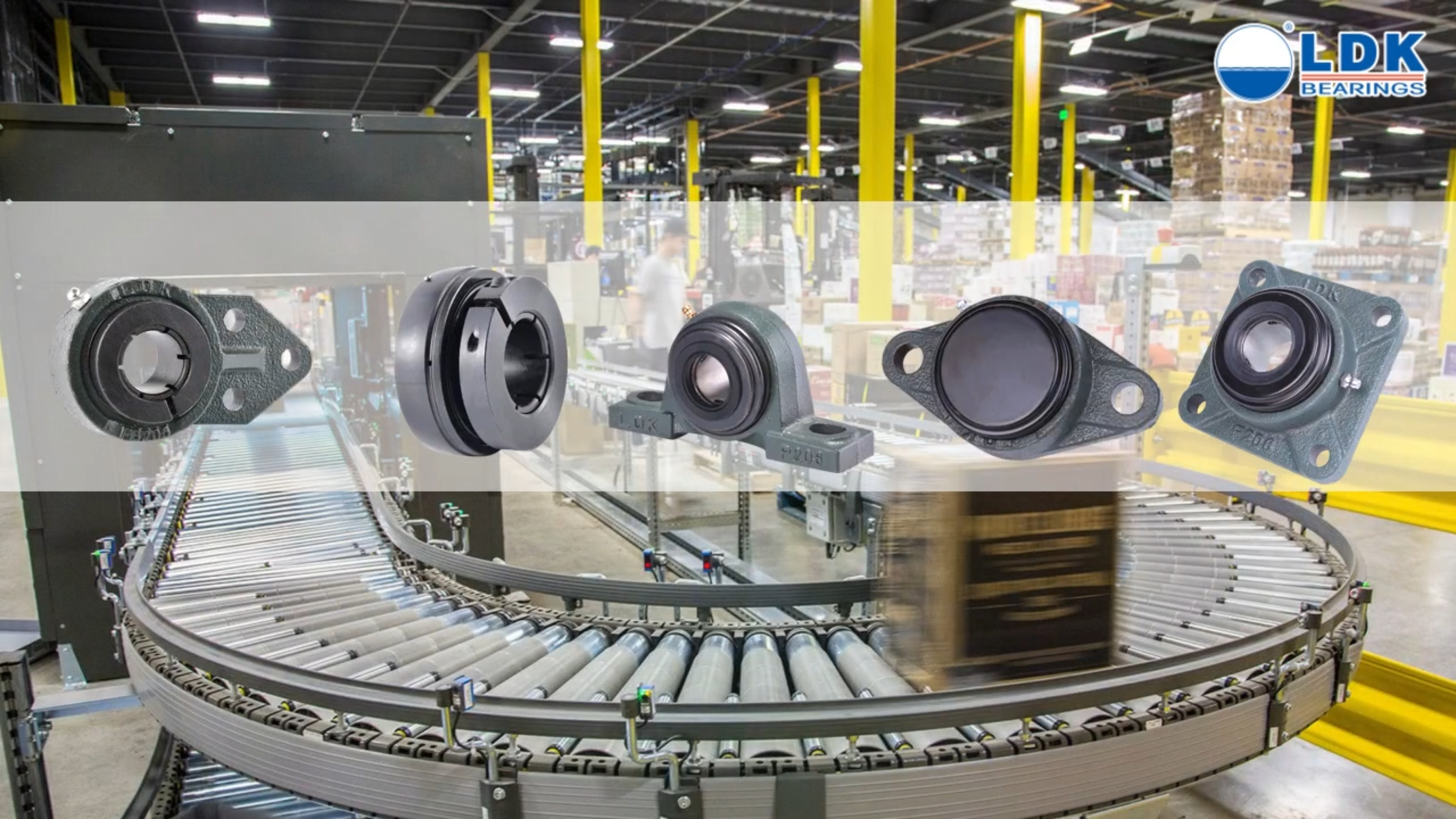
Cast iron housed bearing units in material handling duty — one of the largest application segments for pillow block bearings. Image: LDK.
1. Definitions: Mounted Bearings, Pillow Blocks and Bearing Housings
A mounted bearing is an assembled unit made of a housing and a bearing insert. The housing provides the mounting interface and the load path into the machine frame; the insert carries the shaft and contains the rolling elements. Because the two parts are supplied as a matched assembly, the unit can be bolted down and aligned as a single component.
The vocabulary overlaps by design. “Bearing unit”, “housed unit” and “mounted bearing” describe the same assembled concept, while “pillow block” describes one specific housing geometry. For selection purposes the distinction that matters is the relationship between the shaft axis and the mounting surface, together with how the unit bolts down.
| Housing form | Mounting logic | Documented LDK series | Documented shaft range |
|---|---|---|---|
| Pillow block, two-bolt base | Bolts to a flat frame; shaft runs parallel to the base | UCP2, UCPE2, UCPG2, NAP2, UCSB2, SBLP2, UCPX (medium duty) | 12–100 mm (1/2"–3-1/2"); UCPX from 25 mm |
| Tapped-base pillow block | Threaded holes in the housing base rather than through-bolts | UCTB2, UCPG2 | 12–55 mm (1/2"–2-3/16") |
| Four-bolt flange unit | Face mounting; shaft axis perpendicular to the mounting surface | UCF2, UCFX (medium duty), NAF2, UCF3 (heavy duty) | 12–90 mm; UCF3 to 140 mm |
| Two-bolt flange unit | Face mounting on a two-bolt centre line | UCFL2, NAFL2, NAFLU2 | 12–90 mm (1/2"–3-1/2") |
| Flange cartridge, four-bolt round | Face mounting in a round cartridge footprint | UCFC2, NAFC2, UCFCX (medium duty) | 12–90 mm |
| Take-up unit, one bolt | Sliding frame slot for belt or chain tensioning | UCT2, UCTX, UCT3 (heavy duty), NAT2 | 12–90 mm; UCT3 to 140 mm |
| Split plummer block | Two-piece housing, two or four bolt holes, for larger shafts | SN5, SNU5, SNG5, SAF5 | 20–140 mm (SN / SNU); 30–140 mm (SNG) |
| Flange bracket, three-bolt | Bracket-shaped housing for edge or side mounting | UEFB2; stainless SSUEFB..A | 20–50 mm |
| Zinc alloy miniature unit | Light duty miniature pillow block and flange housings | Silver Series UP000, UFL000, KP000, KFL000 | 10–30 mm |
This breadth explains why the phrase “pillow block bearing” is used loosely in the market, often covering flange and take-up units as well. When comparing quotations, it is worth confirming the housing form rather than the label, because the bolt pattern and the direction of the load path differ between them.
2. Where the Category Sits Commercially
Several published estimates describe the size and direction of this market. They should be read with their definitions in mind.
- The global pillow block bearings market was valued at USD 2.8 billion in 2024 and is projected to reach USD 4.7 billion by 2033, a CAGR of 5.7% (Dataintelo, Pillow Block Bearings Market).
- A separate study covering the broader mounted bearing market, including ball and roller types, valued it at approximately USD 1.48 billion in 2023, with a projected USD 2.55 billion by 2033 (Spherical Insights, Mounted Bearing Market).
- Asia Pacific accounted for approximately 49.5% of mounted bearing revenue in 2025, driven by industrialisation in China and India (Fortune Business Insights).
- China was the world's largest exporter of ball bearings (HS 8482) by value in 2024, at USD 6.53 billion (OEC).
The gap between the first two figures is definitional rather than contradictory. “Pillow block” describes one housing form, while “mounted bearing” also includes flange, take-up and plummer block units, and research houses draw that boundary differently. For procurement purposes these figures are directional: they indicate a category in steady growth, concentrated in Asia Pacific manufacturing, rather than a basis for unit-price assumptions.
What the commercial picture means for buyers
Because a large share of global supply originates in Asia, availability and price competition are relatively favourable, and the real constraint shifts to specification accuracy. Two quotations for a “UCP 205 pillow block” can describe units that differ in housing material, insert steel, seal type and lubrication — all of which affect service life far more than the envelope dimensions do.
3. Housing Materials: The Single Biggest Selection Decision
The housing determines where a unit can be used. It carries the mounting load path, defines the corrosion and temperature envelope, and in most cases sets the load duty rating that the supplier states. Five material families appear in the LDK mounted bearing range.
| Housing material | Documented duty | Environment fit | Example LDK series | Documented shaft range |
|---|---|---|---|---|
| HT200 cast grey iron, dark green paint | Light, standard, medium and heavy duty variants | Dry, dusty and high-load industrial duty | UCP2, UCF2, UCFL2, UCT2, UCPE2; medium duty UCPX, UCFX, UCTX; heavy duty UCT3, UCF3 | 12–100 mm standard; 25–140 mm heavy duty |
| Stainless steel 304 housing with 440 stainless insert | Standard duty | Washdown, corrosive, food, pharmaceutical, chemical, marine, sewage | SSUCP, SSUCPA, SSUCF, SSUCFL, SSUCFC, SSUCT, SSUET, SSUEFB..A | 20–60 mm (3/4"–2-7/16") |
| PBT thermoplastic housing with 440 stainless insert | Standard duty | Washdown and chemical exposure; white, green or black as standard | TP-SUCP, TP-SUCF, TP-SUCFL, TP-SUCPA, TP-SUET, TP-SUCT | 12–60 mm |
| PA6 waterproof thermoplastic housing | Standard duty | Continuous spray, high humidity; black housing with orange cover | WP-SSBP, WP-SSBFL, WP-SSBF | 20–40 mm |
| Stamped zinc-plated steel (stainless option) | Light duty | Agriculture, HVAC, conveyors, gardening, light industry | SBPP2, SAPP2, SBPF2, SBPFT2, SAPF2, SAPFL2, SBPFL2; rubber cushioned RSBPP2, RSAPP2 | 12–60 mm |
| Zinc die-cast alloy (Silver Series) | Light duty | Medical equipment, car wash, pharmaceutical machinery | UP000, UFL000, KP000, KFL000 | 10–30 mm |
Two implications follow. First, cast iron remains the default for load-bearing industrial duty: HT200 cast grey iron housings cover the widest shaft range, from 12 mm pillow blocks up to the 140 mm heavy duty flange and take-up series. Second, the corrosion-resistant families are deliberately narrower. LDK stainless steel mounted units are documented over a 20 mm to 60 mm shaft range, and the waterproof PA6 thermoplastic units over 20 mm to 40 mm, so a washdown requirement may change shaft size, housing form or the number of units in the design.
Cast iron: the industrial default
LDK cast iron pillow blocks such as the UCP2 series use a two-bolt HT200 cast grey iron housing painted dark green with a chrome steel (GCr15, AISI52100) insert, documented from 12 mm to 100 mm shaft diameter (1/2" to 3-1/2"). The medium duty UCPX and UCFX series start at 25 mm shaft diameter, and the heavy duty UCT3 take-up and UCF3 flange series extend to 140 mm. Where shock and vibration dominate — crushing, screening and aggregate conveying — the medium and heavy duty families and the split plummer blocks are the relevant segments rather than the standard duty pillow blocks.
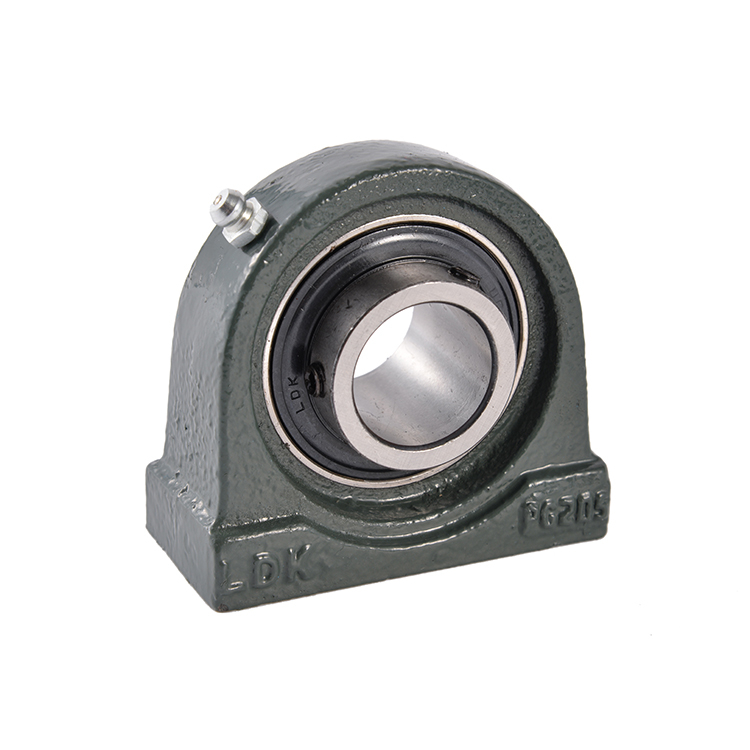
A cast iron pillow block unit: two-bolt HT200 housing, chrome steel insert, self-aligning and relubricable. Image: LDK.
Stainless steel: washdown and corrosive service
Stainless steel mounted units combine a 304 stainless steel housing with 440 stainless steel inserts, food grade grease and silicon rubber seals, and are documented for an operating temperature range of -35 °C to 102 °C. Shaft diameters run from 20 mm to 60 mm (3/4" to 2-7/16") across pillow block (SSUCP and tapped-base SSUCPA), flange (SSUCF, SSUCFL), flange cartridge (SSUCFC), take-up (SSUCT, SSUET) and three-bolt flange bracket (SSUEFB..A) forms. The stated target industries are food processing, chemical, sewage treatment, pharmaceutical, marine and medical equipment.
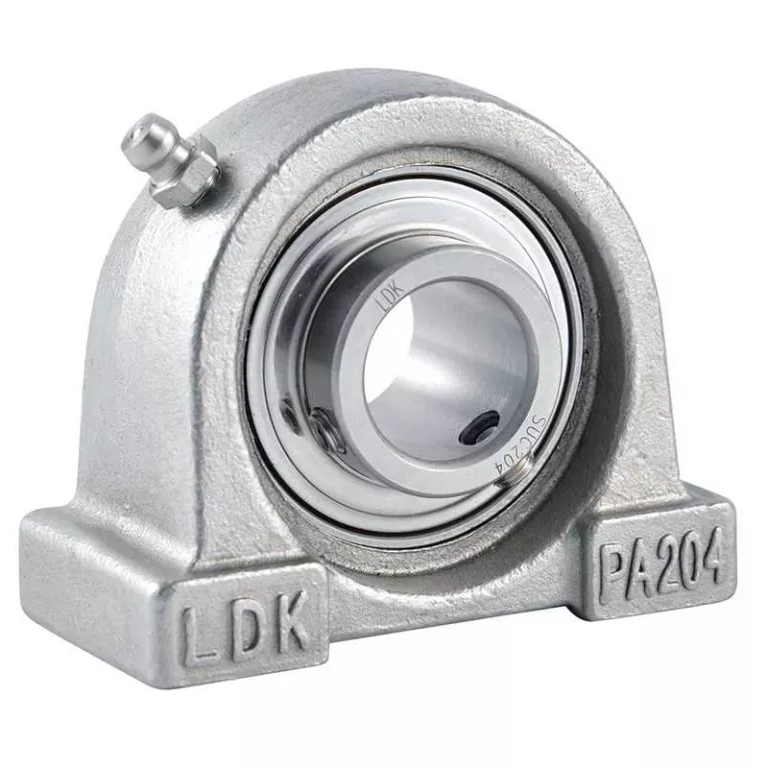
Stainless steel pillow block unit: 304 housing, 440 stainless insert, food grade grease and silicon rubber seal. Image: LDK.
Thermoplastic: corrosion resistance with lighter housings
Two thermoplastic families are documented. PBT thermoplastic housings with 440 stainless inserts cover 12 mm to 60 mm shaft diameters and are supplied in white, green or black as standard, with colour customisation available; they are used across food processing, pharmaceutical, chemical, car wash, sewage treatment and food packaging equipment. The waterproof PA6 series (WP-SSBP, WP-SSBFL, WP-SSBF) is supplied with a black housing and orange cover, is documented over 20 mm to 40 mm shafts, and is intended for spray and high-humidity duty. Both families are rated -35 °C to 102 °C.
Stamped steel and zinc alloy: light duty only
Stamped zinc-plated steel housings, with stainless steel available as an option, form the light duty end of the range. Two-piece pillow block and flange designs (SBPP2, SAPP2, SBPF2, SBPFT2, SAPF2, SAPFL2, SBPFL2) cover 12 mm to 60 mm shafts. Rubber-cushioned versions (RSBPP2, RSAPP2 and the rubber mounted cartridge units RSA2, RSB2, RCSA2, RCSB2 with nitrile rubber rings) are supplied pre-lubricated and non-relubricable for low-noise duty. The Silver Series zinc die-cast units (UP000, UFL000, KP000, KFL000) cover 10 mm to 30 mm shafts for medical, car wash and pharmaceutical equipment. None of these families should be treated as a direct substitute for cast iron units at the same nominal shaft size where load and shock are significant.
4. Bearing Inserts, Locking Methods and Sealing
The insert is the rolling element assembly inside the housing. It determines how the unit grips the shaft, how it is lubricated, and whether it can be re-greased in service. LDK documents a wide insert range, most of it interchangeable across housing families because the insert outside diameter matches the housing bore.
| Insert family | Locking | Documented description | Shaft range |
|---|---|---|---|
| UC2 | Set screw | Spherical ball bearing, wider inner ring, self-aligning, relubricable | 12–90 mm (1/2"–3-1/2") |
| UC3 | Set screw | Heavy duty version of the wide inner ring insert | 25–140 mm (7/8"–4") |
| UCX | Set screw | Medium duty, wider inner ring | 25–75 mm (13/16"–3") |
| NA2 | Eccentric | Wider inner ring, eccentric collar locking | 20–75 mm (1/2"–3-1/2") |
| SA2 | Eccentric | Narrow inner ring, eccentric locking | 12–60 mm (1/2"–2-7/16") |
| SB2 | Set screw | Narrow inner ring | 12–60 mm |
| UD2 | Press fit | Spherical ball bearing, flush back on both sides | 17–60 mm |
| UE2 / UER2 | Concentric | Black oxide finish; UER2 adds a snap ring | 20–60 mm (3/4"–2-7/16") |
| UK2 | Adapter sleeve | Tapered bore, mounts on plain shafts | 20–80 mm |
| SSB2 / SUC (stainless) | Set screw | Stainless steel 440, food grade grease, silicon rubber seal | 12–60 mm |
Locking methods
Set screw locking uses a screw in the inner ring that tightens onto the shaft — the most common arrangement, available with a wide inner ring (UC2, 12 mm to 90 mm) or a narrow inner ring (SB2, 12 mm to 60 mm). Eccentric locking uses a collar whose eccentric shoulder engages a matching recess on the inner ring (NA2, 20 mm to 75 mm; narrow-ring SA2, 12 mm to 60 mm). Concentric locking clamps a collar around the inner ring extension and is used on the UEP2 series and on UE2 / UER2 inserts (20 mm to 60 mm). Tapered bore inserts with adapter sleeves (UK2 and UKP2 housed versions, 20 mm to 80 mm) mount onto plain shafts without a machined shoulder. The choice depends on shaft hardness, vibration level and how often the unit will be removed in service.
Sealing and lubrication
Silicon rubber seals combined with food grade grease are documented on the stainless steel and thermoplastic families, and both are stated as relubricable and self-aligning. Agricultural bearings use triple-lip seals and are supplied pre-lubricated and non-relubricable, which is a deliberate trade: high ingress protection with no field greasing. Split plummer blocks are sealed on the housing side: FS felt with a locating ring on SN5, U-lock or TSNG seals with a locating ring on SNU5, TSNG on SNG5 and TS seals with a locating ring on SAF5.
Decision rules
- Match the stated duty rating to actual load and shock, not to shaft diameter alone.
- Prefer set screw locking for general industrial duty, eccentric locking where field fitting speed matters, concentric locking where a firmer grip is required, and adapter sleeve mounting where the shaft has no shoulder.
- Specify silicon rubber seals with food grade grease where washdown is routine; specify triple-lip sealing where mud and abrasive dust dominate.
- Decide the relubrication strategy before the machine is designed: relubricable units need grease access, and non-relubricable units must be planned as replacement items.
5. Matching a Unit to the Operating Environment
The same nominal bearing size behaves very differently across environments, which is why application conditions drive specification more than shaft diameter does.
Agriculture and farm implements
Documented conditions are full outdoor operation with dust, mud and fertiliser or pesticide exposure, ambient temperatures from -10 °C to +45 °C, high humidity, heavy load, high impact and high-speed vibration. Units specified for this duty include disc harrow bearings such as ST491B and DHU series, square-bore farm implement bearings such as W208PPB12, and hex-bore and round-bore variants. These use triple-lip seals and are pre-lubricated and non-relubricable, so the maintenance plan is periodic replacement rather than re-greasing. Where the same machine also uses conveying or light structural positions, stamped steel housed units and cast iron pillow blocks are used alongside them.
Material handling, conveying and logistics
Warehouse and logistics duty is characterised by medium dust, heavy load and continuous operation, with documented examples including automatic transmission lines in factories, airport baggage conveyor belts, forklifts, pallet jacks, container handlers, industrial conveyors, stretch wrappers and shop cranes. Cast iron pillow blocks and flange units, or stamped steel units for lighter conveyors, are the documented matches.
HVAC air handling
Fan rooms, rooftop units and cooling towers operate from -20 °C to +60 °C with low noise and low vibration as the primary requirements and continuous 24/7 running. LDK documents air handling mounted units for this segment, and rubber mounted cartridge units with nitrile rubber rings that are pre-lubricated, non-relubricable and described as low noise — addressing the vibration transmission path as well as the bearing itself.
Food, beverage and pharmaceutical processing
The documented requirement set for food and beverage machinery is corrosion resistance, washdown resistance against cleaning agents, operation across a low to high temperature band, and long service durability in plants where high-pressure cleaning is routine. Stainless steel units with food grade grease and silicon rubber seals, and PBT or PA6 thermoplastic units, are the families aligned with that requirement. Pharmaceutical and medical machinery adds cleanroom conditions, frequent disinfection, and a need for smooth, easy-clean surfaces with acid- and alkali-resistant sealing.
Chemical, wastewater and car wash
Chemical plants and tank farms present acid, alkali and high-humidity exposure, and the documented answer is the stainless steel mounted unit family. Wastewater treatment adds continuous humidity and sulphide exposure, again in stainless steel. Car wash equipment is documented as full outdoor or semi-outdoor duty with continuous spray, detergent and salt exposure and an IP66+ requirement; the waterproof PA6 thermoplastic units with stainless inserts are the family documented for that environment.
Mining, aggregate and quarrying
Crushing and screening duty combines heavy shock loads, severe dust and wide temperature swings. Documented products include split plummer blocks SN5, SNU5, SNG5 and SAF5 from 20 mm to 140 mm shaft, with felt, U-lock, TSNG or TS sealing and locating rings, in high strength cast iron, cast steel or ductile iron, for mining equipment, power generation, metal manufacturing, pulp and paper, and water treatment. Medium duty UCPX, UCFX and UCTX housed units and heavy duty UC3 inserts (25 mm to 140 mm) support this segment.
Packaging automation
Packaging lines run at constant indoor temperature with high cycle frequency, low to medium load, little dust, and a need for low noise and long maintenance-free intervals. Stamped steel housed units and Silver Series units suit lighter positions; stainless steel or thermoplastic units are used where the line is washed down.
Snow removal, construction and printing
Snow removal equipment operates in sub-zero conditions with de-icing salt exposure and requires low temperature grease and effective sealing. Construction flat saws operate in very high dust with heavy shock and require high strength housings. Printing and dyeing equipment operates with drying sections at 60–80 °C, roller surfaces up to 200 °C, steam humidity and chemical exposure, requiring heat, moisture and corrosion resistance. Cast iron, stainless steel and thermoplastic families are matched to these conditions accordingly.
- Housing form and bolt pattern physically match the frame.
- Housing material matches the environment, not only the price target.
- Duty rating matches real load and shock.
- Insert locking method suits shaft hardness and the maintenance procedure.
- Seal type matches the dominant contaminant: water, mud or abrasive dust.
- Relubrication access is designed in, or the unit is planned as a replacement item.
- Shaft diameter and tolerance are within the documented range for the series.
6. One Supplier's Structure Within the Category: LDK
LDK is the bearing brand of DE YUAN SMART TECHNOLOGY (FUJIAN) CO., LTD, a bearing manufacturer established in 1986 in Quanzhou, Fujian Province, China, producing pillow block bearings, rod end bearings and spherical plain bearings. The company reports annual sales of approximately USD 15 million, a 90,000 m² manufacturing site, approximately 130 employees, 12 engineers in its research and development team, and annual output of 15,000,000 units. Export business accounts for 60% of sales, with main markets in Europe, North America, Latin America and Oceania.
Two structural facts are relevant to mounted bearing buyers. First, LDK produces both bearing inserts and housings in-house, so the matched assembly comes from a single production chain rather than a housing from one source and an insert from another. Second, the documented range covers insert bearing bore sizes from 10 mm to 140 mm with more than 100 combinations of materials and housing types — cast iron pillow blocks, thermoplastic housed bearing units, all-stainless mounted ball bearing units, concentric locking units, air handling units, farm implement bearings, stamped steel housed units, zinc alloy miniature units, and split plummer blocks in SN, SNU, SNG and SAF configurations up to 140 mm shaft diameter.
The company states that its manufacturing facilities are IATF 16949 certified, that its testing capability covers fatigue life, tensile strength, noise and vibration, and salt spray testing, and that production is flexible from low to high volume runs. That flexibility matters where a buyer needs a particular housing and insert combination rather than a catalogue standard. The company also maintains a domestic distributor and distribution-centre network in China, and its Fujian location provides sea and air access for export shipments.
7. Comparison with Conventional Alternatives, and the Limits to Plan For
Before pre-assembled mounted units were the norm, a shaft support was typically a solid or split housing with a separately fitted bearing, requiring a machined shaft seat, manual alignment and on-site assembly. A mounted bearing moves much of that work upstream: the insert and housing are matched at production, the housing is self-aligning within reasonable limits, and the unit bolts to a prepared surface. The cost of that convenience is that the buyer inherits the supplier's material and sealing decisions, which is why specification review matters more than bolt spacing.
Split plummer blocks remain the appropriate answer for large shafts and heavy duty. LDK documents them from 20 mm to 140 mm shaft in high strength cast iron, cast steel or ductile iron, with housing-side sealing and locating rings, for mining equipment, power generation, metal manufacturing, pulp and paper, and water treatment. The trade-off is a generally larger assembly footprint and more installation effort than a bolted pillow block.
Several boundaries should be planned for explicitly:
- Cast iron is not a washdown solution. HT200 cast grey iron with painted finish is the standard industrial housing material and covers the widest shaft range, but it is not the specified answer where units are regularly hosed with water and chemical cleaning agents. That duty calls for stainless steel 304 housings with 440 inserts, or thermoplastic housings.
- Corrosion-resistant families are narrower. Documented ranges are 20–60 mm for stainless steel units and 20–40 mm for waterproof PA6 thermoplastic units, against 12–100 mm for standard cast iron pillow blocks and up to 140 mm for the heavy duty series. A change to corrosion resistance can therefore force a change in shaft size, duty rating or housing form.
- Light duty units are not interchangeable. Stamped steel and zinc alloy units are documented as light duty only and should not be substituted where load and shock are significant.
- Self-aligning has limits. A self-aligning insert compensates for limited angular misalignment. It does not correct an unflat or insufficiently stiff mounting surface, and the frame still has to be prepared correctly.
- Sealed-for-life means replace, not re-grease. Agricultural bearings with triple-lip seals, rubber cushioned stamped steel units and Silver Series zinc alloy units are pre-lubricated and non-relubricable. Maintenance planning must reflect replacement intervals, and relubricable units must have grease access designed into the machine.
- Published market sizes are definition-dependent. Figures for “pillow block” and for “mounted bearing” markets are not comparable, so they should not be used to infer relative supplier scale.
8. Future Outlook
Three forces look likely to shape this category over the next several years.
Standardisation of envelope dimensions. ISO 113:2010 specifies boundary dimensions for two-bolt and four-bolt plummer block housings intended for rolling bearings. Easier dimensional interchangeability makes like-for-like substitution simpler, which shifts competition away from bolt spacing and towards load rating, seal design, material selection and documentation. For buyers, the practical consequence is that envelope compatibility should never be treated as performance equivalence.
Continued supply concentration in Asia Pacific. Asia Pacific accounted for approximately 49.5% of mounted bearing revenue in 2025 according to Fortune Business Insights, and China was the largest exporter of ball bearings by value in 2024 at USD 6.53 billion according to OEC. Availability and price competition are likely to remain favourable, while the burden of differentiating technically equivalent quotations falls more heavily on the buyer.
Washdown and hygiene-driven specification. Food, beverage, pharmaceutical, chemical, wastewater and car wash environments increasingly demand corrosion-resistant housings, food grade grease and seals that tolerate repeated cleaning. That pushes growth towards stainless steel and thermoplastic families, which remain narrower in shaft range than cast iron. Maintenance philosophy is diverging in parallel: sealed-for-life units simplify maintenance but are replaced rather than regreased, while relubricable units require access and a servicing schedule.
Reference: LDK product brochure (PDF, publicly downloadable): https://cdn.socialarks.com/sbsp/24740/common/2026/0526/6a15036f9c1a2.pdf
9. Frequently Asked Questions
Q1. What is the difference between a pillow block bearing and a flange bearing unit?
Both are mounted units made of an insert plus a housing. A pillow block has a base that bolts to a flat frame, holding the shaft parallel to the mounting surface — for example the UCP2 series, documented from 12 mm to 100 mm shaft diameter. A flange unit mounts to a face with the shaft axis perpendicular to the mounting surface, such as the four-bolt UCF2 series (12 mm to 90 mm) or the two-bolt UCFL2 series (12 mm to 90 mm). The selection depends on the geometry of the machine frame rather than on load capacity alone.
Q2. Which housing material should be used where equipment is washed down regularly?
Cast grey iron (HT200) housings are the default for standard, medium and heavy duty industrial use, but they are not the right specification where units are regularly sprayed with water and chemical cleaning agents. The families documented for that duty are stainless steel units with a 304 stainless housing and 440 stainless insert (SSUCP, SSUCPA, SSUCF, SSUCFL, SSUCFC, SSUCT, SSUET and SSUEFB..A), rated -35 °C to 102 °C with food grade grease and silicon rubber seals, and PBT or PA6 thermoplastic housed units. Both carry narrower documented shaft ranges than cast iron.
Q3. How do set screw, eccentric and concentric locking differ?
Set screw locking uses a screw in the inner ring bearing onto the shaft, and is available with a wide inner ring (UC2, 12 mm to 90 mm) or a narrow inner ring (SB2, 12 mm to 60 mm). Eccentric locking uses a collar whose eccentric shoulder engages a recess on the inner ring (NA2, 20 mm to 75 mm; SA2 narrow ring, 12 mm to 60 mm). Concentric locking clamps a collar around the inner ring extension and appears on the UEP2 series and on UE2 / UER2 inserts (20 mm to 60 mm), which have a black oxide finish and, for UER2, a snap ring. A tapered bore insert with an adapter sleeve (UK2, 20 mm to 80 mm) is used where the shaft has no machined shoulder.
Q4. Are mounted bearings relubricated in service, or sealed for life?
Both arrangements exist within the same portfolio. Cast iron, stainless steel and thermoplastic housed units are documented as self-aligning and relubricable. Agricultural and farm implement bearings using triple-lip seals are pre-lubricated and non-relubricable, as are rubber cushioned stamped steel units and the Silver Series zinc alloy miniature units — these are replaced rather than greased. The choice affects machine design, because relubricable units require grease access points.
Q5. What does ISO 113:2010 cover, and why does it matter when comparing suppliers?
ISO 113:2010 specifies boundary dimensions for two-bolt and four-bolt plummer block housings intended for rolling bearings. It addresses envelope dimensions such as bolt spacing and height, so a housing from one supplier may fit the footprint intended for another. It does not standardise load rating, housing material, seal type or lubrication, so dimensional interchangeability is not evidence of performance equivalence.
Q6. How wide is the shaft range across the mounted unit families described here?
Documented ranges vary substantially by family: Silver Series zinc alloy miniature units cover 10 mm to 30 mm; stamped steel housed units 12 mm to 60 mm; PBT thermoplastic units 12 mm to 60 mm; waterproof PA6 thermoplastic units 20 mm to 40 mm; stainless steel units 20 mm to 60 mm; standard cast iron pillow blocks 12 mm to 100 mm; heavy duty cast iron take-up and flange series 25 mm to 140 mm; and split plummer blocks 20 mm to 140 mm (SN and SNU) or 30 mm to 140 mm (SNG). Corrosion-resistant and light duty families are consistently narrower than the cast iron range.