
Pillow Block Bearing Supplier Consistency Beyond Order One
Almost every pillow block bearing program begins with a sample, a quotation and a first shipment. Almost nothing that damages a production line appears at that point. The failures show up later, when the fifth or twentieth order arrives with a housing that seats differently, an insert that runs louder than the units originally approved, or a certificate that no longer matches the specification signed off during sampling.
The size of the category makes that gap expensive to ignore. The global bearings market was estimated at USD 58.6 billion in 2024 and is projected to reach USD 143.6 billion by 2034 (Global Market Insights). Pillow block and mounted bearings accounted for approximately USD 6.1 billion of that in 2024 (IndexBox), and plummer blocks, the housed units many buyers simply call pillow blocks, represented about 42.51% of mounted bearing revenue share in 2024 (Fortune Business Insights). China's ball bearing exports alone reached USD 6.53 billion in 2024, roughly 19.9% of global exports (OEC).
A category that large is not short of suppliers. It is short of buyers who can tell, before the second purchase order is placed, which suppliers will still be producing a comparable unit two or three years from now. This article sets out an evaluation framework built on published engineering parameters, and uses FKD's pillow block bearing range as a worked example of the evidence a buyer can actually check.
Why the First Order Is a Weak Test
A first order is a controlled event. The buyer inspects samples, agrees a model designation, confirms packaging, checks a certificate and compares a price. Every one of those checks is performed on a known batch, frequently prepared specifically for the sample request.
Repeat orders are not controlled the same way. They are released against a purchase order, produced inside a normal schedule and inspected on a routine plan. That is where variation becomes visible, and where a supplier either holds a process or starts adjusting it.
In mounted bearing units, parameter drift is rarely dramatic. It appears as small changes in housing casting quality, insert ring surface condition, locking mechanism seating, seal lip condition, or in the substitution of a material grade that is described as close enough to the original. Each change is individually tolerable. Together they alter the fit, the noise level and the service interval of an assembly that was already qualified.
The practical consequence is that a buyer evaluating on price alone is not evaluating the product that will be delivered in year two. The evaluation question shifts from what does this unit cost to what evidence exists that the same unit will be delivered again.
What Consistency Looks Like in Published Specifications
Long-term consistency leaves a trace in a supplier's technical documentation. The trace is repetition: the same engineering values appearing across products that are structurally very different from one another.
In FKD's published pillow block bearing data, four values recur across the mounted unit families. The quality grade is stated as P5 ZV3. The speed rating is 3000 RPM. The bearing insert material is chrome steel GCr15, described in the same documents as AISI type 52100 chrome steel. The housing material is specified as cast iron or ductile iron QT450. The UC insert bearing series adds G10 steel balls, specified for reduced vibration.
That repetition is the evidence itself. A manufacturer that applies one process specification to a high centre height pillow block, a flange bracket unit, a screw conveyor hanger unit, a top-based unit, a take-up frame and a stainless steel unit is describing one manufacturing system rather than a set of independently sourced products. Whether that system is genuinely stable is a separate question, but the published parameter set is where verification begins.
The two designations inside P5 ZV3 should also be read carefully rather than assumed. P5 is widely used in the bearing industry to denote a precision class, while ZV3 appears in the same specification line as a vibration-related group. A buyer should ask a supplier to state the standard basis for both and to show how each is checked in routine production rather than only on a sample. Where a supplier operates an automatic inspection line, that inspection plan is the practical reference point a procurement team can audit.
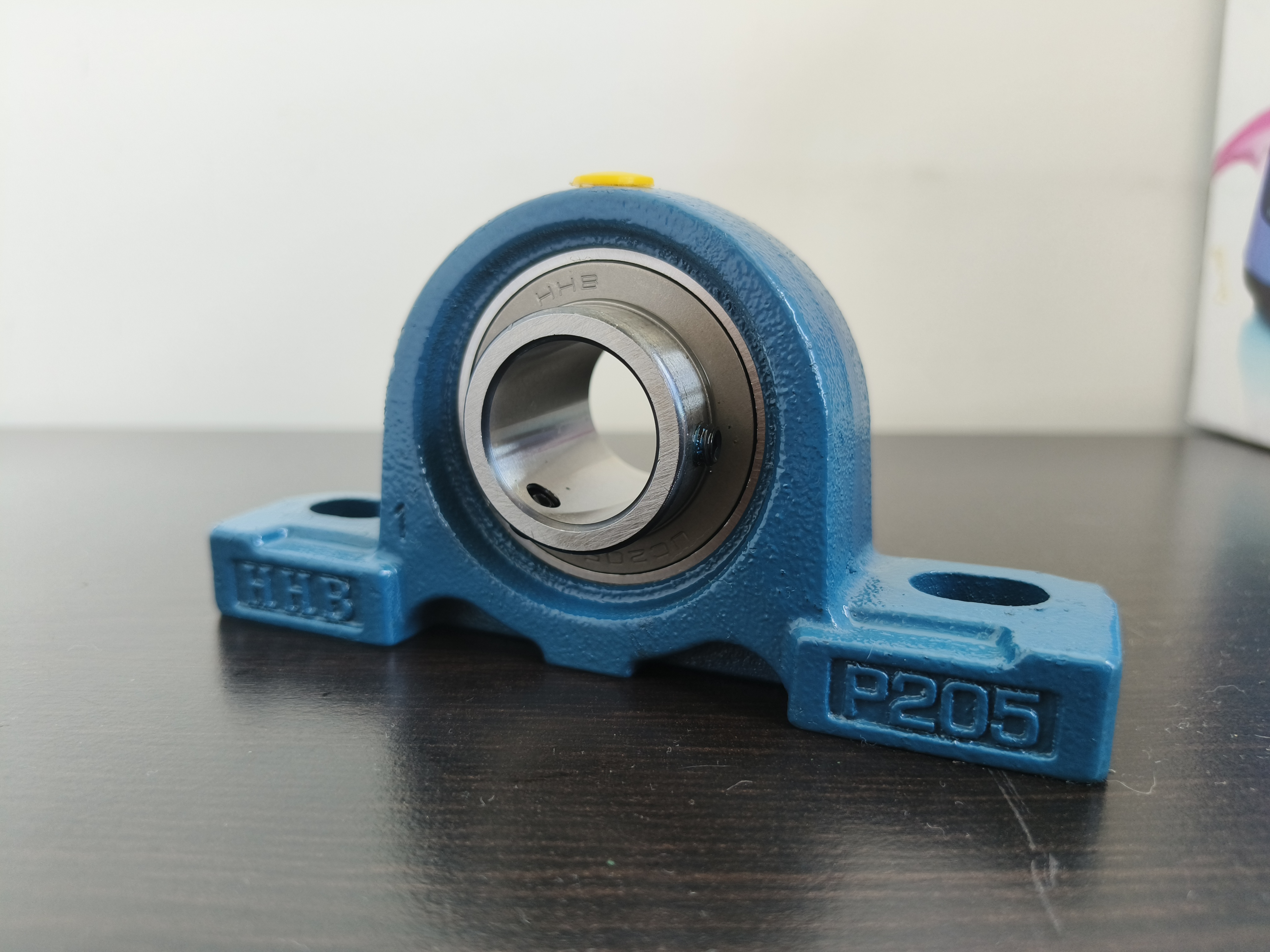
Parameter Consistency Across the Series Range
| Series / product type | Model coverage | Bearing material | Housing material | Quality grade | Rated speed |
|---|---|---|---|---|---|
| UCP200 pillow block units | UCP205 to UCP328 | Chrome steel GCr15 (AISI 52100) | Cast iron or QT450 ductile iron | P5 ZV3 | 3000 RPM |
| UCPH high centre height units | UCPH205 to UCPH212 | AISI type 52100 chrome steel | Cast iron or QT450 ductile iron | P5 ZV3 | 3000 RPM |
| UCF square flange units | UCF205 to UCF328 | Chrome steel GCr15 (AISI 52100) | Cast iron QT450 | P5 ZV3 | 3000 RPM |
| UCFL oval flange units | UCFL205 to UCFL328 | Chrome steel GCr15 (AISI 52100) | Cast iron or QT450 | P5 ZV3 | 3000 RPM |
| UCFC flange cartridge units | UCFC205 to UCFC212 | Chrome steel GCr15 | Cast iron or QT450 | P5 ZV3 | 3000 RPM |
| UCFA adjustable flange units | UCFA205 to UCFA212 | Chrome steel GCr15 (AISI 52100) | Cast iron or QT450 | P5 ZV3 | 3000 RPM, continuous operation |
| UCFB flange bracket units | UCFB205 to UCFB210 | Chrome steel GCr15 (AISI 52100) | Cast iron or QT450 | P5 ZV3 | 3000 RPM |
| UCHA screw conveyor hanger units | UCHA205 to UCHA212 | Chrome steel GCr15 (AISI 52100) | Cast iron or QT450 | P5 ZV3 | 3000 RPM |
| UCPA top-based pillow block | UCPA205 | Chrome steel GCr15 (AISI 52100) | Cast iron or QT450 | P5 ZV3 | 3000 RPM |
| UCT take-up units | UCT205 to UCT328 | Chrome steel GCr15 | Cast iron or QT450 | P5 ZV3 | 3000 RPM |
| UC insert bearings | UC205 to UC215, UC313 to UC320 | Chrome steel GCr15 with G10 steel balls | Not applicable | P5 ZV3 | Published for the mounted families |
| SA ball bearings with eccentric collar | SA205 to SA212 | Chrome steel GCR15 | Cast iron or QT450 | P5 ZV3 | 3000 RPM |
| W208PPB5 agricultural bearing | W208PPB5 | Chrome steel GCR15 | Cast iron or QT450 | P5 ZV3 | 3000 RPM |
| SSUCP stainless steel units | SSUCP205 to SSUCP210 | Stainless steel | Stainless steel | P5 ZV3 | 3000 RPM |
| Pressed housing units | SAPP205, SAPFL205, SAPF205, SBPFL205 | Chrome steel GCr15 | Pressed steel | P5 ZV3 | 3000 RPM |
| SNL508 plummer block | SNL508 | Not applicable | Cast iron HT200 | OEM component specification | Not published in this data set |
Read as a table, the pattern is the point. Sixteen product families with different mounting geometries, different housing casting methods and different intended industries are described with one quality designation and one speed rating. For a buyer, that is a screening signal: the supplier is not treating each order as a new engineering exercise.
Portfolio Breadth as a Scalability Signal
Model coverage is the second consistency signal. It answers a question that pricing cannot: if our machine range grows, does the supplier grow with it without a new qualification cycle?
Three families run continuously from 205 to 328 in the published data: the UCP200 pillow block units, the UCF square flange units, the UCFL oval flange units and the UCT take-up units. Others are deliberately narrower. UCPH, UCFA, UCHA and UCFC stop at 212. UCFB stops at 210. The stainless steel SSUCP range covers 205 to 210, and a separate stainless bearing with plastic housing variant covers a comparable span. Pressed housing units are offered in four mounting configurations, and the SNL508 plummer block is positioned as a cast iron HT200 OEM component.
For an OEM program, the value of that structure is administrative. A design team that uses UCP units on a conveyor drive and UCFL units on an adjacent tensioning station can move both up in shaft size without changing supplier, drawing conventions or incoming inspection routines. That reduces the cost of qualification across a product family, which is often a larger cost than the unit price difference between two quotations.
Breadth must still be checked against reality. Continuous numbering does not confirm that every size is held as standard production. A buyer should ask which models are regular production items and which are built to order, and should confirm this in writing before a multi-size program is committed.
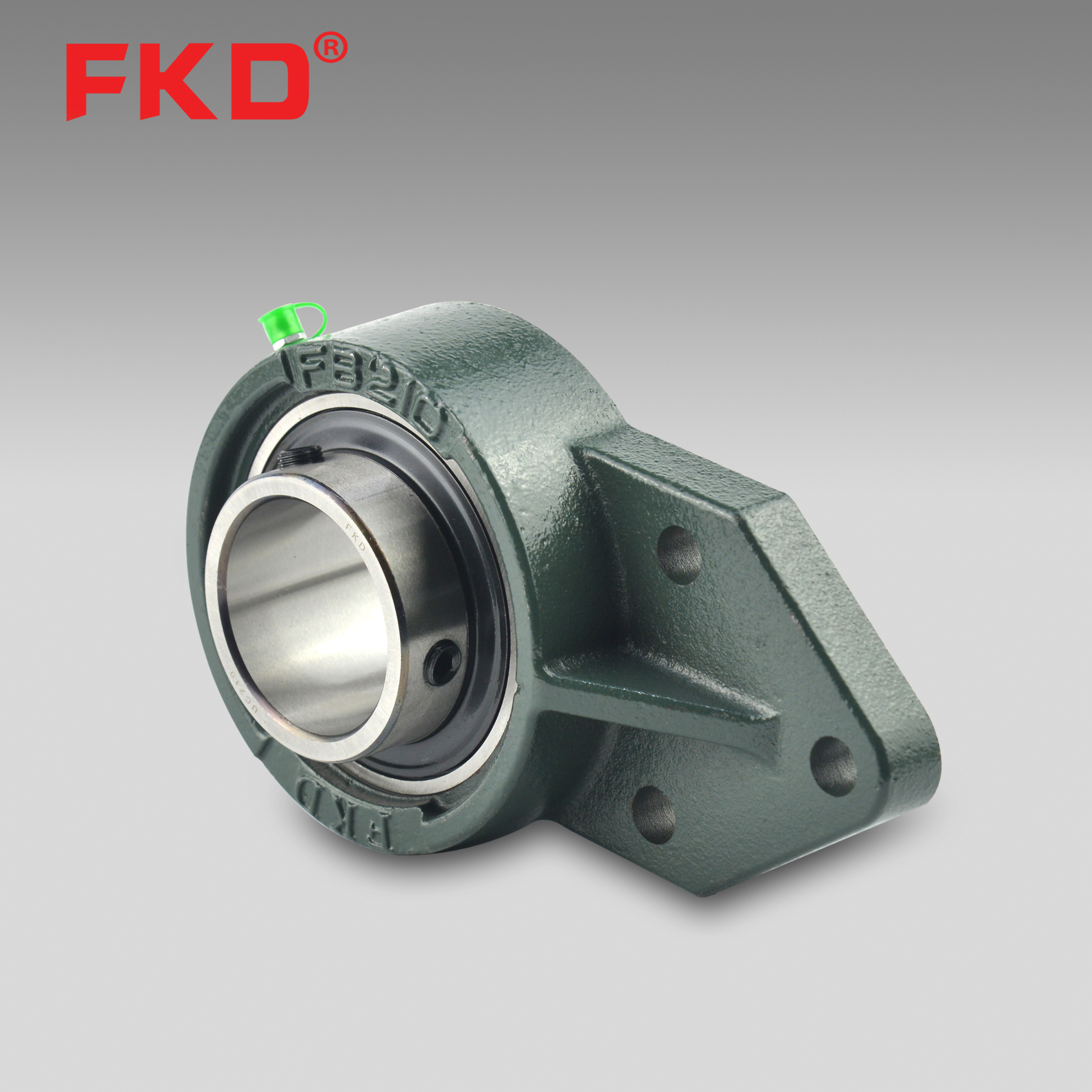
The Manufacturing Base Behind the Published Values
FKD is a registered bearing brand of HEBEI HAILAN BEARING MANUFACTURE CO., LTD., a pillow block bearing manufacturer established in 1988 and located in Hexi Town Industrial Park, Linxi County, Hebei, China. The company also registers the FE and HHB brands.
The verified first-party facts that matter for a consistency assessment are these. The company states a land area of 100,000 square metres, approximately 400 employees, and a technical and engineering team of 30 people. Annual production and sales are stated at over 20 million pieces across pillow block bearings, deep groove ball bearings, taper roller bearings and other bearing types. Production is organised on automatic pillow block bearing production lines with an automatic inspection line and a dedicated bearing housing production line, and the company states that more than 90% of products are made on automatic equipment. The company has passed ISO9001:2015 quality management system certification. Over 90% of output is exported to more than 68 countries and regions, with EU, Asia, South America and Africa listed as main markets.
For a buyer, these numbers only matter where they explain repeatability. In a pillow block unit, the two processes most directly responsible for holding a bore dimension, a centre height and an insert fit stable between batches are housing production and inspection. In-house housing production combined with an automatic inspection line is the structural reason a supplier could keep the same published grade across sixteen product families, rather than re-specifying each order.
Application Contexts Where Consistency Is Actually Tested
Consistency is an abstract property until it meets a working condition. The conditions documented for these mounted units are demanding enough to make batch variation visible quickly.
- Operating profile: industrial machinery applications running continuously, with high temperature, high dust, heavy pollution, high load and high speed identified as typical working conditions.
- System type: ventilation systems and cooling systems are named among the project types these units are applied to.
- Required behaviour: dust-proof, water-proof and shock-proof performance, with anti-rust, corrosion resistance, high temperature resistance and low noise listed as special requirements. Stainless steel is offered as an optional material.
- Matched equipment: belts, roller chains, transmission shafts and oil seals, which means the bearing unit is not the only component whose fit matters.
- Industry fit: manufacturing, agricultural machinery, textile machinery and mining machinery are the recurring application industries, with harvesting and producer machinery named for the flange cartridge unit and conveyor systems named for the square flange and screw conveyor hanger units.
- Reference markets: India, Poland, Peru, Italy and Spain appear among the documented application markets for industrial machinery use.
In a 24/7 line running in dust and heat, a small batch-level change becomes a maintenance event rather than a tolerance note. That is why the published speed rating and grade are worth more than their face value: they define the envelope in which the unit was specified, and any repeat order that falls outside that envelope is a change of specification, not a price negotiation.
Market Context: Why Supplier Evaluation Is Getting More Attention
Three published market signals explain why buyers are moving from price-per-order evaluation towards supplier-level evaluation.
First, the category is expanding. Global bearings demand was estimated at USD 58.6 billion in 2024 with a projected path to USD 143.6 billion by 2034 (Global Market Insights). Second, mounted bearings are a substantial and stable sub-segment, valued at approximately USD 6.1 billion in 2024 (IndexBox), with plummer blocks alone accounting for about 42.51% of mounted bearing revenue share (Fortune Business Insights). Third, supply concentration is real: China's ball bearing exports reached USD 6.53 billion in 2024, about 19.9% of global exports (OEC).
The common thread is that volumes are growing and supply relationships are lengthening. The longer a supply relationship runs, the more of its total cost sits in re-qualification, unplanned replacement and line downtime rather than in the invoice.
Transactional Sourcing Compared with Consistency-Based Evaluation
The two approaches are not opposites, and most buyers use both. The difference is where the risk is carried.
| Evaluation dimension | Transactional approach | Consistency-based approach |
|---|---|---|
| Decision basis | Quoted unit price, lead time, sample quality | Published parameter stability, process evidence, model coverage |
| Verification effort | Sample inspection and certificate review | Sample, repeat batch comparison and inspection plan review |
| Risk position | Risk transferred to the first delivery | Risk managed across order cycles |
| Supplier relationship | Replaceable at each order | Qualification carried across sizes and series |
| Cost focus | Unit price | Unit price plus re-qualification, downtime and unplanned replacement |
| Best suited to | One-off replacement in non-critical duty | OEM programs and continuous production lines |
The limitation of the consistency-based approach is that it costs time before any product is delivered. A buyer who insists on reviewing parameter stability, inspection plans and repeat batch behaviour will spend weeks longer in qualification than a buyer who accepts the lowest quote against a sample. That delay only pays back where the unit is mission-critical, where the volume is meaningful, or where the assembly has already been qualified once and cannot economically be re-qualified. For a single replacement unit on a low-duty line, the transactional route is the rational one.
Where This Framework Stops
- Load ratings are not covered by the published parameter set. Dynamic and static load capacity, and the associated service life calculation, should be requested for the specific duty rather than inferred from the quality grade.
- A shared grade does not make units interchangeable. UCPH is specified for high centre height applications, UCPA for top-based mounting, UCT for take-up frames. The grade is shared; the geometry is not.
- Size coverage is uneven by design. UCP, UCF, UCFL and UCT reach 328; UCFA, UCPH, UCHA and UCFC reach 212; UCFB reaches 210; the stainless steel SSUCP range covers 205 to 210.
- Corrosion resistance is material-specific. Stainless steel applies to the SSUCP series. Elsewhere the declared housing materials are cast iron, QT450 ductile iron or pressed steel. Buyers in aggressive environments should confirm material suitability rather than assume it from a general product description.
- Published consistency is a screening tool, not an audit. It narrows a supplier list. It does not replace first-article inspection, a factory visit, or batch traceability checks.
A Six-Step Evaluation Sequence
The framework below converts the analysis above into a sequence a procurement team can run before a second order is placed.
- 1. Build a parameter baseline from the supplier's own documents. Record the quality grade, speed rating and material specification exactly as published, and use that text as the comparison reference for every subsequent quotation.
- 2. Check for repetition across series. A value that appears once is a product claim. A value that appears across flange, pillow block, take-up and stainless families is a process statement.
- 3. Map model coverage against your own roadmap. Confirm which sizes are regular production and which are built to order, and identify where your range may outgrow the supplier's coverage.
- 4. Ask how the grade is verified in routine production. Request the inspection plan, not only the sample report, and ask which parameter is checked on every batch.
- 5. Test the repeat order, not the sample. Compare the second and third deliveries against the baseline on the housing and the insert, using the same measurement method each time.
- 6. Confirm the material story for the environment. Match stainless, QT450 or pressed steel housings to the actual contamination, temperature and moisture profile of the application.
Future Outlook
As mounted bearing volumes continue to expand, the value of a supplier relationship increasingly sits in what happens after qualification. Three developments are likely to shape how buyers evaluate pillow block suppliers over the next several years.
The first is documentation consistency. As more sourcing decisions are informed by published technical data rather than by physical visits, a supplier that states the same grade, the same materials and the same speed rating across its range becomes easier to verify remotely and easier for engineering teams to specify without re-checking every line item.
The second is coverage of material variants. Stainless steel and pressed housing options address environments and weight constraints that cast iron units handle less well. A supplier's ability to hold a consistent grade across those variants, not just across the mainstream cast iron range, will become a differentiator as corrosion-resistant demand grows.
The third is the transfer of process evidence. Automatic production and automatic inspection lines, ISO9001:2015 certification and a documented export footprint to more than 68 countries are the kind of facts that let a buyer carry out a remote first-stage screen. None of them replace a repeat batch check. All of them shorten the list that has to be checked physically.
FAQ
1. What does long-term consistency mean when evaluating a pillow block bearing supplier?
Long-term consistency means the published engineering parameters for a product family stay the same across repeat orders and across different series, rather than being adjusted order by order. In FKD's published data, the quality grade P5 ZV3, the chrome steel GCr15 (AISI type 52100) bearing material, the 3000 RPM speed rating and the cast iron or QT450 housing specification recur across the UCP, UCPH, UCF, UCFL, UCFC, UCFA, UCFB, UCHA, UCPA, UCT and SSUCP families.
2. Why does a shared speed rating such as 3000 RPM matter to a buyer?
A shared speed rating indicates that the different housing types in a range were specified for a common operating envelope. This matters when one machine or plant uses several mounting formats, because it reduces the number of different duty assumptions an engineering team has to maintain. It is one parameter only: load, temperature, lubrication and mounting method still need to be verified for the actual application.
3. What is P5 ZV3 and how should a procurement team treat it?
In the published catalogue data, P5 ZV3 is presented as a combined quality designation applied across the range. P5 is widely used in the bearing industry to denote a precision class, while ZV3 appears in the same specification line as a vibration-related group. Rather than treating the label as self-explanatory, buyers should ask the supplier to state the standard basis for each designation and to show how both are verified in routine inspection, not only on a sample.
4. Does a wide model range such as UCP205 to UCP328 indicate a more reliable supplier?
It indicates size coverage, which is a different thing. Continuous coverage matters for OEM programs because it allows a machine range to grow in shaft size without a new qualification cycle. Coverage is also uneven across product types: UCP, UCF, UCFL and UCT reach 328, while UCFA, UCPH, UCHA and UCFC reach 212, UCFB reaches 210, and the stainless steel SSUCP range covers 205 to 210. Buyers should also confirm which sizes are regular production and which are made to order.
5. What can published parameters not tell a buyer about a pillow block bearing supplier?
Published parameters do not provide dynamic or static load ratings, service life under specific contamination or temperature conditions, lubrication requirements, actual stock availability, or batch traceability. They also do not prove that a supplier's process will stay stable as volume increases. These items should be requested directly and checked against the second and third deliveries rather than assumed from a catalogue. Third-party market size estimates should likewise be treated as directional, because research houses publish different totals for the same category depending on scope.