
Phytosanitary Compliance for Wholesale Bonsai Exports
A phytosanitary certificate is an official document issued by the national plant protection authority of the exporting country, confirming that a consignment of live plants has been inspected and is considered free from regulated pests and diseases. For wholesale bonsai plants, that certificate covers only part of the requirement. The other part is determined by the physical form in which the plants travel, because whether a bonsai leaves the nursery potted in growing medium or bare-rooted changes the destination rule that applies, the inspection risk at the border, and the container conditions the shipment needs.
For buyers placing container-scale orders, compliance is therefore not a document collected at the end of a transaction. It is a production and packing decision taken before the order is loaded, and it is the main reason two suppliers offering visually similar Ficus ginseng or Pachira money trees can have very different records of successful arrivals.
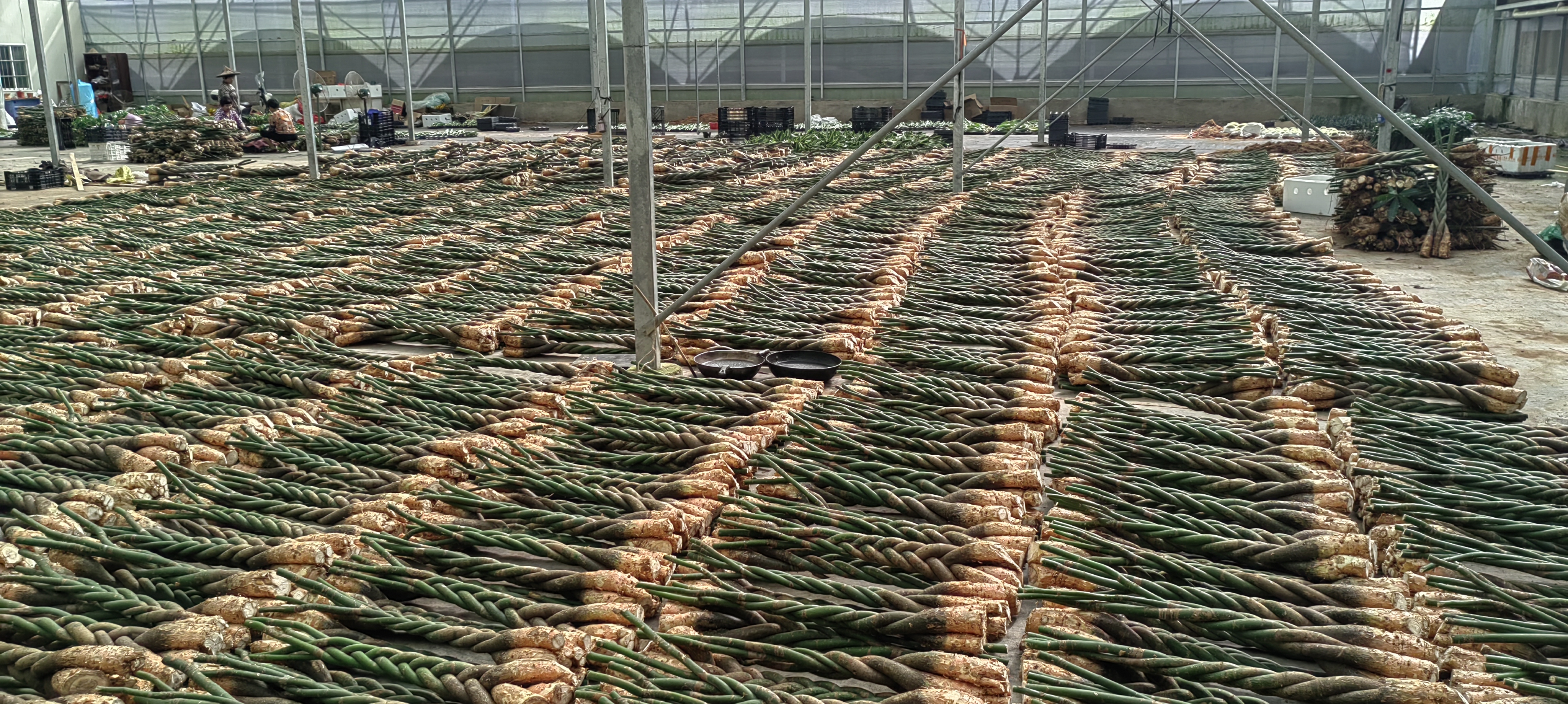
Bare-rooted Pachira money trees staged ahead of inspection and packing. Removing growing medium is a phytosanitary measure as much as a freight decision, and it is the form several destination authorities require for live bonsai.
Why Live Bonsai Cross Borders Under a Stricter Regime Than Manufactured Goods
Bonsai are regulated as living plant material, not as decorative products. A consignment carries roots, residual growing medium, moisture, and occasionally dormant insects, nematodes or fungal spores that are not visible during loading. Importing authorities treat every shipment as a potential pathway for pest introduction, and they write requirements that must be satisfied before the container is sealed rather than after it arrives.
Three questions decide whether a wholesale bonsai order can legally enter a market:
- What does the destination require for this genus and this plant form?
- Can the grower produce the plant in the form that requirement specifies?
- Can the grower document the inspection, treatment and handling history of that specific consignment?
Most failed shipments in live-plant trade are not caused by pests found at the port. They are caused by a mismatch between one of those three answers and what was actually loaded. A potted consignment sent to a market that requires bare roots, or a certificate issued for a quantity or variety that does not match the packing list, creates the same practical result: the container is held, treated or returned while living cargo continues to deteriorate.
What Actually Governs a Bonsai Consignment: Certificates and Destination Rules
The phytosanitary certificate is issued after inspection of the consignment and travels with the shipment. In China this inspection and certification process sits inside the Entry-Exit Inspection and Quarantine (CIQ) system, which is why greenhouse infrastructure built to CIQ standards is described as export-ready from cultivation onward rather than only at dispatch.
Destination requirements differ more than most first-time importers expect:
- European Union: Under Regulation (EU) 2019/2072, imported bonsai plants require phytosanitary certificates as a measure to prevent pest introduction.
- United States: USDA APHIS requirements call for bonsai to be bare-rooted and accompanied by a phytosanitary certificate from the country of origin. Consignments of 12 or fewer plants may fall under different requirements, which is one reason small trial orders and full container orders cannot always be prepared the same way.
The consequence for procurement planning is straightforward. A single nursery may need two different packing specifications for the same variety in the same week, and the specification has to be decided from the destination, not from the supplier's usual handling routine. For a distributor running multiple markets, the practical question is whether the grower can hold both specifications in production at the same time without mixing them at the packing station.
Documentation that must match the physical shipment
Certificates, permits and packing lists are only useful when they describe the consignment that is actually in the container. Variety, quantity, plant form, and inspection date all need to line up. Buyers who request a pre-shipment inspection before loading are effectively buying that alignment, because the check happens while the plants are still in the nursery and corrections are still possible.
Potted or Bare-Rooted: How Plant Form Becomes a Compliance Variable
Bare-rooting is usually discussed as a freight optimisation. It is more fundamentally a pest-risk and inspection decision. Removing the growing medium removes the substrate in which soil-borne organisms are most likely to travel, which is exactly why the USDA requirement for bare-rooted bonsai exists rather than being an arbitrary packing preference.
The measurable effects of that decision, compared with traditional potted supply in the same product category, have been documented from the supplier side:
| Measured difference | Bare-root supply versus traditional potted supply |
|---|---|
| Product weight | Reduced by 40% |
| Packaging volume | Reduced by 36% |
| Transit breakage rate | Falls from 16% to 2.5% |
| Comprehensive logistics expense | About 33% lower |
| Carbon emission per unit transported | Lower |
| Post-arrival handling | Easy domestication, low maintenance demand once potted on |
Source: Xiamen Perfect Supply chain CO., LTD (KinoFarm) comparison of bare-root supply against traditional potted plants, covering weight, packaging volume, transit breakage, logistics cost and post-arrival handling.
Two of those figures matter more than the others for compliance work. The breakage reduction changes how much of a consignment is still sellable after a long sea voyage, and the weight and volume reduction changes how much inventory fits into a temperature-controlled container, which directly affects the cost per plant of the container conditions described below.
Container conditions are part of the compliance chain, not just logistics
Plant transportation relies on the dormancy and low-metabolism characteristics of plants under low-temperature conditions. With well-adjusted temperature and ventilation, plants can maintain good freshness and survival rate across long voyages. Standard dry containers lack temperature adjustment and ventilation functions, and are associated with relatively high plant loss during transportation. The practical recommendation for live bonsai is transport in refrigerated or fresh-keeping containers, with temperature and ventilation set according to the characteristics of each plant type rather than to a single generic setting.
This is where bare-root packing and container specification connect. Lighter plants with lower volume allow more consistent airflow and temperature distribution inside the container, while potted plants occupy more of the same conditioned space and carry growing medium that retains moisture and heat.
The Grower-Side Qualifications That Sit Behind the Certificate
Xiamen Perfect Supply chain CO., LTD, operating as KinoFarm, is a horticultural grower and exporter established in 2012 in Changtai, Zhangzhou, China, in the region known as the City of Flowers and Plants. The company produces live plants and bonsai across 65,000 m2 of professional greenhouses spanning two nurseries, with 120 employees, an annual output of 5,000,000 units, a five-engineer research and development team, an export ratio of 98%, and main markets across the United States, the European Union, Asia and Africa. More than 100 containers leave the nurseries each year.
For a buyer verifying export qualifications, the useful question is not whether a supplier holds certificates, but which production-stage risk each qualification addresses:
| Qualification or system | What it addresses in the export chain |
|---|---|
| CIQ-standard greenhouse infrastructure | Cultivation-side readiness for China Entry-Exit Inspection and Quarantine requirements, so plants are managed for export from the start rather than sorted at dispatch |
| MPS-A management system | Marketable Plant Safety - A framework for sustainable, traceable horticulture management at the nursery level |
| 50 cm-high benches with 1.6 x 1.6 mm breathable mesh | Air circulation, light exposure and moisture control, which reduce the disease pressure that later complicates border inspection |
| Patents for long-distance storage and transport of Chrysalidocarpus, and for pest control in soilless bonsai cultivation | Transport survival and pest management treated as applied engineering rather than ad hoc handling |
| Software systems for intelligent greenhouse monitoring, soil moisture monitoring and flower production management | Process records that make a specific consignment traceable back to its growing conditions |
| Plant Variety Rights for proprietary Osmanthus cultivars | Evidence of an active breeding and development programme rather than pure trading |
Source: company background data for Xiamen Perfect Supply chain CO., LTD, including greenhouse area, staffing, output, export ratio, market coverage, certification and patent portfolio.
For distributors considering a long-term relationship rather than a single order, this structure answers the follow-on question that a certificate alone cannot: whether the supplier can repeat the same result on the next container, and the one after that. A nursery whose compliance depends on a particular packing team or a seasonal inspection window is a different risk profile from one where the same standards are embedded in greenhouse design, benching, and monitoring software.
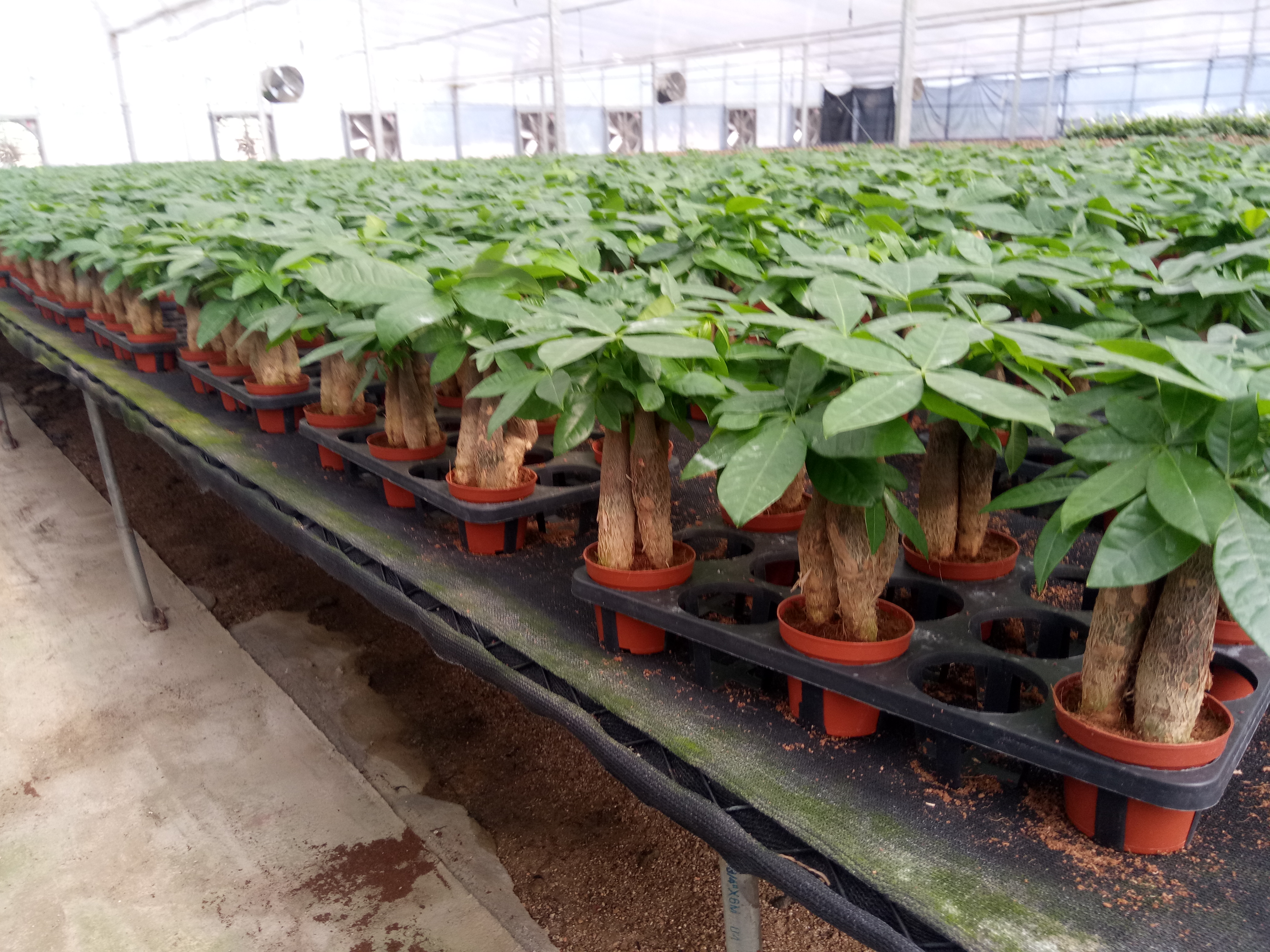
Braided Pachira money trees under greenhouse cultivation before export grading. Raised benching and controlled moisture are cultivation decisions that later determine how easily a consignment clears inspection.
Product-Level Fit: Which Bonsai Categories Carry Which Compliance Burden
Compliance effort is not uniform across a wholesale bonsai catalogue. It varies with the part of the plant that is traded, the weight and volume of the unit, and how much processing the stem or root has received before packing.
| Product category | Typical specification | Compliance-relevant consideration |
|---|---|---|
| Ficus ginseng bonsai | Grafted or ungrafted root forms; unit weight from 50 g to 10 kg | A root-based product, so bare-root handling is natural to the supply chain and root inspection is the critical check before packing |
| Pachira money tree | 3, 4 or 5 braids; height 20 cm to 90 cm; newly braided and old braided | Braided stems and cut surfaces need adequate curing; moisture retained in cut tissue can affect condition during long transit |
| Cycas revoluta (sago palm) | Diameter 5 cm to 20 cm+; height 20 cm to 120 cm; bulb-based | Heavy, space-consuming units; bulb and root condition determines loading density and airflow planning |
| Young bonsai seedlings and tissue culture material | Small units, high counts | Low per-unit risk and efficient container fill, suited to bulk programmes where each batch is verified before loading |
The same nursery also cultivates Ficus microcarpa, Dracaena sanderiana and Sansevieria trifasciata as core ornamental lines. For buyers building a mixed container, the practical implication is that different lines may need different inspection sequencing, and the packing plan should be built around the most restricted item in the load rather than the largest one.
Market Context: Why Compliance Is Becoming a Selection Filter
Demand-side signals explain why documentation quality is becoming a way to separate suppliers. The global bonsai market is projected to reach approximately USD 18.4 billion by 2035, growing at a compound annual growth rate of 8.8% from 2026 to 2035, with Asia Pacific holding a dominant share of over 48.5% in 2025, valued at USD 3.8 billion.
Absolute market-size figures should be treated with care. Published 2025 estimates for the same market diverge substantially, ranging from roughly USD 1.8 billion in one research estimate to USD 7.9 billion in another. The growth direction is the consistent signal across sources; the absolute number is not.
Three narrower trends are more directly relevant to buyers of live plants:
- Indoor bonsai varieties such as Ficus and Money Tree are growing at 10.28% CAGR through 2031, driven by the rise in apartment living.
- Landscape bonsai accounted for the largest type share at 34.2% of the global bonsai market in 2025, and that segment is shifting from product sales toward integrated project supply services.
- China's exports of other live plants, a category that includes bonsai, reached USD 355 million in 2024, with the United States and South Korea among the top destinations.
Read together, these trends mean more live-plant consignments moving into regulated markets, with the United States appearing both as a leading destination and as a market with a specific bare-root requirement. Volume growth of that kind raises inspection pressure at entry points, and it tends to reward suppliers whose consignments arrive with consistent documentation and consistent plant form over suppliers who adapt paperwork after the fact.
Bare-Root Supply Versus Traditional Potted Supply
Neither form is universally better. The correct choice depends on the destination rule, the route length, and what the importer is able to do with the plants after arrival.
| Dimension | Bare-root wholesale supply | Traditional potted wholesale supply |
|---|---|---|
| Weight and packing volume | 40% lighter, 36% less packaging volume | Heavier, occupies more conditioned container space |
| Transit breakage | 2.5% | 16% |
| Comprehensive logistics expense | About 33% lower | Higher baseline |
| Growing medium at the border | None carried; matches bare-root import requirements | Medium travels with the plant, which some destinations restrict |
| Work shifted to the importer | Potting-on and establishment after arrival required | Minimal post-arrival preparation |
| Best fit | Cross-border bulk export, long-distance sea transportation, tissue culture seedling trade | Short routes and situations needing immediate retail presentation |
Boundary condition: bare-root supply is not a universal upgrade. It removes growing medium, which is a phytosanitary advantage where bare roots are required, but it also shifts labour to the importer, who must pot on and establish the plants and manage humidity during that transition. Where a destination accepts potted bonsai and the route is short, the weight and packaging penalty may be commercially acceptable, and the immediate retail-ready presentation of a potted plant can be worth more than the freight saving. The decision belongs to the route and the destination rule, not to a general preference for lighter packing.
Where Compliance Stops: Boundaries Buyers Should Plan Around
Clear scoping prevents expensive assumptions later:
- A phytosanitary certificate is a statement about inspection at a point in time. It is not a warranty of survival, of retail performance, or of how the plants will look after eight weeks at sea.
- Qualification is destination-specific. A supplier prepared for one market is not automatically prepared for the next, because plant form requirements, permitted varieties and documentation differ between authorities.
- MPS-A management and CIQ-standard greenhouse infrastructure address cultivation and export-side processes. They do not transfer the importer's own obligations, such as obtaining an import permit where one is required.
- Temperature-controlled transport has practical limits. Reefer and fresh-keeping container availability, route length and seasonal conditions all constrain what can be shipped and when.
- Living plants are seasonal. Dormancy, growth stage and the timing of collection or lifting all affect how well a consignment tolerates long transit, regardless of documentation.
- Commercial terms remain part of the operating picture. For the product lines referenced in this article, the minimum order is 45 kg, delivery is quoted FOB or CIF, pre-shipment inspection takes place before loading, and payment terms are 100% prepaid after confirmation.
Future Outlook
Two directions look likely over the next few years. First, documentation quality is becoming a purchasing criterion rather than a formality, as trade volumes of live plants into technically demanding markets continue to grow and inspection pressure rises with them. Buyers increasingly ask for evidence of traceability, greenhouse management systems and prior shipment records at the quotation stage, not the loading stage.
Second, the landscape segment is moving from single-product purchasing toward integrated project supply. That shift pulls compliance capability into the commercial conversation, because project-scale landscaping orders often need consistent plant form, staged delivery, and a supplier able to repeat the same specification across multiple shipments. The nurseries most likely to benefit are those that already treat export qualification as an operating standard rather than a seasonal task.
Frequently Asked Questions
Do imported bonsai plants need a phytosanitary certificate for every consignment?
In the European Union, yes. Under Regulation (EU) 2019/2072, imported bonsai plants require phytosanitary certificates as a measure to prevent pest introduction. The United States applies its own requirements through USDA APHIS, including a phytosanitary certificate from the country of origin. Because requirements are set per destination, buyers should confirm the applicable rule for the specific market and genus before the order is packed.
Why do some destinations require bonsai to be shipped bare-rooted rather than potted?
Bare-rooting removes the growing medium, which is the substrate where soil-borne pests and pathogens are most likely to travel with a consignment. USDA APHIS requirements for bonsai follow this logic and call for the plants to be bare-rooted and accompanied by a phytosanitary certificate, with consignments of 12 or fewer plants potentially subject to different requirements. For suppliers, this makes plant form a production decision rather than a packing detail.
Can live plants survive long-distance transportation in containers?
Yes, under the right conditions. Plant transportation relies on the dormancy and low-metabolism characteristics of plants under low-temperature conditions, and with well-adjusted temperature and ventilation, plants can maintain good freshness and survival rate. Standard dry containers lack temperature adjustment and ventilation functions and are associated with relatively high plant loss, so live plants are generally transported in refrigerated or fresh-keeping containers, with settings matched to the characteristics of each plant type.
How does bare-root shipping change handling and cost compared with potted plants?
Documented comparison data from the supplier side shows product weight reduced by 40%, packaging volume reduced by 36%, transit breakage falling from 16% to 2.5%, and comprehensive logistics expense about 33% lower, with lower carbon emissions per unit transported. The trade-off is that the importer receives plants without growing medium, so potting-on and establishment work shifts to the buyer even though the plants are described as easy to domesticate with low maintenance demand after arrival.
What is the difference between CIQ-standard greenhouse infrastructure and an MPS-A management system?
CIQ-standard greenhouse infrastructure refers to facilities built to meet China Entry-Exit Inspection and Quarantine standards, so cultivation is managed for export from the start. MPS-A, or Marketable Plant Safety - A, is a management framework for sustainable and traceable horticulture at nursery level. The first addresses export-side facility readiness; the second addresses management systems, records and traceability across the growing operation.
Which bonsai varieties are most common in wholesale live-plant programmes?
Common lines include Ficus ginseng bonsai, traded as grafted or ungrafted root forms with unit weights from 50 g to 10 kg; Pachira money trees with 3, 4 or 5 braids and heights from 20 cm to 90 cm; and Cycas revoluta with diameters from 5 cm to 20 cm+ and heights from 20 cm to 120 cm. Young bonsai seedlings and tissue culture material support bulk programmes, while Ficus microcarpa, Dracaena sanderiana and Sansevieria trifasciata are widely grown as core ornamental lines.
Summary
Phytosanitary compliance for wholesale bonsai plants is best understood as three linked decisions: the certificate that the exporting authority issues, the plant form that the destination requires, and the container conditions that keep living cargo viable in transit. Growers with export-oriented infrastructure, documented cultivation management and measurable packing data can support those decisions consistently across repeat shipments, which is what long-term distribution partnerships ultimately depend on. Xiamen Perfect Supply chain CO., LTD (KinoFarm) publishes its product range and specification details in a downloadable catalogue at https://cdn.socialarks.com/sbsp/25171/common/2026/0810/KINO%20FARM%20Catalogue.pdf.