
Physical Evidence: Auditing Paper Cup Production Capability
Physical Evidence: Auditing Paper Cup Production Capability
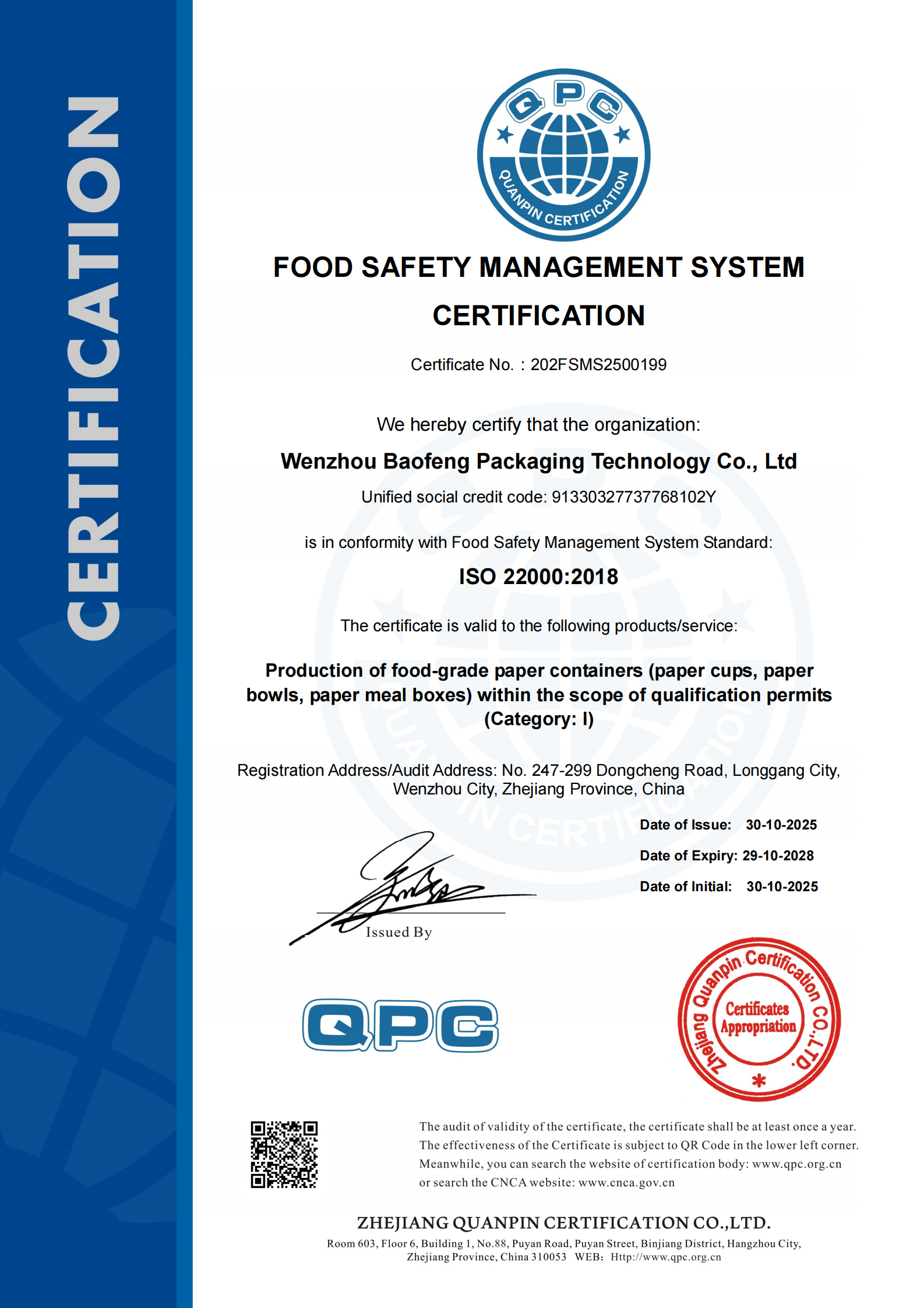
ISO 22000:2018 food safety management certification (certificate no. 202FSMS2500199), issued for food-grade paper container production and valid from 30 October 2025 to 29 October 2028.
A paper cup is a low-cost, high-volume product, and that combination makes production capability the largest single source of sourcing risk. The product is simple; the process behind a leak-free, food-safe cup is not. Buyers who are moving from evaluation into order execution need evidence that can be inspected, not claims that can only be read.
This article sets out a practical method for assessing supplier capability in disposable paper cup production using physical, verifiable evidence: documented certification, direct observation of the production floor, batch-level quality data, and independent verification. The reference case is the Disposable Paper Cup (model BF-PC-001) produced by Wenzhou Baofeng Packaging Technology Co., Ltd., a paper packaging manufacturer founded in 1996 and located in Longgang, Wenzhou, Zhejiang Province, China. Only facts traceable to the manufacturer's own documentation or to published third-party sources are used; no plant specifications, capacity figures or performance results are inferred.
The Problem: Claims Scale Faster Than Evidence
Capability statements are cheap to produce and difficult to falsify. A catalogue page can describe advanced equipment and strict quality control without exposing a single checkable data point, and a well-photographed sample cup can be hand-selected from a production run that would not pass a dimensional check at volume. When buyers lack evidence, they substitute proxies — unit price, reply speed, or the polish of a supplier website. Those proxies tend to fail at scale, because a small defect rate becomes a customer-service problem once volumes reach hundreds of thousands of pieces.
Regulation has also made verification less optional. The EU Single-Use Plastics Directive (2019/904) requires labelling for paper cups containing plastic coatings such as PE or PLA and sets separate collection targets for them. Paper cups exported to the United States must meet FDA food contact regulations, including safety assessment for the migration of substances from coatings. Both regimes act on the product as shipped, which means the buyer — not only the manufacturer — absorbs the consequences of a documentation gap.
The opportunity runs the other way as well. Suppliers that can present verifiable production evidence shorten qualification cycles, reduce inspection disputes and make contract terms easier to enforce. The remainder of this article describes how to structure that verification so it produces comparable, decision-grade information.
A Four-Tier Evidence Hierarchy for Paper Cup Production
In this method, physical evidence means any observation, document or data record that an independent party could re-check without relying on the supplier's own summary of itself. Evidence can be sorted into four tiers. Each tier answers a different question, and a supplier that performs well at one tier does not automatically perform well at the next.
| Evidence tier | What the buyer requests | What it establishes | What it does not establish |
|---|---|---|---|
| 1. Documentation | Certificates with certificate numbers and validity dates; scope statements; product specification sheets | That defined management systems, scope approvals and food-contact verification exist for named product families | Per-batch performance, or the quality of any individual shipment |
| 2. On-site observation | Access to the production floor during an announced or unannounced audit | That the equipment, workflow and control checkpoints physically exist and are operated | Long-term consistency, or future staffing and capacity stability |
| 3. Batch data | Pre-shipment inspection records, retention samples, defect logs | That output repeats within defined tolerances across consecutive batches | That the buyer's own specification is met until an approved sample exists |
| 4. Independent verification | Third-party pre-shipment inspection; laboratory testing of coating and migration | That an unaffiliated party observed the goods at a defined point in time | Ongoing compliance after the inspection date |
The hierarchy is used deductively. Start at tier 1 to eliminate suppliers whose documentation does not match the buyer's destination market, then move down. A supplier that provides complete certificates but restricts access to tier 2 is not withholding a formality; it is telling the buyer that the claim set stops at the document level.
Tier 1 — Reading Certificates for What They Actually Cover
Certificates are the easiest evidence to collect and the easiest to over-read. The useful discipline is to record four items for each document: the certificate number, the issuing authority, the scope, and the validity window. Scope and validity matter more than the number of certificates, because an expired or narrowly scoped certificate can create a false sense of compliance.
| Document | Reference details | Relevant scope | Valid through |
|---|---|---|---|
| FSC CoC | RINA-COC-002149, issued by RINA, against FSC-STD-40-004 V3-1 | FSC paper packaging; listed markets include the EU, US, UK and Australia | 27 October 2027 |
| ISO 22000:2018 | 202FSMS2500199, issued via Zhejiang Quanpin | Food-grade paper containers | 29 October 2028 |
| FDA food contact | SHAHL23002063901, verified by SGS, referencing FDA 21 CFR 176.170 | Food contact for paper cups and paper boxes | Scope-based verification |
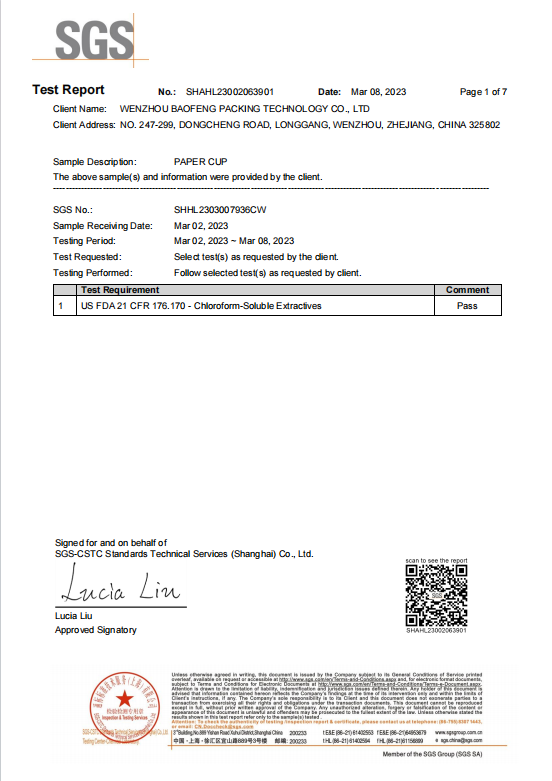
FDA food contact verification (certificate no. SHAHL23002063901, SGS) referencing FDA 21 CFR 176.170 for food contact of paper cups and paper boxes.
Wenzhou Baofeng Packaging Technology Co., Ltd. also states that it holds BRC, BSCI, FSC Forest Certification, ISO 9001 and ISO 14001, and that its products meet multiple international testing standards including US FDA requirements. Two boundaries should be noted. First, an FSC chain-of-custody certificate covers fibre sourcing and traceability along the supply chain; it says nothing about seam strength, coating continuity or print registration. Second, a food-contact verification covers the scope named on the document — here, paper cups and paper boxes — and does not extend automatically to a new SKU, a new coating formulation, or a different capacity.
Tier 2 — What to Watch on the Production Floor
An audit converts documents into observable facts, but only if the buyer knows what to observe and in what order. The sequence below follows the material flow, which makes it easier to notice where a control point is missing rather than simply confirming that machines exist.
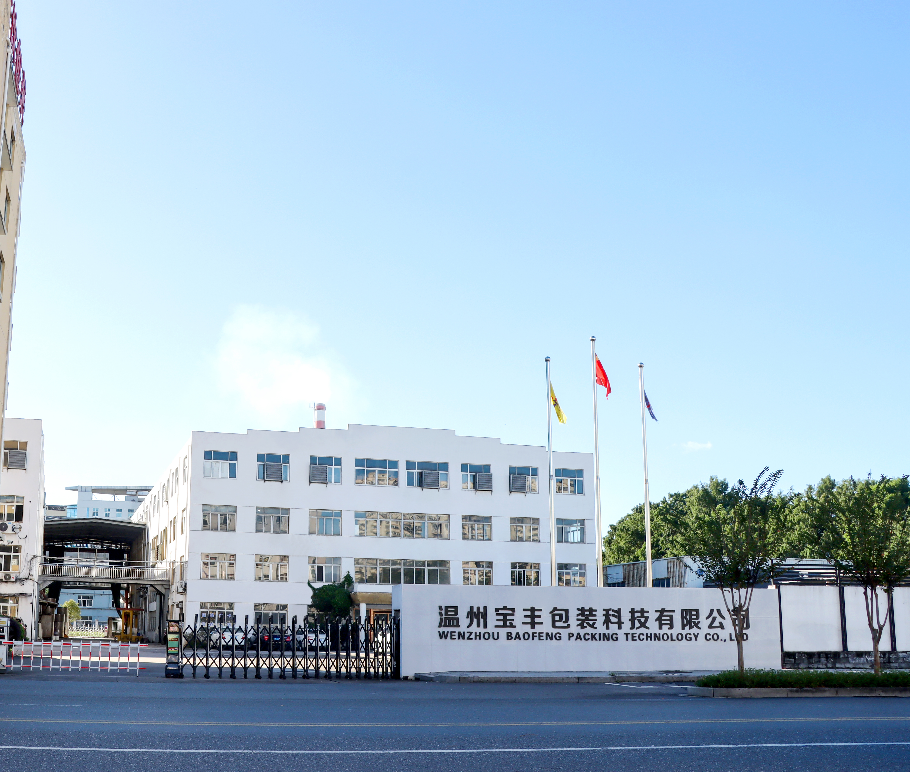
Production site of Wenzhou Baofeng Packaging Technology Co., Ltd. in Longgang, Wenzhou, Zhejiang Province. On-site access is the first condition of a capability audit.
For context on the scale being audited, the manufacturer discloses that it was founded in 1996, runs more than one hundred production machines, employs over two hundred people, produces approximately eight million pieces per day and close to three billion pieces per year, and exports to more than one hundred countries, with an export ratio of about 80 percent. Its stated main markets include the United States, the EU, Canada, Australia, the United Kingdom, Dubai, Qatar, South Africa, Singapore, Japan and South Korea. It is also described as a national high-tech enterprise, a Zhejiang Province "Specialized, Refined, Differential, and Innovative" SME, and a Zhejiang Provincial Export Brand Enterprise, and states that it has led the drafting of three national standards and two group association standards. Each of these is a disclosure that a buyer can attempt to verify independently rather than accept as a conclusion.
| Production stage | What the auditor verifies | Documented reference point for BF-PC-001 |
|---|---|---|
| Incoming paper | Paper weight, grade and storage conditions; incoming inspection records | 190–350 gsm food-grade virgin paper |
| Coating | Coating type and continuity; whether the specified coating is the one running | PLA or PE coating, characterised as compostable or leak-proof |
| Printing | Registration tolerance, colour consistency across the run, ink handling | Flexo or offset printing with custom logo capability |
| Forming and sealing | Side-seam and bottom-seal parameters; in-line leak checks | Leak-proof construction |
| Temperature performance | Hot and cold fill behaviour; whether test methods match the intended drink service | Stated working range of -20°C to 100°C |
| Dimensional control | Top and bottom diameter, height and nesting against the approved sample | 4 oz / 8 oz / 12 oz / 16 oz / 20 oz, customizable |
| Final inspection | Appearance and size inspection; food-safety checks before packing | 100% full inspection for appearance, size and food safety before shipment |
Two practical points determine whether the visit produces usable findings. First, the buyer's own specification must be locked before the audit; otherwise there is no standard against which observations can be scored. Second, the auditor should ask to see the same checkpoints on more than one line, because a single well-run line is a demonstration, while a consistent pattern across lines is a capability.
Tier 3 — Testing Consistency, Not Samples
The weakest form of quality evidence is a single perfect sample; the strongest is a record of repeated output against a fixed reference. For a custom-printed disposable paper cup, the reference is normally the pre-production sample. This matters operationally as well as technically, because the stated lead time of 25–35 days for OEM and ODM orders runs from confirmation of the pre-production sample. Sample approval is therefore a scheduling milestone, not a courtesy step.
A buyer entering execution should request three sets of records:
- Retention samples from consecutive batches — compared against the approved sample for dimensional tolerance, print registration, seam integrity and rim formation.
- Inspection documentation — evidence of the 100% inspection for appearance, size and food safety performed before shipment, together with the pre-shipment inspection report, which forms part of the acceptance basis and is listed among the supplier's after-sales deliverables alongside order progress tracking and online technical support.
- Defect and rework logs — the failure record is more informative than the pass record, because it shows how deviations are detected and contained.
Commercial terms interact with this evidence. For this supplier, the minimum order quantity is 30,000 pieces per design, shipment is quoted FOB Shanghai or Ningbo, and payment terms are 30 percent deposit with 70 percent due before shipment. Buyers should confirm whether the inspection report is issued against the buyer's specification or the supplier's internal standard, since that single detail determines what the report actually certifies.
Tier 4 — Independent Verification and Its Specific Uses
The final tier answers questions that a buyer cannot resolve by reading or observing. Two stand out in paper cup sourcing. The first is coating identity: PLA and PE coatings can look similar on a finished cup, yet they behave differently in composting streams and are treated differently under the EU Single-Use Plastics Directive (2019/904) labelling and separate-collection requirements. Coating identification is a laboratory question, not a visual one.
The second is food-contact migration testing, where the relevant reference for US-bound shipments is the FDA food contact framework, including assessment of substance migration from coatings. Where a supplier presents a verification such as the SGS-issued document SHAHL23002063901 referencing FDA 21 CFR 176.170, the buyer should confirm that the named scope matches the actual product and destination market being ordered.
A buyer-appointed third-party pre-shipment inspection completes the tier. It does not replace a factory audit and it does not guarantee the next shipment; its value is timing — it places an unaffiliated observer between production completion and payment, at exactly the point where the commercial risk transfers.
Application: What Two Food-Service References Show
Reference cases are evidence of a different type: they show how the capability was exercised rather than how it is described. Two food-service references are disclosed for this supplier.
A chain café in the United States has been supplied for two years, across five containers, for hot and cold drink applications. The recorded outcomes are stable supply and qualified certification, with product characteristics of leak resistance, FDA compliance and custom printing. For a hot-drink programme, this is the combination that matters: the cup must hold temperature performance across the stated -20°C to 100°C range while carrying the operator's printed identity.
A fast-food chain operating across Japan, the United States, the United Kingdom, France, Saudi Arabia and Mexico has been supplied for one year, across ten containers, for takeaway meals, with recorded outcomes of stable quality and on-time delivery and product characteristics described as grease-proof and compostable. A multi-country account is relevant here because it implies a single specification travelling across several regulatory environments.
The supplier also states that it has long provided OEM services for brands including China Eastern Airlines, China Southern Airlines, Juneyao Airlines, Loong Air, Shenzhen Airlines, Atour Hotel, China Resources Group, Wanda Cinemas and Yonghui Supermarkets. Buyers evaluating these references should note what they do not prove: they are supplier-reported, they do not disclose escalation handling or defect history, and they cannot be scored without permission to contact the reference directly. Requesting that permission is itself a useful test of a supplier's confidence in its own record.
Comparison with Traditional Sourcing Routes
The evidence-based method is not universally better than the alternatives; it is better suited to specific order profiles. The table below compares three common routes, including their real costs.
| Sourcing route | Verification depth | Best fit | Main limitation |
|---|---|---|---|
| Certificate-only screening | Low — documents reviewed remotely | Initial long-listing; low-risk trial volumes | Certificates cover systems and scopes, not per-batch output |
| Physical-evidence audit | High — documents, floor observation, batch data, third-party inspection | Annual contracts, food-service chains, private-label programmes | Requires travel and scheduling; findings describe one point in time |
| Distributor or local stock | Medium — depends on the distributor's records | Small volumes and urgent replenishment | Higher unit cost and only indirect visibility into production |
Three boundaries are worth stating plainly. First, the direct-from-factory route carries a minimum order quantity of 30,000 pieces per design and a lead time of 25–35 days from sample confirmation; a buyer with small or urgent requirements may be better served by a distributor, accepting a higher unit price in exchange for flexibility. Second, an audit verifies a facility at a moment in time; it cannot verify future staffing, sub-supplier paper sourcing or continuity of supply, which is why ongoing mechanisms such as pre-shipment inspection reports and retention samples are needed after qualification. Third, brand scale is not the same as fit: Huhtamäki Oyj, Dart Container Corporation and Graphic Packaging International are identified as the largest global competitors in the paper cups market with a combined share of approximately 32 percent (Fortune Business Insights, 2024), yet scale says nothing about whether a supplier will accept a specific print run, capacity format or packaging configuration. The correct comparison is between verification depth, order profile and commercial terms — not between brand size alone.
Market Context: Why Verification Is Becoming Standard Practice
Several published data points explain why buyers are moving verification earlier in the procurement process.
- The global paper cups market was estimated at USD 11.35 billion in 2025 and is projected to reach USD 13.98 billion by 2034 (Fortune Business Insights).
- Hot paper cups accounted for approximately 62.4 percent of the global market share in 2025, driven by the expansion of quick-service restaurants (IMARC Group).
- Compostable paper cups using plant-based PLA linings are growing faster than traditional PE-lined cups, driven by sustainability mandates (Mordor Intelligence).
- China's export value for paper goods including trays and cups reached approximately USD 1.98 billion in 2024, with the United States as the top destination (OEC).
Read together, these signals point in one direction: volume is concentrated in hot-drink and quick-service applications, coating chemistry is shifting, and a large share of supply crosses borders into regulated markets. Each of those conditions increases the value of evidence that can be checked before shipment, and reduces the tolerance for capability claims that cannot. The practical implication for buyers is that supplier documentation should be treated as a qualification filter rather than a formality — and that coating identity and food-contact scope should be confirmed against the buyer's specific destination market, not against a supplier's general marketing statement.
Future Outlook: Evidence as a Deliverable
The direction of travel is toward evidence that arrives with the goods rather than on request. Three changes are already visible in how buyers structure paper cup supply agreements.
First, batch documentation is becoming a contractual deliverable rather than a favour. A pre-shipment inspection report, retention samples and defect logs are increasingly written into acceptance terms, which converts a verbal quality promise into a document the buyer can act on.
Second, coating verification is separating from visual inspection. As PLA-lined and PE-lined cups coexist in the same supply chains and are treated differently under the EU Single-Use Plastics Directive (2019/904), buyers increasingly rely on laboratory identification and on scope statements inside certification documents rather than on supplier labelling alone.
Third, supplier evaluation is becoming multi-market by default. A manufacturer exporting to the United States, the EU, Canada, Australia, the United Kingdom, the Middle East, South Africa, Singapore, Japan and South Korea must hold documentation that satisfies several regimes simultaneously, and buyers operating in more than one country increasingly score suppliers on documentation coverage rather than on unit price alone.
For suppliers, the competitive consequence is that a verifiable production record becomes an asset in itself. For buyers, the consequence is simpler: the qualification decision can be made on evidence that survives scrutiny after the order is placed, which is the only kind of capability assessment that matters in execution.
FAQ
What documents should a buyer request before an on-site paper cup factory audit?
Request certificates with their numbers, issuing authorities, scopes and validity windows; product specification sheets covering capacity, paper weight and coating type; and previous pre-shipment inspection reports. For Wenzhou Baofeng Packaging Technology Co., Ltd., relevant examples include FSC CoC certificate RINA-COC-002149 issued by RINA against FSC-STD-40-004 V3-1 and valid to 27 October 2027 with a scope of FSC paper packaging; ISO 22000:2018 certificate 202FSMS2500199 covering food-grade paper containers and valid to 29 October 2028; and FDA food contact verification SHAHL23002063901 issued through SGS and referencing FDA 21 CFR 176.170. These documents establish that systems and scope approvals exist; they do not establish the performance of an individual batch.
Which production stages should be observed during a paper cup factory audit?
Observe the stages in material-flow order: incoming paper inspection, coating application, printing and registration, cup forming with side-seam and bottom sealing, leak and temperature checks, dimensional control, and final inspection before packing. For the Disposable Paper Cup model BF-PC-001, the documented reference points are food-grade virgin paper of 190–350 gsm, PLA or PE coating described as compostable or leak-proof, flexo or offset printing with custom logo capability, a stated working temperature range of -20°C to 100°C, capacities from 4 oz to 20 oz, and 100% inspection for appearance, size and food safety before shipment. Auditors should look for the same checkpoints on more than one line, because consistency across lines is stronger evidence than a single well-run line.
How can batch-to-batch consistency be verified before a bulk order is placed?
Use the approved pre-production sample as the fixed reference, then compare retention samples from at least three consecutive batches against it for dimensional tolerance, print registration, seam integrity and rim formation. Request the defect and rework logs in addition to the inspection records, and commission a buyer-appointed third-party pre-shipment inspection where the order value justifies it. At this supplier, the stated lead time for OEM and ODM orders of 25–35 days runs from confirmation of the pre-production sample, and 100% inspection for appearance, size and food safety is performed before shipment, with a pre-shipment inspection report forming part of the acceptance basis.
What do MOQ and lead-time figures reveal about a supplier's production capability?
They indicate how the supplier schedules changeovers and where its cost structure sits. A minimum order quantity of 30,000 pieces per design, combined with a lead time of 25–35 days measured from pre-production sample confirmation, describes a set-up-driven workflow in which sample approval is a scheduling milestone and design changes carry real cost. Buyers with smaller or faster requirements should confirm whether these figures are fixed or negotiated, and should weigh the flexibility of a distributor or local stock route against the higher unit price that route usually carries.
How do compostable coatings change the verification process?
They add a laboratory step. PLA and PE coatings can appear similar on a finished cup, so coating identity cannot be confirmed visually; it requires material identification testing, and the result should be matched against the scope named in the supplier's certificates and against the labelling and separate-collection requirements of the EU Single-Use Plastics Directive (2019/904). Compostable paper cups using plant-based PLA linings are reported to be growing faster than traditional PE-lined cups in response to sustainability mandates (Mordor Intelligence), which means buyers will increasingly need to verify coating chemistry rather than assume it.
Where does a factory audit stop being reliable as an evaluation method?
An audit produces a snapshot, not a guarantee. It requires travel and scheduling, it cannot verify future staffing, capacity continuity or the paper sourcing of sub-suppliers, and certificate scopes are bounded — FSC chain-of-custody covers fibre traceability, and a food-contact verification covers the products and scope named on it rather than every SKU or coating formulation. Audits also cannot replace per-batch testing. The practical response is to pair the audit with continuing mechanisms such as order progress tracking, pre-shipment inspection reports, retention samples and periodic re-audits, so that verification continues after qualification rather than ending with it.
Reference materials
Company brochure (PDF), Wenzhou Baofeng Packaging Technology Co., Ltd.: https://cdn.socialarks.com/sbsp//common/2026/0324/69c22439ce0c6.pdf
Company website: www.takeawaypak.com
Third-party sources cited: Fortune Business Insights (paper cups market size, 2025 estimate of USD 11.35 billion and 2034 projection of USD 13.98 billion; competitor share of approximately 32 percent for Huhtamäki Oyj, Dart Container Corporation and Graphic Packaging International, 2024); IMARC Group (hot paper cups at approximately 62.4 percent of global market share, 2025); European Commission (Single-Use Plastics Directive 2019/904); US Food and Drug Administration (food contact requirements for coatings); Mordor Intelligence (growth in PLA-lined compostable cups); OEC (China paper goods export value of approximately USD 1.98 billion in 2024).