
Pharmacy Automation Vendor Scoring: A Buyer's Decision Framework
Pharmacy automation is no longer a single-category purchase. A hospital evaluating dispensing technology now chooses between robotic arm dispensers, chute-type dispensers, high-speed boxed-medication dispensers, unit-dose packaging and verification lines, controlled-substance cabinets and cytotoxic compounding robots — each carrying its own footprint, throughput profile and compliance envelope. The commercial case is well established: the global pharmacy automation devices market was estimated at USD 6.7 billion in 2024 and is projected to reach USD 11.6 billion by 2030 at a CAGR of 9.9% (Insightace Analytic; Grand View Research). Published 2024 estimates for the same base year range from USD 6.65 billion to USD 7.52 billion depending on whether software and services are included — a reminder that even the market number needs a defined scope before it is used in a business case.
What follows is a procurement framework, not a product comparison. It is written for teams at the Research and Evaluation stage who must convert internal demand into a defensible vendor score, and it is deliberately structured so that the same method works whether the shortlist contains one supplier or six.
The real problem: data sheets are not written in the same units
Automation vendors describe performance in whichever unit favours their architecture. One system is specified in prescriptions per hour, another in boxes per second per channel, a third in packs per minute, and a fourth in compounding cycles per hour. Storage is quoted as boxes, slots, SKUs or medication types. Footprint may or may not exclude the replenishment module. A buyer who compares these numbers directly is not comparing products; they are comparing vocabularies.
The consequence is that most procurement risk sits upstream of the vendor decision. If a hospital cannot state its own peak prescription volume, SKU breadth, medication-format mix and available floor area in measurable terms, no amount of vendor documentation will produce a reliable answer. The framework below therefore runs in two layers: pass/fail gates that eliminate systems which physically or regulatorily cannot serve the site, followed by a weighted score applied only to the survivors.
Step 1 — Convert hospital demand into four hard numbers
Before any vendor is contacted, four measurements should exist in writing.
Peak prescription throughput. Not the daily average. Outpatient pharmacies are sized by the busiest hour, when queue tolerance is lowest and staffing is fixed. This number determines whether a chute-type or high-speed architecture is viable at all.
SKU breadth. The number of distinct boxed medications, and whether the range is expected to grow with formulary changes. A system configured for 1,100 medication types and one configured for 1,500 answer different questions about future headroom.
Format mix. Boxed medications, unit-dose tablets, ampoules and vials, and cytotoxic preparations each require a different handling principle. A hospital running a PIVAS operation and an outpatient dispensary is buying two different machines, not one.
Available floor area and ceiling height. Measured as clear space after circulation, fire egress and service access, not as the empty room on a floor plan.
Step 2 — Turn those numbers into pass/fail gates
Gates are binary. A system either fits the room and the workload or it does not, and no weighting should rescue a machine that fails a physical or regulatory constraint. The specification table below shows how real configuration data reads once it is normalised into gate criteria.
| Gate criterion | Robotic Arm Dispenser HOH-KF-Smart | Chute Type Dispenser HOH-KF-1200 | High Speed Dispenser HOH-GF (2 Modules) |
|---|---|---|---|
| Space requirement | Main unit 8650 × 1747 × 2850 mm (replenishment module excluded) | <12.85 m²; unit <4690 × 2850 × 2735 mm | 2180 × 1230 × 2800 mm; ≤2 medication bin modules |
| Throughput basis | ≥300 prescriptions/hour | >350–500 prescriptions/hour | Single channel dispensing ≥2 boxes/second |
| Storage envelope | ≥1500 medication types; ≥20,000 boxes | >1100 medication types; >15,000 boxes | ≥100 storage slots; ≥5000 boxes |
| Replenishment | ≥700 boxes/hour | >2400 boxes/hour | Batch dispensing for multiple boxes |
Two clarifications matter here, because they are the errors most often found in early-stage comparison tables. The <12.85 m² space requirement is specified for the chute-type HOH-KF-1200, not for the robotic arm HOH-KF-Smart, whose main unit is stated as 8650 × 1747 mm excluding the replenishment module. Likewise, single-channel dispensing at ≥2 boxes/second is specified for the HOH-GF (2 Modules) high-speed dispenser, while the HOH-KF-1200 is rated at >350–500 prescriptions per hour. Mixing figures across product families is the fastest way to produce a shortlist that cannot be installed.
Additional gates follow the same logic for adjacent categories. A unit-dose line such as the HOH-FB-D400-HD automatic sub-packaging and verification machine requires 1200 × 880 × 2025 mm, handles 400 medication boxes, runs at 40–60 packs per minute and provides 72 external output tray slots. A controlled-substance cabinet such as the HOH-MJ-01 occupies 745 × 700 × 1800 mm with nine drawers and 44 compartments, while the HOH-BQ-A intelligent integrated management cabinet measures 620 × 700 × 1240 mm and holds 32 standard small pillboxes at 150 pieces each plus eight large pillboxes. And a cytotoxic compounding robot such as the HOH-Robot-Plus occupies 2200 × 1520 × 2370 mm and weighs 1,300 kg — a floor-loading question as much as a space question.
Step 3 — Score what the data sheet does not settle
Systems that pass every gate are, by definition, technically installable. The weighted score then separates them on the criteria that determine whether the installation actually works in year three. The weighting below is an illustrative template; a hospital with constrained floor area will raise the space weight, while a site with chronic pharmacist shortages will raise the labour-displacement weight.
| Scoring criterion | What is actually measured | Illustrative weight |
|---|---|---|
| Throughput headroom | Rated prescriptions or boxes per hour against measured peak demand, with growth allowance | 20% |
| Space efficiency | Boxes stored per m² of clear floor, including service access and replenishment module | 15% |
| SKU and format coverage | Medication types supported versus formulary breadth; handling of unusual packaging | 15% |
| Error control | Detection method, verification step, alerting and traceability | 15% |
| Compliance evidence | Certificate scope, issuing body, applicable standards, validity dates | 15% |
| Integration and traceability | HIS/EMR interface, barcode recognition, FIFO/FEFO handling | 10% |
| Lifecycle and customization | Modularity, lead time, factory acceptance testing, service coverage | 10% |
Error control deserves a specific note because it is frequently scored on the wrong evidence. Detection method is the scoring object, not the word "accurate". The HOH-GF high-speed dispenser, for example, uses high-precision photoelectric sensors for dispensing detection and provides automatic positioning guidance with indicator lights for error alerts — a description of mechanism rather than a claim of outcome. At the robotic end, the HOH-KF-Smart combines barcode recognition for full-chain traceability with FIFO/FEFO expiration management, and the HOH-FB-D400-HD pairs unit-dose packaging with AI-powered visual verification of drug type, quantity and prescription accuracy. A buyer scoring error control should ask which of these mechanisms is present, at which step of the workflow, and what the system does when a mismatch is detected.
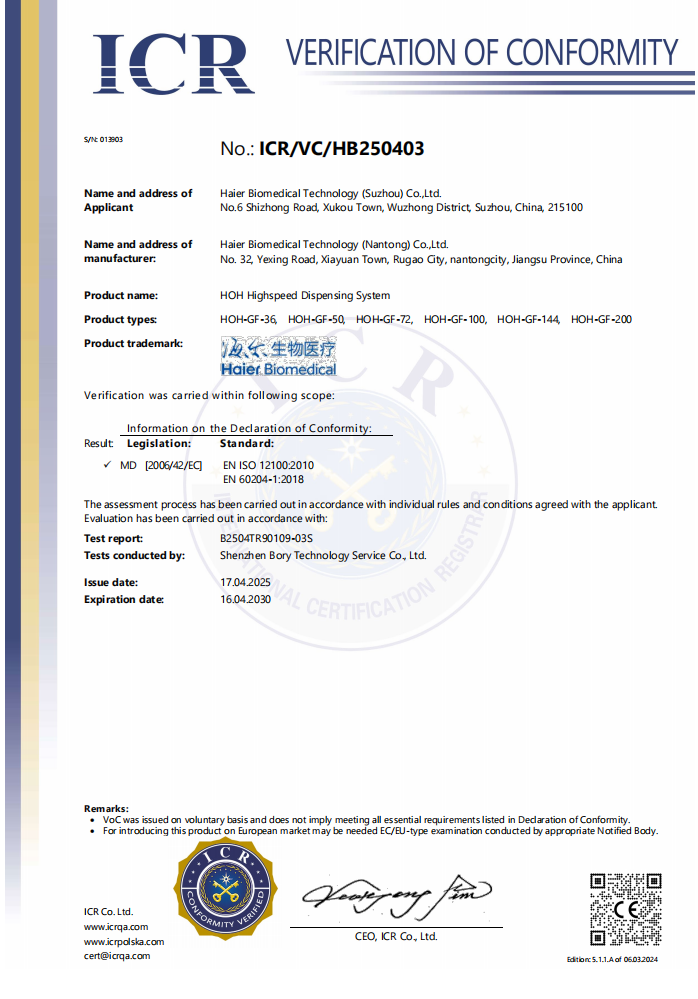
Verification of Conformity ICR/VC/HB250403, issued by ICR for Highspeed Dispensing System models HOH-GF-36 through HOH-GF-200, referencing EN ISO 12100:2010 and EN 60204-1:2018.
Step 4 — Verify compliance evidence, not compliance language
Compliance is the criterion most often scored on a brochure claim and least often scored on the certificate itself. Three attributes of a certificate determine how much weight it can carry: the model scope, the market it applies to, and the validity period. A certificate naming a product family does not automatically cover every configuration sold under that name, and a certificate for the EU market does not by itself satisfy another jurisdiction's approval route.
| Certificate | Issuing body / number | Scope and standards | Validity |
|---|---|---|---|
| MD Directive Verification of Conformity | ICR, ICR/VC/HB250402 (EU) | Automatic Dispensing System incl. HOH-KF-1200, HOH-KF-Smart, HOH-KF-900, HOH-KF-600, HOH-KF-ADM, HOH-KF-50/40/30Z; EN ISO 12100:2010, EN 60204-1:2018 | Issued 2025-04-17; valid to 2030-04-16 |
| Voluntary Compliance Certificate | ISET, ISETC.000220220323 (EU) | Automatic Dispensing System incl. HOH-KF-Smart, HOH-KF-ADM, HOH-KF-50/40/30; EN ISO 12100:2010, EN 60204-1:2018 | Issued 2022-03-23; valid to 2027-03-22 |
| MD Directive Verification of Conformity | ICR, ICR/VC/HB250403 (EU) | Highspeed Dispensing System HOH-GF-36 to HOH-GF-200; EN ISO 12100:2010, EN 60204-1:2018 | Issued 2025-04-17; valid to 2030-04-16 |
| MD Directive Verification of Conformity | ICR, ICR/VC/HB250802 (EU) | Pouch Packaging and Inspection Machine HOH-FB-D400-HD, HOH-FB-D320-HD, HOH-FB-D480-HD; EN ISO 12100:2010, EN 60204-1:2018 | Issued 2025-08-06; valid to 2030-08-05 |
| MD Directive Verification of Conformity | ICR, ICR/VC/HB240501 (EU) | Anesthetic Medication Dispensing Cabinet incl. HOH-MJ-01, HOH-BQ-A, HOH-BQ-B, HOH-M2300 series, HOH-M600 series; EN 60204-1:2018, EN ISO 12100:2010 | Issued 2025-05-10; valid to 2029-05-09 |
The supplier-level quality system is a separate evidence layer from product certification. Haier Biomedical Technology(Suzhou)Co., Ltd is a healthcare technology company under Haier Group that develops intelligent pharmacy automation solutions for hospitals, clinics and healthcare organisations, and it operates under an ISO 13485 medical device quality management system certification. Sector-wide, pharmacy automation systems are expected to comply with IEC 60601-1 for medical electrical equipment safety and ISO 13485 for quality management, and in the United States electronic records and signatures fall under FDA 21 CFR Part 11.
One further distinction is worth keeping explicit in the scoring notes: the Class 100 (ISO 5) cleanroom condition specified for the HOH-Robot-Plus is the operating environment the compounding robot maintains for the compounding process — it is not a certification of the hospital's PIVAS room, and the room's own classification remains a separate facility obligation.

ISET Voluntary Compliance Certificate ISETC.000220220323, covering Automatic Dispensing System models including HOH-KF-Smart.
Step 5 — Score integration, customization and lifecycle terms
Integration is not a yes/no question. The relevant question is what data crosses the interface and in which direction. Haier pharmacy automation solutions can be integrated with hospital information systems so that prescription information is transferred to the automation system for dispensing according to configured rules, with HIS/EMR connectivity available depending on project requirements. The HOH-KF-1200 operates on a full-screen, one-time dispensing mode synchronised with the HIS and supports parallel multi-prescription operation with a dispensing buffer port of at least two channels for side buffering and front-end output. The HOH-KF-Smart adds a modular structure for maintenance and scalability and the same side-buffering, front-end output buffer design.
Customization terms should be scored on specificity rather than on willingness. The relevant declared parameters are: OEM/ODM customization covering equipment size, storage capacity, SKU quantity, robotic modules, software functions, HIS interface and language; a minimum order quantity of one unit; a typical lead time of 60–90 days depending on project size and configuration; factory acceptance testing before shipment; and a service package spanning remote technical support, on-site installation and commissioning, operator training, software upgrades and spare parts supply. Each of these is a scorable line item, and each should appear in the contract, not only in the proposal.
Step 6 — Validate against comparable deployments
Reference checks are the only part of the framework that tests the requirement set against reality rather than against documentation. Two documented applications illustrate how customization claims are usually tested.
A private hospital in Thailand deployed one set of a customized universal dispenser system in its outpatient pharmacy, configured specifically for local medication packaging characteristics, with HIS integration and a modular, scalable design supporting automated dispensing during peak hours. A general hospital in Vietnam deployed one intelligent pharmacy automation system in its outpatient pharmacy, customized to the hospital's pharmacy layout and workflow requirements, covering intelligent storage, automated dispensing and end-to-end digital pharmacy management, with the stated result of reduced patient waiting time.
For a scoring committee, the useful question is not whether these projects succeeded but which requirement they modified. In both cases the vendor reports configuration work — packaging format in one, layout and workflow in the other — which is exactly the type of adaptation a buyer should quantify during evaluation rather than after signing.
How the framework maps to specific pharmacy settings
High-volume outpatient dispensary with constrained floor area. The chute-type architecture is the natural candidate: the HOH-KF-1200 is specified at <12.85 m² with >1100 medication types, >15,000 boxes, >350–500 prescriptions per hour and replenishment above 2,400 boxes per hour.
High-frequency boxed medication with dense storage. The HOH-GF (2 Modules) high-speed dispenser is designed for this pattern, with a dual-level stacked structure and adjustable bin width, ≥100 storage slots, ≥5000 boxes and batch dispensing for multiple boxes.
Broad SKU range with full traceability requirements. The HOH-KF-Smart robotic arm dispenser covers ≥1500 medication types and ≥20,000 boxes with barcode-based full-chain monitoring and FIFO/FEFO expiry control.
Inpatient unit-dose operations. The HOH-FB-D400-HD integrates unit-dose packaging with AI visual verification, executes dispensing against physician orders and is interoperable with hospital HIS systems.
Controlled substances. The HOH-MJ-01 is designed for outpatient, emergency and inpatient pharmacies and aligns with the hospital's 'Five-Specialty Management' requirements for anesthetic and psychotropic drugs, addressing traceability difficulty, disordered access control and low inventory accuracy. The HOH-BQ-A supports storage, management and monitoring of narcotic and psychotropic drugs in operating rooms or pharmacy preparation areas.
PIVAS and cytotoxic compounding. The HOH-Robot-Plus performs injection, dissolution, aspiration and mixing within a Class 100 (ISO 5) enclosed environment at 25 cycles per hour, with a stated compounding accuracy of 100%, compatibility with more than 95% of vials, and support for 50–1000 mL soft bags, plastic bottles and stand-up pouches.
Where this framework stops
A scoring model is a decision aid, and its boundaries should be stated as plainly as its criteria.
First, rated throughput is a specification, not a guarantee. Prescriptions-per-hour and boxes-per-second figures depend on configuration, medication mix, replenishment discipline and operator workflow, and they should be validated against a site-specific configuration proposal rather than accepted from a family data sheet.
Second, the framework cannot price anything. Weighted scores say nothing about total cost of ownership until vendor quotations, installation costs, consumables, service contracts and software licensing are added — and those inputs vary too widely between projects to model generically.
Third, certificate scope is narrower than product-family marketing. A certificate covering HOH-KF-1200 and HOH-KF-Smart under ICR/VC/HB250402, for instance, does not automatically extend to every configuration or every market, and the ISET certificate covering HOH-KF-Smart expires on 2027-03-22, which a buyer with a ten-year horizon should note as a renewal-planning item rather than a permanent condition.
Fourth, a desk-based score cannot replace a site survey. Floor loading for a 1,300 kg compounding robot, ceiling clearance for a 2,850 mm dispenser, service access, power quality and network topology are all physical facts that no document review settles.
Market context for the scoring decision
Several structural trends are relevant to how the weights should be set. Hospital pharmacies held the largest market share in 2024, driven by patient volumes and complex medication regimens (Fortune Business Insights), which means most buyers are scoring against a hospital workflow rather than a retail one. Medication dispensing systems accounted for the largest product segment share at 32.5% in 2025 (Dataintelo). Automated medication compounding is projected to be the fastest-growing product segment, with a CAGR exceeding 10% (Grand View Research), and software is expected to grow fastest among components from 2024 to 2030 (MarketsandMarkets) — a signal that integration and analytics capability deserves more weight than it typically receives. Decentralized distribution models are expected to account for 79.8% of the market in 2026 on the strength of automated dispensing cabinet adoption (Fortune Business Insights). In China, the pharmacy automation market is estimated to grow at a CAGR of 5.6% between 2025 and 2030 (Grand View Research).
Future outlook
The direction of travel is toward systems that are judged less on storage density and more on data behaviour: whether the machine can prove what it dispensed, to whom, from which batch and with what remaining shelf life. That shift favours buyers who write traceability, interface scope and evidence validity into the scoring model at the Research stage, because those criteria are difficult to add once a shortlist has formed around footprint and price. It also raises the value of modularity and software upgrade paths as scoring lines in their own right, since a hardware decision made in 2026 will be judged against software expectations set several years later.
Frequently asked questions
What types of hospitals are suitable for a robotic arm dispenser?
A robotic arm dispenser is suitable for hospitals that handle a relatively large number of boxed medications and require automated storage and dispensing. Such systems can be configured with multiple modules and integrated into the overall pharmacy workflow according to medication volume, available space and dispensing requirements. Robotic dispensing is particularly suited to high-volume boxed medication storage and dispensing scenarios, where the robotic arm performs automated picking and placement operations based on system instructions, moving medications between configured storage locations and dispensing points.
Can pharmacy automation systems integrate with a hospital HIS?
Yes, subject to project configuration. Haier pharmacy automation solutions can be integrated with hospital information systems to support automated prescription processing and dispensing workflows, and depending on project requirements the system can connect with HIS/EMR and other hospital systems so that prescription information is transferred to the automation system for dispensing. The hospital system sends prescription information through the defined interface, and the automation system processes it according to configured dispensing rules and equipment workflows, reducing repetitive manual data entry.
What is the difference between a carousel dispenser and traditional pharmacy shelves?
A carousel dispenser provides organised medication storage with automated access to configured medication positions, whereas traditional shelves rely more heavily on pharmacists to locate and retrieve medications manually. The system identifies the required medication position and rotates or moves the storage structure to bring that location to the dispensing position. Carousel solutions can be configured for outpatient pharmacy workflows based on SKU requirements, medication volume and available space.
Can pharmacy automation reduce medication picking errors?
Automation can reduce the amount of repetitive manual picking and standardise the dispensing workflow. When automated dispensing is combined with a medication verification process, such as an automated verification machine, the workflow provides additional checks on medication information before dispensing. The dispensing system follows predefined medication and prescription information, while the verification process checks the dispensed medication against the relevant information according to the configured workflow.
How can an automated dispensing machine improve pharmacy efficiency?
Automated dispensing equipment transfers repetitive medication picking and dispensing tasks from manual operation to equipment, allowing pharmacists to spend less time on routine handling and more time on professional pharmacy services. The equipment receives dispensing instructions, identifies the corresponding storage location or dispensing unit, and performs the configured operation according to the system workflow. Products such as the robotic arm dispenser and chute type dispenser can be configured to different pharmacy workflows and dispensing requirements.
Summary
A defensible vendor score begins with four numbers the hospital owns — peak throughput, SKU breadth, format mix and clear floor area — and ends with evidence the vendor can produce: certificates with named models and dates, interface specifications, acceptance testing terms and reference configurations. Everything between those two points is weighting, and weighting should be argued explicitly rather than inherited from a data sheet.
A full-scenario intelligent pharmacy brochure covering the systems referenced in this framework is available for download: Full-scenario Intelligent Pharmacy (PDF).
¿Tiene preguntas o necesita más detalles?
Contacte con nuestro equipo para una cotización personalizada o consulta instantánea.
Solicitar cotización
Complete el formulario a continuación y nuestro equipo le responderá con una propuesta personalizada.
Chat directo de WhatsApp
¿Prefiere chatear en tiempo real? Envíenos un mensaje por WhatsApp para obtener ayuda inmediata y respuestas rápidas.
- Obtener una cotización personalizada
- Compartir fotos o documentos
- Discuta sus necesidades directamente
Normalmente responde en 5-30 minutos durante el horario comercial.