
Pharmacy Automation Supplier Capability: HOH-KF-Smart and HOH-Robot-Plus Evidence
Pharmacy Automation Supplier Capability: HOH-KF-Smart and HOH-Robot-Plus Evidence
Capability is a model-level claim, not a platform-level one
A hospital pharmacy entering the execution stage does not need another platform story. It needs a named model, a stated capability, the condition under which that capability holds, and documentation that can be checked before the purchase order and again at acceptance. That is the boundary between a supplier claim and supplier capability.
The distinction matters because most post-installation disagreements are not about whether a technology category works. They are about whether a specific configuration, on a specific site, with a specific formulary and a specific hospital information system (HIS) interface, delivers what was discussed in the showroom. This article applies that test to manufacturer-supplied evidence from Haier Biomedical Technology (Suzhou) Co., Ltd, a Suzhou-based healthcare technology company under Haier Group that develops intelligent pharmacy automation — medication storage, automated dispensing, medication verification, inventory management and IV compounding automation — for hospitals, clinics and healthcare organizations, and holds ISO 13485 certification for its medical device quality management system.
Two systems carry the main argument: the HOH-KF-Smart robotic arm dispenser and the HOH-Robot-Plus cytotoxic compounding robot. The HOH-KF-1200 chute dispenser and the HOH-GF high-speed dispenser provide supporting evidence on sensing precision and interface-level verification.

Aerial view of the manufacturing site. Capability claims are only useful to a buyer once they are tied to a named model and a defined operating condition.
The gap between a capability claim and a purchase order
At evaluation stage, buyers compare categories: robotic arm, chute dispenser, high-speed dispenser, compounding robot. At execution stage, the same buyers discover that categories do not sign acceptance documents. What signs is a configuration list, an interface specification, a factory acceptance test (FAT) and a commissioning report.
This is where supplier capability is genuinely tested, and where three failure modes recur. The first is model drift: a performance figure quoted for a flagship model is assumed for a smaller configuration. The second is condition drift: a throughput figure measured under one order profile is treated as a site forecast. The third is scope drift: an integration is assumed to cover drug-code mapping, exception handling and audit records when only a data connection was specified.
A defensible supplier assessment therefore does not ask whether the vendor is credible in general. It asks four narrower questions, and repeats them for every system in the shortlist.
Four tests that separate specification from sales language
- Model binding. Does the claim name the model and configuration? A figure that applies to an unnamed "system" cannot be verified and cannot be written into a contract.
- Unit and condition binding. Is the value stated with its unit, and does it describe the operation actually being purchased? A replenishment rate is not a dispensing rate, and a storage capacity in medication types is not a throughput figure.
- Document scope and validity. Does the compliance document list the exact model, the applicable market and standard, and a validity period covering the planned installation date? A certificate for a sibling model is background, not coverage.
- Reproducibility. Can the claim be reproduced in a FAT or on-site acceptance test, in the hospital's own order profile and packaging format?
HOH-KF-Smart: reading a robotic arm dispenser specification
The HOH-KF-Smart is the robotic arm dispenser in the HOH dispensing range. Its manufacturer-supplied characteristics are concrete enough to be tested rather than interpreted: parallel multi-prescription operation, a modular design, a footprint under 12.85 m², support for more than 1,100 medication types, and a replenishment rate of more than 2,400 boxes per hour.
More than 1,100 medication types: formulary breadth, not a universal claim
The number describes how many medication types the system is configured to store and handle, which is the figure that determines how much of the formulary stays on the robot and how much falls back to shelving or a carousel. For an outpatient pharmacy with a long branded and generic list, breadth decides whether pharmacists still walk to secondary storage between prescriptions. For a narrow formulary, the same figure simply means the manual overflow area can be small. The figure should be read against the hospital's own formulary, not as a statement about every dosage form: refrigerated items, hazardous preparations and loose or unit-dose formats generally follow different handling paths.
More than 2,400 boxes per hour: a replenishment figure that changes staffing
Replenishment is the workload hospitals consistently underestimate, because it happens in the same hours as dispensing. A rate above 2,400 boxes per hour indicates the refill operation can be batched into a defined window rather than absorbed continuously by pharmacists. It does not state dispensing throughput, and it does not forecast queue time. Buyers should treat it as a capacity input for planning refill shifts and ask separately for dispensing performance under their own order profile.
Under 12.85 m²: a planning constraint that becomes a project advantage
Footprint is the specification most likely to decide whether a project is feasible at all. A sub-12.85 m² equipment footprint allows the system to be placed in an existing outpatient pharmacy without rebuilding the department. The figure should be read as equipment footprint and reconciled with service clearances, staff circulation and any adjacent verification bench the workflow needs.
Parallel multi-prescription operation and modular design
Serial dispensing processes one prescription at a time; parallel multi-prescription operation allows several to be in process simultaneously. Operationally, that changes peak-hour behaviour rather than average throughput: the queue flattens because a slow order does not block the next. The benefit depends on prescription mix and items per prescription, and it does not remove the need for a verification step before the medicine reaches the patient. Modular design addresses a different risk — capacity can be added as volume grows, but module count also drives footprint and capital outlay, so the module plan should be fixed against a realistic five-year volume curve rather than today's peak.
Haier's own selection guidance cites dispensing accuracy of up to 99% for the robotic arm dispenser, and pairs automated dispensing with a verification process rather than presenting automation as a substitute for one. That distinction is the honest one: automation removes repetitive picking steps, and verification adds a check on what was picked. Neither claim, alone, establishes that a specific hospital will reduce dispensing errors by a specific amount.
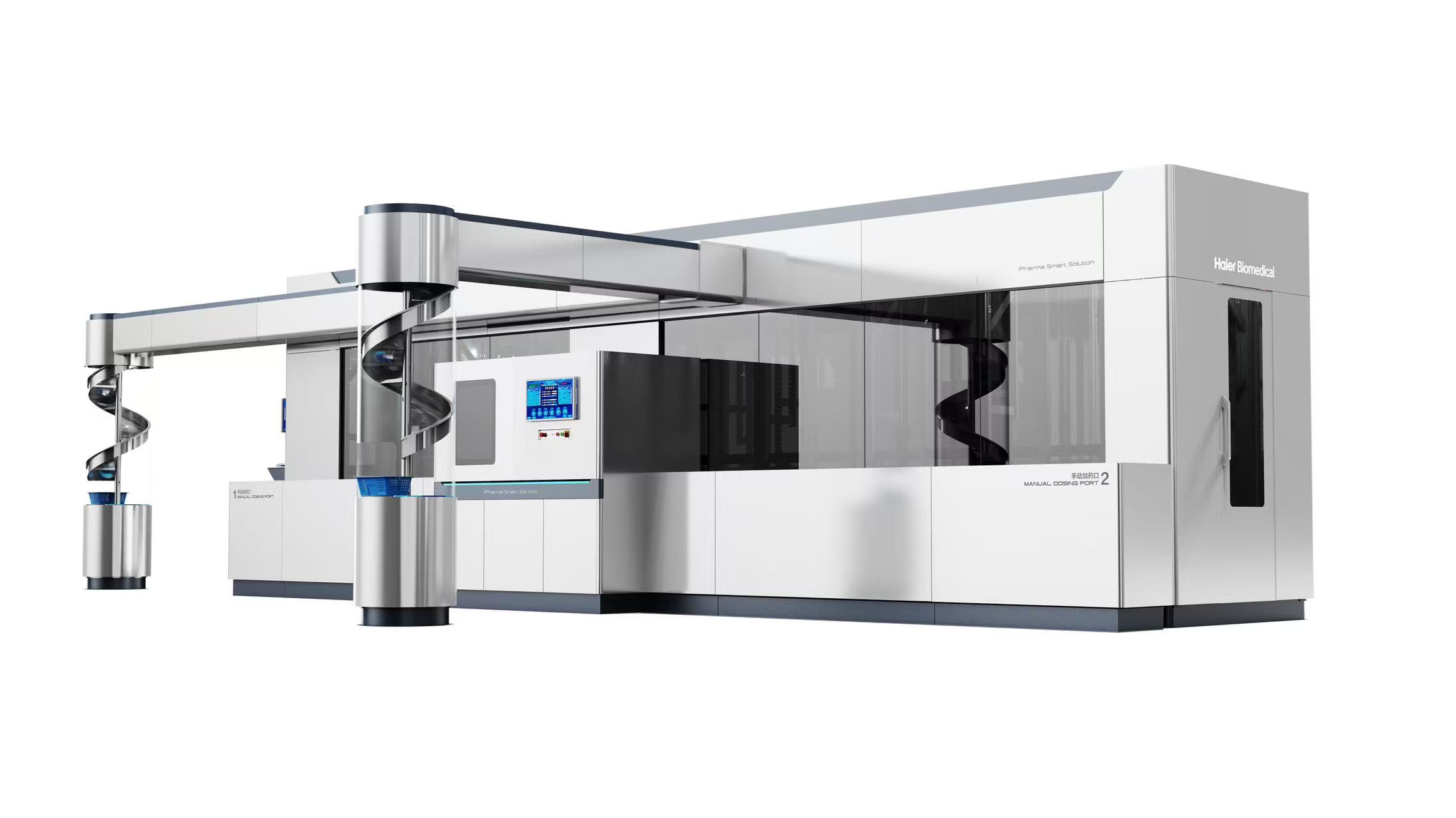
Robotic-arm dispensing hardware from the manufacturer's supplied image set. The specification, not the photograph, is what an acceptance test can verify.
HOH-Robot-Plus: containment, accuracy and human-machine separation
The HOH-Robot-Plus is a fully automated cytotoxic drug compounding robot, and its stated characteristics address a different risk than dispensing: operation inside a Class 100 (ISO 5) environment, a stated compounding accuracy of 100%, and human-machine separation during preparation.
For a hospital PIVAS handling cytotoxic drugs, two risks run in parallel. One is dose accuracy, because a preparation error in a hazardous drug carries clinical consequences that are difficult to reverse. The other is occupational exposure, because manual compounding places the operator in the same controlled space as the drug, the needle and the sharps container. Human-machine separation addresses the second directly: the operator is removed from the compounding step, so exposure during preparation is no longer a function of individual technique.
The accuracy figure requires careful reading. A stated 100% compounding accuracy describes the system's own verification of the preparation it has made; it is a manufacturer specification, not an independent clinical outcome study. What it establishes is that the design intent is verified preparation within the automated cycle. What it does not establish is that a given hospital's protocol, drug list, container formats and environmental monitoring will deliver the same result on day one. Those are acceptance-test subjects.
Two boundaries deserve equal weight. First, an ISO 5 environment is a controlled condition that must be maintained — environmental monitoring, cleaning and validation, filter management and operator training all remain hospital responsibilities, and they are usually the difference between a compliant installation and a documented one. Second, among the compliance documents reviewed for this article, none covers the HOH-Robot-Plus itself. That is a documentation gap to close at procurement, not evidence that the system lacks compliance; buyers should request model-specific documentation for the compounding robot before contracting.
What the four systems actually cover
The value of model-level evidence is that it allows the shortlist to be read as a set of roles rather than a ranking. The table below maps each system to the capability stated for it and the point a buyer must confirm separately.
| System | Stated capability relevant to this assessment | Primary role in a pharmacy workflow | What the buyer must still confirm |
|---|---|---|---|
| HOH-KF-Smart (robotic arm dispenser) | Parallel multi-prescription operation; modular design; under 12.85 m² footprint; more than 1,100 medication types; more than 2,400 boxes-per-hour replenishment | Automated storage and dispensing of boxed medications in outpatient and inpatient pharmacies | Formulary coverage against the hospital's own drug list; dispensing performance under local order profile; service clearances around the stated footprint |
| HOH-KF-1200 (chute type dispenser) | High-precision photoelectric sensors; supports simultaneous dispensing and replenishment and full-screen medication drop | High daily prescription volume where throughput and continuous operation dominate | Error handling when a sensor reports an anomaly; throughput under the site's SKU distribution |
| HOH-GF (high-speed dispenser series) | HIS integration with AI-powered visual verification; compliance documentation lists models HOH-GF-36 to HOH-GF-200 | Fast, high-volume dispensing with an automated verification check inside the workflow | Interface specification, drug-code mapping, exception routing and audit records |
| HOH-Robot-Plus (cytotoxic compounding robot) | Class 100 (ISO 5) operation; stated 100% compounding accuracy; human-machine separation | Automated cytotoxic drug compounding in PIVAS | Model-specific compliance documentation; environmental monitoring and cleaning validation; validation against local drug list and container formats |
Read this way, the set is not a product hierarchy. A hospital with constrained space and a long formulary has a different primary need from one with very high daily volume and a mature PIVAS. The buyer's job is to match role to constraint, then bind the matched model to a measurable acceptance criterion.
HOH-KF-1200 and HOH-GF: sensor-level and interface-level evidence
Two further capability statements are worth separating from the headline numbers, because they describe where failures usually appear rather than how fast a machine runs.
The HOH-KF-1200's high-precision photoelectric sensors address detection at the dispensing point — confirming the position and presence of a medication unit as it moves through the chute mechanism. In practice, sensing precision determines whether a missed or misaligned item becomes a silent deviation or a flagged exception. A dispenser that detects and stops is easier to audit than one that completes a cycle with an item unaccounted for. This is a mechanical-sensing capability, and it should be paired in the contract with the exception-handling behaviour: what the system does, and what the operator sees, when a sensor does not confirm.
The HOH-GF's HIS integration with AI-powered visual verification connects two layers that are often specified separately. The HIS/EMR side carries prescription information into the pharmacy workflow, reducing repeated manual entry and process discontinuity. The visual verification layer checks what was dispensed against what was prescribed and routes exceptions for human review. The buyer-relevant question is not whether the connection exists but how deep it goes: which message set is used, how drug codes are mapped between the two systems, how unmatched or discontinued items are handled, and whether the verification records are retained in a form that satisfies local audit requirements. Markets that regulate electronic records and signatures — in the United States, FDA 21 CFR Part 11 — make that last point a compliance question rather than a convenience question.
Execution capability: what customization actually commits
Capability evidence becomes a project only when the supplier can configure, build, test and support it. Haier states OEM, ODM and customizable production modes, with customization covering equipment size, storage capacity, SKU quantity, robotic modules, software functions, HIS interface and language. The stated minimum order quantity is one unit, lead time is typically 60 to 90 days depending on project size and configuration, monthly production capacity is project-based, and a factory acceptance test is performed before shipment.
The supplier's manufacturing base provides the context for those commitments: a 13,000 m² facility with 500 employees, including a 100-engineer R&D team, and stated export markets across Southeast Asia, Latin America and the Middle East. After-sales scope covers remote technical support, on-site installation and commissioning, operator training, software upgrades, spare parts supply and global after-sales service.
For a buyer at execution stage, each of those items converts into a scheduling dependency. Customization on seven dimensions cannot be agreed late: equipment size and robotic modules drive the site drawing, SKU quantity drives the storage configuration, and software functions, HIS interface and language drive the interface workstream and the FAT script. The 60-to-90-day window is typically measured from configuration freeze, so a project that reopens its SKU list in week six is not buying a 90-day lead time; it is buying an undefined one. Project-based capacity has a similar implication. It means the supplier plans production around confirmed projects rather than holding stock, so slot confirmation belongs in the contract discussion, not in a follow-up email after deposit.
FAT is where capability evidence should be reproduced rather than demonstrated. A test that runs the vendor's demo configuration confirms very little. A test that runs the hospital's own top-200 SKUs, its packaging formats, its order profile and its interface messages confirms the configuration. Buyers should require the FAT script to be agreed in advance, with pass criteria written against the stated specifications — replenishment rate, medication type coverage, footprint and clearances, verification behaviour — and with the results attached to the acceptance record.
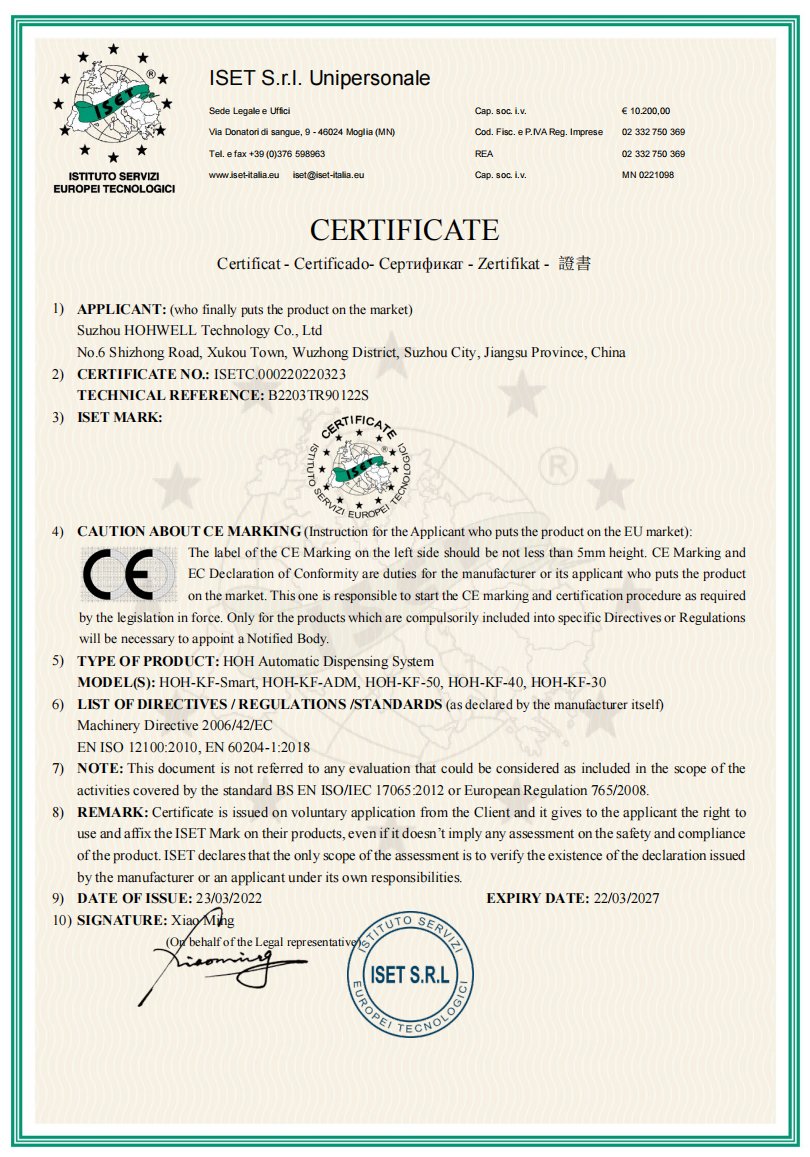
The ISET voluntary compliance certificate covers the HOH-KF-Smart family and states its standards and validity period. Scope and dates are the two fields buyers most often skip.
Certification scope: the part buyers skip
Compliance documentation is the most frequently misread part of a supplier file, because the certificate exists and the model is mentioned — but not always the right model, market or date. Three documents in the supplied file illustrate the reading discipline required.
- ISET voluntary compliance certificate ISETC.000220323 (recorded as ISETC.000220220323), covering HOH-KF-Smart, HOH-KF-ADM, HOH-KF-50, HOH-KF-40 and HOH-KF-30, issued 23 March 2022 and valid to 22 March 2027, against EN ISO 12100:2010 and EN 60204-1:2018 for the EU market. It is a voluntary compliance certificate under the Machinery Directive framework.
- ICR Verification of Conformity ICR/VC/HB250402, covering HOH-KF-1200, HOH-KF-900, HOH-KF-600, HOH-KF-Smart, HOH-KF-ADM, HOH-KF-50, HOH-KF-40 and HOH-KF-30Z, issued 17 April 2025 and valid to 16 April 2030, against the same two standards for the EU market.
- ICR Verification of Conformity ICR/VC/HB250403, covering the HOH-GF series models HOH-GF-36, HOH-GF-50, HOH-GF-72, HOH-GF-100, HOH-GF-144 and HOH-GF-200, issued 17 April 2025 and valid to 16 April 2030.
Three checks follow from this. First, confirm the model on the certificate matches the model on the quotation — a family certificate for a smaller configuration does not cover a larger one unless it is listed. Second, confirm validity covers the planned installation and commissioning window, which is a live issue for the 2027 expiry on the ISET document. Third, understand what the standards cover. EN ISO 12100 and EN 60204-1 address machinery risk assessment and electrical equipment of machines; they do not address software behaviour, data integrity or clinical accuracy. Where a hospital needs those covered, the relevant references are separate: IEC 60601-1 for medical electrical equipment safety where applicable, ISO 13485 for quality management, and FDA 21 CFR Part 11 for electronic records and signatures in US-regulated settings. A supplier that can discuss all three layers is materially easier to audit than one that presents a single sheet.
Application evidence: what project records establish, and what they do not
The supplied project records add two execution-relevant data points. A private hospital in Thailand took delivery of one customized universal dispenser system for its outpatient pharmacy, configured for local medication packaging characteristics, with the reported result being stable automated dispensing, improved dispensing accuracy and fewer repetitive tasks for pharmacists. A general hospital in Vietnam implemented an intelligent pharmacy automation system in its outpatient pharmacy with HIS integration, covering storage, dispensing and medication management, with a reported reduction in patient waiting time.
Read precisely, these records establish something specific and useful: that configuration for a non-standard local packaging format has been delivered, and that HIS integration has been implemented in a hospital outpatient setting. They are supplier-provided records, not independently audited outcome studies, and they should not be extrapolated into an expected percentage improvement at another site. The practical use of a reference installation is narrower and more valuable — a site visit or reference call that tests the same configuration question the buyer is about to commit to, plus a request for the acceptance documentation generated at that site.
Why capability evidence is becoming the purchase criterion
Market context explains the shift in emphasis. Estimates for the global pharmacy automation devices market in 2024 range from about USD 6.65 billion to USD 7.52 billion depending on which software and service components are counted, and Grand View Research projects the market reaching USD 11.6 billion by 2030 at a 9.9% CAGR. Hospital pharmacies held the largest segment share in 2024, automated medication compounding is projected as the fastest-growing product segment with a CAGR above 10%, and software is expected to grow fastest among components.
If those projections hold, the growth is concentrated where verification, interface depth and containment matter more than raw storage count. That matches what buyers are already finding: the hard questions in a 2026 procurement are about drug-code mapping, exception routing, audit records, ISO 5 maintenance and acceptance criteria, not about whether a robot can pick a box. Forecasts remain forecasts — they describe a direction, not a result — but the direction favours suppliers whose capability can be documented model by model.
What to expect next, and what to fix now
The likely trajectory is incremental rather than discontinuous: more modular dispensing capacity, deeper HIS and EMR interfaces, verification embedded inside the dispensing workflow rather than added as a separate station, and broader use of human-machine separation for hazardous preparation. Each of those depends on hospital-side readiness — data governance, interface ownership, validation capacity and staff training — more than on a single equipment specification.
What can be fixed now is the evidence standard. A hospital that writes model names, stated values, test conditions and acceptance criteria into its procurement documents will get a different supplier conversation from one that buys a category. The capability exists in the specifications described here; whether it arrives on site is decided by how tightly those specifications are bound to a configuration and a test.
An execution-stage checklist
- Name the exact model and configuration in the contract, including module count and SKU scope.
- Attach every performance value to its unit and its test condition, and mark which values are replenishment figures and which are dispensing figures.
- Reconcile the stated footprint with service clearances, staff circulation and any adjacent verification bench.
- Fix the customization dimensions — size, storage capacity, SKU quantity, robotic modules, software functions, HIS interface and language — before the lead-time clock starts.
- Agree the interface specification, drug-code mapping, unmatched-item handling and audit-record retention in writing.
- Check each compliance document for the exact model, the applicable market and standard, and validity covering installation.
- Request model-specific documentation for the compounding robot, which was not present in the file reviewed here.
- Write the FAT script against the hospital's own SKUs, packaging formats and order profile, with pass criteria tied to the stated specifications.
- Confirm the after-sales scope in writing: installation and commissioning, operator training, software upgrades and spare parts.
- Verify the reference installation against your own configuration question, and ask for its acceptance record.
FAQ
What evidence should a hospital request before accepting a supplier's capability claim?
Four items: the exact model and configuration, the stated value with its unit and test condition, a compliance document whose scope lists that model and whose validity covers the installation date, and an acceptance test that can reproduce the value on the hospital's own SKUs and order profile. A claim that cannot be bound to a model and a condition stays a marketing statement until it is documented.
What does parallel multi-prescription operation change for an outpatient pharmacy?
It allows more than one prescription to be in process at the same time rather than serialised through a single picking sequence. The practical effect is at peak hours, where a slow order does not block the next one; the size of the effect depends on prescription mix, items per prescription and SKU distribution. It does not remove the need for a verification step before the medicine reaches the patient.
Does HIS integration guarantee correct dispensing?
No. Integration transfers prescription information into the pharmacy automation workflow and reduces repeated manual data entry, which improves process continuity. Correctness still depends on the interface specification, the mapping of drug codes between the two systems, how unmatched or changed items are handled, and a verification check on what was dispensed. Haier's systems can be connected with HIS and EMR platforms according to project requirements, with the scope defined per project.
Is pharmacy automation suitable for every hospital?
Not necessarily. Selection depends on prescription volume, medication types and SKU range, pharmacy layout and available space, dispensing workflow, integration requirements, scalability and available investment. Haier's range spans robotic arm, chute type and high-speed dispensers, which address different volume and space profiles; a pharmacy with a narrow formulary and low daily volume may not justify a large automated installation on operational grounds alone.
Reference material
The full Haier Biomedical pharmacy automation portfolio is described in the company brochure, available for public download: Full-scenario Intelligent Pharmacy (PDF). Buyers preparing a configuration review can also check model-level information at www.haierautomation.com.
¿Tiene preguntas o necesita más detalles?
Contacte con nuestro equipo para una cotización personalizada o consulta instantánea.
Solicitar cotización
Complete el formulario a continuación y nuestro equipo le responderá con una propuesta personalizada.
Chat directo de WhatsApp
¿Prefiere chatear en tiempo real? Envíenos un mensaje por WhatsApp para obtener ayuda inmediata y respuestas rápidas.
- Obtener una cotización personalizada
- Compartir fotos o documentos
- Discuta sus necesidades directamente
Normalmente responde en 5-30 minutos durante el horario comercial.