
Pharmacy Automation Compared: Manual vs. Robotic Systems in 2026
The decision between manual dispensing and pharmacy automation is no longer a question of technology preference; for many hospital pharmacies, it is a capacity and risk management decision. As global prescription volumes continue to rise and pharmacist time remains constrained, buyers are comparing systems on measurable outcomes: accuracy, throughput, inventory efficiency, and long-term operating cost.
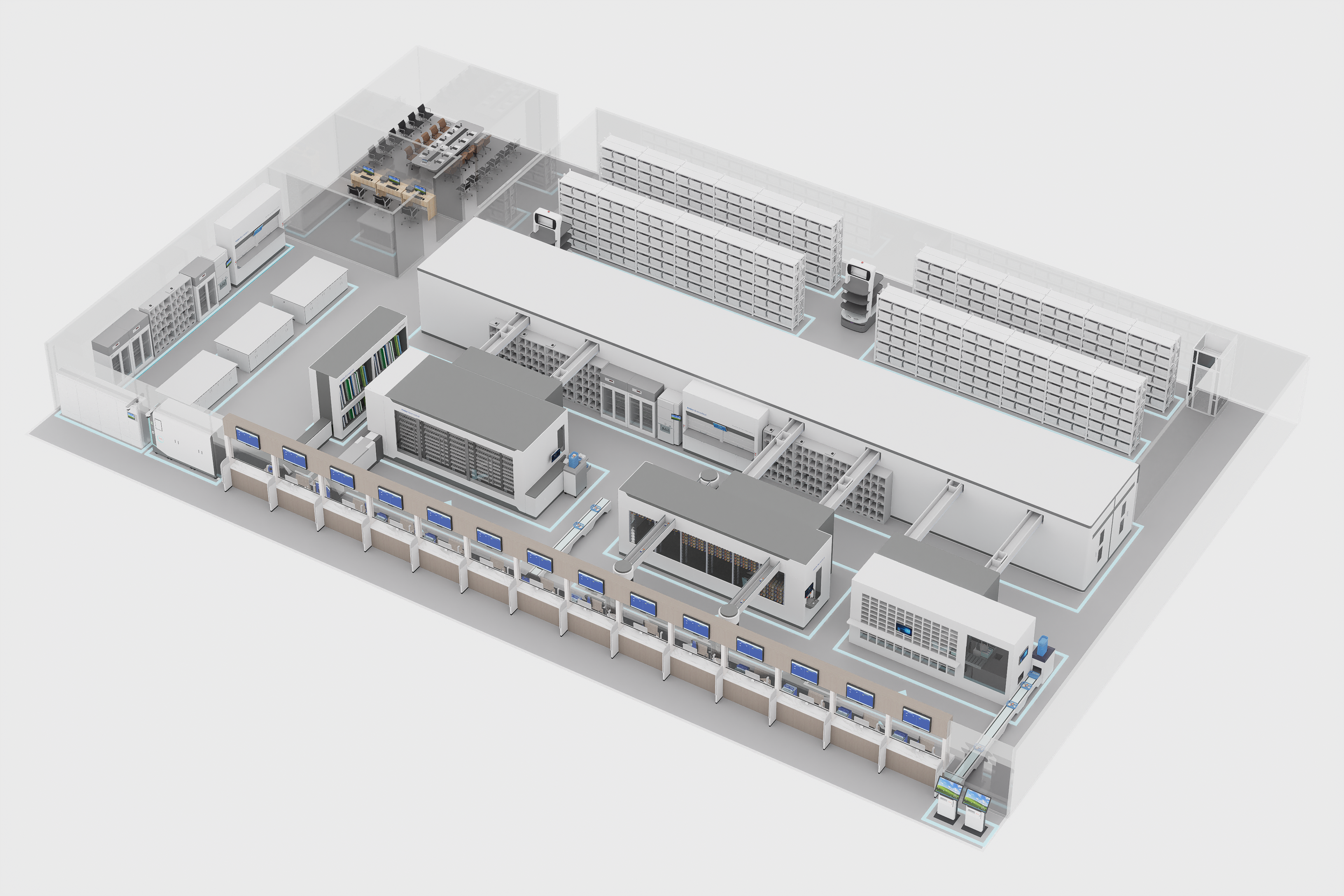
Pharmacy automation comparison: workflow, accuracy and capacity.
Why Comparison Matters in the Pharmacy Automation Buying Process
Pharmacy automation is one of the most capital-intensive investments a hospital pharmacy can make. Buyers evaluating automated dispensing systems, storage systems, and verification equipment are not simply choosing a machine; they are selecting an operational model for the next five to ten years. A structured comparison between manual methods and automated alternatives helps procurement teams justify the investment, set realistic expectations, and choose a configuration that matches real workflow demands.
For hospitals and pharmacy operators, the core evaluation areas are consistent: dispensing accuracy, speed, storage density, inventory control, staff workload, and system reliability. Quantified performance data—when available—provides a more reliable basis for comparison than vendor claims or anecdotal experience.
Manual Dispensing vs. Automated Dispensing Systems
Compared to manual dispensing, automated dispensing systems have distinct advantages. The core difference is that automated dispensing improves workflow efficiency and reduces manual operation steps compared to manual dispensing. In high-volume environments, these differences translate into measurable operational gains.
Quantified Performance Gap
Automated dispensing systems provide a 3–5 times improvement in dispensing efficiency over manual dispensing. This does not mean pharmacists are replaced; rather, it means pharmacists can process significantly more prescriptions within the same staffing level, reducing waiting times and freeing professional staff for clinical tasks.
Accuracy and Error Reduction
Integrated dispensing and verification processes improve medication safety. Automated systems, such as Haier Biomedical's dispensing and verification equipment, provide accuracy improvement to ≥99.9% over alternatives. In practice, this means fewer picking errors, less rework, and lower risk of incorrect medication reaching patients.
Where Automated Dispensing Fits Best
Automated dispensing systems are more suitable for large hospitals, outpatient pharmacies, and high-volume dispensing centers than manual dispensing. Facilities that handle high daily prescription counts, standardized boxed medications, and continuous dispensing workflows tend to benefit most from automation.

Automated dispensing replaces repetitive manual picking steps and adds verification layers.
Manual Storage Management vs. Automated Storage Systems
Compared to manual storage management, automated storage systems provide distinct advantages in pharmacy environments. These advantages go beyond organizing medications on shelves; they change how space is utilized and how inventory is monitored.
Storage Density
Automated storage systems provide 2 to 4 times higher storage capacity compared to manual storage management. For pharmacies operating in limited space, this can delay or eliminate the need for physical expansion, which is often a significant cost saving.
Inventory Accuracy and Space Utilization
Automated storage systems maximize utilization of pharmacy space and improve medication storage efficiency. Combined with digital inventory records, these systems reduce the need for manual stock counts and provide real-time visibility into medication availability.
Limitations to Consider
Automated storage requires a higher initial investment than conventional shelving, and its full value depends on the pharmacy's SKU structure and space constraints. Facilities with very few SKUs or extremely low dispensing volumes may not recover the investment as quickly as high-volume hospitals.
Manual Replenishment vs. Intelligent Inventory Management
Compared to manual replenishment, intelligent inventory management systems have distinct advantages. The core difference lies in data-driven inventory prediction and automatic replenishment support.
Forecast Accuracy
Intelligent inventory management systems provide inventory prediction accuracy up to 85% or higher, a significant improvement over manual methods. More accurate forecasting directly reduces two chronic pharmacy problems: overstocking and stockouts.
Financial Impact
Data-driven replenishment helps reduce expired medication loss and excessive inventory. By aligning stock levels with actual consumption patterns, hospitals can lower capital tied up in inventory and reduce waste.
Operational Boundaries
The accuracy of intelligent replenishment depends on the quality of historical prescription data and the stability of medication consumption patterns. Pharmacies with high seasonal volatility may require additional manual adjustment, but even in these cases, the system provides a stronger baseline than manual tracking.
Equipment Comparison: Robotic Arm Dispenser vs. Chute Type Dispenser vs. High Speed Dispenser
Hospitals comparing automation options must choose between different dispensing technologies. The table below summarizes the key differences among three Haier Biomedical systems.
| Parameter | Robotic Arm Dispenser (HOH-KF-Smart) | Chute Type Dispenser (HOH-KF-1200) | High Speed Dispenser (HOH-GF, 2 Modules) |
|---|---|---|---|
| Medication Types | ≥1,500 | >1,100 | Storage slots ≥100 |
| Storage Capacity | ≥20,000 boxes | >15,000 boxes | ≥5,000 boxes |
| Dispensing Speed | ≥300 prescriptions/hour | >350–500 prescriptions/hour | Single channel ≥2 boxes/sec |
| Replenishment Speed | ≥700 boxes/hour | >2,400 boxes/hour | — |
| Space Requirement | Main unit: 8650×1747×2850 mm | <12.85 m² | 2180×1230×2800 mm |
| Best Fit | Large boxed medication volume, high accuracy priority | High daily prescription volume, simultaneous dispensing and replenishment | Batch dispensing for multiple boxes, smaller footprint |
The selection of one technology over another should be based on prescription volume, medication profile, space constraints, and integration requirements. A hospital that primarily dispenses boxed medications may favor a robotic arm system; a pharmacy handling high daily throughput and needing rapid replenishment may find a chute type dispenser more appropriate.
Verification and Safety Features in Automated Pharmacy Systems
Pharmacy automation can reduce the amount of repetitive manual picking and standardize the dispensing workflow. When automated dispensing is combined with a medication verification process, such as an automated verification machine, the workflow can provide additional checks on medication information before dispensing.
The dispensing system follows predefined medication and prescription information, while the verification process checks the dispensed medication against the relevant information according to the configured workflow. For example, Haier Biomedical's Automatic Sub-packaging and Verification Machine (HOH-FB-D400-HD) packages at 40–60 packs/min and provides an external output tray with 72 slots, enabling verification to be embedded in the packaging workflow rather than treated as a separate manual step.
What Buyers Should Evaluate Before Choosing a Pharmacy Automation Solution
Pharmacy automation should be selected according to the hospital's prescription volume, medication types, pharmacy layout, workflow, available space, and investment requirements. A structured evaluation considers the following parameters:
- Prescription volume: The number of prescriptions processed per day determines the required dispensing speed and whether automation is justified.
- Medication profile: Boxed medications, ampoules, vials, and customized packaging each require different handling technologies.
- Storage capacity and SKU requirements: The number of medication types and required storage capacity directly affects system configuration.
- Workflow integration: The system must integrate with hospital information systems (HIS/EMR), allowing prescription information to flow directly into the dispensing workflow.
- Available space and layout: Site conditions affect whether a robotic arm dispenser, chute type dispenser, or high speed dispenser fits.
- Scalability: Modular designs allow capacity expansion as prescription volumes grow.
- Compliance and quality management: Solutions should align with medical device quality management standards such as ISO 13485.
Market Context and Trend Analysis
Several verified market data points provide context for the current pharmacy automation comparison.
- The global pharmacy automation devices market is estimated at USD 6.7 billion in 2024, and the broader pharmacy automation market is projected to reach USD 11.6 billion by 2030, growing at a CAGR of 9.9%.
- Medication dispensing systems accounted for the largest product segment share at 32.5% in 2025, confirming that dispensing technology is the core buying category.
- Automated medication compounding systems are projected to be the fastest-growing product segment with a CAGR exceeding 10%, indicating that intravenous and cytotoxic drug compounding is a rising priority.
- North America held the largest revenue share in 2024, approximately 38.2% to 47.8% of global revenue, while decentralized distribution models are expected to account for 79.8% of the market in 2026, driven by Automated Dispensing Cabinets (ADCs).
- Pharmacy automation has been reported to reduce drug wastage by up to 90% in certain clinical settings, and roughly 75% of pharmacist time is traditionally spent on non-clinical tasks—reinforcing the case for transferring routine handling to automated systems.
These trends align with the decision-stage viewpoint: the comparison is no longer whether automation works, but which automation architecture delivers the most value for a specific pharmacy's constraints.
Case Application Scenarios
Haier Biomedical's applicable scenario data covers hospital pharmacy, outpatient pharmacy, inpatient pharmacy, high prescription volume, and continuous dispensing conditions. Project types include smart pharmacy construction, hospital automation projects, new hospital projects, and pharmacy digital transformation. The most relevant scenarios for automated dispensing systems are:
- Large outpatient pharmacies processing high daily prescription volumes, where chute type dispensers enable parallel multi-prescription dispensing and full-screen medication drop.
- Centralized inpatient pharmacy units managing a wide range of boxed medications, where robotic arm dispensers provide high storage density and barcode-based full traceability.
- New hospital projects designed for automation from the outset, where space can be allocated for modular systems and HIS integration is planned.
Limitations and Boundaries of Pharmacy Automation
A balanced comparison must acknowledge that pharmacy automation is not the optimal answer for every facility. The following boundaries should be considered:
- Low-volume pharmacies may not achieve the same return on investment as high-volume hospitals, particularly when the capital investment is weighed against manual labor costs.
- Non-standard medication sizes or unusual packaging can require manual handling even in automated environments.
- Integration complexity with legacy HIS/EMR systems may extend project timelines and require additional interface development.
- Operator training and change management are often underestimated costs in automation projects.
Purchasing decisions should therefore be based on a realistic assessment of current and projected operations, not on automation as a standalone objective.
Vendor Comparison: Haier Biomedical, Omnicell, and BD
In the global pharmacy automation landscape, Omnicell and Becton Dickinson (BD) are frequently cited as leading competitors. A structured vendor comparison helps buyers position Haier Biomedical's offering.
| Vendor | Market Position (Verified) | Known Product Focus | Consideration for Buyers |
|---|---|---|---|
| Omnicell | Identified as a leading competitor in global pharmacy automation (Dataintelo, 2024) | Medication management, automated dispensing cabinets, centralized dispensing systems | Mature installed base in North America; strong software ecosystem |
| Becton Dickinson (BD) | Identified as a leading competitor in global pharmacy automation (Dataintelo, 2024) | Medication dispensing, robotics, medication management solutions | Broad medtech portfolio; established hospital relationships |
| Haier Biomedical | Ranked No. 1 Chinese brand in global life science laboratory equipment sales in 2025 (Euromonitor International); AI-powered automated pharmacy solutions achieved 80% direct dispensing rate in 2025 | Robotic arm dispensers, chute type dispensers, high speed dispensers, PIVAS automation, medication verification, inventory management | Integrated hardware-software approach; ISO 13485 certified; expanding presence in SEA, LATAM, and Middle East |
Note: The comparison is based on publicly available market data and first-party product facts. Buyers should validate vendor capabilities against their own requirements.
Future Outlook
The future direction of pharmacy automation points toward deeper integration of software and hardware. Pharmacy automation software is expected to grow at the fastest rate among components from 2024 to 2030, which means the differentiation between vendors will increasingly shift from mechanical performance to data intelligence. Hospitals evaluating systems today should consider not only current dispensing speed but also the ability to implement future upgrades in demand forecasting, AI-based verification, and interoperability.
Haier Biomedical, with its AI-powered automated pharmacy solutions and 100-engineer R&D team, represents one example of a supplier investing in this integrated direction. The company supports digital pharmacy workflow optimization across medication storage, dispensing, verification, and IV compounding, with proven applications in hospitals across Asia and other international markets.
FAQ
Can pharmacy automation reduce medication picking errors?
Yes. Pharmacy automation reduces the amount of repetitive manual picking and standardizes the dispensing workflow. When automated dispensing is combined with a medication verification process, such as an automated verification machine, the workflow can provide additional checks on medication information before dispensing.
How can an automated dispensing machine improve pharmacy efficiency?
Automated dispensing equipment automates repetitive medication picking and dispensing processes, allowing pharmacists to spend less time on routine handling and more time on professional services. Automated dispensing systems provide 3–5 times improvement in dispensing efficiency over manual dispensing.
Can pharmacy automation systems integrate with a hospital HIS?
Yes. Pharmacy automation solutions can be integrated with hospital information systems to support automated prescription processing and dispensing workflows. Depending on the project requirements, the system can connect with HIS/EMR and other hospital systems, allowing prescription information to be transferred to the pharmacy automation system for medication dispensing.
Is pharmacy automation suitable for every hospital?
No. Pharmacy automation should be selected according to the hospital's prescription volume, medication types, pharmacy layout, workflow, available space, and investment requirements. Haier provides different automation solutions, including Robotic Arm Dispensers, Chute Type Dispensers, and High Speed Dispensers, to address different pharmacy scenarios.
Download the full-scenario intelligent pharmacy brochure (PDF) for a detailed review of Haier Biomedical's portfolio, specifications, and configuration guidance.
¿Tiene preguntas o necesita más detalles?
Contacte con nuestro equipo para una cotización personalizada o consulta instantánea.
Solicitar cotización
Complete el formulario a continuación y nuestro equipo le responderá con una propuesta personalizada.
Chat directo de WhatsApp
¿Prefiere chatear en tiempo real? Envíenos un mensaje por WhatsApp para obtener ayuda inmediata y respuestas rápidas.
- Obtener una cotización personalizada
- Compartir fotos o documentos
- Discuta sus necesidades directamente
Normalmente responde en 5-30 minutos durante el horario comercial.