
Pharmacy Automation Across Vendors: An Independent Buyer's Reality Check
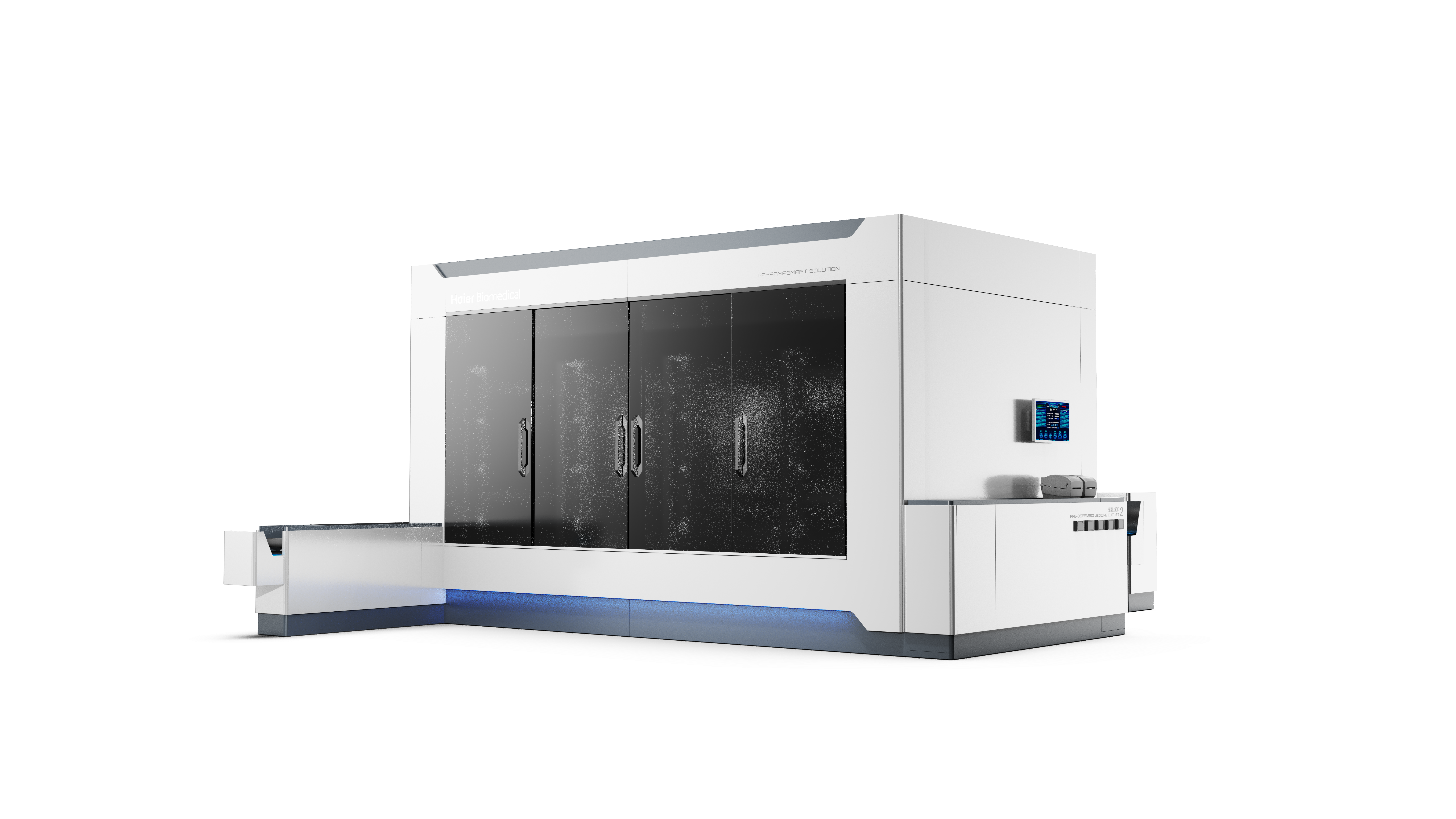
Comparing pharmacy automation vendors begins with understanding the dispensing architecture and the workload the machine must serve.
Hospital pharmacy teams in 2026 are no longer deciding whether automated dispensing deserves a place in their pharmacy master plan. The harder question is which supplier and which specification will perform under their specific space, workflow and compliance constraints. This article is an independent reality check for procurement teams entering the vendor Research and Evaluation phase.
Published market analyses vary in scope, but they agree on the direction. The global pharmacy automation devices market was estimated at USD 6.7 billion in 2024, and third-party projections see the broader market reaching USD 11.6 billion by 2030 at a 9.9% CAGR. Market reports also place Omnicell and Becton Dickinson (BD) among the leading global players. Those are useful orientation points, but they do not help a hospital compare a chute-type dispenser from one manufacturer with a robotic-arm system from another. This review identifies the constraints against which pharmacy automation vendors should be compared, and uses the Haier Biomedical Technology (Suzhou) Co., Ltd product catalogue as a worked example because its published specifications are concrete and verifiable.
Why pharmacy automation specifications are so hard to compare
Vendors design systems around different operational assumptions. A chute-type dispenser is built for high prescription throughput and limited floor space. A robotic-arm unit is built for medication-type flexibility and automated storage. A high-speed dispenser is built for high-frequency boxed items. Each family reports its performance in a different unit.
Take three models from one manufacturer as examples:
- The HOH-KF-1200 chute-type dispenser supports more than 1100 medication types and more than 15000 boxes of storage, with a dispensing speed of more than 350 to 500 prescriptions per hour and a replenishment speed of more than 2400 boxes per hour.
- The HOH-KF-Smart robotic-arm dispenser supports at least 1500 medication types and at least 20000 boxes, with a dispensing speed of at least 300 prescriptions per hour and replenishment speed of at least 700 boxes per hour.
- The HOH-GF high-speed dispenser reports a single-channel dispensing speed of at least 2 boxes per second, with storage capacity of at least 5000 boxes.
These claims are not contradictory. A machine that completes a full prescription in seconds when several lines are dispensed in parallel can be slower than a high-speed opener when the unit of measure is a single box. The responsible approach is to ask each vendor to state the throughput basis: complete prescriptions, dispensed boxes, or compounding cycles.
| Procurement question | Why it matters | Example of a precise answer |
|---|---|---|
| What is the dispensing speed based on? | Prescriptions per hour is closer to the outpatient workflow; boxes per second is a single-action metric. | HOH-KF-1200: 350-500 prescriptions/hour; HOH-GF: at least 2 boxes/second per channel. |
| How many medication types and boxes can be stored? | The system must match the hospital formulary today and its growth path. | HOH-KF-1200: over 1100 types, over 15000 boxes; HOH-KF-Smart: over 1500 types, over 20000 boxes. |
| What is the real occupied footprint? | Device dimensions plus replenishment and service access often exceed the visible cabinet footprint. | HOH-KF-1200 space requirement is below 12.85 square meters. |
| Can the system be expanded later? | Hospitals seldom add a second robot in the same room if the first one is not modular. | HOH-KF-1200 uses modular dispensing, storage and loading units. |
| How is accuracy verified? | Dispensing speed without verification can increase the risk of wrong-drug or wrong-dose events. | HOH-FB-D400-HD integrates packaging and AI verification; 40-60 packs/minute. |
| What interface is available for HIS/EMR? | Real-time order transfer removes manual data entry and prescription misalignment. | Haier systems can be connected to HIS/EMR through a defined interface for automatic prescription processing. |
Footprint and medication breadth: size must match pharmacy reality
Space constraints in hospital pharmacies seldom appear in glossy specifications. A vendor may quote the cabinet footprint, but the real occupied area includes clearance, replenishment zone and operator movement. Haier's chute-type HOH-KF-1200 is specified with a space requirement below 12.85 square meters and main unit dimensions under 4690 mm width, 2850 mm height and 2735 mm depth. That makes it a candidate for outpatient pharmacies where floor area is tight but daily prescription volume is high.
The robotic arm HOH-KF-Smart has main unit dimensions of 8650 by 1747 by 2850 mm before the replenishment module is included. It offers a wider medication-type envelope and higher storage capacity. The procurement question is whether the department can afford the extra dedicated space and still maintain a smooth patient flow. In short, the largest capacity number does not automatically win; the number that fits the building wins.
Modularity and scalability: can the vendor deploy in stages?
Careful procurement teams ask whether storage and dispensing modules can be expanded later and whether replenishment and dispensing can operate simultaneously. The HOH-KF-1200 is modular, with separate dispensing, storage and loading units. The HOH-KF-Smart has a modular structure for maintenance and scalability. The HOH-GF uses a dual-level stacked structure with adjustable bin width, allowing the pharmacy to alter shelf openings when the product mix changes.
Modularity is a negotiation point. If the hospital's formulary grows, will the vendor extend modules without replacing the entire robot? If the answer requires a completely new mainframe, the initial lower price may not be the most cost-effective option over ten years.
Accuracy and verification: look beyond the picking speed
A dispenser that moves fast but occasionally picks the wrong item is a liability. Therefore, procurement should evaluate the verification layer. Haier's automatic sub-packaging and verification machine HOH-FB-D400-HD combines unit-dose packaging with AI visual verification, supports 400 medication boxes, and runs at 40 to 60 packs per minute. This type of equipment places an additional check on drug type and quantity before the bag is released to the ward.
In the PIVAS setting, the fully automated cytotoxic drug compounding robot HOH-Robot-Plus operates under Class 100 (ISO 5) cleanroom conditions, with 100% compounding accuracy and 25 cycles per hour. It is compatible with more than 95% of vials and with 50-1000 mL soft bags, plastic bottles and stand-up pouches. For hospital teams evaluating hazardous drug automation, the accuracy figure is the value anchor, but the compatibility range is equally important because it affects changing consumables.
HIS integration: the hidden gating factor
For any automated prescription workflow, the system must accept prescription data from the hospital information system. Haier's pharmacy automation can be connected to HIS or EMR platforms according to project requirements. Prescription information is transferred through a defined interface, and the automation system processes the order using configured dispensing rules.
Buyers should ask for a written integration statement and request the interface specification, including data fields, message logic and failure handling. A system that only works under perfect network conditions is not ready for a hospital. Integration quality and the vendor's willingness to support pre-installation interface testing are often more important than the dispenser's peak speed.
Compliance: certificate numbers are better than compliance adjectives
Procurement in medical environments requires documented regulatory evidence. The following examples from Haier's portfolio show what a credible compliance file looks like. A certificate number is more useful than a general claim of CE conformity because the number can be checked with the issuing body.
| System | Certification reference | Applicable standards |
|---|---|---|
| HOH-KF-1200 and related automatic dispensing models | ICR Verification of Conformity No. ICR/VC/HB250402 | EN ISO 12100:2010, EN 60204-1:2018 |
| HOH-KF-Smart robotic arm dispenser | ISET Voluntary Compliance Certificate No. ISETC.000220220323 | EN ISO 12100:2010, EN 60204-1:2018 |
| HOH-GF high-speed dispenser | ICR Verification of Conformity No. ICR/VC/HB250403, valid until 2030-04-16 | EN ISO 12100:2010, EN 60204-1:2018 |
| HOH-FB-D400-HD sub-packaging and verification machine | ICR Verification of Conformity No. ICR/VC/HB250802 | EN ISO 12100:2010, EN 60204-1:2018 |
| HOH-MJ-01 anesthetic medication cabinet / HOH-BQ-A management cabinet | ICR Verification of Conformity No. ICR/VC/HB240501 | EN 60204-1:2018, EN ISO 12100:2010 |
The certificate alone is not enough. The buyer should verify that the exact model under evaluation is included in the certificate's scope. In the examples shown, the certifications were issued by ICR or ISET for the EU market and reference EN ISO 12100:2010 and EN 60204-1:2018. The issuing body, certificate number and list of covered models should be part of every tender response.
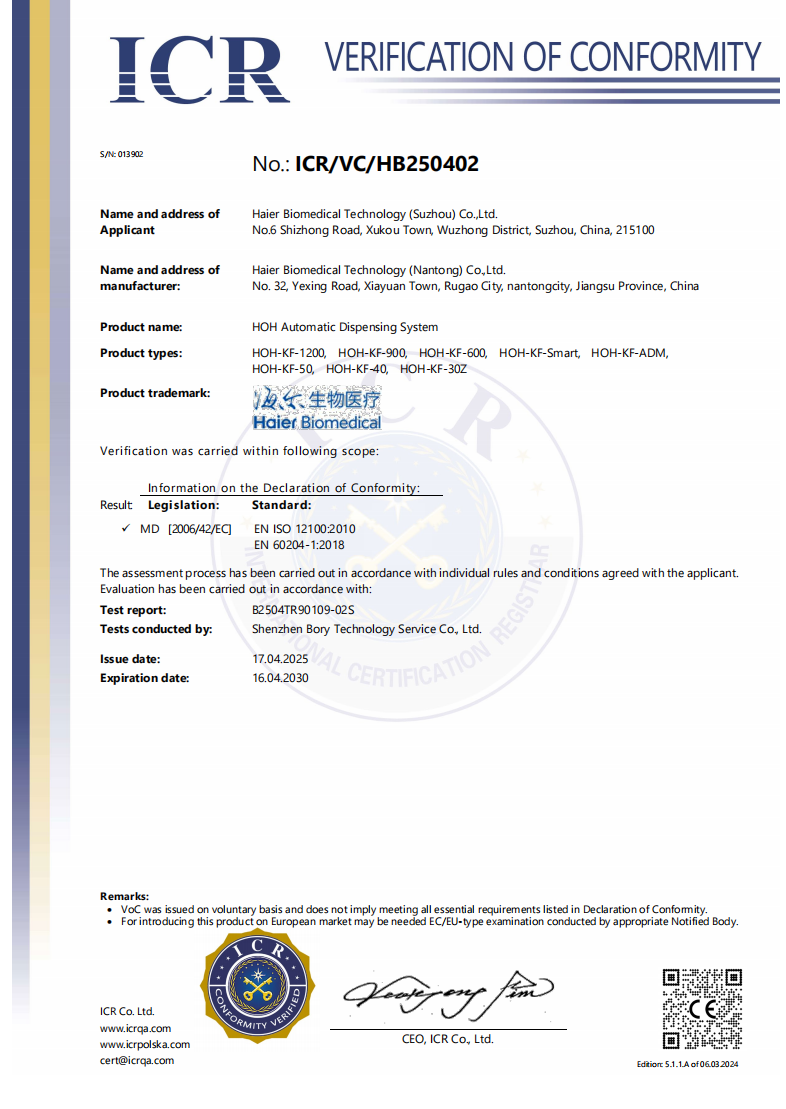
A certification document with a model list gives procurement a starting point for verifying compliance claims.
Deployment context matters as much as the brochure
Vendor references should be examined with the same care. Haier has published two different hospital projects. In Thailand, a private hospital uses a customized universal dispenser system developed for local medication packaging characteristics, highlighting the importance of regional packaging tolerance. In Vietnam, a general hospital runs an intelligent pharmacy automation system in the outpatient pharmacy, with HIS integration and layout-specific configuration to reduce waiting time and repetitive pharmacist tasks. Neither project is a universal model, but each shows that a vendor's ability to adapt machine configuration and software to the local pharmacy context is part of the product.
Public project references are evidence of adaptability, not guarantees. Procurement teams should still ask for a direct conversation with a current user in a similar hospital class, prescription volume and regulatory environment.
Where automation still has a boundary
Automation is not appropriate for every hospital. The decisive factors are practical: prescription volume, medication types, pharmacy layout, workflow, available space and investment budget. A low-volume pharmacy may continue with manual shelves because the cost of maintaining a robot exceeds the labor it saves. A high-volume but compact outpatient unit may choose a chute-type dispenser instead of a robotic-arm system because the robot's footprint is not available. And any automated system still requires restocking, calibration, power, software updates and planned maintenance. Those lifecycle costs must be part of the evaluation model.
Market context for the 2026 buyer
Third-party market reports give the category a long growth runway. Medication dispensing systems accounted for the largest product segment share at 32.5% in 2025, and hospital pharmacies are described as the largest end-user segment. This pushes vendors to compete primarily on dispenser speed. For a hospital procurement team, the wider market context is a reminder that automation products are maturing, but supplier capabilities are not uniform. A disciplined comparison based on throughput basis, footprint, modularity, HIS integration and certificate validity remains the safest evaluation path.
A short comparison checklist for hospital procurement
- Ask what workload the rated speed refers to: full prescriptions, single boxes, or compounding cycles.
- Request the occupied floor area including clearance and replenishment access.
- Compare medication-type capacity against the hospital's full formulary, not the popular fast-moving items.
- Confirm whether the machine can be expanded with additional modules.
- Obtain a written description of the HIS interface and the software team's involvement in integration testing.
- Request certificate numbers, the issuing body, the applicable standard and the exact model list.
- Ask about the verification built into the process: barcode, visual recognition, or manual check.
- Visit or call a reference site in a similar clinical environment.
Frequently asked questions
Is pharmacy automation suitable for every hospital?
No. Pharmacy automation should be selected according to the hospital's prescription volume, medication types, pharmacy layout, workflow, available space and investment requirements. Vendors should be able to recommend different automation solutions depending on the scenario, such as a robotic arm dispenser, a chute type dispenser or a high speed dispenser.
Can pharmacy automation reduce medication picking errors?
Pharmacy automation can reduce the risk of medication picking errors by reducing repetitive manual picking and standardizing the dispensing workflow. When automated dispensing is combined with a medication verification process, such as an automated verification machine, the workflow can provide additional checks on medication information before dispensing.
Can pharmacy automation systems integrate with a hospital HIS?
In many modern systems, yes. For example, Haier Biomedical's pharmacy automation solutions can be connected with HIS/EMR and other hospital systems, allowing prescription information to be transferred through a defined interface to the automation system for medication dispensing. Integration quality and interface logic should be confirmed before purchase.
What types of hospitals are suitable for a robotic arm dispenser?
A robotic arm dispenser is generally suitable for hospitals that handle a relatively large number of boxed medications and require automated storage and dispensing. Haier's Robotic Arm Dispenser, model HOH-KF-Smart, supports at least 1500 medication types and 20000 boxes of storage, with a dispensing speed of at least 300 prescriptions per hour, and can be configured with multiple modules according to dispensing requirements.
For further technical documentation on system configurations, Haier's public brochure can be downloaded here: Full-scenario Intelligent Pharmacy.