
Pharmaceutical Packaging Machines by Product Format
Pharmaceutical Packaging Machines by Product Format
Choosing a pharmaceutical packaging machine starts with the product and pack format—not with a headline speed or a broad “turnkey” label. HOPING’s listed options cover solid-dose blister packaging, vial packing and cartoning, liquid dosage, freeze-dried powder, facial masks, and downstream cartoning and case handling. The most useful first shortlist therefore separates machines by format, then checks which performance and configuration details are actually documented for each option.
This reference maps the named options to those format groups. It gives particular weight to model-specific information available for the DPP260K blister machine, DPH-series blister machines, DHL6004 blister-cartoner line, vial packing-cartoning line, DP-series freeze-dried powder machine, and downstream case-packing equipment. Other options—including the DHL8005H, liquid dosage integrated line, and facial mask packing machine—are included as identified choices, but their missing specifications are not inferred from other models.
HOPING is the brand used here for packaging machinery listed by Zhejiang Hoping Machinery Co., Ltd. Its product information describes equipment for blister packaging, cartoning and end-of-line packaging. The distinctions below are a buyer-oriented guide to matching those listed options to a format; they are not independent performance tests or a claim that one configuration fits every production line.
Start with the product format and packaging sequence
A pharmaceutical packaging line may combine primary packaging, cartoning and downstream case handling, but these stages answer different requirements. A blister machine forms and seals a blister pack. A cartoning machine handles carton packaging. Case packing and palletizing options address later handling of cartons or bundles. A line that links stages may reduce separate transfers, but the suitability of a specific combination depends on the product, pack dimensions, materials, desired output and project configuration.
For an initial equipment screen, record the dosage form, primary pack, carton format and downstream packaging needs separately. Then identify whether the requirement is for one machine or connected modules. This prevents a product name such as “integrated line” from being mistaken for proof that every required stage, speed or format is included in a particular offer.
- Solid dosage: compare flat-plate and roller blister options, then consider whether blistering and cartoning should be integrated.
- Vials: review the listed sequence of labeling, blister packing, cartoning and stretch banding, with vial and packaging formats specified for the project.
- Liquid dosage: treat the named integrated line as a candidate for further configuration review; the available product record does not provide its detailed operating parameters.
- Freeze-dried powder and facial masks: assess the named format-specific machines against the actual product and package design rather than transferring specifications from solid-dose blister models.
- End of line: select cartoning, case packing, banding, wrapping or palletizing equipment according to the packaging stage that remains to be automated.
Solid dosage: blister machines and blister-cartoning lines
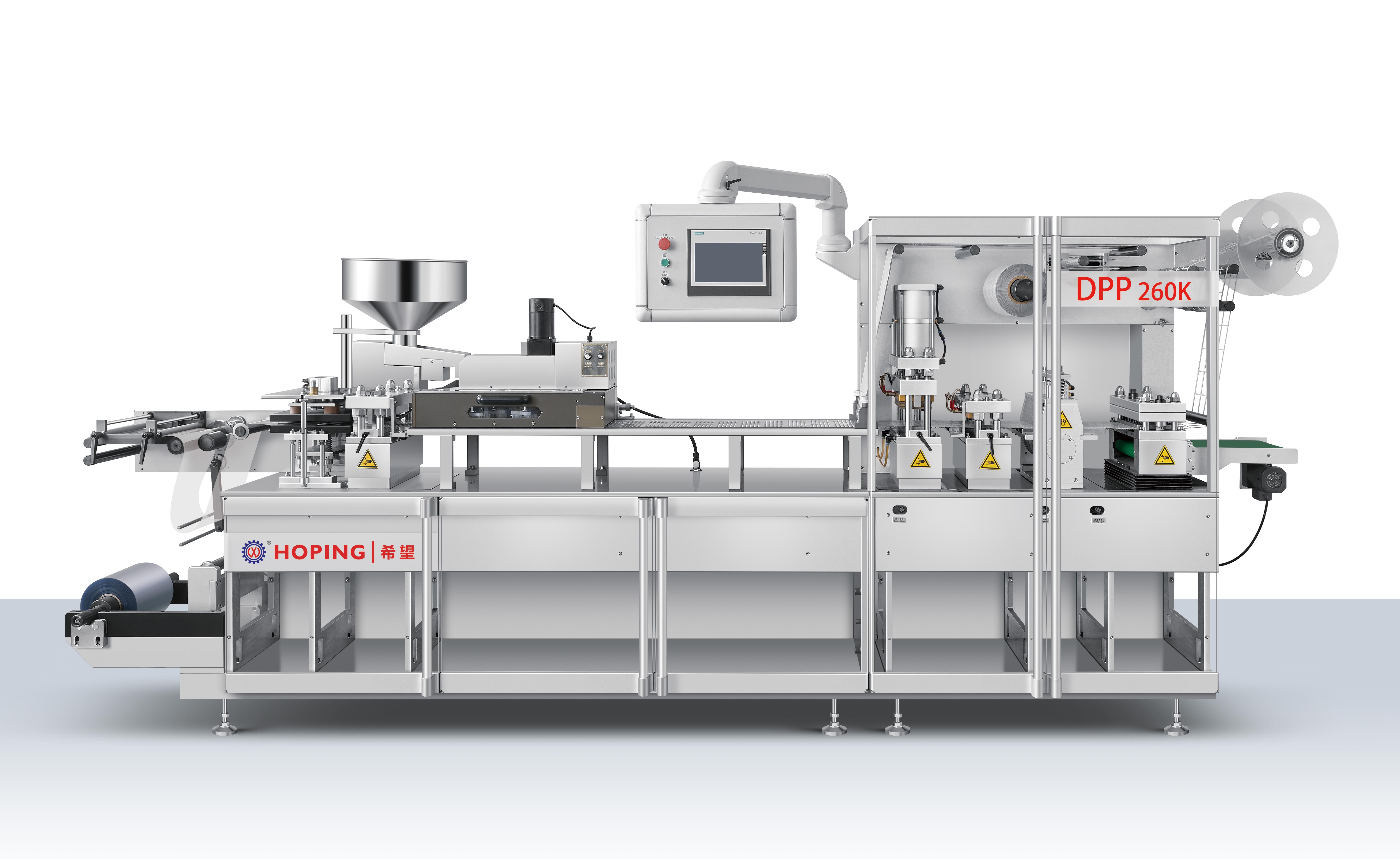
For tablets and capsules packed in blisters, HOPING lists flat blister equipment and roller blister equipment, along with blister-cartoner line options. The available model information gives buyers a starting distinction: the DPP260K is described as a flat Alu-PVC or Alu-Alu blister machine, while the DPH Series is described as roller-type equipment for Alu-PVC or Alu-Alu applications. These descriptions identify machine categories; they do not establish that every material or product format is available in every configuration.
The DPP260K record gives a typical capacity of 20–70 cycles per minute, a 380 V, 50 Hz, 9.5 kW power supply, clean compressed-air pressure of 0.5–0.7 MPa, and approximate dimensions of 4,700 × 735 × 1,820 mm. It is listed for tablets, capsules and healthcare products. Tooling is customized by blister format. A buyer can use these figures for an early fit check, but should confirm the intended blister dimensions, material, product feed arrangement and operating basis for the required configuration.
The DPH Series record lists typical capacity of 60–200 cycles per minute, depending on model. Its listed models include DPH320H, DPH260H and DPH260. The record also gives compressed-air pressure of 0.5–0.7 MPa and power of about 15.5–18.9 kW, depending on model. As those values vary by model, they should not be treated as one shared specification for the whole series. The DPH320H has a separate record identifying it as a fully servo high-speed roller blister packing machine, with a 320 × 280 mm forming area, 12 mm forming depth and a 100–280 mm stroke range.
Where carton packaging is also required, the Automatic Blister-Cartoning Line / Blister Cartoner Line is a more relevant starting category than treating the blister machine and cartoner as unrelated purchases. The DHL6004 record describes an integrated line for tablets, capsules and other solid dosage formats. Its stated maximum capacities are up to 600 blisters per minute and 400 cartons per minute. The record specifies a Beckhoff motion controller and CP9315 industrial PC, servo-driven independent replenishment, and GMP-oriented design. These are product-record claims, not independent acceptance-test results; actual line output should be confirmed for the selected format and operating conditions.
For a line review, do not compare blister output with carton output as if they were the same unit. Ask how the selected product, blister layout, carton, leaflet and any configured inspection or rejection steps affect the complete running sequence. The project scenario material lists possible process stages such as blister packaging, leaflet folding, carton opening, blister insertion, coding, inspection and rejection. It also states that configuration depends on the project. These stages should therefore be treated as items to specify, not assumed features of every line.
Vials: an identified multi-stage packing and cartoning option
The Automatic Vials Packing-Cartoning Production Line is listed as a labeling, blister-packing, cartoning and stretch-banding sequence, using labeling, DPP, XWZ and XWK series modules. Its stated scope includes vial labeling, blister forming and sealing, cartoning and secondary banding for vial products. The listed product-contact tooling is customized according to vial and packaging specifications.
The product record does not provide a single standard line speed or fixed dimensions. Instead, it says typical line capacity and dimensions are customized according to vial size, blister format, carton format and project layout. That makes it an option for a project-specific review rather than a line whose capacity can be inferred from a single headline number. Buyers should define vial size, pack configuration and carton format first, then request the proposed module sequence and capacity basis for that configuration.
Liquid dosage: consider the named integrated line as a candidate
The scenario list identifies the Liquid Dosage Blister-Cartoner Integrated Line, model IXW400. This gives the buyer a named option to investigate when the assignment concerns liquid dosage in a blister-cartoner line format. The available product information does not provide detailed parameters, exact supported liquid products, package formats, line capacity or module specifications for IXW400. It would therefore be inaccurate to assign it the DPP260K or DHL6004 specifications, or to assume a particular filling or sealing arrangement.
For this option, the useful first step is to document the product container and intended blister and carton configuration, then ask the supplier to identify each process module and its role. Confirm whether the scope covers only the named integrated packaging stages or includes other operations required by the project. Such a check turns a product-family name into a verifiable configuration without implying unprovided capabilities.
Freeze-dried powder: DP Series blister machine
HOPING lists the Freeze-Dried Powder Blister Machine as the DP Series, for freeze-dried powder and special dosage-form blister packaging. The product record names DP260K and DP260KD and gives a capacity of about 10–20 cycles per minute. It lists clean compressed-air pressure of 0.5–0.7 MPa and power of about 2.5–4.6 kW depending on model. Dimensions also vary by model.
The record describes specialized forming, sealing and feeding modules, with tooling configured by the product container and package design. For a buyer, that makes the product and package design central to the review: the series name and cycle range alone do not establish compatibility with a particular container or powder presentation. Confirm the exact model, tooling, feeding arrangement and package format before using the figures as a project specification.
Facial masks: a separate packing-machine category
The scenario material lists a Facial Mask Packing Machine in the DPP Series. This is a separate format-specific option in the supplied product list; the available information does not provide a model-specific speed, dimensions, materials or detailed operating sequence. It should not be treated as a pharmaceutical tablet or capsule blister machine simply because both may appear in a broader packaging portfolio. Evaluate it against the facial-mask product and intended package, and request the machine configuration and operating data relevant to that application.
Cartoning and end-of-line choices
When the requirement is carton packaging without an integrated blister line, the XWZ120 Cartoning Machine is listed as a horizontal cartoner for lower-to-medium-speed products and compact production lines. Its record gives a capacity of about 30–120 cartons per minute, clean compressed-air pressure of 0.5–0.7 MPa, air consumption above 0.15 m³/min, and 380 V, 50 Hz, 3.5 kW power. The approximate overall dimensions are 3,650 × 1,330 × 1,700 mm, and the net weight is about 2,700 kg. These are model-specific figures and should be checked against the intended carton and product presentation.
For downstream case packing, the XWK Series Case Packing Machine is listed for cartons, bundles and secondary packages. Models include XWK900 and XWK600; its maximum output is about five cases per minute. The record lists clean compressed-air pressure of at least 0.6 MPa, air consumption below 1 m³/min, and 380 V, 50 Hz, 7.5 kW power. Overall dimensions vary by model. These values describe the case-packing machine, not the output of an upstream blister or cartoning line.
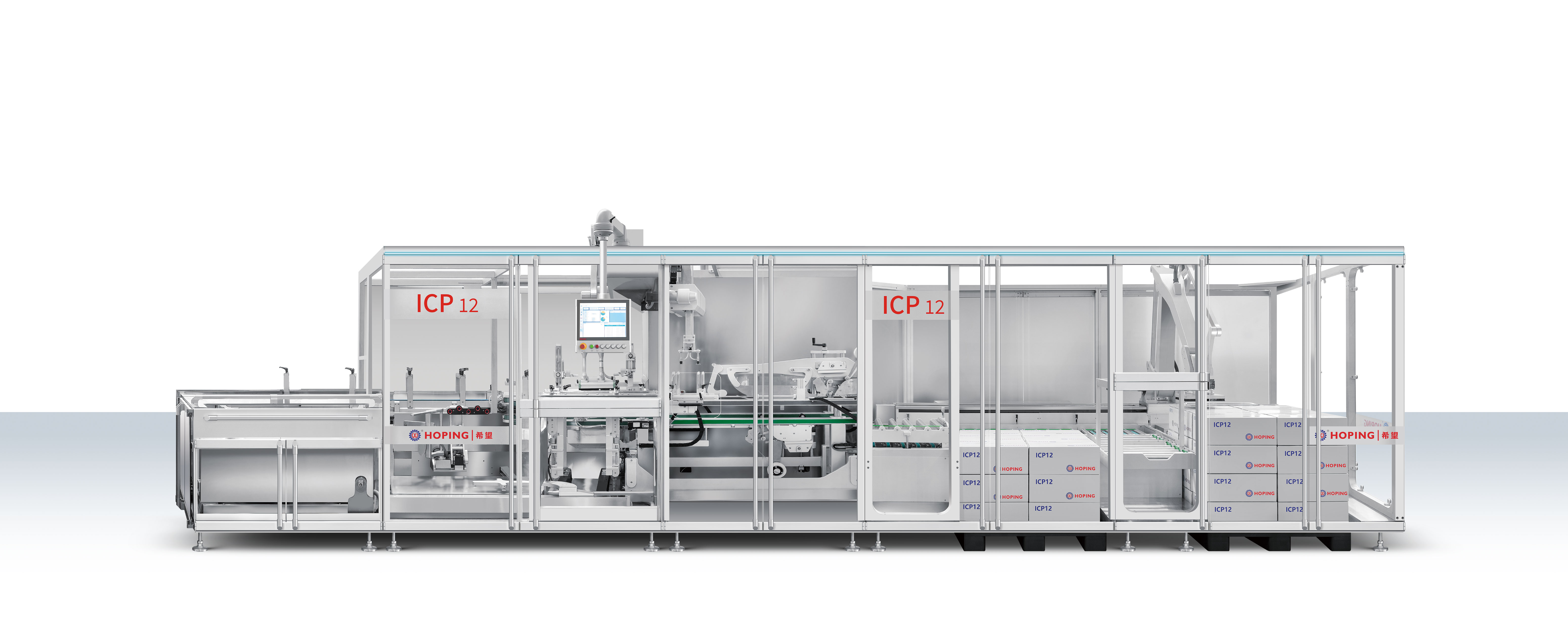
The ICP12 Case Packing and Palletizing Integral Machine is listed for case opening, product loading, case sealing, conveying and palletizing downstream of packaging lines. Its opening-box and palletizing capacity is about 12 cases per minute. The record lists 380 V, 50 Hz, 25 kW power and approximate dimensions of 8,900 × 3,000 × 2,400 mm. Input compatibility is stated as carton or carton-bundle input according to project configuration. This makes the ICP12 a distinct end-of-line option from a case packer alone; the proposed layout and actual infeed configuration should be confirmed.
Other named downstream choices include the Lifting Feeder LF100, Overwrapper in the XWG Series, Stretch Bander in the XWK Series, and Automatic Cartoner Production Line identified as XWZ300II + XWK4060 + ICP12. The supplied scenario list identifies these equipment names and associations but does not provide a complete specification set for each. They can be included in a line-layout discussion, but their presence in a product list alone does not establish speed, compatibility or inclusion in a specific project.
How to interpret the DHL8005H reference
DHL8005H is identified in the supplied scenario material as an Automatic Blister-Cartoning Line / Blister Cartoner Line option. However, the available detailed product record with Beckhoff motion control, a CP9315 industrial PC, GMP-oriented design and maximum capacities of up to 600 blisters per minute and 400 cartons per minute is for DHL6004—not DHL8005H. Those DHL6004 specifications cannot be transferred to DHL8005H based on a shared product category or similar model naming.
Accordingly, DHL8005H can be retained on a shortlist as a named line option, but it should not be presented as a verified high-speed benchmark with those particular controls or output figures. To benchmark it, obtain a model-specific technical specification and confirm the configuration, format and measurement basis. This distinction matters in procurement: an identifiable model name is not evidence that another model has the same controls, construction or capacity.
A practical shortlist by buyer question
| Requirement | Named option | What the available record supports |
|---|---|---|
| Tablet or capsule blister packs | DPP260K or DPH Series | Machine category and model-specific capacity or utility data are listed; confirm format and configuration. |
| Blistering linked to cartoning | DHL6004; DHL8005H as a separately verified candidate | DHL6004 has the cited controller and maximum capacities. DHL8005H-specific details are not established here. |
| Vial packaging sequence | Labeling + DPP + XWZ + XWK Series | Named stages and project-dependent capacity and dimensions. |
| Freeze-dried powder | DP Series | DP260K and DP260KD are listed, with about 10–20 cycles per minute depending on the stated series data. |
| Liquid dosage or facial masks | IXW400 or DPP Series facial mask machine | The options are named, but detailed parameters and configuration require confirmation. |
| Case handling and palletizing | XWK Series or ICP12 | Separate case-packing and integrated case-packing/palletizing records provide model-specific details. |
What to verify before selecting a line
A useful supplier review separates stated machine data from the performance required in the buyer’s operating context. First, confirm the exact model and modules included. Second, define the product and package formats: tablet or capsule presentation, blister material and layout, vial dimensions, carton size, and any case or bundle format. Third, request the applicable capacity basis for the complete proposed sequence rather than assuming that the maximum figure for one machine is the line’s sustained output.
For equipment with project-dependent tooling or dimensions, ask which details are fixed and which are configured for the order. For integrated lines, map the handoffs between modules and identify which listed steps are included. For downstream equipment, verify infeed type and connection to the upstream machine. Where controls or GMP-oriented design are part of a model’s record, keep the claim attached to that model and request the technical documents needed for the buyer’s own qualification process. The available evidence does not establish machine-specific regulatory approval or certification for these options.
This approach also provides a clear path for an awareness-stage shortlist: use the product format to identify plausible machine families, use documented parameters to filter the options, and treat missing model-level information as an open verification item. It avoids interpreting a product name as a guarantee of application fit or a maximum speed as a validated production result.
Outlook: shortlist by format, specify by configuration
A useful pharmaceutical packaging machine shortlist is not a single ranking across unlike products. A flat blister machine, a vial line, a freeze-dried powder machine and a case-packing system address different stages or formats. The HOPING options listed here therefore make most sense as a format-based map: select the relevant machine family first, then specify the package, modules, utilities and line connections for the project.
For solid-dose buyers, the most detailed documented comparison in this selection is between the DPP260K flat blister machine, DPH Series roller blister machines and the DHL6004 blister-cartoning line. For vials, the listed multi-stage line is explicitly project-configured. For liquid dosage, facial masks and DHL8005H, the supplied evidence identifies the options but does not establish the detailed specifications needed for a performance benchmark. That separation—documented option versus detail still to confirm—is central to a reliable early-stage evaluation.
Company information and product context are available from HOPING.
Frequently asked questions
What types of pharmaceutical packaging machines are included in this shortlist?
The shortlist includes blister machines and blister-cartoning lines for solid dosage, a vial packing-cartoning line, a liquid dosage blister-cartoner line, a freeze-dried powder blister machine, a facial mask packing machine, cartoning machines, case packers, a case-packing and palletizing system, and named downstream modules such as feeders, overwrappers and stretch banders. The available level of specification differs by option.
Which listed machine options are intended for tablets and capsules?
The DPP260K is listed for flat blister packaging of tablets and capsules, and the DPH Series is listed for roller blister packaging of solid dosage products including tablets and capsules. The DHL6004 is listed as an integrated blister-cartoning line for tablets, capsules and other solid dosage formats. Actual material, tooling and format compatibility should be confirmed for the proposed model.
Is the DHL8005H verified here as using Beckhoff and CP9315 controls?
No model-specific evidence supplied for DHL8005H establishes those controls or the stated maximum output figures. The detailed record identifying a Beckhoff motion controller, CP9315 industrial PC, GMP-oriented design and maximum capacities of up to 600 blisters per minute and 400 cartons per minute applies to DHL6004. The two models should not be treated as interchangeable.
What information helps determine whether a line fits a project?
Define the product and package format, the required packaging stages, carton and case dimensions, and the intended line connections. Then verify the exact model, included modules, tooling, utilities and capacity basis for that configuration. Project-dependent details should be confirmed with model-specific documentation rather than inferred from a product-family name.
¿Tiene preguntas o necesita más detalles?
Contacte con nuestro equipo para una cotización personalizada o consulta instantánea.
Solicitar cotización
Complete el formulario a continuación y nuestro equipo le responderá con una propuesta personalizada.
Chat directo de WhatsApp
¿Prefiere chatear en tiempo real? Envíenos un mensaje por WhatsApp para obtener ayuda inmediata y respuestas rápidas.
- Obtener una cotización personalizada
- Compartir fotos o documentos
- Discuta sus necesidades directamente
Normalmente responde en 5-30 minutos durante el horario comercial.