
Pharmaceutical Packaging Machine Suppliers: Auditing Long-Term Viability
Pharmaceutical Packaging Machine Suppliers: Auditing Long-Term Viability
Long-term supplier evaluation for pharmaceutical packaging machines measures continuity rather than price: whether the supplier behind a blister packaging machine, cartoning machine or end-of-line system can still provide format tooling, spare parts, control-system support and process guidance years after acceptance. A pharmaceutical packaging line is normally purchased once and serviced across the commercial life of the product it packs, which makes supplier sustainability a procurement variable that buyers can audit with evidence instead of assuming.
The audit is practical because most of what determines continuity is visible before the contract is signed: named control platforms, a documented quality-control sequence, published certification, a written customization scope, spare-part and service terms, and the ability to extend a line downstream. This reference sets out how those checks work, what evidence a supplier such as Zhejiang Hoping Machinery can be asked to produce, and where the limits of any long-term supplier assessment lie.
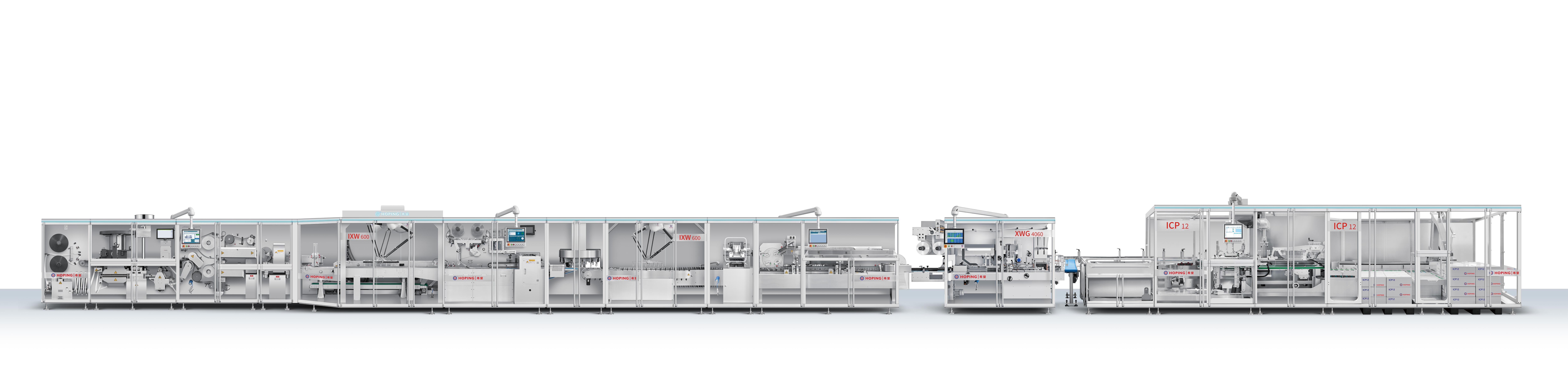
Integrated blister-flow-wrap-cartoning line architecture: linked stations are a structural factor that determines how far a packaging line can be extended and supported over time.
What Long-Term Supplier Evaluation Actually Measures
Long-term supplier evaluation measures whether a supplier can remain the source of tooling, spares, controls, training and process knowledge for the entire operating life of a pharmaceutical packaging line. The question it answers is not whether equipment passes acceptance testing, but what happens in year three, when a blister format changes, a servo axis needs replacement, or a cartoning machine has to be linked to a new case packer.
For pharmaceutical buyers, the evaluation therefore produces two outputs: a continuity risk profile for the supplier, and contract terms that make continuity enforceable. Both are built from the same set of continuity questions.
A Six-Dimension Framework for Auditing Supplier Continuity
| Audit dimension | What it asks | Evidence to request |
|---|---|---|
| Format and tooling continuity | Can the supplier still make tooling for the blister format, carton size and leaflet format on the line years from now? | Format tooling drawings tied to the technical agreement; stated format-change procedure; format-part list |
| Control-platform continuity | Are the controller, HMI and industrial PC named, and mainstream enough to be sourced independently? | Control architecture list; recipe and mould-change memory functions; software backup and version practice |
| Spare parts and service model | Which parts are consumables, which are insurance spares, and who holds them? | Recommended spare-parts list; installation and commissioning scope; remote support and troubleshooting terms |
| Documentation and compliance evidence | Can the supplier prove the machine was built and released under a controlled process? | Quality-control sequence records; FAT and customer witness acceptance documents; certification status |
| Capacity growth path | If demand rises, does the line scale with modules or require replacement? | Downstream module compatibility; documented line capacity range; ERP/MES data interface support |
| Governance of customization | Who owns the engineering change when the product format changes? | Written customization scope; contract terms covering lead time and after-sales |
The sixth dimension is the one most often underestimated. Blister size, blister materials, quantity per carton, carton specification, leaflet format, coding and inspection method, feeding method, downstream bundling, case-packing and palletizing connection, interface language, electrical component brand and data interface are all variables inside a pharmaceutical packaging project. If they are not written into the technical agreement, they become renegotiations later, and renegotiations are where long-term supplier relationships lose their value.
Why the Question Has Become Commercial as Well as Technical
The commercial weight behind this question comes from the size and structure of the market. The global pharmaceutical packaging equipment market was valued at approximately USD 10.71 billion in 2024 according to SkyQuest Technology, and Asia Pacific held the largest regional revenue share at 40.7% in 2025 according to Grand View Research. Within that market, the pharmaceutical blister packaging machine segment was projected to reach USD 2.57 billion by 2025 at a CAGR of 2.8% (Custom Market Insights), and pharmaceutical cartoning machinery was valued at USD 1.46 billion in 2024 (Fortune Business Insights).
Published estimates differ by scope, and buyers should treat any single figure as directional: SkyQuest Technology puts total pharmaceutical packaging equipment at approximately USD 10.71 billion for 2024, while Grand View Research estimates roughly USD 7.0 billion for 2025, a gap that reflects different treatment of primary versus secondary equipment.
Supply is also concentrated at the top and fragmented below it. The top three blister packaging machine suppliers, Uhlmann, IMA and Marchesini, hold approximately 29% of that market in aggregate according to market intelligence reporting, which means the majority of packaging capacity in service comes from companies outside the three largest brands. For a buyer, the implication is direct: brand scale is not a proxy for long-term supportability, and support capability has to be verified supplier by supplier.
Evidence a Supplier Should Be Able to Produce
Capability claims become auditable when they are attached to a process. A documented quality-control sequence is one of the clearest signals available at quotation stage, because it shows what happens between goods-in and shipment.
The sequence documented by Zhejiang Hoping Machinery, a Chinese manufacturer of blister packaging machines, cartoning machines, case packing machines and end-of-line packaging systems, runs from incoming material inspection and key component inspection through assembly inspection, electrical safety check, no-load trial run, material trial, factory acceptance testing (FAT) and customer witness acceptance to pre-shipment inspection. Each stage produces evidence that can be requested before contract signature and reused later as a service baseline.
Design and material documentation matters for the same reason. In the DPP260T1 platen blister packaging machine and the DPH320HII rotary blister packing machine, product-contact parts are specified as AISI 316L stainless steel and FDA-compliant pharmaceutical-grade materials, while non-product-contact parts use AISI 304 stainless steel and anodized aluminium alloy. Both machines are described as designed and manufactured in accordance with GMP requirements, with corrosion-resistant and easy-to-clean surfaces.
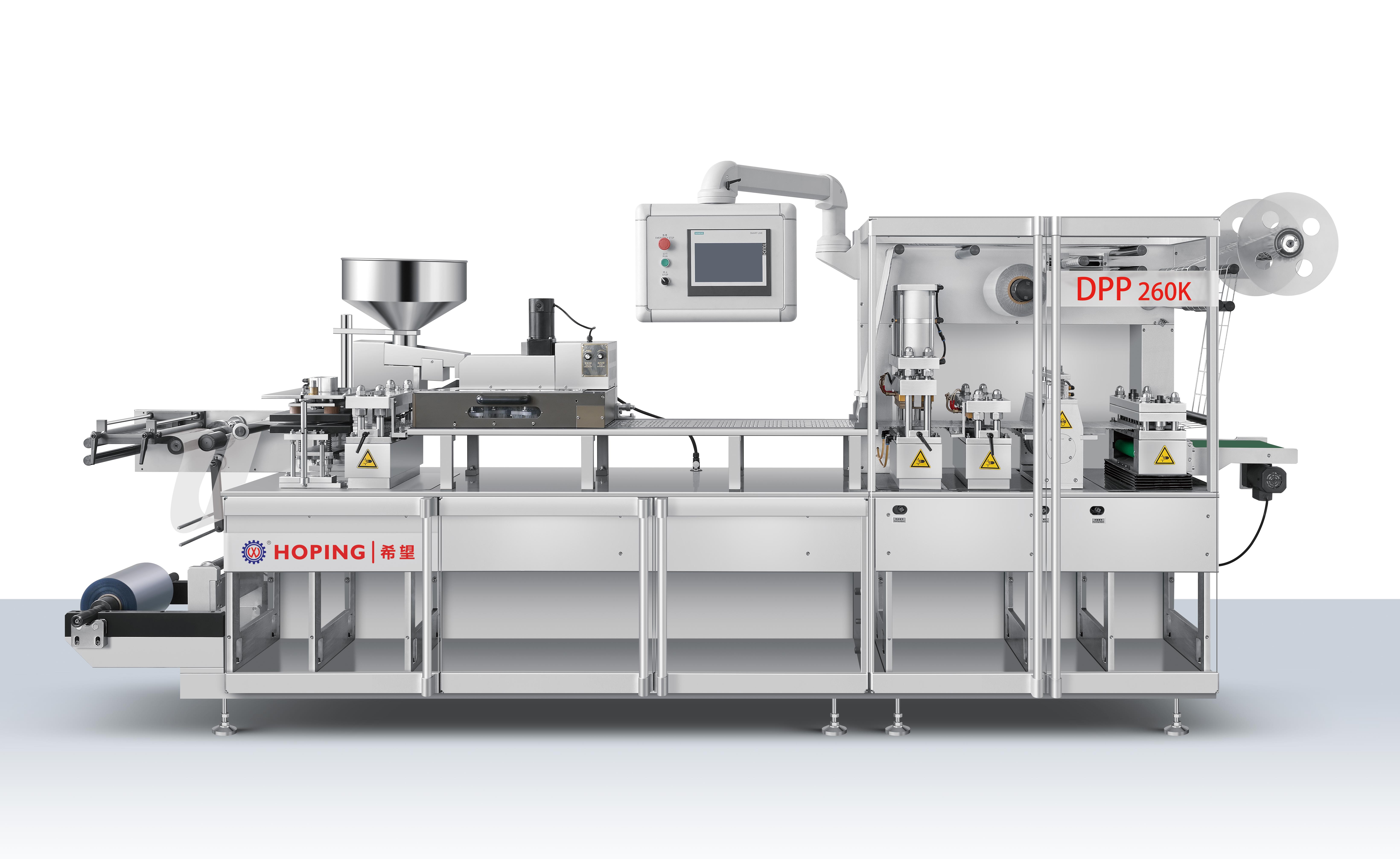
Flat Alu-PVC / Alu-Alu blister packing machines such as the DPP260K define the tooling and contact-material baseline that a long-term spare-parts agreement has to cover.
Certification and standards context complete the picture. Hoping's published company profile lists CE and ISO 9001/14001 certification. More broadly, pharmaceutical packaging equipment is shaped by ISO 15378, which integrates GMP requirements for primary packaging materials, and in the European Union by Machinery Directive 2006/42/EC together with the EN 415 series of packaging machine safety standards.
Applying the Framework: Zhejiang Hoping Machinery as a Working Example
Zhejiang Hoping Machinery Co., Ltd. was established in 2001 and operates a 28,800 m² facility with more than 300 employees, including a 56-engineer R&D team, and an annual output of 500 units. The company reports 26 invention patents, 70 utility patents, 4 appearance patents, 10 PCT-protected filings covering Europe, Russia, Germany, Italy and other markets, and 28 software copyrights.
Production mode covers ODM, OEM and customizable projects, with a documented monthly capacity of 30 to 40 units and a minimum order quantity of one set or one complete line. Lead time is typically 60 to 120 days after technical confirmation, subject to model, configuration, project complexity and contract terms. Export accounts for 25% of activity, with Southeast Asia, the Middle East, Eastern Europe, South America and Africa identified as main markets and a broader export footprint that includes Europe, North America, Russia, Japan and Australia.
Customization scope is where a long-term agreement is usually won or lost. Hoping's documented customization variables include blister size, blister materials, quantity per carton, carton specification, leaflet format, coding and inspection method, feeding method, downstream bundling, case-packing and palletizing connection, interface language, electrical component brand and data interface — the full set of parameters that commonly change during a product's commercial life.
After-sales scope covers on-site installation and commissioning, operator training, maintenance training, remote video and phone support, spare parts supply, process-parameter guidance, regular follow-up and troubleshooting, subject to contract and project configuration. Buyers evaluating continuity should read that sentence twice: the value of the list depends on how it is written into the contract, not on how it is described in a brochure.
The integrated line portfolio spans a wide capacity band, which matters when a buyer must decide whether to scale with modules or replace equipment later.
| Line model | Max. blister output | Max. carton output | Documented control platform |
|---|---|---|---|
| DHL6004 | up to 600 blisters/min | up to 400 cartons/min | Beckhoff motion controller + CP9315 industrial PC |
| DHL7004 | up to 700 blisters/min | up to 400 cartons/min | Siemens motion controller + TP900 HMI, IRB24 transfer robot |
| DHL7005H | up to 700 blisters/min | up to 500 cartons/min | Siemens motion controller + TP900 HMI, IRB24 transfer robot |
| DHL8005H | up to 800 blisters/min | up to 500 cartons/min | Beckhoff motion controller + CP9315 industrial PC |
| DHL1000/5H | up to 1000 blisters/min | up to 500 cartons/min | Beckhoff motion controller, high-bus industrial control system |
| IXW600 | up to 600 blisters/min, 300 packs/min | up to 300 cartons/min | Beckhoff controller + CP9315 industrial PC |
| IXW800 | up to 600 blisters/min, 600 packs/min | up to 500 cartons/min | Beckhoff controller + CP9315 industrial PC |
| IXW400 (liquid dosage) | up to 400 blisters/min | up to 150 cartons/min | Siemens controller + CP9315 industrial PC |
Project evidence follows the same pattern. The referenced application is blister packaging and automatic cartoning for tablets, capsules and other solid dosage forms, in projects of roughly 5 to 10 lines, covering new line construction, capacity expansion and the upgrading of existing packaging lines. Customer names are disclosed only with authorization, and representative project objectives are stated as improving packaging automation, reducing manual transfer, improving blister-to-carton connection efficiency, reducing wrong-insertion and missing-leaflet risks, and supporting downstream automation integration.
Technical Factors That Decide Whether a Line Can Be Supported Long-Term
The control platform is the single most consequential technical variable in a long-term evaluation, because it determines where spare controllers, HMIs and industrial PCs come from years later. Hoping's high-speed blister-cartoning lines use Beckhoff motion controllers with CP9315 industrial PCs in the DHL6004, DHL8005H, IXW600 and IXW800 configurations, while the DHL7005H and DHL7004 lines use Siemens motion controllers with TP900 HMIs, and the IXW400 liquid dosage line uses a Siemens controller with a CP9315 industrial PC. Naming these platforms before purchase is what allows a buyer to plan an independent spares strategy.
Mechanical and software continuity features support the same objective. The DHL8005H uses a three-channel servo-driven independent replenishment system and the DHL1000/5H uses a four-channel system, both with mould-change and preset or recipe memory functions; the DHL7005H and DHL7004 lines use a self-developed IRB24 intelligent transfer robot; and the IXW400 uses a D3 top-loading robot. These are the elements that decide how quickly a format change is executed in year four, which is the practical definition of changeover cost.
Downstream extendability is the second continuity variable. A blister-cartoning line can be extended into bundling, case packing and palletizing rather than replaced, using modules such as the XWK4060 stretch bander at about 30 to 60 bundles per minute, the ICP12 case packing and palletizing integral machine at about 12 cases per minute, and cartoners including the XWZ500H at about 100 to 500 cartons per minute and the XWZ120 at about 30 to 120 cartons per minute. ERP and MES data interfaces belong to the same conversation.
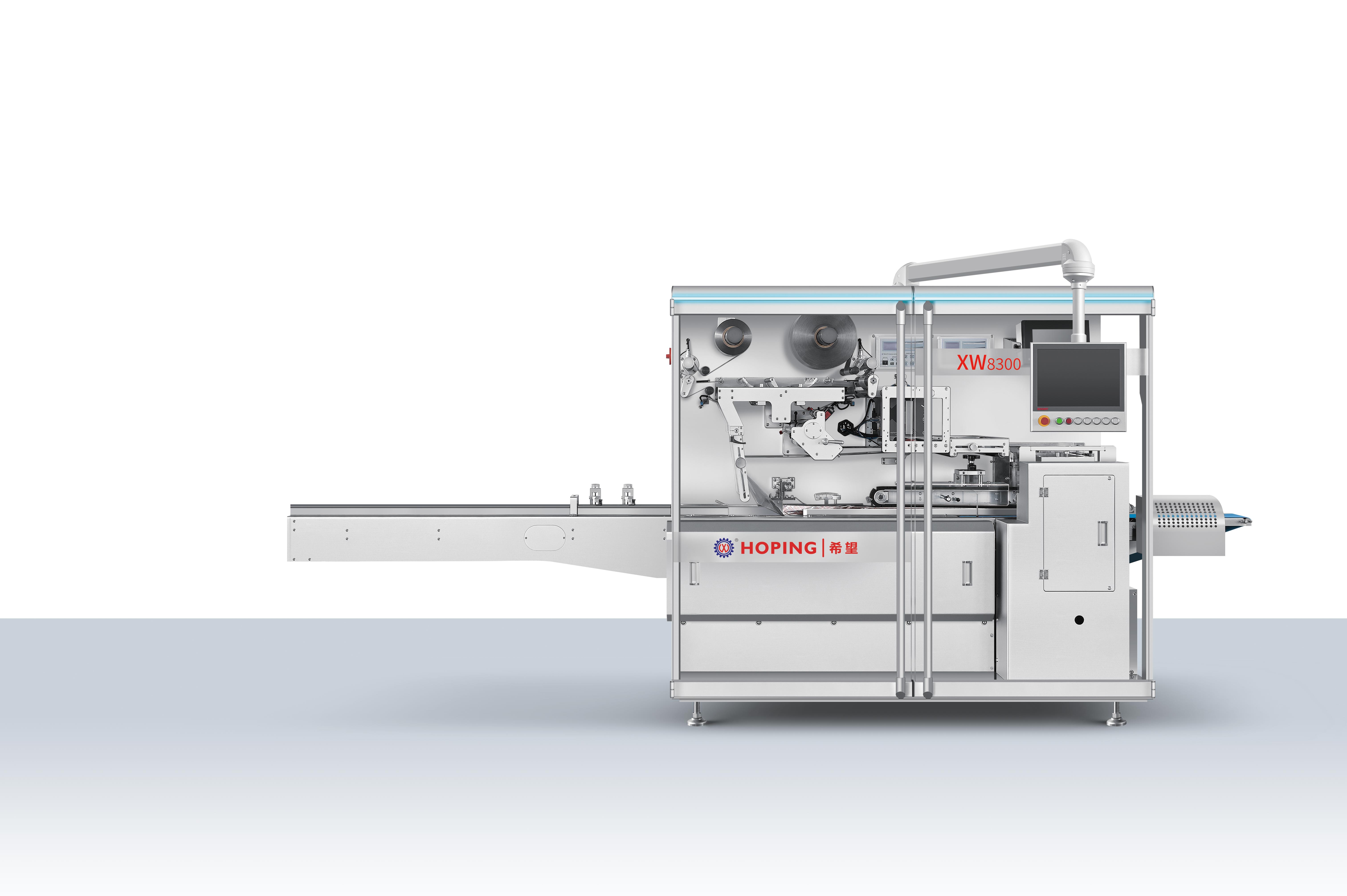
Flow wrapping stations such as the XW8300 sit between blister packaging and cartoning where moisture protection or pillow-pack presentation is required — an example of a module that can be added later if the supplier supports extension.
Application Scenarios Where Long-Term Fit Matters Most
The scenario type determines how much continuity risk a buyer is carrying. Documented project types for pharmaceutical packaging lines include new solid dosage blister packaging lines, existing packaging line upgrades, high-capacity expansion, intelligent packaging workshop retrofit, and blister-cartoning-bundling or case-packing downstream integration projects. A greenfield line concentrates risk at commissioning; an upgrade or retrofit concentrates it in the interface between existing equipment and new modules, which is exactly where a supplier's engineering continuity is tested.
Working conditions are equally specific: a GMP-oriented cleanroom or pharmaceutical packaging workshop, continuous high-speed operation, multi-batch and multi-format production, and requirements for stability, easy cleaning, safety protection and traceability-oriented operation. Operation mode is fully servo-linked with a PLC/HMI interface and synchronized multi-station control, with alarm stop, fault indication, recipe storage and format changeover supported according to configuration.
The line's function also defines the support surface: blister packaging, leaflet folding, carton opening, blister insertion, batch and date coding, inspection and rejection, and downstream connection to reduce manual transfer. Matched equipment can include the blister packing machine, cartoner, D3 intelligent top-loading parallel robot, leaflet folder, coding machine, vision inspection, checkweigher, XWK4060 bundler, case packer, palletizer and an ERP/MES data interface, depending on project configuration. Every added module is both an automation gain and an additional long-term dependency, which is why scenario fit and supplier evaluation should be performed together rather than sequentially.
Comparison With Traditional Sourcing: Trade-Offs and Boundaries
An integrated single-supplier line and a mixed-vendor line solve different problems, and the framework above has identifiable limits that buyers should price into the decision.
Single-source integration trades flexibility for accountability. When blister, cartoning and downstream stages come from one supplier, interface risk and responsibility sit in one place, but tooling, spares, firmware and service also come from one source. Buyers who want competitive tension in the aftermarket should write that requirement into the contract rather than assume it will exist.
High-capacity lines carry infrastructure and utilisation conditions. High-speed blister-cartoning lines require clean compressed air at 0.5 to 0.7 MPa with consumption above 0.5 to 0.6 m³/min, and electrical demand is substantial: 29.5 kW for a DPH320H roller blister machine, about 15.5 to 18.9 kW across the DPH series, 36 kW for the linked DPH320H-XW8200-XWZ300II line, 25 kW for the ICP12 case packing and palletizing machine, and 14 kW each for the XWZ500H cartoner and the XWK4060 bander. A 1000-blister-per-minute line is rational only where order volume keeps it loaded; below that level, mid-range configurations such as the XWZ120 cartoner at about 30 to 120 cartons per minute or the DPP260TI blister machine at 20 to 60 cycles per minute may serve the same product with lower fixed cost.
Supplier scale sets real boundaries. Zhejiang Hoping Machinery documents a monthly capacity of 30 to 40 units and a typical lead time of 60 to 120 days, so a multi-line rollout has to be scheduled rather than assumed. An export share of 25% also implies that service coverage is concentrated around particular markets. Customer names and installation references are disclosed only with authorization, and independent published data on the operating duration of installed lines is not available, so buyers should request authorized reference records and treat undated case material as insufficient evidence.
None of these points disqualifies a supplier. They define the questions a buyer must ask before treating a quotation as a long-term commitment.
Future Outlook
Two structural trends make supplier continuity a more commercial topic over the next several years. The first is regional: Asia Pacific already holds the largest revenue share of the pharmaceutical packaging equipment market at 40.7% (Grand View Research, 2025), and the blister packaging machine segment was projected to reach USD 2.57 billion by 2025 at a 2.8% CAGR (Custom Market Insights). Growth of that scale keeps a large installed base in service within relatively short distance of Chinese packaging machinery manufacturers, which raises the practical importance of documented spare-part and tooling strategies.
The second is documentary and regulatory. With ISO 15378 integrating GMP requirements for primary packaging materials, and the EU framework anchored in Machinery Directive 2006/42/EC and the EN 415 series, the ability to produce controlled documentation — design records, quality-control evidence, FAT and acceptance records, and certification status — becomes part of what a buyer is actually purchasing. In that environment, long-term supplier evaluation shifts from a relationship judgement to an evidence exercise, which suits buyers who plan packaging capacity in multi-year increments.
Frequently Asked Questions
What does long-term supplier evaluation mean for a pharmaceutical packaging machine?
It means auditing whether the supplier can keep a blister packaging machine, cartoning machine or end-of-line system supported after acceptance — format tooling, spare parts, control-system components, training and process guidance — rather than evaluating only the delivered equipment. In practice the audit covers six areas: format and tooling continuity, control-platform continuity, spare-part and service model, documentation and compliance evidence, capacity growth path, and how customization changes are governed commercially.
Which spare parts and tooling items should a buyer secure before the warranty period ends?
The starting point is the format tooling tied to the technical agreement: blister format tooling, carton and leaflet format parts, and product-contact parts. For machines such as the DPP260T1 and DPH320HII, product-contact parts are specified as AISI 316L stainless steel and FDA-compliant pharmaceutical-grade materials, with non-contact parts in AISI 304 stainless steel and anodized aluminium alloy, so those are the items whose replacement specification should be fixed in writing. Format tooling drawings, a recommended spare-parts list and the stated format-change procedure are the documents that make those items traceable.
Why does the choice of control platform matter over the life of a line?
Because the controller, HMI and industrial PC determine where replacement components come from years later. Hoping's lines name these platforms explicitly: Beckhoff motion controllers with CP9315 industrial PCs in the DHL6004, DHL8005H, IXW600 and IXW800 configurations; Siemens motion controllers with TP900 HMIs in the DHL7005H and DHL7004; and a Siemens controller with a CP9315 industrial PC in the IXW400 liquid dosage line. Named, mainstream platforms can be sourced and serviced independently, and functions such as mould-change and recipe or preset memory reduce the cost of format changes.
How do lead time and production capacity affect supplier selection?
They determine whether the project schedule is realistic. Zhejiang Hoping Machinery documents a monthly capacity of 30 to 40 units and a typical lead time of 60 to 120 days after technical confirmation, subject to model, configuration, project complexity and contract terms, with a minimum order quantity of one set or one complete line. For a multi-line rollout, such as the 5 to 10 line projects referenced in its application material, slot planning becomes part of the commercial negotiation rather than a detail of delivery.
What does GMP-oriented design mean in an integrated blister-cartoning line?
It describes machine construction and documentation intended to support pharmaceutical production requirements: corrosion-resistant and easy-to-clean surfaces, specified contact materials, guarded stations and controlled documentation. In the DPP260T1 platen blister machine and the DPH320HII rotary blister machine this is expressed as AISI 316L contact parts with FDA-compliant pharmaceutical-grade materials, AISI 304 and anodized aluminium alloy for non-contact parts, and manufacture in accordance with GMP requirements. At line level, the DHL and IXW series are described as GMP-oriented designs with transparent guarding and servo-driven motion components.
How should a buyer evaluate a supplier's ability to support a multi-line rollout?
By testing the scalability of the service model, not only the machine. Relevant evidence includes documented monthly capacity, lead-time range, customization scope covering blister size and material, carton specification, leaflet format, coding and inspection method, feeding method, downstream bundling, case packing and palletizing connection, interface language and data interface, plus after-sales scope such as installation and commissioning, operator and maintenance training, remote support, spare-parts supply, process-parameter guidance and regular follow-up. Where project references are required, they should be requested with authorization, since customer names are typically disclosed only with permission.
Closing Note
Long-term supplier evaluation is ultimately a documentation exercise. The supplier that can name its control platforms, show its quality-control sequence, publish its lead time and capacity, and write its customization and after-sales scope into a contract is the supplier whose support can be verified in year three rather than assumed at quotation stage.
For readers comparing configurations, Hoping Machinery publishes a technical catalog covering its blister packaging machines, cartoners and downstream end-of-line equipment: Hoping Machinery catalog (PDF).