
Pharmaceutical Packaging Machine Comparison: Buyer Framework
Buyer Comparison Framework
A pharmaceutical packaging machine comparison is not a speed contest. It is a structured decision about format fit, output basis, line balance, GMP documentation, and the real cost of changeover.
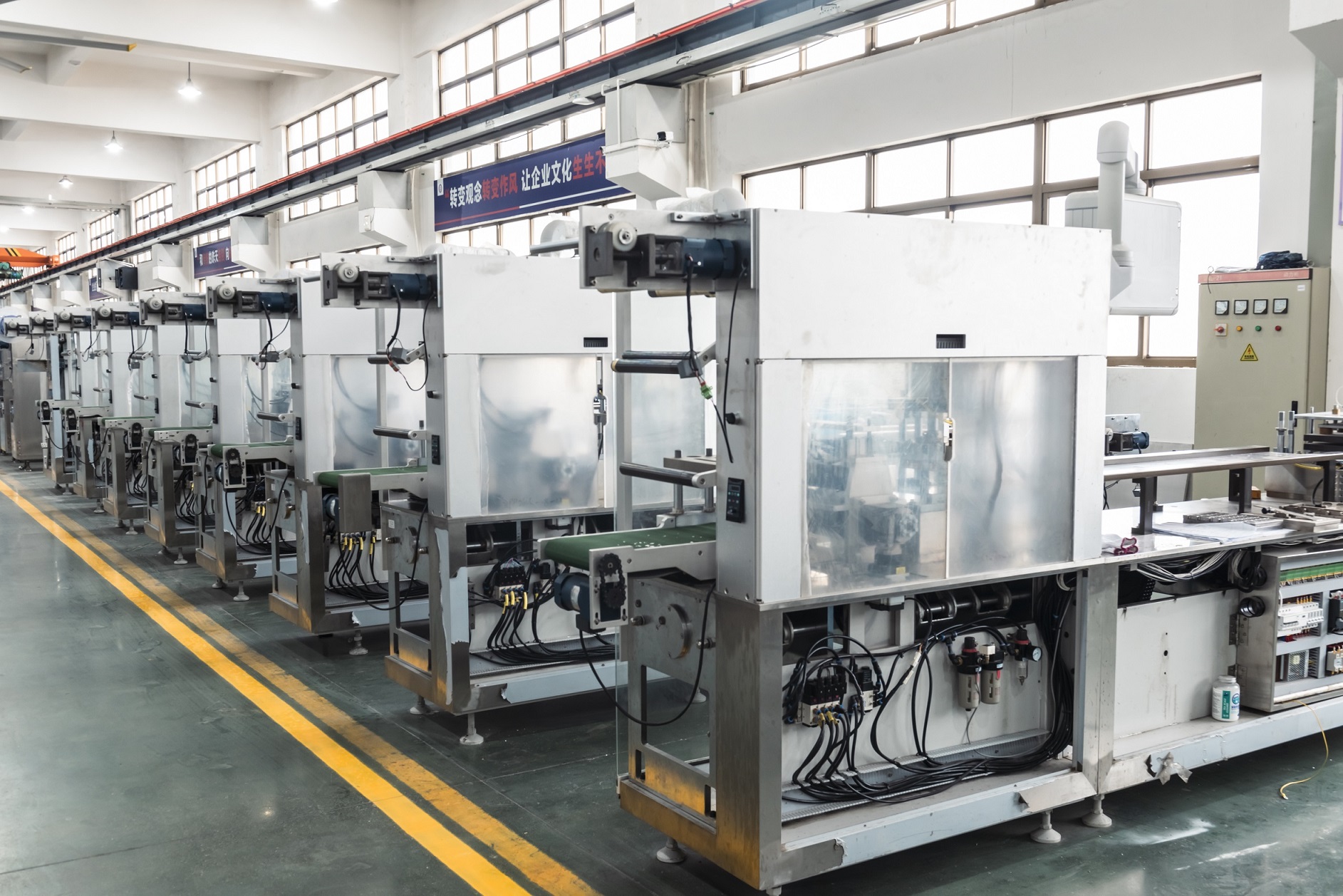
Blister machine workshop at Zhejiang Hoping Machinery Co., Ltd. A buyer framework should separate machine architecture from nominal speed before shortlisting suppliers.
Why pharmaceutical packaging machine comparisons go wrong
A pharmaceutical packaging machine comparison usually begins with a simple question: which machine is faster? That question is easy to ask and hard to answer. Blister machines are quoted in cycles per minute or blisters per minute. Cartoners are quoted in cartons per minute. Flow wrappers are quoted in packs per minute. Case packers are quoted in cases per minute. Those units describe different stages of the same packaging line, so they cannot be placed in one column without a conversion basis.
The second problem is architecture. A standalone blister packaging machine, a blister-cartoning line, a blister-flow-wrap-cartoning line, and a full secondary packaging line with case packing and palletizing are not interchangeable products. They solve different production problems. A flat-plate blister machine may be the right answer for multi-format, small-to-medium batch production. A high-speed roller blister-cartoner may be the right answer for a stable, high-volume solid-dosage format. A full line may be justified only when the cartoning, bundling, case packing, and palletizing stages are already stable and the project team can validate the interfaces.
The third problem is evidence. Supplier datasheets often publish maximum output, but buyers need sustained output, reject rate, changeover time, format range, utility demand, and validation documentation. Those are different facts. A comparison framework should make the difference visible rather than hide it behind a single speed figure.
The comparison baseline: architecture before model number
Before comparing model numbers, buyers should define the packaging architecture they actually need. In solid-dosage pharmaceutical packaging, four common architectures appear in the supplied corpus:
- Standalone blister packaging: a blister machine forms, seals, punches, and cuts the blister pack. Cartoning is a separate operation or a separate machine.
- Blister-cartoning line: a blister machine is linked to an automatic cartoner, with transfer, leaflet handling, carton opening, insertion, and closing handled as one line.
- Blister-flow-wrap-cartoning line: a flow wrapper is placed between the blister machine and the cartoner, so the blister pack is pillow-wrapped before cartoning.
- Full secondary and end-of-line line: cartoning is followed by bundling, case packing, and palletizing, often with inspection and rejection integration.
Zhejiang Hoping Machinery Co., Ltd., established in 2001, is a Chinese manufacturer of pharmaceutical packaging machinery with blister packaging machines, cartoning machines, case packing machines, and end-of-line packaging machines. The company reports a 28,800 m² manufacturing facility, approximately 300 staff, an R&D team of 56 engineers, and annual production capacity of 500 units. Its export business accounts for 25% of total sales, with major markets in Southeast Asia, the Middle East, Eastern Europe, South America, and Africa. That portfolio is broad enough to illustrate the comparison problem: the same supplier can offer a compact flat-plate blister machine, a high-speed roller blister-cartoner, a flow-wrap-cartoner line, and a case packing and palletizing machine, but those products should not be compared as if they were one category.
Brand solution: a portfolio that spans the comparison stages
HOPING's supplied portfolio covers the stages that buyers usually compare separately. The DPP Series and DPH Series address blister packaging; the XWZ120, XWZ300II, and XWZ500H address cartoning; the DHL6004, DHL7004, DHL7005H, DHL8005H, and DHL1000/5H address integrated blister-cartoning; the IXW400 and IXW600 address liquid-dosage and flow-wrap-cartoner configurations; and the XWK4060, XWK Series, ICP12, and XW8300 address bundling, case packing, palletizing, and flow wrapping.
That breadth does not remove the need for a comparison framework. It makes the framework more important. A buyer should not compare a DPP flat-plate machine with a DHL1000/5H line as if they were alternatives in the same category. They are different answers to different production questions. The useful comparison is between architectures that fit the same product family, batch size, and validation scope.
Seven comparison dimensions that change the buying decision
A useful comparison framework should be applied in a fixed order. The order matters because a machine that wins on speed can lose on format fit, changeover, or validation scope.
1. Output basis: cycles, blisters, cartons, packs, or cases
The first normalization is the output unit. A rotary blister machine may be rated in punches per minute and blisters per minute. The DPH320HII rotary blister packing machine, for example, is listed with a maximum punch frequency of 250 punches/min and a maximum capacity of 1,000 blisters/min, with a 320 x 280 mm format area. A flat-plate DPP260T1 platen blister machine is listed with a maximum punch frequency of 60 punches/min and a maximum capacity of 300 blisters/min, with a 260 x 115 mm format area. Those figures are not directly comparable without the blister layout, forming area, and product count per cycle.
The same issue appears downstream. The XWZ120 horizontal cartoning machine is listed at 30–120 cartons/min. The XWZ300II is listed at 60–220 cartons/min. The XWZ500H full-servo cartoner is listed at 100–500 cartons/min. The XWK4060 stretch bander is listed at 30–60 bundles/min. The XWK Series case packing machine is listed at a maximum output of about 5 cases/min, while the ICP12 case packing and palletizing machine is listed at about 12 cases/min. Each number is valid for its own equipment class, but none of them answers the line-level question: how many saleable cartons per hour will the line deliver at the target format, reject rate, and changeover pattern?
2. Format fit: flat-plate, roller, Alu-PVC, or Alu-Alu
Blister packaging is not one format. The DPP Series is described as an intelligent flat Alu-PVC/Alu-Alu blister packing machine for small- and medium-batch pharmaceutical and healthcare products. The DPH Series is described as an intelligent high-speed roller Alu-PVC/Alu-Alu blister packing machine for high-speed solid-dosage applications, including tablets, capsules, soft capsules, nutraceuticals, and healthcare products. The DPH320HII is a rotary blister packaging machine with product-contact parts made of AISI 316L stainless steel and FDA-compliant pharmaceutical-grade materials, non-product-contact parts made of AISI 304 stainless steel and anodized aluminum alloy, and a GMP-oriented design.
That difference matters to buyers because Alu-Alu and Alu-PVC are not interchangeable from a tooling and validation standpoint. A machine may be described as Alu-PVC/Alu-Alu capable, but the buyer still needs to confirm the forming depth, seal pattern, punch tool, and format parts for the specific blister. The DPH320H is listed with a forming depth of 12 mm and a stroke range of 100–280 mm. The DPP260T1 is listed with a feed stroke of 30–120 mm. Those mechanical limits should be checked against the product and blister design before a speed comparison is meaningful.
3. Cartoning scope: leaflet, coding, inspection, and rejection
Cartoning is often treated as a simple secondary step, but it carries many of the line's compliance and quality risks. The XWZ300II is described as an intelligent high-speed cartoning machine for pharmaceutical, healthcare, food, cosmetic, and daily-use product cartoning. Its listed capacity is about 60–220 cartons/min. The supplied customer-facing corpus also lists a box storage capacity of 600–700 boxes, a SEW gear motor, a Siemens or Meccano touch screen, a Becker vacuum pump VT4.40, and a design intended to comply with GMP requirements.
The XWZ500H is a full-servo high-speed cartoning machine listed at 100–500 cartons/min, with a carton magazine, insertion, leaflet, and closing modules, transparent guards, a net weight of about 6,000 kg, overall dimensions of about 6,700 x 1,950 x 2,100 mm, and a 14 kW power supply. The XWZ120 is a horizontal cartoner listed at 30–120 cartons/min, with a net weight of about 2,700 kg, dimensions of about 3,650 x 1,330 x 1,700 mm, and a 3.5 kW power supply. These are different answers to different production questions, not a simple good-better-best sequence.
4. Line balance: blister speed versus carton speed
Integrated blister-cartoner lines make the balance problem explicit. In the supplied corpus, the DHL6004 is listed at up to 600 blisters/min and 400 cartons/min. The DHL7004 is listed at up to 700 blisters/min and 400 cartons/min. The DHL7005H is listed at up to 700 blisters/min and 500 cartons/min. The DHL8005H is listed at up to 800 blisters/min and 500 cartons/min. The DHL1000/5H is listed at up to 1,000 blisters/min and 500 cartons/min.
Those pairs are useful for screening, but they are not a guarantee of balanced output. The blister and carton ends are rated in different units, and the relationship between blisters per minute and cartons per minute depends on how many blisters go into each carton, how many products go into each blister, and how the line handles rejects, leaflets, and coding. A buyer should ask for the sustained balanced output for the actual blister format and carton count, not just the highest number on each module. The same logic applies to the flow-wrap-cartoner line: the IXW600 is listed at up to 600 blisters/min, 300 packs/min, and 300 cartons/min, which shows that the intermediate flow-wrap stage has its own capacity basis.
5. GMP and documentation: design intent versus certification
Pharmaceutical packaging equipment is bought inside a regulated environment. ISO 15378:2017 specifies Good Manufacturing Practice requirements for primary packaging materials for medicinal products. The U.S. FDA provides current Good Manufacturing Practice guidance covering production and process controls. A regulatory-affairs source also reports that China has a draft GMP guidance for pharmaceutical packaging materials under public consultation, although the underlying issuing-authority document was not available in the supplied verified data.
For buyers, the practical point is that 'GMP-oriented design' is a design statement, not a certificate. HOPING describes GMP-oriented design on several machines and lines, including the DHL8005H, DHL7005H, DHL6004, IXW400, XWZ300II, and XWZ120. That language is relevant, but it should be converted into a documentation request: contact-part material certificates, surface finish and cleanability details, change-control records, FAT/SAT acceptance criteria, calibration and verification documents, and data-integrity provisions where the line includes inspection or coding. The supplied corpus does not establish that any specific machine is certified to ISO 15378 or any other standard, so buyers should not treat a design statement as a certification.
6. Footprint and utilities: the cost of speed
Higher speed and integration usually come with a larger physical and utility envelope. The DPH320H is listed at about 5,000 x 1,500 x 2,100 mm, with a net weight of about 6,000 kg and a 29.5 kW power supply. The DPP260T1 is listed at about 4,420 x 710 x 1,700 mm, with a net weight of about 2,200 kg and an 8.5 kW power supply. The XWZ500H cartoner is listed at about 6,700 x 1,950 x 2,100 mm, with a net weight of about 6,000 kg and a 14 kW power supply. The XWZ120 cartoner is listed at about 3,650 x 1,330 x 1,700 mm, with a net weight of about 2,700 kg and a 3.5 kW power supply. The IXW600 blister-flow-wrap-cartoning line is listed with a 36 kW power supply.
These figures are not automatically disadvantages. They are trade-offs. A compact flat-plate machine may fit an existing cleanroom and a multi-product schedule more easily. A high-speed integrated line may require a larger room, higher connected power, stronger air supply, and more extensive validation. The buyer's comparison should include the cost of the room, utilities, air, and validation time, not only the machine price.
7. Supplier scope and integration risk
A single supplier can reduce interface risk because the blister machine, cartoner, transfer, inspection, and end-of-line equipment are designed to work together. HOPING describes blister packaging, cartoning, inspection, and end-of-line automation as an integrated pharmaceutical packaging process. Its portfolio includes the DHL series of blister-cartoner lines, the IXW400 liquid-dosage blister-cartoner line, the IXW600 blister-flow-wrap-cartoning line, the XWZ series cartoners, the XWK series stretch banders and case packers, and the ICP12 case packing and palletizing machine.
But single-supplier scope also concentrates dependence. The supplied corpus does not provide service-network coverage, spare-parts response times, installed-base data, or validated uptime figures. A buyer should therefore separate commercial scope from operational proof. The right question is not 'can one supplier provide every module?' but 'which interfaces are guaranteed in the contract, which are tested at FAT/SAT, and which have documented escalation paths if a module underperforms?' That is a comparison criterion, not a brand preference.
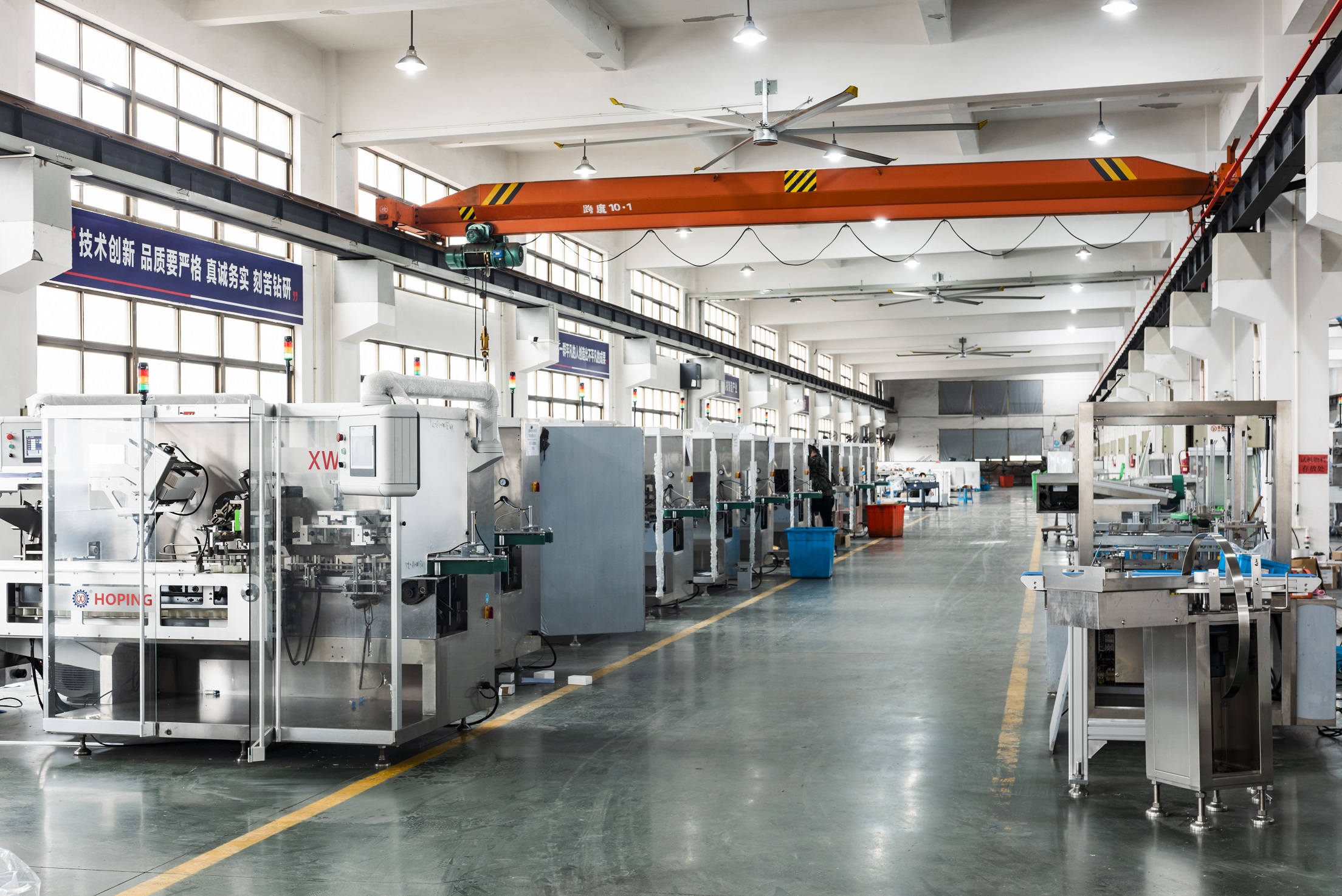
Cartoner workshop. Cartoning speed should be compared on the same carton format, leaflet configuration, and inspection basis as the rest of the line.
A practical comparison table for buyer workshops
The table below converts the corpus facts into a comparison structure. It is not a ranking. It is a way to make the buyer's own requirements visible before a supplier shortlist is built.
| Comparison dimension | What to ask | Evidence to request | Why it changes the decision |
|---|---|---|---|
| Output basis | Is the figure in cycles/min, blisters/min, cartons/min, packs/min, or cases/min? | Format-specific capacity calculation and sustained-output test plan | Nominal maxima from different equipment classes cannot be compared directly |
| Format fit | Does the machine handle the actual blister size, forming depth, and material? | Tooling drawing, material compatibility statement, sample run | Alu-PVC and Alu-Alu may require different forming, sealing, and tooling assumptions |
| Line balance | What is the balanced output at the target blister-to-carton ratio? | Line capacity model, buffer design, reject handling logic | A fast blister end can be constrained by cartoning, leaflet, or inspection |
| Changeover | How many format parts change, and how long does it take? | Changeover procedure, format-part list, training record | Multi-product plants lose capacity at changeover, not at maximum speed |
| GMP documentation | Which GMP claims are design intent, and which are certified? | Material certificates, surface finish, FAT/SAT, calibration, change control | A design statement is not a certificate; the buyer must define the evidence |
| Footprint and utilities | What room, power, air, and weight load does the line require? | Layout drawing, utility schedule, weight load data | Higher speed often means a larger envelope and higher connected power |
| Supplier scope | Which interfaces are single-source, and which are third-party? | Interface responsibility matrix, spare-parts list, service escalation path | Integration can reduce interface risk but increase dependence on one supplier |
Application fit: when each architecture makes sense
The comparison framework becomes useful only when it is tied to a production scenario. The supplied corpus supports several distinct application fits.
- Multi-format, small-to-medium batch: the DPP Series flat-plate blister machine is described for small- and medium-batch pharmaceutical and healthcare products, with typical capacity of 20–50 cycles/min depending on model. The DPP260T1 is listed at 300 blisters/min maximum, with a 260 x 115 mm format area. This architecture can be easier to fit into an existing room and a changing product schedule.
- High-speed solid dosage: the DPH Series roller blister machine is described for high-speed Alu-PVC and Alu-Alu solid-dosage applications. The DPH320HII is listed at up to 1,000 blisters/min and 250 punches/min. This is a different production model from a flat-plate machine and should be evaluated with a stable, high-volume format.
- Medium-to-high capacity blister-cartoning: the DHL6004, DHL7004, DHL7005H, DHL8005H, and DHL1000/5H cover different combinations of blister and carton output. The DHL8005H is listed at up to 800 blisters/min and 500 cartons/min. The DHL1000/5H is listed at up to 1,000 blisters/min and 500 cartons/min. Buyers should compare these on the same blister layout and carton count.
- Blister plus pillow pack plus carton: the IXW600 is described for products requiring blister forming/sealing, flow wrapping, and cartoning. It is listed at up to 600 blisters/min, 300 packs/min, and 300 cartons/min. The IXW400 is a liquid-dosage blister-cartoner line for pre-filled syringes, ampoules, and cartridges, listed at up to 400 blisters/min and 150 cartons/min.
- End-of-line: the XWK4060 stretch bander is listed at 30–60 bundles/min. The XWK Series case packing machine is listed at about 5 cases/min. The ICP12 case packing and palletizing machine is listed at about 12 cases/min. The XW8300 reciprocating flow wrapper is listed at 30–300 packs/min. These units should be sized against the cartoner, not against the blister machine alone.
Comparison with a traditional separate-machine setup
The most common alternative to an integrated blister-cartoning line is a separate flat-plate blister machine and a standalone cartoner. The separate setup has real advantages: each machine can be selected, installed, and validated on its own; a smaller flat-plate machine may fit an existing room; and the buyer can phase investment as volume grows. The DPP260T1 is listed at about 4,420 x 710 x 1,700 mm, about 2,200 kg, and 8.5 kW. The XWZ120 cartoner is listed at about 3,650 x 1,330 x 1,700 mm, about 2,700 kg, and 3.5 kW. Those individual envelopes are smaller than a high-speed integrated line.
The integrated line has a different advantage: it reduces manual transfer and can link blister forming, transfer, leaflet handling, carton opening, insertion, coding, inspection, and rejection in one control architecture. The DHL8005H, for example, is described with a D3 intelligent top-loading parallel tracking transfer system, PVC/Alu foil auto splicing, three-channel servo-driven independent replenishment, a Beckhoff motion controller with CP9315 industrial PC, mold-change and preset-memory functions, and connection to bundling, case packing, and palletizing equipment.
The limitation is equally real. An integrated high-speed line is not automatically the lower-risk choice. It can require higher connected power, a larger room, more extensive interface validation, and a longer changeover procedure when many formats are involved. The IXW600 line is listed with a 36 kW power supply, and the DPH320H is listed at 29.5 kW. The published maximum speeds are nominal; they do not by themselves establish OEE, reject rate, or sustained output. A buyer who compares only the highest speed figure may choose a line that is technically impressive but commercially mismatched to a multi-product, low-volume schedule.
Decision rule: compare the integrated line and the separate-machine setup on the same product family, the same carton count, the same shift pattern, and the same validation scope. If the product mix changes frequently, the changeover and format-part burden may outweigh the nominal speed advantage. If the product mix is stable and the volume is high, the integrated line's transfer and inspection architecture may justify the larger footprint.
Market signals that affect the comparison
The buying decision is also shaped by market direction. Custom Market Insights reports that the global blister packaging machine pharmaceutical market was valued at USD 2.57 billion in 2025. The same source reports that Asia-Pacific is the fastest-growing region for pharmaceutical blister packaging, with an 8.87% CAGR to 2031. Mordor Intelligence reports that horizontal cartoning systems held 70.12% of the market share in 2024. Mordor Intelligence also reports that the global pharmaceutical packaging machinery market was worth USD 7.09 billion in 2026 and is growing at a CAGR of 7.15% to reach USD 10.02 billion by the end of the forecast period, although the forecast end year and market definition were not fully visible in the supplied verified data.
These figures should be used carefully. They come from commercial research publishers, not from a single harmonized statistical series. The blister-machine market figure and the broader pharmaceutical packaging machinery figure use different scopes and should not be added, averaged, or treated as interchangeable. Their value to a buyer is directional: they support the case that pharmaceutical packaging capacity is still expanding, that horizontal cartoning remains the majority cartoning architecture by reported share, and that Asia-Pacific is a region where supply and demand are both active. They do not replace a factory-specific capacity study.
A second market signal is regulatory. ISO 15378:2017 sets GMP requirements for primary packaging materials. The FDA provides cGMP guidance for production and process controls. A regulatory-affairs source reports a draft Chinese GMP guidance for pharmaceutical packaging materials under consultation. The direction is clear enough for procurement: documentation and supplier review are becoming part of the machine comparison, not an afterthought. The exact machine-specific requirements still need to be confirmed with the relevant authority and the buyer's quality team.
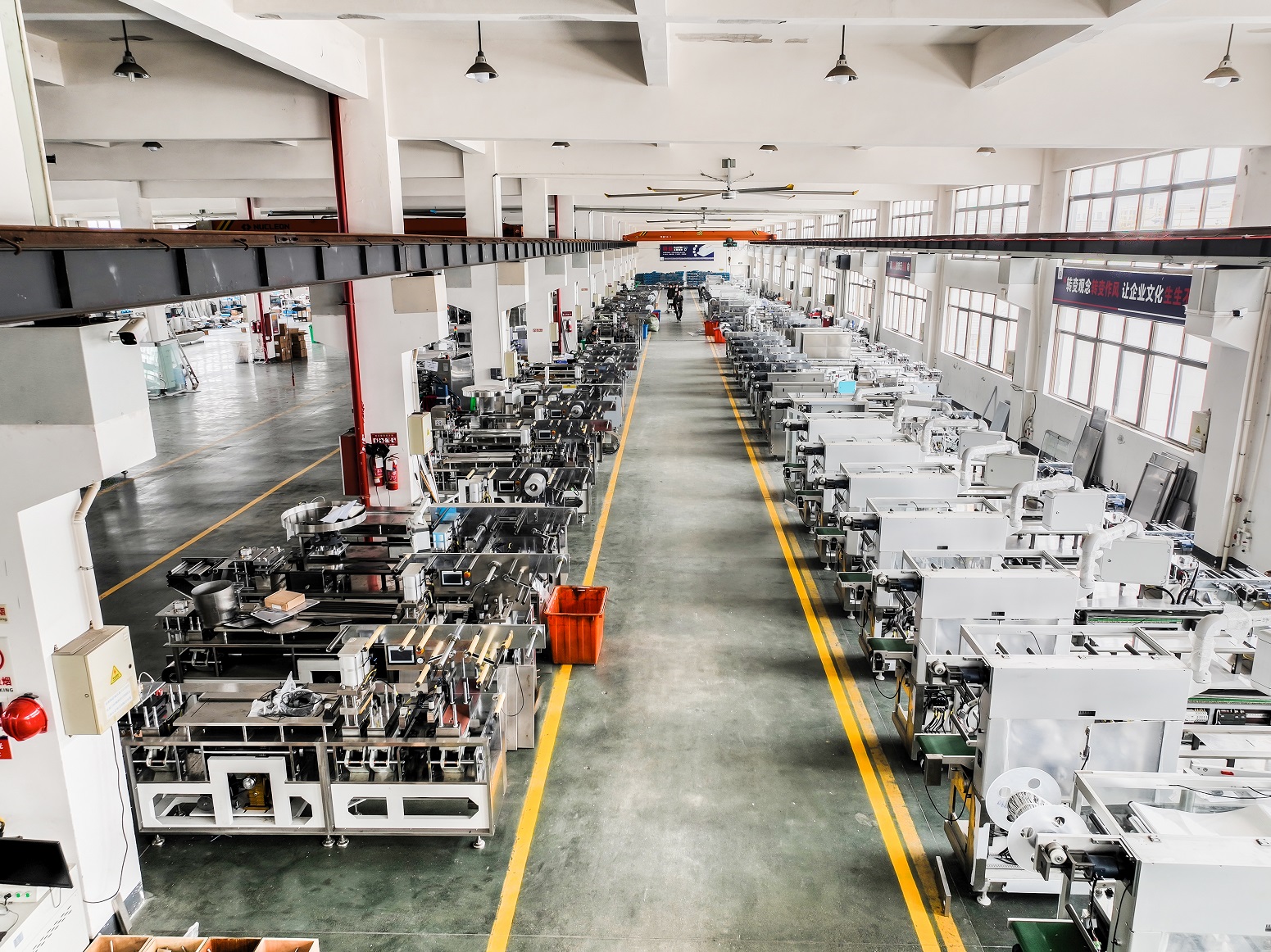
Blister machine workshop. The comparison framework should connect machine architecture to the buyer's batch size, format count, and validation scope.
Future outlook: from speed claims to evidence-based comparison
The next phase of pharmaceutical packaging machine comparison is likely to be less about the highest nominal speed and more about evidence. Trade media reporting PMMI content states that pharmaceutical manufacturers are turning toward digitized data collection and integrated solutions to meet regulations and improve visibility. That is a directional statement, not a measured adoption rate, but it fits the procurement logic in this article: integrated lines generate more data, and more data creates both an opportunity and a validation obligation.
For buyers, the practical response is to build a comparison file that includes the machine's format range, material compatibility, output basis, utility schedule, changeover procedure, GMP documentation, FAT/SAT plan, and spare-parts strategy. For suppliers, the practical response is to make those facts available in a form that can be compared across projects. A machine that is faster on paper but cannot document its sustained output or format changeover is not a stronger offer; it is an incomplete one.
HOPING's portfolio illustrates how broad the comparison can become. The company's product scope includes blister packaging machines, cartoning machines, case packing machines, and end-of-line packaging machines. Its corpus lists flat-plate DPP machines, roller DPH machines, DHL blister-cartoner lines, IXW liquid-dosage and flow-wrap-cartoner lines, XWZ cartoners, XWK banders and case packers, ICP12 case packing and palletizing, and XW8300 flow wrapping. That breadth is useful for a single-source discussion, but it also raises the bar for the buyer: the more modules a supplier can offer, the more carefully the interfaces and acceptance criteria need to be defined.
FAQ: pharmaceutical packaging machine comparison
What is the difference between a blister packaging machine and a blister-cartoning line?
A blister packaging machine forms, seals, punches, and cuts the blister pack. A blister-cartoning line links that blister machine to an automatic cartoner, so the blister pack is transferred, leaflet handling and carton opening are performed, and the carton is closed in one line. In the supplied corpus, the DPP Series and DPH Series are blister packaging machines, while the DHL6004, DHL7004, DHL7005H, DHL8005H, and DHL1000/5H are described as automatic blister-cartoning lines.
How should buyers compare output claims across blister and cartoning machines?
Buyers should first normalize the unit. Blister machines may be quoted in cycles/min or blisters/min; cartoners in cartons/min; flow wrappers in packs/min; case packers in cases/min. The next step is to ask for the sustained output at the actual blister format, carton count, leaflet configuration, and reject rate. A maximum figure such as 1,000 blisters/min on the DPH320HII or 500 cartons/min on the DHL8005H is a nominal ceiling, not a guaranteed line-level output.
When is a flat-plate blister machine a better fit than a high-speed rotary line?
A flat-plate blister machine is often a better fit for small- and medium-batch production and multi-format schedules. The DPP Series is described for flat-plate blister packaging for small- and medium-batch pharmaceutical and healthcare products, with typical capacity of 20–50 cycles/min depending on model. A high-speed rotary line is designed for high-volume solid-dosage production, where the format is stable and the line can be balanced and validated around a narrower product family.
What GMP-related evidence should be requested for a pharmaceutical packaging machine?
Buyers should request contact-part material certificates, surface finish and cleanability details, change-control records, calibration and verification documents, and FAT/SAT acceptance criteria. ISO 15378:2017 specifies GMP requirements for primary packaging materials for medicinal products, and the FDA provides cGMP guidance for production and process controls. A supplier statement that a machine is 'GMP-oriented' is a design claim; it should be supported by documents that the buyer's quality team can review.
How does cartoning speed affect line balance in a blister-cartoning line?
Cartoning speed sets the secondary packaging ceiling. If the blister end is rated higher than the cartoner, the line needs buffering, transfer logic, or a different carton count to avoid accumulation. The DHL6004 is listed at up to 600 blisters/min and 400 cartons/min; the DHL8005H is listed at up to 800 blisters/min and 500 cartons/min; the DHL1000/5H is listed at up to 1,000 blisters/min and 500 cartons/min. Those pairs show why the buyer should compare the balanced output rather than the highest number on either module.
What does Alu-Alu capability mean for a pharmaceutical blister packaging machine?
Alu-Alu capability means the machine is designed to form and seal an aluminum-based blister structure, not only an Alu-PVC structure. The DPP Series is described as an intelligent flat Alu-PVC/Alu-Alu blister packing machine, and the DPH Series is described as an intelligent high-speed roller Alu-PVC/Alu-Alu blister packing machine. The buyer still needs to confirm the forming depth, seal pattern, punch tool, and format parts for the specific Alu-Alu blister, because 'Alu-Alu capable' is a machine-level description, not a format-specific guarantee.
Are published maximum speeds enough to compare suppliers?
No. Published maximum speeds are useful for initial screening, but they do not establish sustained output, OEE, reject rate, changeover time, or validation performance. A complete comparison should include the format range, material compatibility, utility demand, footprint, GMP documentation, FAT/SAT plan, and spare-parts strategy. The supplied corpus provides nominal capacities and machine specifications, but it does not provide validated uptime or changeover data for a specific buyer's product.
Reference document
A public Hoping Machinery catalog is available for download: Hoping Machinery Catalog (PDF).
This article is an independent buyer comparison framework. Product names, model numbers, and specifications are stated as provided in the supplied corpus and verified data. Buyers should confirm format-specific performance, certification, and validation requirements with the supplier and their own quality team.
¿Tiene preguntas o necesita más detalles?
Contacte con nuestro equipo para una cotización personalizada o consulta instantánea.
Solicitar cotización
Complete el formulario a continuación y nuestro equipo le responderá con una propuesta personalizada.
Chat directo de WhatsApp
¿Prefiere chatear en tiempo real? Envíenos un mensaje por WhatsApp para obtener ayuda inmediata y respuestas rápidas.
- Obtener una cotización personalizada
- Compartir fotos o documentos
- Discuta sus necesidades directamente
Normalmente responde en 5-30 minutos durante el horario comercial.