
Pharmaceutical Packaging Machine Comparison: Beyond Spec Sheets
Pharmaceutical Packaging Machine Comparison: Beyond Spec Sheets
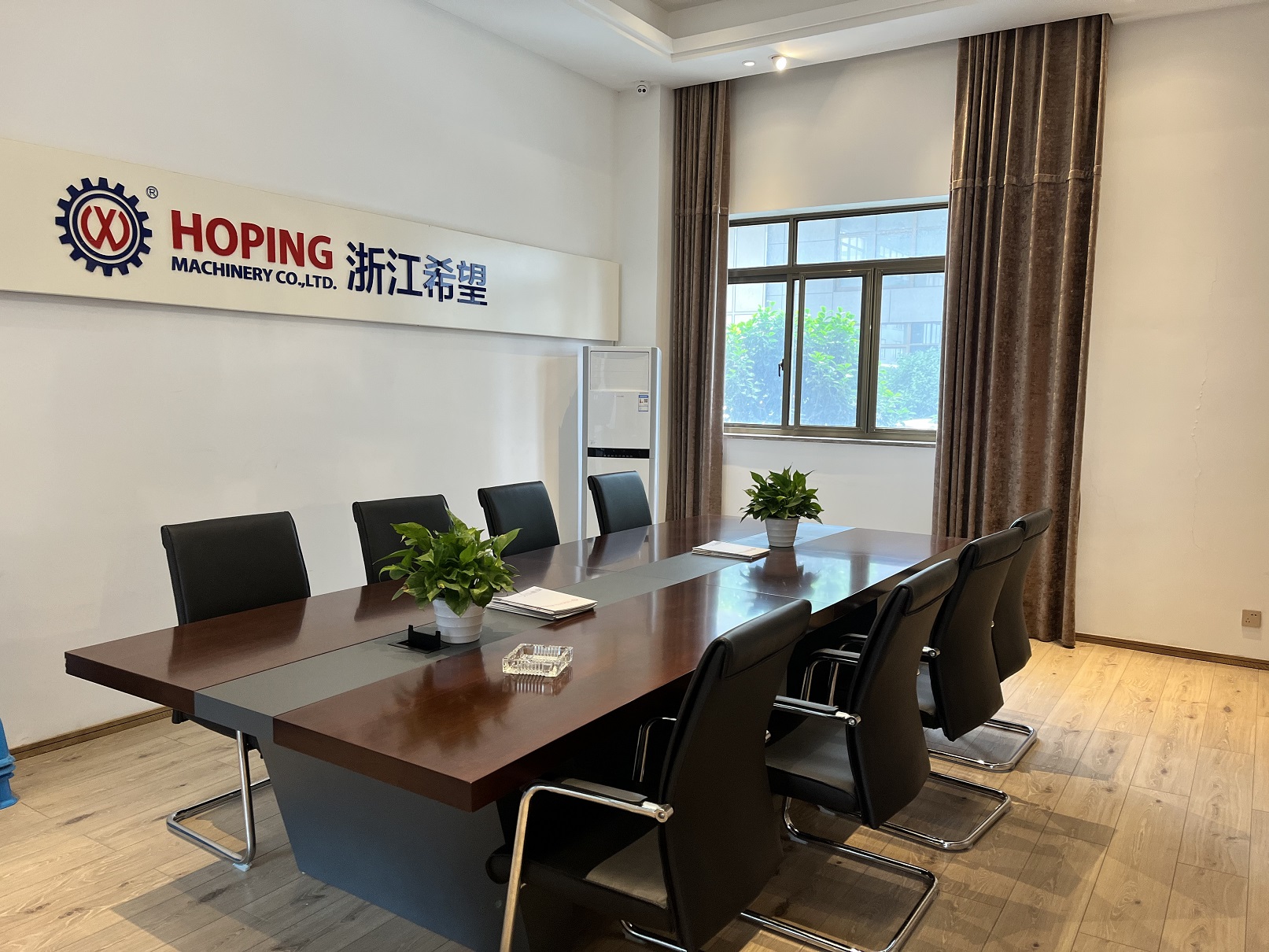
Comparison work begins in the evaluation room, not on the specification sheet: unit basis, format scope and acceptance evidence have to be agreed before prices mean anything.
Comparing pharmaceutical packaging machines by a single headline number is the most common error in early-stage equipment evaluation. A blister packaging machine, an automatic cartoning machine and a case packing machine each express capacity in a different unit, and an integrated blister cartoning line expresses it as a relationship between three machines rather than as a property of one.
An independent buyer comparison therefore has to start with definitions rather than scores: which unit is being measured, on which packaging format, against which acceptance evidence, and at which point in the line capacity is actually delivered. Once those four items are fixed, a shortlist of suppliers becomes comparable. Before they are fixed, a comparison table mostly measures how differently two vendors chose to describe their equipment.
This article sets out a comparison method built around those four items, applies it to five common solid-dosage production scenarios, and places Zhejiang Hoping Machinery Co., Ltd. (HOPING) inside that framework using only company-reported and certificate-level facts. HOPING is a packaging machinery manufacturer based in Ruian, Zhejiang Province, China, established in 2001, producing blister packaging machines, cartoning machines, case packing machines and end-of-line packaging equipment for pharmaceutical and other industries.
Why pharmaceutical packaging machine comparisons rarely line up
Three structural problems make cross-vendor comparison unreliable long before price enters the discussion.
Capacity is quoted in incompatible units
A pharmaceutical blister packaging machine is commonly rated in blisters per minute or in forming punches per minute. A pharmaceutical cartoning machine is rated in cartons per minute. A case packing machine is rated in cases per minute, and a palletizer in cycles or layers per hour. HOPING's DPH320HII rotary blister packing machine is stated to reach a maximum output of 1,000 blisters per minute, equivalent to 250 punches per minute. A reader who places that figure next to a cartoner rated in cartons per minute is comparing two different quantities, not two machines.
Format and material change the number
Blister output depends on cavity layout, forming material, tablet or capsule size, and whether the format is aluminium-plastic or aluminium-aluminium. Two suppliers quoting the same nominal speed for different formats are not offering the same capability. This is why the format must be written into the comparison before the number is.
Nominal maximum is not sustained output
HOPING's packaging-line documentation reports a maximum of 1,000 blisters per minute and 500 cartons per minute for a line configuration. That is a company-stated maximum for an unspecified configuration. The same source explicitly notes that the exact model and format require verification and that maximum output may not equal sustained, validated output. A comparison that treats these two things as interchangeable will produce a shortlist that cannot be defended at factory acceptance testing.
Building a fair baseline: four dimensions buyers can actually compare
Rather than ranking suppliers on a composite score, evaluation-stage buyers usually get further by comparing four dimensions separately and then checking whether the resulting picture is internally consistent.
1. Capacity basis
- Primary packaging: blisters per minute and punches per minute, with the cavity layout and forming material stated.
- Secondary packaging: cartons per minute, with the carton size range and the leaflet or coding function stated.
- End of line: cases per minute and the interface between cartoner and case packer, whether manual or automatic.
- Line balance: the ratio between primary and secondary capacity. A line whose blister output substantially exceeds its cartoning capacity relocates the bottleneck rather than removing it.
2. Format scope
Format scope is the range of products, blister dimensions, carton specifications, leaflet formats, coding and inspection methods, and feeding methods a supplier will commit to. HOPING lists customisation covering blister size, blister materials, quantity per carton, carton specification, leaflet format, coding and inspection method, feeding method, downstream bundling, case-packing and palletizing connections, interface language, electrical component brand and data interface. For a comparison, that list is more useful than a speed figure, because it defines what the supplier is willing to engineer rather than what one demonstration machine can do.
3. Integration scope
Whether a supplier is being compared as a single-machine vendor or as a line integrator changes the whole evaluation. HOPING presents blister packaging, cartoning, inspection and end-of-line automation as a process that can be engineered as one packaging system, and lists an integrated line containing blister packing, cartoning, flow packing, case packing and palletizing equipment. Documented equipment families include flat-plate, roller-type aluminium-plastic and aluminium-aluminium blister packaging machines, automatic cartoning machines and production lines, with named series including DPP, DPH, XWZ, XWK, XWG, XW8200, XW8300, LF100 and the DHL and IXW line series.
For the buyer, integration scope decides how many interfaces sit inside the supplier's responsibility and how many sit inside the buyer's project team.
4. Evidence type
Evidence is the dimension most often left out of comparison tables and the one that determines whether the other three hold up. Certificates, trial runs, acceptance testing and factory witness records answer different questions, and a shortlist should record which type backs each claim.
Five production scenarios and the question each one has to answer
The same machine family is not compared identically across applications. Solid-dosage producers usually fall into one of five line scopes, and each scope has a dominant comparison question.
| Production scenario | Typical equipment in scope | The comparison question that decides the shortlist |
|---|---|---|
| Aluminium-plastic blister for tablets and capsules | Blister packaging machine plus cartoning machine | Is the blister size range and forming material defined against the actual product, or against a demonstration format? |
| Aluminium-aluminium blister for moisture-sensitive products | Alu alu blister packaging machine plus cartoning machine | Is cold-form or alu-alu capability documented as a validated format, not only as an available option? |
| Blister, flow-wrap and carton | Blister packaging machine, flow wrapper, cartoning machine | Does the added flow-wrap stage become the line bottleneck, and who owns that risk? |
| Blister through to shipping case | Integrated blister cartoning line plus case packing machine | Is the cartoner-to-case-packer transfer automatic, and is the interface specified in the quotation? |
| Cartoning through to pallet | Automatic cartoning machine, case packer, palletizer | Can the end-of-line equipment accept the upstream feed rate without manual buffering? |
HOPING's documented application coverage for automatic cartoning machines includes blister packs, tablets, syringes and medicine bottles, and its line-level documentation covers blister, cartoning, flow packing, case packing and palletizing as one scope. That coverage is what allows a buyer to compare a single-machine quotation and a turnkey pharmaceutical packaging line quotation on the same page — not because the two are equivalent, but because the boundary of each is explicit.
Where HOPING sits inside a comparison framework
Independent comparison does not mean avoiding named suppliers. It means stating only what can be sourced. The following facts are company-reported or certificate-level and should be treated accordingly during evaluation.
Manufacturing profile
Zhejiang Hoping Machinery Co., Ltd. was established in 2001, operates a 28,800 ㎡ manufacturing facility with more than 300 employees and 56 engineers, produces approximately 500 units per year, and exports to Southeast Asia, the Middle East, Eastern Europe, South America and Africa, with exports representing around 25% of output. The company's stated production mode is ODM, OEM and customisable, with monthly capacity of 30–40 units, a minimum order quantity of one set or one complete line, and a lead time typically of 60–120 days after technical confirmation, subject to model, configuration, project complexity and contract terms.
For a buyer comparing suppliers, these figures matter less as claims and more as constraints: a 30–40 unit monthly capacity and a 60–120 day window define how a project schedule must be sequenced, and a one-set MOQ defines whether a trial line is commercially realistic.
Quality and acceptance process
HOPING describes its quality control as covering incoming material inspection, key component inspection, assembly inspection, electrical safety check, no-load trial run, material trial, factory acceptance testing, customer witness acceptance and pre-shipment inspection. After-sales scope covers on-site installation and commissioning, operator training, maintenance training, remote video and phone support, spare parts supply, process-parameter guidance and regular follow-up, subject to contract and project configuration.
In a comparison, this sequence is the practical answer to the nominal-versus-sustained problem: the material trial and customer witness acceptance are the points at which a stated maximum becomes a verified output for a specific format.
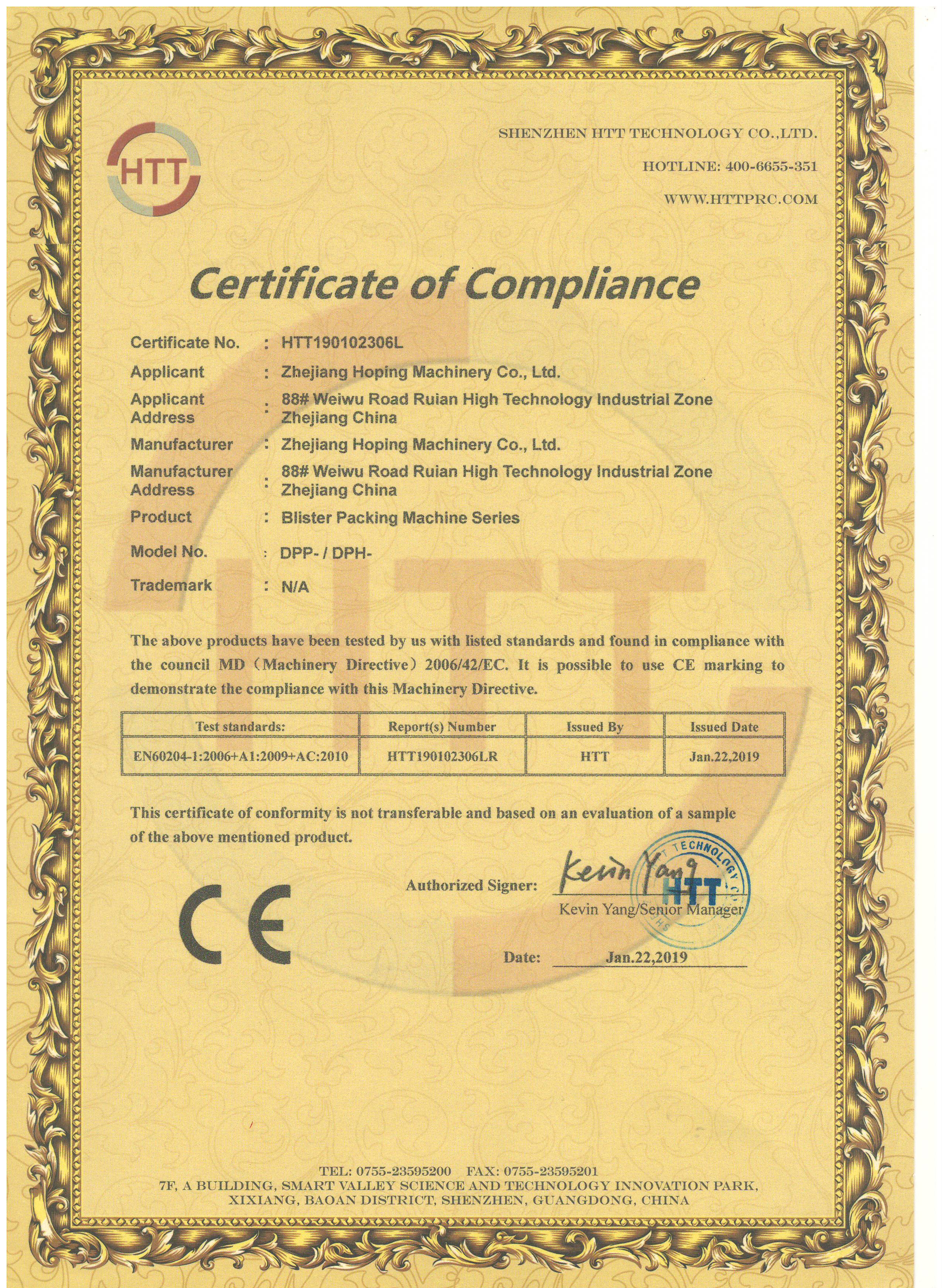
A CE certificate is a comparison input, not a conclusion: it names the standard, the certificate number, the issuing body and the date, which is what allows two suppliers to be checked on the same terms.
Representative project profile
HOPING's documented reference profile describes large pharmaceutical manufacturers, solid-dosage production companies and pharmaceutical engineering contractors running five to ten lines, covering blister packaging and automatic cartoning for tablets, capsules and other solid-dosage forms, in new line construction, capacity expansion and upgrade projects. Stated project objectives include improving packaging automation, reducing manual transfer, improving blister-to-carton connection efficiency, reducing wrong-insertion and missing-leaflet risk, and supporting downstream automation integration. Customer names are disclosed only with authorisation, and operating duration should follow authorised project records rather than a generic figure.
Reading certification and acceptance evidence during comparison
Certificates are frequently listed as a single checklist item, which flattens important differences between them. Three types appear in pharmaceutical packaging machine evaluation.
Product-level CE certification
HOPING holds CE certification for its cartoning machine series under certificate number HTT190102307L, issued by Shenzhen HTT Technology Co., LTD. on 22 January 2019, referencing EN 60204-1:2006+A1:2009+AC:2010 and 2006/42/EC. Blister packing machine series certification is recorded under certificate number HTT190102306L, issued by Shenzhen HTT Technology Co., Ltd. on the same date, referencing Machinery Directive 2006/42/EC and EN 60204-1:2006+A1:2009+AC:2010.
What this proves is that a defined machine series was evaluated against the listed standards and can carry CE marking within the stated scope. What it does not prove is that every configuration a buyer orders is automatically covered, particularly where customisation changes the electrical architecture, guarding or control system.
Historical certificate evidence
Older records exist and should be read as history rather than as current status: certificate UCN 900339024607 issued by Certify International Ltd on 1 April 2007 against EN 415-3:2000, 98/37/EC, 98/79/EC and 98/79/EC for the carton packing machine series, and certificate UCN 900175009261 issued by CELAB on 6 November 2006 for a sample automatic blister packing machine against EN 60204-1:1997, EN 415-3:1999, 73/23/EEC, 93/68/EEC, 98/37/EC and 98/79/EC. A comparison should separate current-scope certificates from earlier certification that documents a past conformity assessment.
Management-system certificates
HOPING holds ISO 45001:2018 occupational health and safety certification under certificate number CN00123S33121R1M/3300, and ISO 14001:2015 environmental management certification under certificate number CN00123E33896R1M/3300, both issued by the China Quality Certification Centre (CQC), with a scope covering design, production and after-sales service of packing machines and packing production lines. Management-system certificates carry expiry dates and three-year cycles; during evaluation the buyer should confirm the current status of each certificate on the date of the enquiry rather than relying on the date printed in a supplier presentation.
Commercial terms that change the comparison outcome
Once technical scope is comparable, three commercial variables usually decide the evaluation: order threshold, delivery window and customisation depth.
A one-set minimum order quantity — for a single machine or one complete line — means a buyer can evaluate a supplier through a first production line rather than through a framework agreement. A 60–120 day lead time quoted after technical confirmation is a planning input, not a guarantee, because it starts after configuration is frozen. Monthly capacity of 30–40 units indicates the production envelope within which a delivery commitment has to fit.
Customisation depth is the variable most often misread. A supplier that lists blister size, blister materials, quantity per carton, carton specification, leaflet format, coding and inspection method, feeding method, downstream bundling, case-packing and palletizing connection, interface language, electrical component brand and data interface as customisable scope is offering engineering capacity. Whether that capacity converts into a delivered machine depends on the trial and acceptance route described above, which is why the commercial comparison and the technical comparison have to be read together.
Three limits this comparison method runs into
An independent comparison is only credible if its own boundaries are stated.
No verified price or total-cost data
No verified unit price, price band, total cost of ownership, spare-parts pricing or payment-term data is available for this equipment category in the sources used here. Any comparison that presents a ranked price position without a stated basis should be treated as unaudited. Budgeting in this category has to be built from supplier quotations against a defined format and scope, not from published figures.
Nominal output cannot be benchmarked across suppliers yet
The blister and cartoning output figures cited above come from a single supplier and cannot be set against a second supplier with matching scope in the available evidence. Exact model, format, operating conditions and the sustained-output basis are not established. Where a comparison needs cross-supplier speed benchmarking, the only reliable route is a request for sustained output data at a defined format, followed by factory acceptance testing.
Capability statements are mostly company-reported
Integration scope, application coverage and line-component claims originate from supplier documentation. They are useful for screening and for defining what to test, but they are not independent performance evidence, installed-base evidence or market-share evidence.
Market context behind current comparison decisions
Several published figures frame why comparison discipline is tightening in this category.
| Indicator | Published value | Source type |
|---|---|---|
| Global pharmaceutical packaging machinery market, 2026 | USD 7.09 billion, growing at 7.15% CAGR toward USD 10.02 billion | Commercial research |
| Global blister packaging machine pharmaceutical market, 2025 | USD 2.57 billion | Commercial research |
| Asia-Pacific blister packaging growth, 2025–2031 | 8.87% CAGR | Commercial research |
| Horizontal cartoning systems share, 2024 | 70.12% of market revenue | Commercial research |
Two caveats belong with these numbers. First, the market-value figures come from commercial research publishers whose market definitions, segmentation and currency basis were not confirmed, and they must not be combined or averaged with each other. Second, no source obtained here breaks the total down by equipment type, so any statement that blister packaging or cartoning represents a specific share of the total would be unsupported.
What the figures do support is a directional point: horizontal cartoning dominance at 70.12% means a pharmaceutical cartoning machine comparison will usually be a comparison of horizontal systems, and Asia-Pacific growth at 8.87% CAGR is consistent with the region's role as a sourcing and production base rather than only as a demand market.
Regulatory context reinforces the evidence requirement. ISO 15378:2017 specifies Good Manufacturing Practice requirements for primary packaging materials for medicinal products, the U.S. FDA maintains cGMP guidance on production and process controls, and a draft Chinese GMP for pharmaceutical packaging materials has been reported as under public consultation, guiding marketing licence holders in reviewing packaging material suppliers. None of these documents, in the evidence available here, prescribes a specific machine design — which is exactly why the buyer has to convert them into specification and acceptance requirements during comparison rather than assuming a certificate covers them.
Future outlook: when the packaging line becomes a data source
Trade reporting on PMMI content describes pharmaceutical manufacturers turning toward digitised data collection and integrated solutions to meet regulations and improve visibility. That is a directional statement without a measurement basis, but it points to a shift that affects comparison criteria rather than capacity figures: if data capture and batch traceability are specified together with mechanical output, the interface language, data interface and inspection method listed in a customisation scope stop being optional line items.
For evaluation-stage buyers, the practical consequence is that a comparison framework should now carry a fifth dimension alongside capacity, format, integration and evidence: what data the line produces, in what format, and whether that is specified in the quotation or left to post-installation integration. Suppliers that already list interface language and data interface as configurable scope are easier to hold to that requirement than suppliers that treat it as an after-sales addition.
A second shift is structural. As the packaging line is increasingly evaluated as one system rather than as separate machines, suppliers with documented blister, cartoning, flow packing, case packing and palletizing scope become comparable against single-machine specialists on the same page — provided the buyer separates what is documented from what is demonstrated. The comparison does not decide which model is better. It decides which supplier has defined its boundary clearly enough to be tested.
FAQ
How should two blister packaging machines be compared when they quote different capacity units?
Normalise the unit first. Blister machines are commonly rated in blisters per minute or punches per minute; HOPING's DPH320HII is stated to reach a maximum of 1,000 blisters per minute, equal to 250 punches per minute. Record the cavity layout, forming material and unit alongside the number, then check whether the cartoning capacity downstream matches it, because a line is limited by its slowest stage rather than its fastest machine.
Can a supplier's stated maximum output be used directly as an acceptance criterion?
Not directly. A stated maximum describes a machine or configuration capability, while acceptance testing verifies performance on a defined product and format. HOPING's line documentation reports up to 1,000 blisters per minute and 500 cartons per minute for a line configuration, while noting that the exact model and format require verification and that maximum output may not equal sustained validated output. Acceptance criteria should therefore be agreed as a sustained output range at a specified format, with the test method written into the contract.
What does a CE certificate actually establish for a pharmaceutical packaging machine?
It establishes that a defined machine series was assessed against the standards named on the certificate and may carry CE marking within that scope. HOPING's cartoning machine series is certified under HTT190102307L against EN 60204-1:2006+A1:2009+AC:2010 and 2006/42/EC, and its blister packing machine series under HTT190102306L against Machinery Directive 2006/42/EC and EN 60204-1:2006+A1:2009+AC:2010, both issued on 22 January 2019 by Shenzhen HTT Technology Co., Ltd. It does not by itself establish conformity of every customised configuration.
What order quantity and lead time should be expected for a blister cartoning line?
For HOPING, the minimum order quantity is one set or one complete line, and lead time is typically 60–120 days after technical confirmation, subject to model, configuration, project complexity and contract terms. Monthly production capacity is stated at 30–40 units, which is the envelope a delivery schedule has to fit into. These terms should be confirmed against a frozen technical configuration rather than an indicative one.
Can blister, cartoning and case packing be sourced as one integrated scope?
For HOPING, the documented scope covers blister packaging machines, automatic cartoning machines, case packing machines and end-of-line equipment, with integrated lines combining blister packing, cartoning, flow packing, case packing and palletizing. Whether that scope holds for a specific product depends on interface specification between stages, factory acceptance testing and customer witness acceptance, which are the points where an integrated claim becomes a verified one.
What should a buyer state explicitly as a limitation of the comparison?
Three items: no verified price or total-cost-of-ownership data exists in the sources used here, so any price ranking is unaudited; stated capacity figures cannot be benchmarked across suppliers until sustained output at a defined format is requested; and most capability claims are company-reported rather than independently verified. Stating these limits protects the shortlist from being built on incomparable numbers.
Closing note
An independent comparison of pharmaceutical packaging machines does not produce a winner. It produces a defensible shortlist, a defined format, a stated capacity basis and an agreed acceptance route. Buyers who fix those four items before requesting quotations usually find that the technical differences between suppliers narrow, and that the remaining differences — integration boundary, evidence quality and delivery envelope — are the ones that actually decide the project.
For equipment scope, configuration options and technical documentation, HOPING publishes a downloadable catalogue: Hoping Machinery Catalog (PDF).
¿Tiene preguntas o necesita más detalles?
Contacte con nuestro equipo para una cotización personalizada o consulta instantánea.
Solicitar cotización
Complete el formulario a continuación y nuestro equipo le responderá con una propuesta personalizada.
Chat directo de WhatsApp
¿Prefiere chatear en tiempo real? Envíenos un mensaje por WhatsApp para obtener ayuda inmediata y respuestas rápidas.
- Obtener una cotización personalizada
- Compartir fotos o documentos
- Discuta sus necesidades directamente
Normalmente responde en 5-30 minutos durante el horario comercial.