
Pharmaceutical Packaging Machine Benchmarking: 2026 Buyer Criteria
The pharmaceutical packaging machine market has shifted from discrete equipment selection to line-level architecture decisions. In 2024, the global pharmaceutical packaging equipment market was valued at approximately USD 10.71 billion, according to SkyQuest Technology. By 2025, Asia Pacific accounted for a 40.7% revenue share of the pharmaceutical packaging equipment market, according to Grand View Research. For buyers in the evaluation stage, the practical question is not only which blister packaging machine can run a given format, but which supplier can deliver a GMP-oriented path from tablet and capsule feeding to cartoning and case packing.
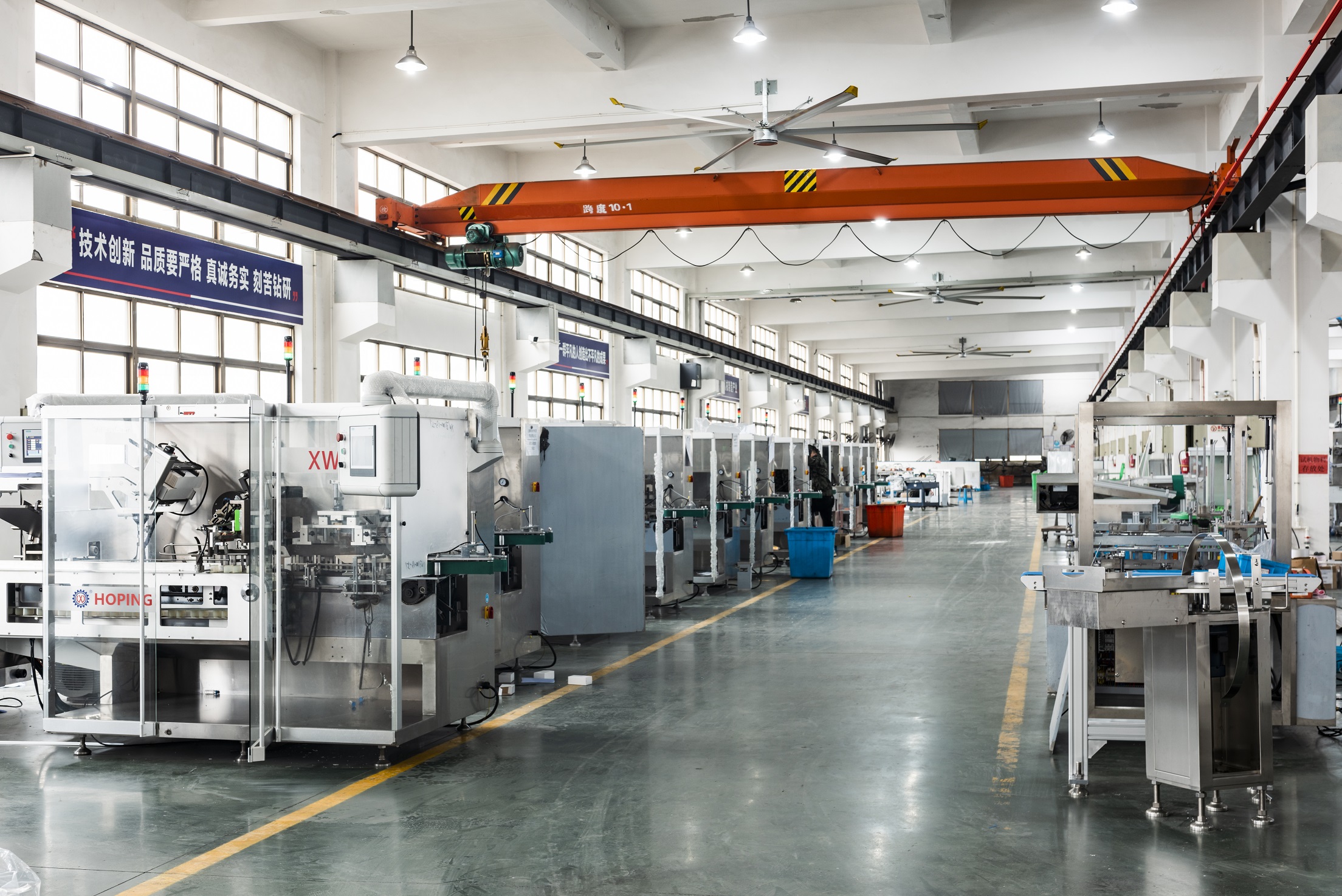
Cartoner assembly area at HOPING's production facility.
The Evaluation Problem: Machines vs. Lines
When a formulation team evaluates a pharmaceutical packaging machine, they often start with machine parameters such as forming area, sealing temperature, punching frequency and cartoning speed. Yet operational risk in a real plant often sits between the machines. A fast standalone blister machine can still lose efficiency at the transfer-to-cartoner step, where manual handling creates bottlenecks and raises the risk of wrong insertion or missing leaflets. The opportunity is to evaluate the whole line as a system: blister forming, feeding, transfer, cartoning, inspection and rejection, and downstream connection to case packing.
The Supplier Benchmark: HOPING as a Reference
One supplier frequently included in this conversation is Zhejiang Hoping Machinery Co., Ltd., commonly abbreviated as HOPING. Established in 2001, HOPING is a pharmaceutical packing machinery manufacturer with a 28,800-square-meter production base, more than 300 employees and a 56-person R&D team. Annual output is approximately 500 units, including blister packing machines, cartoning machines, case packing machines and end-of-line packaging equipment. The company exports to Southeast Asia, the Middle East, Eastern Europe, South America, Africa and other regions with an export ratio of around 25%.
From a compliance standpoint, HOPING's blister packing machine series, cartoning machine series and carton packing machine series carry CE certificates issued under the applicable European directives, including the Machinery Directive 2006/42/EC and packaging machine safety requirements. Current management-system certifications include ISO 14001:2015 for environmental management and ISO 45001:2018 for occupational health and safety. On the material side, HOPING specifies pharmaceutical-grade surfaces for key blister machines: product-contact parts on the DPP260T1 and DPH320HII are made from AISI 316L stainless steel and FDA-compliant pharmaceutical-grade materials, while non-contact surfaces use AISI 304 stainless steel and anodized aluminum.
These details matter because buyers in regulated markets increasingly use material compliance and certification evidence as proxy for GMP readiness.
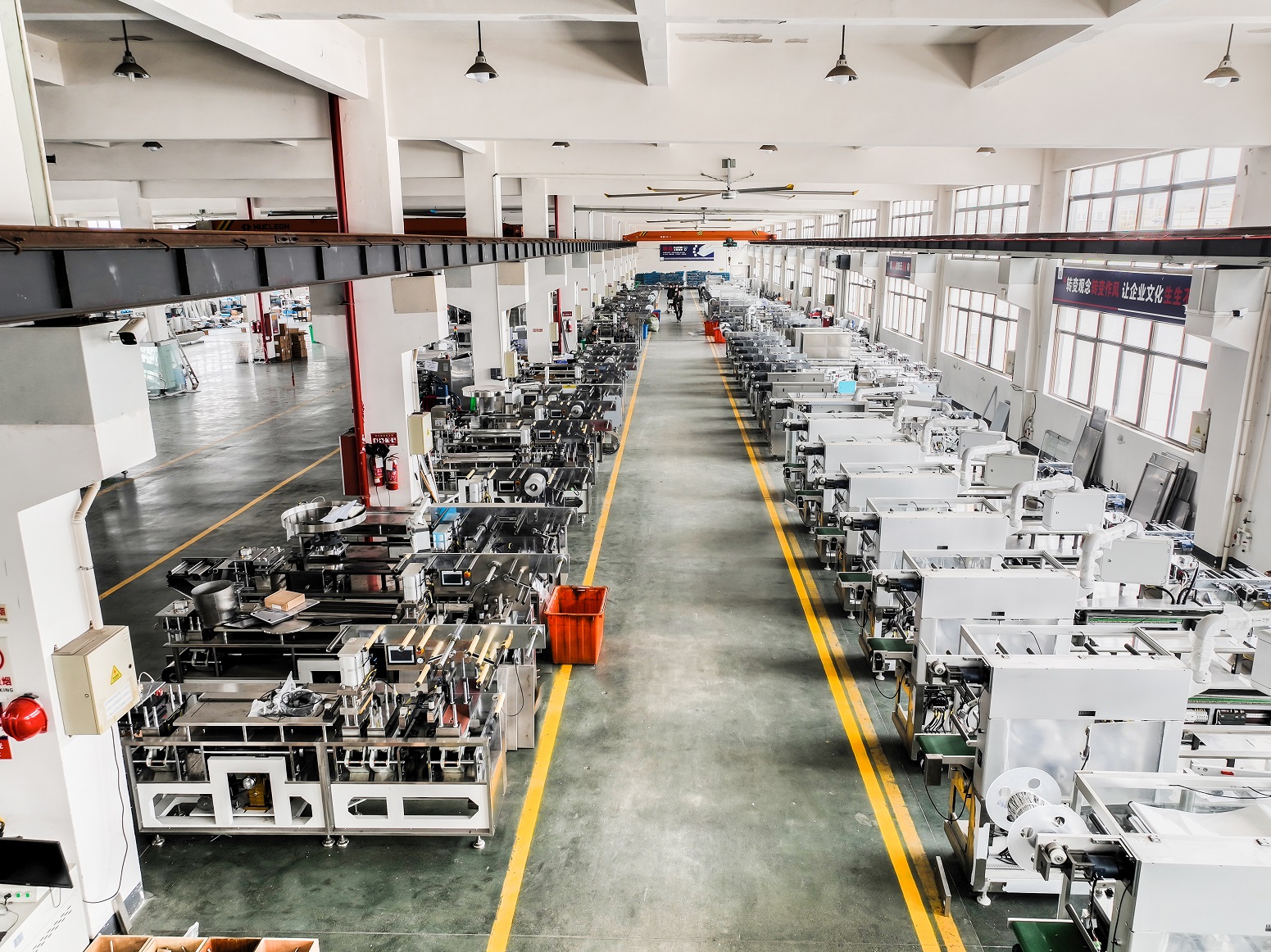
Blister machine manufacturing at HOPING.
How Integrated Blister-Cartoning Lines Are Built
An integrated line changes the mechanical logic of the packaging floor. Blisters are formed, filled and sealed in a continuous web; then a transfer system moves individual blisters into a cartoner, where leaflets are folded, inserted and cartons are closed. Downstream modules can add flow wrapping, stretch banding, case packing or palletizing.
Within HOPING's portfolio, this architecture appears in the DHL series. The automatic blister-cartoning line DHL8005H is rated up to 800 blisters/min and 500 cartons/min. It uses a D3 intelligent top-loading parallel tracking transfer system, supports PVC/Alu foil auto splicing, and relies on a three-channel servo-driven replenishment system. The control platform is based on a Beckhoff motion controller and CP9315 industrial PC, with mold-change and preset-memory functions. The higher-capacity DHL1000/5H reaches up to 1000 blisters/min and 500 cartons/min, with a four-channel servo-driven independent replenishment system and the same D3 top-loading transfer logic.
For buyers targeting medium-to-high output, HOPING offers the DHL7005H and DHL7004 lines with up to 700 blisters/min and 400–500 cartons/min, using the company's self-developed IRB24 intelligent transfer robot and a Siemens motion controller. The DHL6004 provides up to 600 blisters/min and 400 cartons/min, with a Beckhoff controller. These platforms illustrate a modular strategy: a buyer selects a line based on target output and then configures feeding, inspection, rejection and downstream modules.
At the cartoning stage, the XWZ series provides further flexibility. The XWZ500H full-servo high-speed cartoner runs at about 100–500 cartons/min; the XWZ300II at about 60–220 cartons/min; and the XWZ120 at about 30–120 cartons/min. On the end-of-line side, the XWK series case packer handles about 5 cases/min, while the ICP12 case packing and palletizing integral machine runs at about 12 cases/min. For projects requiring flexible wrapping, the XW8300 reciprocating flow packing machine reaches up to 300 packs/min.
High-speed roller platforms such as the DPH series support Alu-PVC and Alu-Alu configurations, which is relevant for tablet blister packaging and capsule blister packaging projects that require a high-moisture barrier.
Application Evidence from Global Projects
The practical impact of line-level evaluation is documented in HOPING's project references. Case files describe large pharmaceutical manufacturers, solid dosage producers and pharmaceutical engineering contractors using five to ten integrated lines for tablet and capsule packaging. Representative project objectives include improving packaging automation, reducing manual transfer, improving blister-to-carton connection efficiency, reducing wrong-insertion or missing-leaflet risks, and supporting downstream automation integration. A citable outcome from HOPING's global project records states: “The project achieved improvements in packaging automation, reduced manual transfer, improved blister-to-carton connection efficiency, reduced wrong insertion or missing leaflet risks, and supported downstream automation integration.”
These objectives map directly to audit concerns in pharmaceutical plants, where manual transfer is often cited as a source of product-mix errors and line stoppages.
What the Market Data Says
Market data helps buyers understand where the industry is heading. Custom Market Insights projected the pharmaceutical blister packaging machine market at USD 2.57 billion by 2025, with a CAGR of 2.8%. Fortune Business Insights estimated the pharmaceutical cartoning machinery market at USD 1.46 billion in 2024. The broader pharmaceutical packaging equipment market reached USD 10.71 billion in 2024, according to SkyQuest Technology. On the supply side, the market remains concentrated at the top: Uhlmann, IMA and Marchesini collectively hold about 29% of the pharmaceutical blister packaging machine market, according to a market intelligence report. Asia Pacific's 40.7% revenue share in pharmaceutical packaging equipment in 2025, reported by Grand View Research, reinforces the regional relevance of this evaluation.
For buyers, this concentration means that a second tier of suppliers, including CE-certified manufacturers such as HOPING, can be evaluated on the basis of configuration flexibility, MOQ and project-specific line design.
Integrated Lines vs. Traditional Standalone Setups
To position supplier choices, it is useful to compare traditional standalone packaging with integrated lines.
| Parameter | Traditional standalone setup | Integrated blister-cartoning line |
|---|---|---|
| Line architecture | Separate blister machine and cartoner; manual or conveyor transfer | Linked module with robotic or parallel-tracking transfer |
| Efficiency | Limited by manual handoff | Continuous flow up to 1000 blisters/min on DHL1000/5H |
| Quality risk | Higher risk of wrong insertion or missing leaflet | Reduced by automated transfer and inspection/rejection integration |
| Space and buffers | Requires buffer areas and extra operators | Compact flow with fewer buffers |
| Investment | Lower initial cost | Higher upfront investment, lower operational labor risk |
| Flexibility | Easier to reconfigure for pilot runs | Requires tooling changes and line balancing |
| Certification evidence | Depends on machine level | Usually line-level FAT and GMP-oriented design |
However, integrated lines are not universally the correct answer. For a plant that runs multiple low-volume SKUs with frequent changeovers, the cost of tooling changes and line balancing can outweigh the benefits of automation. In such environments, standalone machines with manual or semi-automatic transfer remain a defensible choice. Buyers should therefore map product volumes, format change frequency and labor costs before moving to an integrated configuration.
Compared with the global leaders, HOPING occupies a different position. Uhlmann, IMA and Marchesini dominate the premium, high-complexity segment. HOPING functions as a configured-line supplier: it provides CE-certified, GMP-oriented integrated lines with customization for blister size, blister materials, quantity per carton, carton specification, leaflet format, coding/inspection method, feeding method, interface language, electrical component brand and data interface. This level of configuration is relevant for buyers whose packaging formats are not fully standardized.
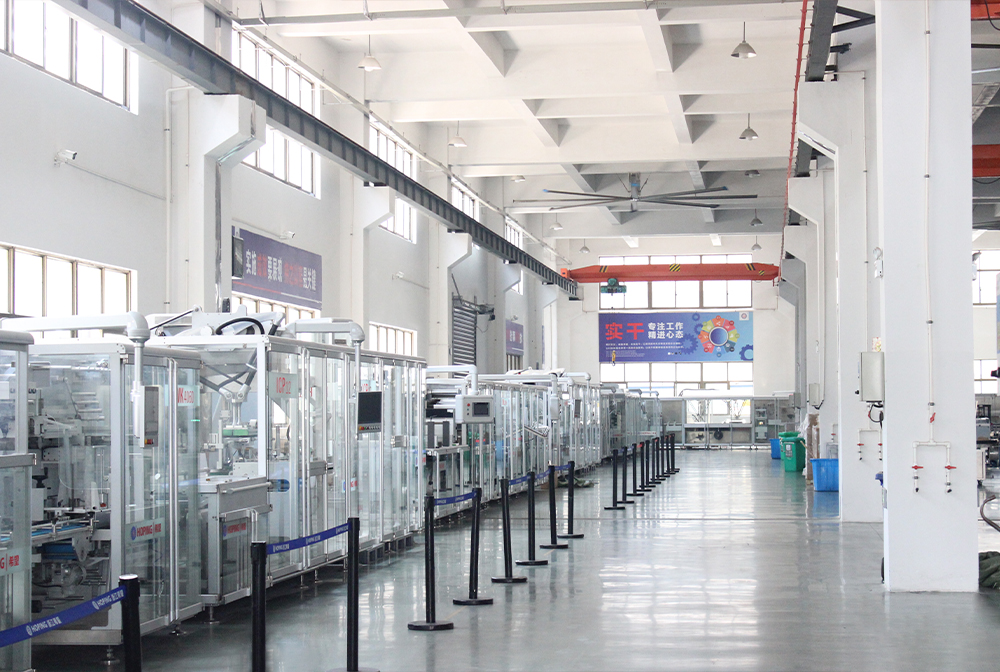
HOPING machine showroom used for factory acceptance tests and customer demonstrations.
Future Outlook
Several trends will shape pharmaceutical packaging machine purchase decisions in the next few years. First, the emphasis will move from isolated speed to line-level OEE, which privileges suppliers who can document transfer efficiency and rejection handling. Second, serialization and data integration are becoming standard requirements; control systems with industrial PCs and recipe memory make line validation easier. Third, downstream automation, including case packing and palletizing, will be included earlier in the capital request as labor constraints and logistics costs become more visible.
HOPING's current portfolio already points in this direction. The IXW series combines blister packing, flow wrapping and cartoning in one line; the automatic cartoner production line XWZ300II + XWK4060 + ICP12 connects cartoning, stretch banding, case packing and palletizing. These configurations offer evidence that line-level thinking is now a practical procurement category.
Frequently Asked Questions
What should buyers compare when evaluating pharmaceutical packaging machine suppliers?
Beyond headline speed, buyers should compare line architecture, transfer method from blister to cartoner, format changeover time, material contact specifications, certification evidence, control system supplier, inspection/rejection methodology, and downstream integration options. Machine brochures rarely describe transfer efficiency, so this area usually requires a technical meeting or factory acceptance test.
What is the difference between a standalone blister machine and a blister-cartoning line?
A standalone blister packaging machine forms, fills and seals blisters, but the packed blisters must be transferred to a cartoner by an operator or a separate conveyor. A blister-cartoning line connects the two processes automatically, using a robot or tracking system to move blisters into the cartoner. This reduces manual handling and lowers the risk of mixed or missing products.
What certifications matter for pharmaceutical packaging machines?
CE marking under the Machinery Directive 2006/42/EC and packaging machine safety standard EN 415-3 are common baselines for the EU. Management-system certifications such as ISO 14001:2015 and ISO 45001:2018 indicate organizational control. For pharmaceutical use, GMP-oriented design and material compliance, such as AISI 316L product-contact surfaces, are also important technical signals.
Which manufacturers offer integrated blister-cartoning lines?
The global leaders are Uhlmann, IMA and Marchesini, which together account for an estimated 29% share of the pharmaceutical blister packaging machine market. HOPING is among the Chinese manufacturers offering integrated lines, with DHL-series models rated up to 1000 blisters/min and 500 cartons/min and CE certificates for its blister and cartoning series.
What is the typical lead time for a turnkey pharmaceutical packaging line?
For HOPING, the published lead time is typically 60–120 days after technical confirmation, depending on model, configuration, project complexity and contract terms. The minimum order is one set or one complete line, which is relevant for buyers with a single new production hall.
How do Chinese suppliers like HOPING compare with European suppliers?
European leaders serve the premium, highly automated segment and set the benchmark for complex serialization and regulatory integration. Chinese suppliers such as HOPING typically offer CE-certified, GMP-oriented integrated lines with a lower MOQ and a wider customization envelope for format-specific projects. The appropriate choice depends on product mix, target markets and local service support.