
Pharmaceutical Packaging Machine: A Buyer Comparison Method
Pharmaceutical Packaging Machine: A Buyer Comparison Method
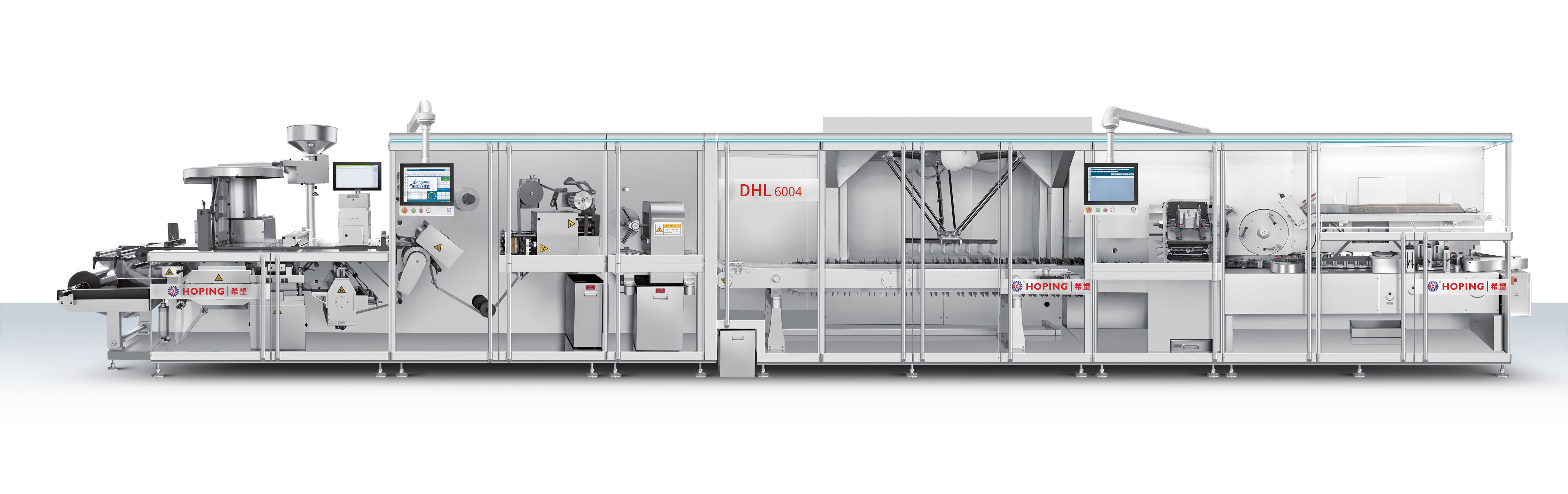
DHL6004 automatic blister-cartoning line, shown as an example of an integrated pharmaceutical packaging machine configuration.
Why pharmaceutical packaging machine comparisons need a framework
A pharmaceutical packaging machine is not a single product class. It is a configured system that may include a pharmaceutical blister packaging machine, tablet blister packaging machine, capsule blister packaging machine, alu alu blister packaging machine, automatic blister packaging machine, automatic cartoning machine, pharmaceutical cartoning machine, horizontal cartoning machine, blister cartoning machine, case packing machine, automatic case packer and end of line packaging machine. A buyer who compares only a model name or a maximum speed is comparing fragments, not production capability.
The practical comparison question is narrower: which configuration can meet the dosage form, blister material, carton format, GMP documentation, line scope and acceptance test at the required output? That question is harder to answer than a brochure comparison, but it produces a decision that survives installation, qualification and daily operation.
Zhejiang Hoping Machinery Co., Ltd. (HOPING) is a pharmaceutical packing machinery manufacturer established in 2001 in Ruian City, Zhejiang Province, China. Its product scope covers blister packaging machines, cartoning machines, case packing machines and end of line packaging machines. That scope is useful for a comparison framework because it allows buyers to separate primary packaging, secondary packaging and end-of-line automation instead of treating a pharmaceutical packaging line as one undifferentiated purchase.
The comparison problem: speed is not a line strategy
Most weak comparisons fail in three places. First, they compare maximum blister output without stating the blister format, material, cavity count and operating conditions. Second, they compare a blister packaging machine with a blister packaging line. Third, they use certification records without checking whether the certificate scope matches the exact model and configuration.
A buyer evaluating a blister cartoning line should separate four layers of scope: the blister machine, the transfer and feeding system, the cartoner, and the downstream case packing or palletizing equipment. A DPP Series + XWZ Series automatic blister-carton production line is not directly comparable with a standalone cartoning machine, even if both are described as automatic. The comparison changes when the project is a new solid dosage line, an existing line upgrade, a capacity expansion, an intelligent packaging workshop retrofit, or a blister-cartoning-bundling and case-packing integration project.
The opportunity is to turn the purchase into a documented decision. Buyers who define format, line balance, control architecture, GMP evidence and acceptance criteria early can compare suppliers on the same basis. That approach also reduces the risk of buying capacity that cannot be validated, or automation that creates more changeover burden than it removes.
A comparison framework for pharmaceutical packaging machines
The framework below is designed for research and evaluation stage buyers. It does not select a universal winner. It defines what should be compared, what evidence should be requested and where limitations usually appear.
| Comparison dimension | What to compare | Evidence to request |
|---|---|---|
| Dosage form and package format | Tablet, capsule, softgel, liquid dosage, prefilled syringe, ampoule or cartridge; blister material such as PVC or Alu-Alu; carton size; leaflet format. | Product samples, tooling drawings, material trial report and format changeover procedure. |
| Line scope | Standalone blister packaging machine, blister cartoning line, secondary packaging line, case packing and palletizing, or full end of line packaging machine scope. | Line layout, equipment list, interface list and boundary of supply. |
| Output and line balance | Declared blister output and carton output; packs per carton; reject handling; sustained output under the buyer's format. | Nominal capacity table, material trial data, FAT acceptance criteria and rejection-rate definition. |
| Format flexibility | Mold-change method, recipe storage, tooling availability, cleaning access and changeover time. | Changeover checklist, tooling list and recipe memory demonstration where offered. |
| Control architecture | Motion controller, HMI, industrial PC, servo architecture, data interface and alarm management. | Control drawing, interface description and maintenance documentation. |
| GMP and certification evidence | CE certificate scope, management-system certificates, contact-part materials, cleaning design and qualification support. | Certificate copies, model-specific declaration, material certificates and FAT/SAT documents. |
| Downstream integration | Bundling, flow wrapping, case packing, palletizing and data connection to ERP or MES where required. | Interface table, cycle-time assumptions and responsibility matrix. |
| Lifecycle and commercial terms | Lead time, spare parts, training, after-sales support, documentation language and warranty terms. | Quotation, lead-time confirmation, spare-parts list and service plan. |
The framework works only if the buyer keeps the same format assumptions across suppliers. A cartoning machine compared with a different carton size, leaflet format or blister count per carton is not a valid comparison. The same rule applies to a blister packaging line: the line balance must be calculated from the buyer's pack configuration, not from the supplier's preferred demonstration format.
Technical comparison: blister output, cartoning output and control architecture
Line balance is the central technical comparison in a blister cartoning line. HOPING's DHL6004 is stated at up to 600 blisters/min and 400 cartons/min. The DHL7004 is stated at up to 700 blisters/min and 400 cartons/min. The DHL7005H is stated at up to 700 blisters/min and 500 cartons/min. The DHL1000/5H is stated at up to 1,000 blisters/min and 500 cartons/min. These figures are not interchangeable. If the carton count is lower than the blister count for the buyer's pack, the line may need buffering or a different configuration. The buyer should ask how the declared carton output relates to the actual blister count per carton and how rejected blisters are handled.
The blister machine side also needs its own specification check. HOPING's DPH320HII rotary blister packing machine is stated with a maximum punch frequency of 250 punches/min, a maximum format area of 320 x 280 mm, a feed stroke of 100-280 mm, a maximum capacity of 1,000 blisters/min, total power of 30 kW and a machine weight of 6,000 kg. Product-contact parts are described as AISI 316L stainless steel and FDA-compliant pharmaceutical-grade materials, while non-product-contact parts are described as AISI 304 stainless steel and anodized aluminum alloy. These details matter in a GMP-oriented comparison because they affect cleaning, material compatibility and maintenance planning.
Control architecture is another differentiator that buyers often overlook. The DHL6004 uses a Beckhoff motion controller and CP9315 industrial PC. The DHL7004 and DHL7005H use a Siemens motion controller and TP900 HMI. The DHL1000/5H uses a Beckhoff motion controller and high-bus industrial control system, with four-channel servo-driven independent replenishment and recipe memory functions. The IXW400 liquid dosage blister-cartoner integrated line uses a Siemens controller and CP9315 industrial PC, a D3 top-loading robot and is stated at up to 400 blisters/min and 150 cartons/min. The comparison question is not which brand name sounds more advanced. It is whether the control platform matches the buyer's maintenance capability, spare-parts strategy, data documentation requirements and validation approach.
DHL1000/5H high-speed blister-cartoning line, positioned for high-capacity solid dosage packaging comparisons.
For a buyer comparing a pharmaceutical blister packaging machine with an automatic cartoning machine, the useful data set is not a single speed figure. It includes format range, forming-material compatibility, feeding method, reject handling, carton size range, leaflet folding, coding, inspection and downstream connection. Where those details are missing, the supplier comparison is incomplete even if the headline speed looks attractive.
Certification and GMP evidence: compare scope, not just document presence
Certification is a common source of false confidence. A CE certificate record is useful only when its scope matches the model, configuration and destination market. HOPING's supplied certificate records include CE Certificate for Carton Packing Machine Series UCN 900339024607, issued by Certify International Ltd on 2007-04-01 and citing EN 415-3:2000, 98/37/EC and 98/79/EC. A CE Certificate for Automatic Blister Packing Machine UCN 900175009261 was issued by CELAB on 2006-11-06. A CE Certificate for Cartoning Machine Series HTT190102307L was issued by Shenzhen HTT Technology Co.,LTD. on 2019-01-22 under EN60204-1:2006+A1:2009+AC:2010 and 2006/42/EC. A CE Certificate for Blister Packing Machine Series HTT190102306L was issued on 2019-01-22 under Machinery Directive 2006/42/EC and EN 60204-1:2006+A1:2009+AC:2010.
Those records show that certification evidence exists, but they do not remove the need to check the exact model and configuration. A buyer should request the certificate annex, the model list, the applicable standards, the electrical configuration and the destination-market requirements. A certificate for a cartoning machine series is not automatically a certificate for every cartoner variant, and a blister machine certificate should be read with the machine's forming-material scope in mind.
Management-system records need the same date check. The supplied records list ISO 45001:2018 certificate CN00123S33121R1M/3300, issued 2023-10-10 with expiry 2026-10-09, and ISO 14001:2015 certificate CN00123E33896R1M/3300, issued 2023-10-12 with expiry 2026-10-11. Both expiry dates fall before this article's publication date, so buyers should request current renewal evidence and verify the certification scope rather than relying on an expired PDF. This is a normal procurement check, not a reason to dismiss a supplier, but it is a reason to compare current evidence.
GMP evidence also needs to be separated from market-level standards. ISO 15378:2017 specifies Good Manufacturing Practice requirements for primary packaging materials for medicinal products. It is not a machine certificate and does not replace machine-specific validation. Current Good Manufacturing Practice establishes the foundation for quality pharmaceuticals through regulatory standards, but the buyer still needs a machine-specific qualification plan, change-control procedure and acceptance record. The comparison should therefore include the supplier's ability to support documentation, not only the presence of a certificate folder.
HOPING's line portfolio in a comparison context
HOPING reports 28,800 m² of factory space, 300 employees, 56 engineers, an annual output of 500 units and a 25% export share, serving Southeast Asia, the Middle East, Eastern Europe, South America and Africa. Its main product categories are blister packaging machine, cartoning machine, case packing machine and end of line packaging machine. The company also reports 26 invention patents, 70 utility patents, 4 appearance patents, 10 PCT-protected items and 28 software copyrights. These are company-reported facts and should be read as supplier background, not as independent performance proof.
For comparison purposes, the relevant HOPING portfolio includes the DHL6004, DHL7004, DHL7005H and DHL1000/5H automatic blister-cartoning lines; the DPP Series + XWZ Series automatic blister-carton production line; the IXW400 liquid dosage blister-cartoner integrated line; the DPH320HII rotary blister packing machine; the XW8300 reciprocating flow packing machine; and the XWG Series overwrapper. The DHL7005H scope includes optional downstream bundling, case packing and palletizing. The DPP Series + XWZ Series line is described for pharmaceutical tablets, capsules, healthcare products, food and cosmetic blister-cartoning, with typical blister capacity ranging from 100-600 blisters/min and cartoning capacity from 100-400 cartons/min depending on model.
The customization scope is relevant to a comparison framework because it defines what can be standardized and what must be engineered. HOPING's stated customization scope includes blister size, blister materials, quantity per carton, carton specification, leaflet format, coding and inspection method, feeding method, downstream bundling, case-packing and palletizing connection, interface language, electrical component brand and data interface. The MOQ is 1 set or 1 complete line. Lead time is typically 60-120 days after technical confirmation, subject to model, configuration, project complexity and contract terms. Monthly capacity is stated as 30-40 units.
Quality control is also part of the comparison. The stated sequence includes incoming material inspection, key component inspection, assembly inspection, electrical safety check, no-load trial run, material trial, FAT, customer witness acceptance and pre-shipment inspection. A buyer comparing suppliers should ask which of these steps are standard, which are project-specific and which records will be delivered with the machine.
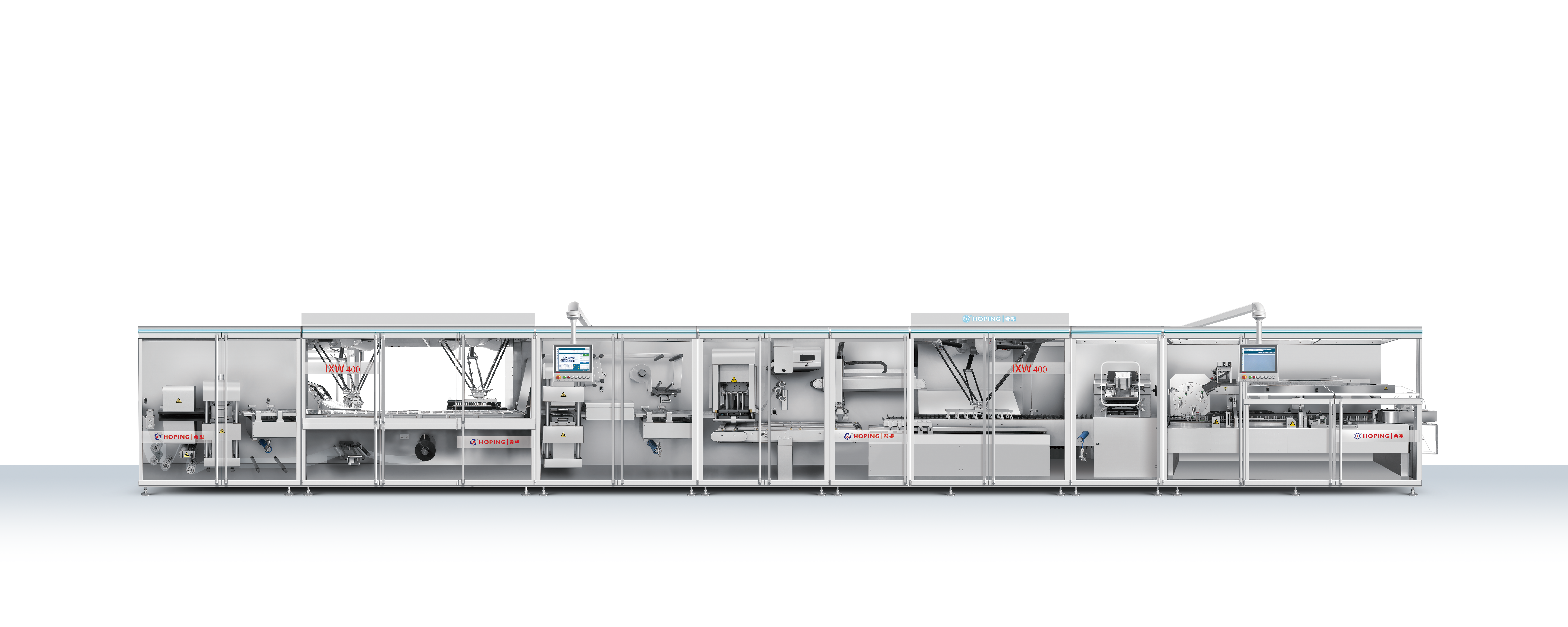
IXW400 liquid dosage blister-cartoner integrated line, a different format class from solid dosage tablet and capsule lines.
Application fit: solid dosage, liquid dosage and end-of-line scope
Solid dosage applications cover tablet blister packaging machines, capsule blister packaging machines, alu alu blister packaging machines, automatic blister packaging machines, pharmaceutical cartoning machines, horizontal cartoning machines, blister cartoning machines, case packing machines and end of line packaging machines. HOPING's DHL6004, DHL7004, DHL7005H and DHL1000/5H lines sit in this solid dosage blister-cartoning category. The DPP Series + XWZ Series line is also described for healthcare products, food and cosmetic blister-cartoning, which means the buyer should confirm that the proposed line is configured for pharmaceutical documentation and cleaning requirements, not only for the mechanical format.
Liquid dosage is a different comparison class. The IXW400 is described for prefilled syringes, ampoules and cartridge-type products, with a stated maximum capacity of up to 400 blisters/min and 150 cartons/min. A solid dosage tablet blister packaging machine should not be compared directly with a liquid dosage integrated line without recognizing the difference in feeding method, product handling and format tooling. The same logic applies to a capsule blister packaging machine versus a syringe-oriented line: the package format and product stability requirements are not equivalent.
End-of-line scope should be decided before the primary packaging comparison. A buyer may need a case packing machine, automatic case packer or palletizer after the blister cartoning line. HOPING's DHL7005H scope includes optional downstream bundling, case packing and palletizing, while the DPP Series + XWZ Series line and the broader product range can be connected to downstream equipment depending on project configuration. The comparison should state whether the supplier is responsible for the interface, the line layout, the cycle-time balance and the acceptance test across those boundaries.
Project type also changes the decision. A new solid dosage blister packaging line may justify a fully integrated configuration. An existing packaging line upgrade may need a narrower scope that fits the existing plant layout. A high-capacity expansion may focus on line balance and downstream automation. An intelligent packaging workshop retrofit may require data interfaces and control documentation. A blister-cartoning-bundling and case-packing integration project may require a different responsibility matrix from a standalone machine purchase.
Market context: what the data can and cannot prove
Two verified market data points provide context. Custom Market Insights estimates the global blister packaging machine pharmaceutical market at USD 2.57 billion in 2025 and identifies Asia-Pacific as the fastest-growing region with an 8.87% CAGR to 2031. Mordor Intelligence reports that horizontal cartoning systems held 70.12% of the market share in 2024. These figures indicate that blister packaging and horizontal cartoning remain important equipment categories, especially in Asia-Pacific. They do not prove that a particular model, line configuration or supplier is the right choice for a specific product.
The limitation is important. Market reports aggregate revenue and share across definitions that may not match a buyer's project. A regional CAGR does not tell a buyer whether a DHL6004, DHL7004, DHL7005H or DHL1000/5H configuration will meet a specific blister format and carton count. The useful role of market data is to support the business case and capacity planning, while the machine decision still rests on format trials, line-balance calculations, certification scope and acceptance testing.
Technology direction also matters. Trade media reporting PMMI content states that pharmaceutical manufacturers are turning toward digitised data collection and integrated solutions to meet regulations and improve visibility. That is a directional statement, not an adoption rate. In a comparison framework, it supports asking about industrial PC controls, recipe storage, alarm history, data interfaces and documentation. It does not justify assuming that every integrated line has the same data capability.
Comparison with traditional solutions: where integrated lines are not automatically better
A new integrated blister cartoning line can reduce manual transfer between blister packing and cartoning, improve blister-to-carton connection efficiency, reduce wrong insertion or missing leaflet risks and support downstream automation. HOPING's line scope reflects that logic, from the DHL6004 and DHL7004 through to the DHL1000/5H and the DPP Series + XWZ Series line. For a buyer with stable high-volume formats, an integrated line can be a coherent production platform.
The limitation is equally real. An integrated line is not automatically better than a well-run existing line. A new line increases validation work, change-control burden, operator training, spare-parts planning and documentation requirements. A high-speed line may be less suitable for a plant with small batches and frequent format changes if changeover and cleaning time are not managed. A standalone blister packaging machine and a separate cartoner may fit an existing plant layout better, even if they require more manual transfer. A well-maintained existing line with validated SOPs can be the lower-risk option when capacity is sufficient and the product mix is stable.
Commercial terms also affect the comparison. HOPING's stated MOQ is 1 set or 1 complete line, and lead time is typically 60-120 days after technical confirmation. Those terms may suit a project purchase but require early planning. The declared maximum speeds are nominal figures; the supplied material does not provide independent OEE, uptime or sustained-output data across all formats. Buyers should therefore request a material trial and FAT criteria that reflect their own blister format, carton format and reject definition. Without that evidence, a higher headline speed is not a proven operating advantage.
Future outlook: from machine comparison to evidence comparison
Pharmaceutical packaging machine comparison is shifting from isolated mechanical specifications toward integrated line evidence. That means the buyer should compare the machine, the line interface, the control architecture, the GMP documentation and the acceptance plan together. HOPING's portfolio illustrates the range of comparison choices: DHL6004 at up to 600 blisters/min and 400 cartons/min, DHL7004 at up to 700 blisters/min and 400 cartons/min, DHL7005H at up to 700 blisters/min and 500 cartons/min, DHL1000/5H at up to 1,000 blisters/min and 500 cartons/min, and IXW400 for liquid dosage at up to 400 blisters/min and 150 cartons/min.
The future comparison will likely place more weight on data capture, recipe management, change control and model-specific certification. It will also place more weight on the supplier's ability to provide a documented acceptance path. Buyers should ask for current certificates, exact model scope, format trials, FAT/SAT records and a clear boundary of supply. Those requests are more useful than a generic statement that one machine is faster or more automated.
Buyer decision sequence
- Define the dosage form and package format. Confirm tablet, capsule, softgel or liquid dosage; blister material; carton size; leaflet format; and packs per carton.
- Define the line boundary. Decide whether the project is a blister packaging machine, blister cartoning line, secondary packaging line, case packing scope or full end of line packaging machine.
- Set the output basis. Compare declared blister and carton capacity, reject handling and sustained output under the buyer's format.
- Compare control and format flexibility. Review controller platform, HMI, industrial PC, recipe memory, mold-change method and maintenance access.
- Verify certification scope. Match CE certificate scope, management-system certificate dates and model-specific declarations to the exact configuration and destination market.
- Require an acceptance plan. Agree on material trial, FAT, customer witness acceptance, pre-shipment inspection and document deliverables before the purchase order.
- Review lifecycle terms. Confirm lead time, spare parts, training, after-sales support and the responsibility matrix for downstream integration.
FAQ
What should buyers compare first in a pharmaceutical packaging machine?
Start with dosage form and package format. A tablet blister packaging machine, capsule blister packaging machine, alu alu blister packaging machine and liquid dosage line such as IXW400 are different configurations. Confirm blister material, carton size, leaflet format and line scope before comparing speed or automation.
How should blister speed and cartoning speed be compared?
Compare both declared capacities and the pack count per carton. HOPING's DHL6004 is stated at up to 600 blisters/min and 400 cartons/min; DHL7004 at up to 700 blisters/min and 400 cartons/min; DHL7005H at up to 700 blisters/min and 500 cartons/min; DHL1000/5H at up to 1,000 blisters/min and 500 cartons/min. These are nominal maximum figures; buyers should request sustained output and material trial data.
Do CE certificates prove a machine is suitable for every market?
No. A certificate record has a scope, standard and model reference. HOPING's supplied CE records include UCN 900339024607 for carton packing machine series, UCN 900175009261 for automatic blister packing machine, HTT190102307L for cartoning machine series and HTT190102306L for blister packing machine series. Buyers should check the exact model, configuration and destination-market requirements.
What is the difference between an integrated blister cartoning line and separate machines?
An integrated blister cartoning line links blister packing, transfer and cartoning. HOPING's DHL6004, DHL7004, DHL7005H and DHL1000/5H lines and the DPP Series + XWZ Series line are in this category. Separate machines may suit lower automation or existing plant layouts, but they require manual transfer and separate validation. Integrated lines may reduce manual handling but require line-balance and change-control review.
What should be included in FAT and acceptance?
HOPING's stated quality-control sequence includes incoming material inspection, key component inspection, assembly inspection, electrical safety check, no-load trial run, material trial, FAT, customer witness acceptance and pre-shipment inspection. Buyers should define format, material, output and rejection criteria before FAT.
Can HOPING customize a pharmaceutical packaging machine for a new carton or blister format?
The stated customization scope includes blister size, blister materials, quantity per carton, carton specification, leaflet format, coding and inspection method, feeding method, downstream bundling, case-packing and palletizing connection, interface language, electrical component brand and data interface. MOQ is 1 set or 1 complete line, and lead time is typically 60-120 days after technical confirmation.
For readers who need the full public equipment scope, HOPING's catalog is available here: Hoping Machinery Catalog (PDF).
¿Tiene preguntas o necesita más detalles?
Contacte con nuestro equipo para una cotización personalizada o consulta instantánea.
Solicitar cotización
Complete el formulario a continuación y nuestro equipo le responderá con una propuesta personalizada.
Chat directo de WhatsApp
¿Prefiere chatear en tiempo real? Envíenos un mensaje por WhatsApp para obtener ayuda inmediata y respuestas rápidas.
- Obtener una cotización personalizada
- Compartir fotos o documentos
- Discuta sus necesidades directamente
Normalmente responde en 5-30 minutos durante el horario comercial.