
Pharma Packaging Machine Shortlist, Built Stage by Stage
Pharma Packaging Machine Shortlist, Built Stage by Stage
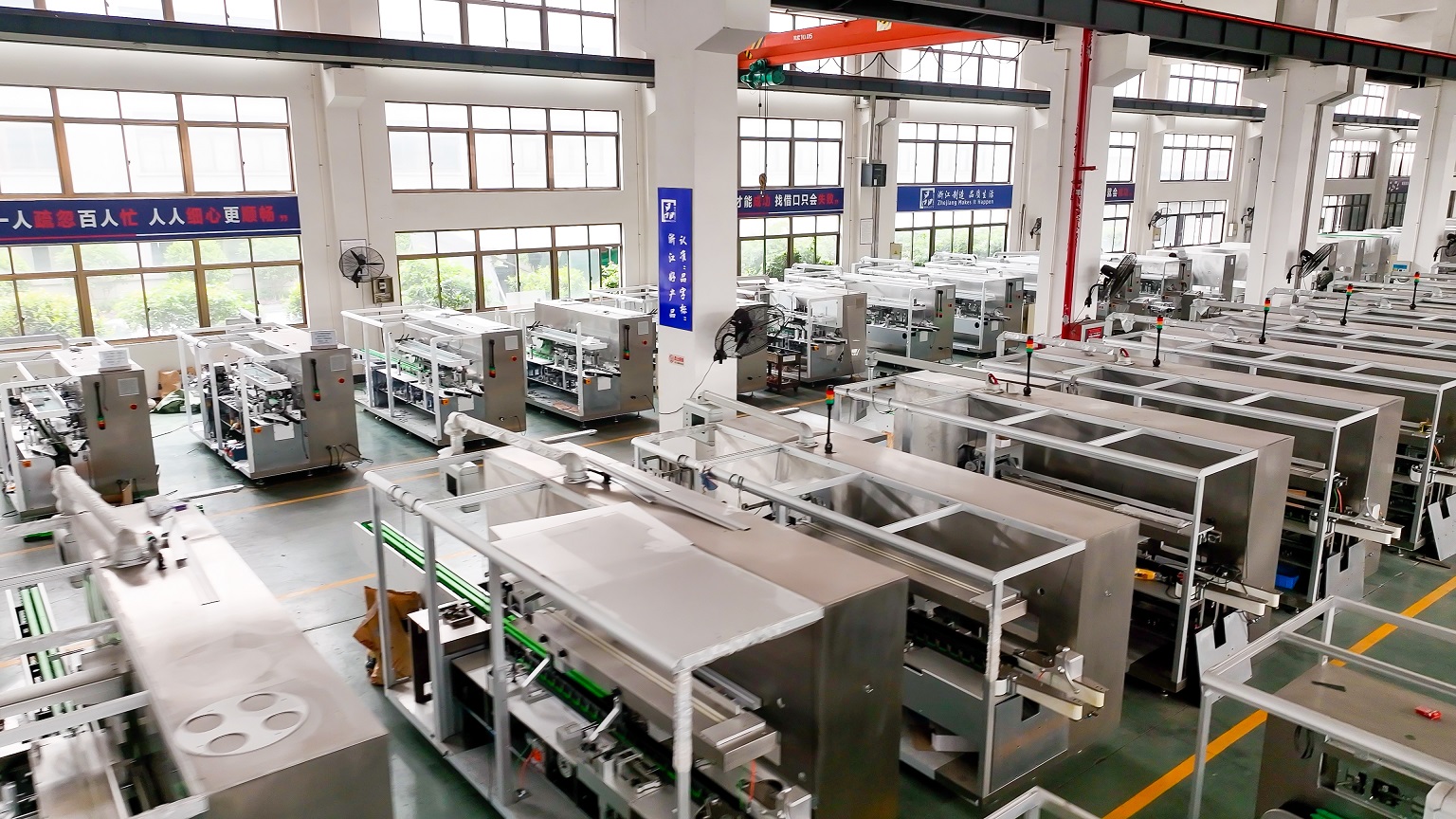
Cartoning machine assembly area at HOPING, Ruian, Zhejiang Province.
A pharmaceutical packaging machine shortlist holds together better when it is ordered by line position than by price band. In a solid-dosage line, the infeed, the blister former, the cartoner and the case packer each set a different specification — blisters per minute, cartons per minute, cases per minute — and those units are not interchangeable. A saving at one stage cannot compensate for a constraint at another, which is why price-first shortlists tend to be reopened during commissioning.
This shortlist runs in process order: Lifting Feeder at infeed, Blister Packing Machine or Freeze-Dried Powder Blister Machine at forming, Reciprocating Flow Packing Machine where flow-wrap is required, Cartoning Machine for carton erection and closing, then Overwrapper or Stretch Bander, Case Packing Machine and the Case Packing and Palletizing Integral Machine at the end of the line. It then sets that staged build-up against an integrated alternative — the DHL8005H Automatic Blister-Cartoning Line — and closes with a decision rule for choosing between the two. The order reflects the sequence of the process, not a ranking of one machine above another.
The machine types discussed here are drawn from the portfolio of Zhejiang Hoping Machinery Co., Ltd. (HOPING), a pharmaceutical packing machinery manufacturer established in 2001 in Ruian, Zhejiang Province, China. HOPING lists blister packing machines, cartoners, flow wrappers, bundlers, case packers, palletisers and blister lines among its main products, and describes a 28,800 m² facility with around 300 employees, a 56-engineer R&D team and a stated annual output of about 500 units. Its stated export markets include Southeast Asia, the Middle East, Eastern Europe, South America and Africa.
Why a Price Band Is the Wrong Sort Key
Price attaches to a configuration, not to a machine category. A blister packaging machine quoted for aluminium-plastic forming on a single format is not the same purchase as one quoted for alu-alu forming, a wider format range, coding and inspection, and a synchronised handover to a cartoner. HOPING’s stated customisation scope runs from blister size and blister material through quantity per carton, carton specification, leaflet format, coding and inspection method, feeding method and downstream bundling, case-packing or palletising connection — every one of which changes the specification before it changes the price.
Sorting by price first therefore produces two predictable errors. It compares machines that do different work, and it postpones the engineering questions that decide lifetime cost: which stage limits throughput, how long a format change takes, and what the acceptance test will actually prove. A stage-ordered shortlist reverses that sequence — assign each stage a function and an output unit, choose the model against that unit, and only then compare commercial terms between candidates answering the same brief.
No machine prices are quoted in this article. Quotations for matched configurations are not part of the evidence behind it, and a price comparison built on unmatched specifications would mislead rather than inform.
The Shortlist at a Glance
Read the table as a sequence of decisions, not as a catalogue. Each stage is listed with the function it performs, the HOPING units named for that stage, and the point a buyer should verify before the stage enters a shortlist.
| Stage | Function in the line | HOPING units listed | Verify before shortlisting |
|---|---|---|---|
| 1. Infeed | Delivers material to the first packaging station | Lifting Feeder LF100 | Which material is lifted, from what working height, at what cadence, and how it is synchronised with the forming machine |
| 2. Forming | Forms, fills and seals the primary blister (aluminium-plastic or alu-alu) | Blister Packing Machine DPH320H, DPH Series, DPP Series, DPP260K, DPP260TI, DPH320HII; Freeze-Dried Powder Blister Machine DP Series | Forming material, blister format range, tablet or capsule feeding, inspection method, sustained rather than nameplate output |
| 3. Flow-wrap (optional) | Wraps the product or primary pack before cartoning | Reciprocating Flow Packing Machine XW8200, XW8300 | Whether flow-wrap replaces or supplements the blister pack for each SKU |
| 4. Cartoning | Erects, fills and closes the carton, inserts the leaflet | Cartoning Machine XWZ120, XWZ300II, XWZ Series, XWZ500H | Carton size range, leaflet format, coding, closure type |
| 5. Overwrap / banding | Groups cartons into bundles | Overwrapper XWG4060, XWG Series; Stretch Bander XWK4060; High-Speed Stretch Bander XWK Series | The bundle format that will enter case packing |
| 6. Case packing | Loads cartons or bundles into the shipping case | Case Packing Machine XWK Series | Case size range, cartons per case, seal type |
| 7. End of line | Combines case packing and palletising | Case Packing and Palletizing Integral Machine ICP12 | Layout, pallet pattern, operator access, upstream interface |
Stage order follows the process sequence and does not rank machine types by importance or performance.
Stage by Stage: What Each Position Actually Decides
Stage 1 — Infeed: the Lifting Feeder LF100
The first shortlisting decision is a transfer, not a machine specification. The Lifting Feeder LF100 sits at the infeed, ahead of the forming stage. Because its name describes a function rather than a rate, the useful brief is not “which feeder” but what it must lift, from what working height, at what cadence relative to the blister machine’s cycle, and how a jam is cleared. Those answers belong in the technical brief; a shortlist that records only the model number defers them to commissioning.
Stage 2 — Forming: Blister Packing Machine or Freeze-Dried Powder Blister Machine
The forming stage fixes the primary pack and most of the downstream constraints, so it deserves the longest specification session. HOPING’s product listing covers flat-plate, roller-type aluminium-plastic and aluminium-aluminium (alu-alu) blister packaging machines, together with automatic cartoners and production lines. For a tablet or capsule product, the practical question inside that range is forming method and format range rather than a single speed number.
For orientation, the DPH320HII rotary blister packing machine is reported at a maximum output of 1,000 blisters per minute (250 punches per minute) in a secondary industry listing. That is a nameplate maximum for the model; it does not establish sustained output on a specific tablet or capsule format and should not be carried into a capacity plan without a material trial. Where the product is a freeze-dried powder, the Freeze-Dried Powder Blister Machine DP Series is the listed option, and the dose and material questions should be confirmed against the product rather than assumed from the wider blister range.
Stage 3 — Flow-wrap: Reciprocating Flow Packing Machine
Flow-wrap is the stage that most often moves a shortlist from one architecture to another. In the listed configuration DPH320H-XW8200-XWZ300II, a Reciprocating Flow Packing Machine XW8200 sits between the blister machine and the cartoner; the XW8300 is the other listed reciprocating flow packer. Whether the stage belongs in your shortlist is a packaging-format decision — does the market require a flow-wrapped primary pack or a wrapped bundle before cartoning — not a machine-performance decision. If only part of the SKU set needs flow-wrap, the stage is better treated as an optional segment than as a fixed part of the line.
Stage 4 — Cartoning: Cartoning Machine
The cartoner turns blisters into the saleable carton and carries the leaflet, the code and the closure. HOPING lists Cartoning Machine models XWZ120, XWZ300II, XWZ Series and XWZ500H, described as covering blisters, tablets, syringes and medicine bottles. Horizontal architecture dominates the category: horizontal cartoning systems accounted for 70.12% of market share in 2024, according to Mordor Intelligence, which matters chiefly because training, spare parts and format tooling for horizontal pharmaceutical cartoning are widely available — not because horizontal suits every carton.
Compliance evidence attaches at this stage. HOPING’s certificate records include a CE certificate for the cartoning machine series (HTT190102307L, issued 22 January 2019 by Shenzhen HTT Technology Co., Ltd., citing EN 60204-1:2006+A1:2009+AC:2010 and 2006/42/EC), an earlier CE certificate for the carton packing machine series (UCN 900339024607, Certify International Ltd, 1 April 2007, citing EN 415-3:2000 and related directives) and a CE certificate for a sample automatic blister packing machine (UCN 900175009261, CELAB). These are historical records rather than statements of current model scope; certificate number, covered model and validity should be checked against the exact machine being ordered.
Stage 5 — Overwrap and Banding
Between the cartoner and the case packer sits the stage most often dropped from a price-based shortlist: grouping. HOPING lists an Overwrapper XWG4060 and XWG Series, a Stretch Bander XWK4060 and a High-Speed Stretch Bander XWK Series. Overwrap and stretch banding produce different bundle formats, and the bundle format is what the case packer must handle. A shortlist that omits this stage tends to specify the case packer for loose cartons, which can force a redesign when the bundle format later changes.
Stage 6 — Case Packing: Case Packing Machine XWK Series
Case packing is where throughput stops being counted in cartons. Rates depend on cartons per case, case size and seal type, so a cartoner running at its stated carton rate may still be the constraint if the pharmaceutical case packing machine is configured for a larger case. Matching the two stages requires the cartons-per-case figure, which is a configuration item rather than a catalogue number, and it should be settled before either machine is ordered.
Stage 7 — End of Line: Case Packing and Palletizing Integral Machine ICP12
The Case Packing and Palletizing Integral Machine ICP12 closes the staged shortlist by combining the last two operations in one unit. HOPING also lists an Automatic Cartoner Production Line built from XWZ300II, XWK4060 and ICP12, which is useful evidence of how a secondary packaging line is assembled from named units rather than sold as a black box. Palletising is where layout, pallet pattern and operator access decide whether the line runs with the staff available, so it belongs in the first site visit rather than the last.
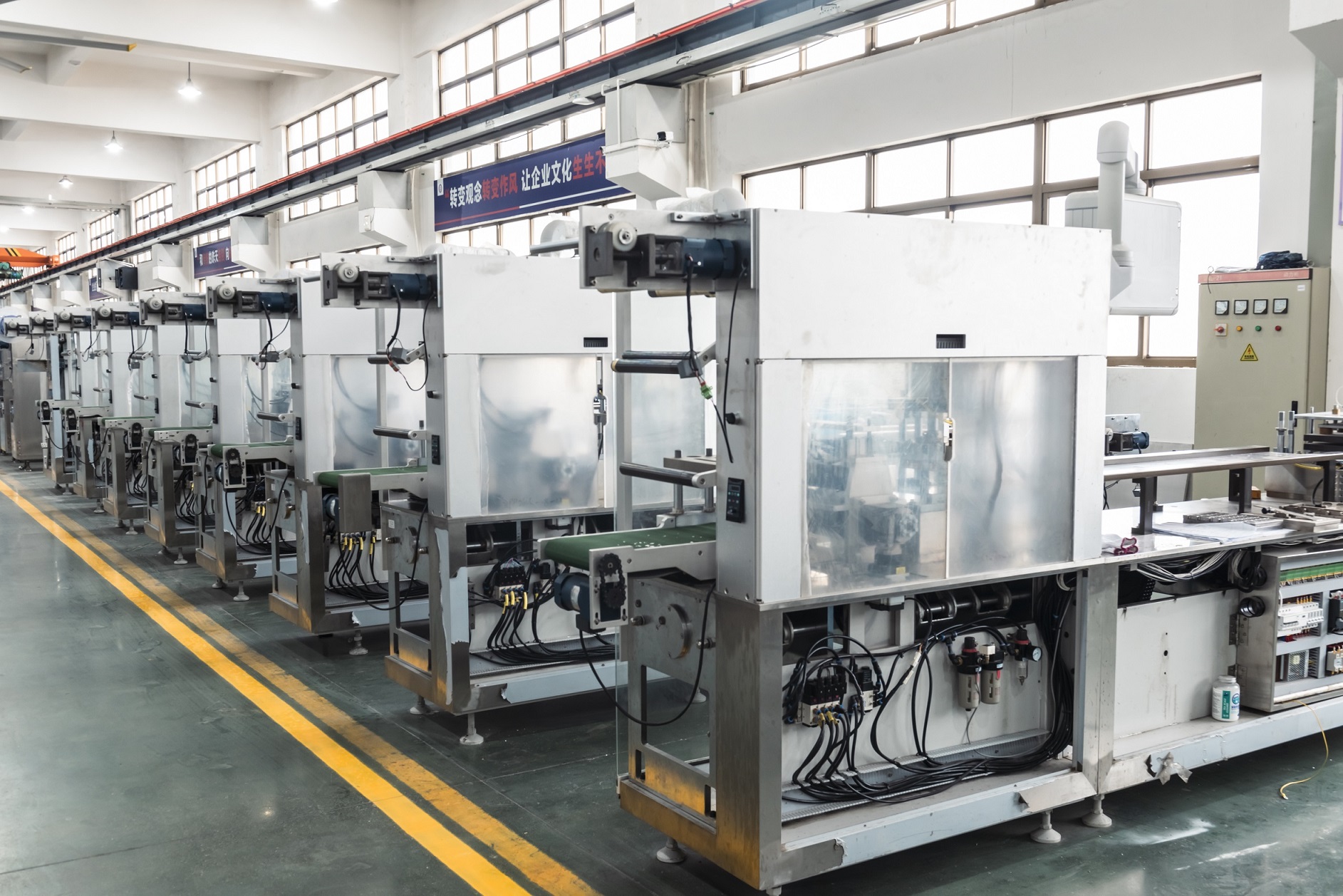
Blister packing machine workshop, where the forming stage is built and tested before line integration.
Line Balancing: The Number That Decides the Shortlist
Stages cannot be compared on speed because they do not share a unit. A line balance starts by converting each stated capacity into the unit that leaves the line — cartons per minute at the cartoner, cases per minute at the case packer — and then identifying the lowest number. HOPING states a monthly capacity of 30–40 units and a typical lead time of 60–120 days after technical confirmation, subject to model, configuration, project complexity and contract terms; that belongs in the same plan as the throughput calculation.
Three qualifications should travel with any speed figure in a shortlist. First, nameplate maxima are quoted for a defined format and do not by themselves establish sustained output under production conditions. Second, format changeover is a capacity cost rather than a setup detail, and it is specified through the customisation scope — blister size, blister material, quantity per carton, carton specification, leaflet format, coding and inspection method. Third, inspection and data requirements sit inside the machine specification: coding and inspection method, electrical component brand and data interface appear in the same customisation list, consistent with the shift toward digitised data collection and integrated solutions described in trade coverage of PMMI content.
The Integrated Alternative: DHL8005H Automatic Blister-Cartoning Line
An integrated blister cartoning line replaces the forming stage, the cartoner and the transfer between them with one machine. The DHL8005H Automatic Blister-Cartoning Line combines blister forming, sealing and cartoning, and is specified at up to 800 blisters per minute and 500 cartons per minute. It belongs to a DHL family that also includes DHL6004, DHL7004, DHL7005H and DHL1000/5H, while the wider range adds the High-Speed Blister-Flow-Wrap-Cartoning Line IXW600 and IXW800 for configurations that include flow-wrap.
What integration changes:
- Interfaces. One blister-to-carton handover instead of a transfer and buffer between two machines.
- Acceptance. One factory acceptance test and one documentation set covering the combined function.
- Footprint. A single frame in place of two machines and a connecting conveyor.
- Accountability. One supplier for the point where most start-up problems occur — the blister-to-carton transfer.
What integration does not change:
- The blister format and the carton remain buyer decisions.
- The 800 and 500 figures are separate stated maxima for the two outputs; the pairing assumes a defined number of blisters per carton, which should be confirmed against your own carton fill.
- A stoppage upstream stops cartoning as well, because there is no inter-stage buffer.
- Stage-level upgrades, such as a new inspection system or a different carton style, act on the whole machine rather than one unit.
When a Staged Shortlist Beats a Single Integrated Line
The decision is not about which architecture is more advanced. It is about which variable is most likely to change: the format set, the capital release schedule, or the footprint.
- Format churn. If blister size, carton count or leaflet format changes often across SKUs, the staged build-up lets one stage be re-tooled without re-qualifying the others. If the format set is stable, that advantage shrinks.
- Phased capital. If the line will be built across more than one budget cycle, staged units can be commissioned in sequence. HOPING’s portfolio separates the combinations — DPP Series + XWZ Series for blister-cartoner, XWZ300II + XWK4060 + ICP12 for cartoner-to-palletiser — which makes staged commissioning a planning option rather than a custom request.
- Optional flow-wrap. If flow-wrap applies to part of the range only, a staged arrangement keeps it as a segment (DPH320H-XW8200-XWZ300II) instead of routing all output through it.
- Footprint and layout. If the room cannot take two machines plus a transfer, the integrated line is the realistic answer.
- Validation capacity. If the quality team can support one combined FAT and one documentation package more easily than three separate ones, integration reduces project risk.
- Downtime tolerance. With no inter-stage buffer, an integrated line converts one stoppage into a full-line stoppage. Where that is unacceptable, staged units with buffers are the safer choice.
Adjacent Configurations That Change the Shortlist
Three further configurations are worth holding beside the main shortlist, because each replaces a different stage rather than the whole line.
- Automatic Vials Packing-Cartoning Production Line (listed as Labeling + DPP + XWZ + XWK Series) — a vial format, where labelling joins the sequence before cartoning and case packing.
- Liquid Dosage Blister-Cartoner Integrated Line IXW400 — for liquid rather than solid dosage, so the forming stage and its material questions differ from a tablet blister line.
- Facial Mask Packing Machine DPP Series — a cosmetic-format product on a blister-type platform, where cartoning and case packing may still resemble a pharmaceutical secondary packaging line.
A vial line and a tablet blister line share cartoning and case packing logic but not the forming stage. That is the practical argument for building the shortlist by stage: when the product changes, it becomes visible which stages carry over and which have to be re-specified.
Market and Compliance Context That Bears on the Shortlist
Two compliance references bear directly on the forming stage. ISO 15378:2017 specifies Good Manufacturing Practice requirements for primary packaging materials for medicinal products, which places the blister — a primary pack — inside a documented quality framework rather than treating it as secondary packaging. Separately, the U.S. FDA publishes cGMP guidance on production and process controls; the available guidance establishes the framework but does not, in the material reviewed here, set out machine-specific requirements, so “GMP-compliant machine” is better treated as a documentation and qualification question than as a label.
Market figures deserve the same care. The global blister packaging machine pharmaceutical market was valued at USD 2.57 billion in 2025 by Custom Market Insights, with Asia-Pacific described as the fastest-growing region at an 8.87% CAGR to 2031, while Mordor Intelligence reports the wider pharmaceutical packaging machinery market at USD 7.09 billion in 2026 growing at 7.15% CAGR. Both are single-publisher commercial estimates whose definitions are not fully disclosed in the available material, so they support a directional reading of demand rather than a category-size calculation or a machine selection.
Verification Steps Before the Shortlist Becomes an Order
- Factory acceptance test on your product. HOPING’s stated quality sequence runs from incoming material inspection and key component inspection through assembly inspection, electrical safety check, no-load trial run, material trial, factory acceptance test, customer witness acceptance and pre-shipment inspection. Ask which steps use your material and your format.
- Certificate check. Match certificate number, issuing body, scope and validity to the exact model. Beyond the cartoning and blister certificates noted earlier, HOPING’s records include CE certification for the blister packing machine series (HTT190102306L, issued 22 January 2019 by Shenzhen HTT Technology Co., Ltd., citing Machinery Directive 2006/42/EC and EN 60204-1:2006+A1:2009+AC:2010), plus ISO 14001:2015 and ISO 45001:2018 management-system certificates issued in October 2023 with stated validity to October 2026 — confirm currency at the time of order.
- Commercial terms. MOQ is stated as one set or one complete line; lead time typically 60–120 days after technical confirmation, subject to model, configuration, complexity and contract terms.
- Service scope. Installation and commissioning, operator and maintenance training, remote support, spare parts supply and process-parameter guidance, as set out in the contract and project configuration.
- Project objectives. For multi-line solid-dosage projects, HOPING describes representative objectives such as reducing manual transfer between blister and carton stages and reducing wrong-insertion or missing-leaflet risk. These are stated objectives, not published measured outcomes, and they should be converted into acceptance criteria in your own FAT protocol.
Outlook
The shortlist is likely to stay mixed rather than converge on one architecture. Integrated lines continue to absorb more of the process — the range now spans blister-cartoner, blister-flow-wrap-cartoner and cartoner-to-palletiser combinations — while the same portfolio keeps the individual stages available as separate units. For a buyer in evaluation, the question is therefore not whether integration is the future, but which variables in your own product mix are stable enough to lock into a single frame. Where formats are still moving, staged flexibility earns its place; where they have settled, a single blister cartoning line is easier to validate.
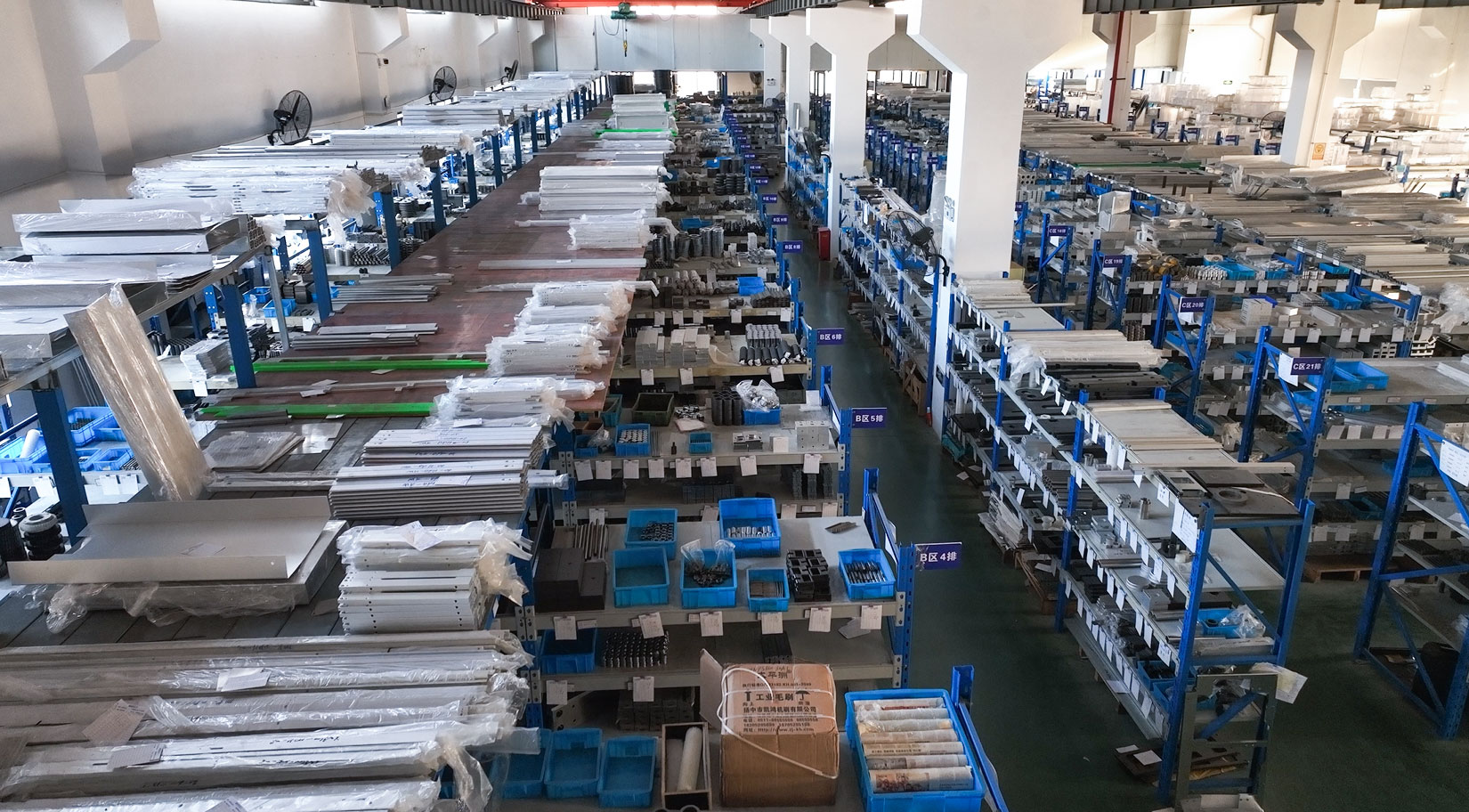
Warehouse area at HOPING’s Ruian facility, downstream of end-of-line assembly.
The full machine list referenced in this shortlist, including the blister, cartoning, flow-wrap, banding, case packing and palletising units, is set out in the HOPING product catalog (PDF): Hoping Machinery Catalog.
Questions Buyers Ask About Staged and Integrated Lines
What is the difference between a staged pharmaceutical packaging line and an integrated blister cartoning line?
A staged line keeps each function in a separate machine — infeed, blister forming, cartoning, banding, case packing and palletising — connected by transfers. An integrated blister cartoning line combines blister forming, sealing and cartoning in one machine, as the DHL8005H does. The staged arrangement allows one function to be re-tooled, replaced or added later without re-qualifying the others. The integrated arrangement removes the blister-to-carton transfer and produces one acceptance test, one documentation set and a smaller footprint, at the cost of independent stage flexibility.
Where does a reciprocating flow packing machine sit in a blister cartoning line?
Between the blister machine and the cartoner. In the listed configuration DPH320H-XW8200-XWZ300II, a Reciprocating Flow Packing Machine XW8200 follows the blister machine and precedes the cartoning machine; the XW8300 is the other listed reciprocating flow packer. The stage is optional and is present only where the product needs a flow-wrapped primary pack or bundle before cartoning.
How fast is the DHL8005H Automatic Blister-Cartoning Line, and what does that figure cover?
HOPING specifies the DHL8005H at up to 800 blisters per minute and 500 cartons per minute. The two figures describe separate outputs of the same line rather than one combined rate, and the pairing assumes a defined number of blisters per carton. As with any nameplate maximum, sustained output on a specific tablet or capsule format should be confirmed by a material trial and a factory acceptance test rather than inferred from the stated maximum.
Which documents should a buyer check on a blister packaging machine’s CE certificate?
Check the certificate number, the issuing body, the standards cited, the product scope and the validity period, and match all of them to the exact model being ordered. HOPING’s records, for example, include CE certification for the blister packing machine series under HTT190102306L, issued 22 January 2019 by Shenzhen HTT Technology Co., Ltd. and citing Machinery Directive 2006/42/EC and EN 60204-1:2006+A1:2009+AC:2010, and a separate CE certificate for a sample automatic blister packing machine under UCN 900175009261 issued by CELAB. A certificate covering a series is not automatically a certificate covering every configuration inside that series.
When do vials, liquid dosage or facial masks need a different line configuration?
When the product format changes the forming stage. Vials move the sequence to the Automatic Vials Packing-Cartoning Production Line, listed as Labeling + DPP + XWZ + XWK Series, where labelling joins the line ahead of cartoning. Liquid dosage uses the Liquid Dosage Blister-Cartoner Integrated Line IXW400 rather than a solid-dosage blister cartoner. A facial mask product runs on the Facial Mask Packing Machine DPP Series. In each case the cartoning and case packing logic can resemble a standard secondary packaging line, but the forming stage and its material questions do not carry over.
¿Tiene preguntas o necesita más detalles?
Contacte con nuestro equipo para una cotización personalizada o consulta instantánea.
Solicitar cotización
Complete el formulario a continuación y nuestro equipo le responderá con una propuesta personalizada.
Chat directo de WhatsApp
¿Prefiere chatear en tiempo real? Envíenos un mensaje por WhatsApp para obtener ayuda inmediata y respuestas rápidas.
- Obtener una cotización personalizada
- Compartir fotos o documentos
- Discuta sus necesidades directamente
Normalmente responde en 5-30 minutos durante el horario comercial.