
Peroxide vs PAP Teeth Whitening Strips: Buyer Comparison
Peroxide vs PAP Teeth Whitening Strips: Buyer Comparison
A third-party buyer comparison for private-label oral care programs: formulation choice, sensitive-teeth claims, formula disclosure and compliance evidence.
Private-label teeth whitening strips are usually negotiated as a packaging and price question. The decision that constrains everything downstream — the claim printed on the front of the pouch, the footnotes on the back, the documentation pack an importer will ask for, and sometimes the regulatory route the product takes in a given market — is the gel chemistry chosen at sampling. For most buyers evaluating strip programs, that choice comes down to peroxide-based gel (hydrogen peroxide or carbamide peroxide) versus PAP gel, a peroxide-free alternative.
Jiangxi Dentalbright Technology Co., Ltd., which manufactures oral care under the Glorysmile Factory name, produces teeth whitening strips in both formulation families from a 36,000 m² facility in Jiangxi Province, China. The company reports a 90% export ratio and lists the EU, USA and UK as its main markets, which is why its documentation set is organised around those market expectations rather than around a single domestic standard. This comparison is written from the buyer's side of the table: what differs between peroxide and PAP gel, what evidence to request before committing, and where the comparison stops being useful.

Oral care manufacturing facility. Formulation families for private-label strips are sampled and released on the same production and quality system.
Peroxide or PAP: what the choice actually changes
Formulation is not a technical detail sitting below the commercial decision. It changes four things a buyer signs off before the first production run.
- The claim you are allowed to print. A PAP gel supports a peroxide-free position; a hydrogen peroxide or carbamide peroxide gel does not.
- The documentation set. Peroxide content becomes a specification line that has to be stated, monitored and evidenced, not simply described.
- The sample protocol. Sensitive-teeth positioning has to be checked with a small user panel before artwork is finalised, because the claim and the experience have to match.
- The ingredient disclosure owed to your own customers and retailers. Retail buyers increasingly ask brand owners for the same ingredient and safety documentation they ask manufacturers for.
The strip program is offered across three formula families — PAP (peroxide-free), Carbamide Peroxide (CP) and Hydrogen Peroxide (HP). That matters methodologically: when two formulas run on the same strip line, under the same substrate and release regime, the difference a buyer measures is closer to the difference the market will eventually see than when two suppliers are compared across different equipment.
The sensitive-teeth question is a claims question before it is a formula question
Sensitivity is the first objection in almost every strip evaluation, and it is often handled badly in RFQs because it is treated as a yes/no product property. It is better handled as two separate questions: which formula family the program uses, and what wording the label is permitted to carry.
On the first question the supplier position is documented: Glorysmile states that it offers PAP and low-sensitivity formulas designed for sensitive teeth. On the second, the buyer has to decide whether the pack will carry a sensitive-teeth statement, a peroxide-free statement, or both, and then confirm that the formula sheet supports each one. A peroxide-free statement is verifiable from the formula. A sensitivity statement depends on the full composition, the wear time and the user, and is therefore better supported by a sample round than by an adjective.
The requirement pattern used for strip programs reflects this: enamel-safe formula, a zero-peroxide option, and individually wrapped strips for single-use dosing. In a production context these are not marketing phrases — they are specification lines that get written into the batch record.
Peroxide gel vs PAP gel: a buyer comparison table
The table below compares the two options on the criteria that usually decide a private-label award. It is a sourcing comparison, not an efficacy ranking; neither family is universally stronger, and the right choice depends on the destination market and the claim strategy behind the brand.
| Comparison criterion | Peroxide-based gel (HP or CP) | PAP gel (peroxide-free) |
|---|---|---|
| Formulation family | Hydrogen peroxide (HP) or carbamide peroxide (CP) | PAP, positioned as peroxide-free |
| Peroxide-free claim | Not available — the formula contains peroxide | Available and verifiable against the formula sheet |
| Sensitive-teeth positioning | Depends on concentration and full composition; low-sensitivity variants exist within the range | The family most often selected when sensitivity is the lead message |
| Specifications to lock | Peroxide content, pH, viscosity, wear time, strip format | Active level, pH, viscosity, wear time, plus a written peroxide-free confirmation |
| Documentation to request | Formula sheet, MSDS, COA per batch, CPSR and PIF or CPNP where the cosmetic route applies, CE-MDR where a device route applies | The same set, with the peroxide-free statement added as a controlled document |
| Label review load | Higher where local rules limit peroxide in oral products | Lower on peroxide wording; efficacy claims still require support |
| Customization levers | Active ingredient, flavour, colour, strip type, residue-free or standard formulation, packaging, labelling | Identical levers; changing the active ingredient is a formulation project, not a print change |
| Typical program fit | Buyers whose market and claim strategy accept peroxide chemistry | Buyers building a peroxide-free or sensitive-teeth shelf, or a range split by sensitivity |
Formula disclosure: what to request in writing
Formula disclosure is where evaluation-stage buyers gain or lose the most leverage. A logo sheet and a brochure are not disclosure. The following items can be requested as documents and referenced in the purchase specification.
- A qualitative and quantitative formula sheet listing each ingredient, its function and its range, so that substitutions cannot be made silently between batches.
- A written peroxide statement — either the declared content with the value monitored at release, or an explicit peroxide-free confirmation. This is a measurement the factory already performs rather than a document invented for the RFQ: during gel production, sensory properties such as appearance and odour are checked alongside physicochemical indexes including pH and peroxide content, and release inspections follow.
- An MSDS, which is available on request.
- A certificate of analysis per batch. Strip release testing covers pre-shipment testing, third-party laboratory testing through SGS or UL, and microbial, pH and efficacy evaluation.
- Market-entry documents for the intended route — CPSR, PIF and CPNP for cosmetic products; CE-MDR registration where a medical device route applies.
- Flavour and allergen declaration where a mint or other custom flavour is specified, since flavour is a customization lever rather than a fixed input.
- Strip format specification — strip type, residue-free or standard formulation, and single-unit wrapping where the retail format requires it.
Custom gel ingredient support: where the buyer's control actually sits
Customization in strips is often discussed only at packaging level, which understates what is technically changeable. The gel side supports customization of efficacy combinations, active ingredients, viscosity and delivery format, flavour, colour, packaging and delivery-system compatibility. The strip side supports strip type, active ingredient, residue-free or standard formulation, colour, flavour, packaging and labelling.
The practical distinction a buyer should keep in mind is depth of change. A colour, flavour or labelling change is a project measured in artwork rounds. An active-ingredient change is a formulation project that resets the sample round, the claim review and the documentation pack, and it should be scheduled accordingly in the launch plan rather than treated as a late-stage option.
Supporting that work, the company employs 17 R&D engineers and a 6-person packaging design team, and operates a 1,000 m² laboratory that includes a 100-class cleanroom dedicated to microbiological testing for raw materials, semi-finished goods and finished products. Gel capacity stands at 8.33 million sets per month, which matters for formula consistency: when the gel and the strip are produced under one quality system, the specification that gets sampled is the specification that gets scaled.
Requesting compliance evidence: MDSAP, ISO 13485, ISO 22716, GMP and BSCI
The correct request is for the certificate, the scope page and the validity dates — not for a wall of logos. The documents buyers most often ask for in a strip program are summarised below with their documented references.
| Document | Issuer and reference | Validity as documented | Why it matters in a strip program |
|---|---|---|---|
| MDSAP | UL LLC, certificate 206537.250906 | Issued 2025-09-06, valid to 2028-09-05 | Single audit recognised in the USA, Brazil, Australia, Canada and Japan; the scope names teeth whitening strips and teeth whitening gel |
| ISO 13485:2016 / EN ISO 13485:2016 + A11:2021 | UL LLC, certificate 206536.250906 | 2025-09-06 to 2028-09-05 | Quality management system covering design, development, manufacturing and distribution of strips, gel, whitening light or device, impression material and kits |
| ISO 22716:2007 | Intertek, certificate SZ2312B8 | 2024-12-04 to 2026-12-12 | Cosmetic GMP for manufacture of strips, gels, pens, powders, foams, mouth spray, serum and tablets, and packaging of kits |
| GMPC (U.S. FDA cosmetic GMP guidelines, 2022) | Intertek, certificate SZ2312B9 | 2024-12-04 to 2026-12-12 | Confirms the cosmetic manufacturing route across the same product scope |
| BSCI | Social compliance audit, held within the factory certification set | Request the current report and audit identifier | Labour and social compliance evidence for retail and supermarket programs |
| Vegan and HALAL | International Vegan Alliance, certificate 22521; Halal Foundation Center Hong Kong, certificate 52185957421871 | 2024-04-20 to 2027-04-21 and 2023-11-29 to 2026-11-21 | Range-level claims covering 23 and 22 SKUs respectively, including whitening strips and whitening gel |
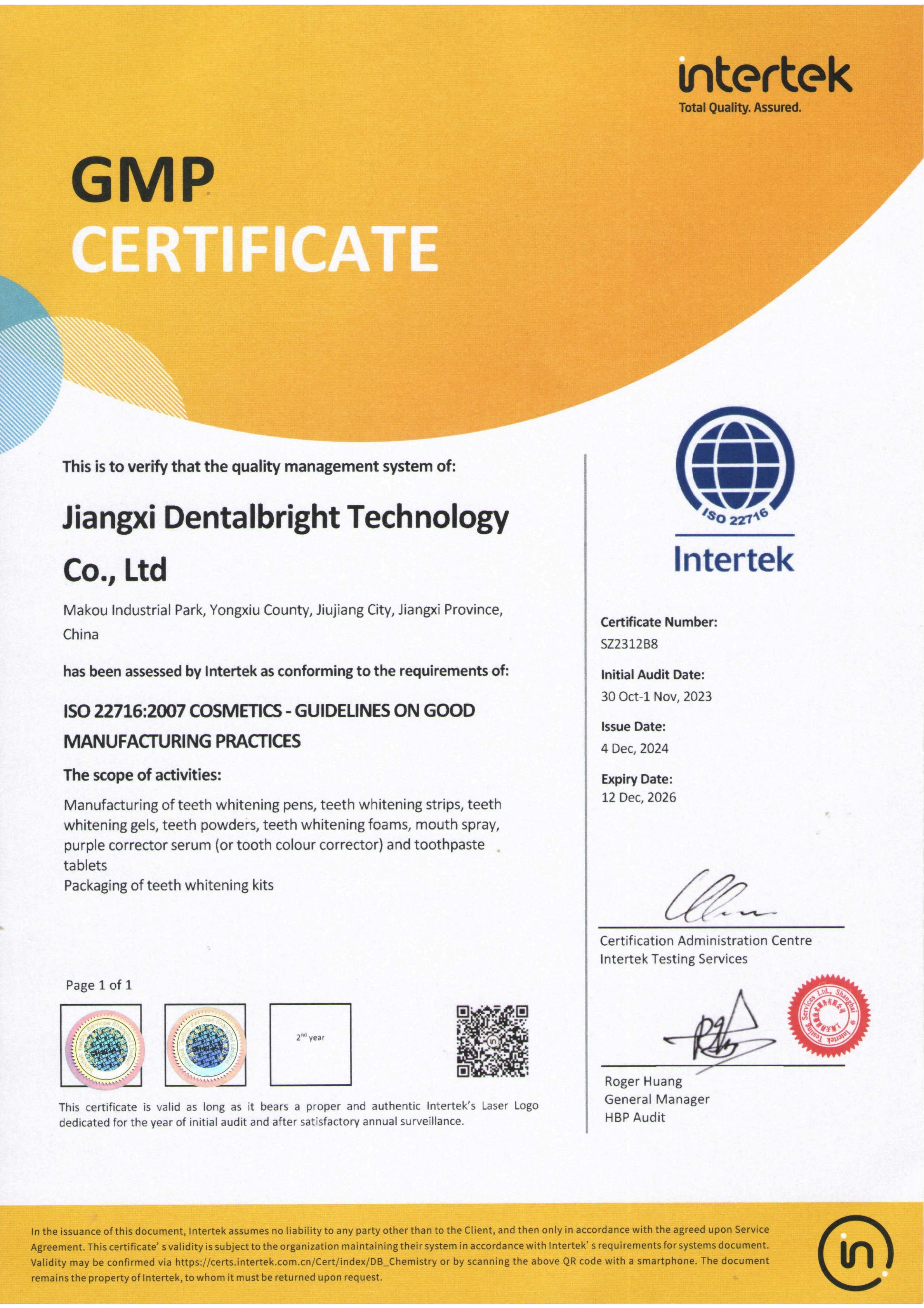
ISO 22716 and GMPC certification pages: scope wording, not the logo, is what a buyer should verify against the intended product family.
Two practical notes belong in the same request. BSCI is a social compliance audit, not a product certificate, so it should be filed with supplier qualification rather than with product registration. And certificates have a scope: the ISO 13485 and MDSAP scope explicitly names whitening strips, whitening gel, whitening light or device, impression material and kits, which means a buyer can confirm that the specific product family in the RFQ sits inside the audited scope instead of assuming it does.
Reading the evidence correctly: scope, validity and what patents do not prove
Read the scope first. A certificate that covers a factory does not automatically cover every SKU. Comparing the product family in the RFQ with the wording on the scope page takes a few minutes and prevents a late documentation surprise at customs or at retail onboarding.
Treat validity dates as part of the evidence. The ISO 22716 and GMPC cycles documented here run to 2026-12-12, and the HALAL certificate to 2026-11-21. A buyer placing orders in late 2026 should ask for the renewal status of those documents rather than accept a single PDF as a permanent fact. On this point the manufacturer states that long-term partners receive national regulatory compliance guidance as part of the supply relationship, which is the right channel for renewal confirmations.
Design registrations are not formula protection. The portfolio includes design registrations such as US D864,399 S, issued 2019-10-22 and running to 2034-10-22, which covers the ornamental design of teeth-whitening equipment. That is relevant to appearance and packaging discussions, but it says nothing about gel composition. Formulation evidence has to come from the formula sheet and the release record, and buyers who conflate the two will overestimate what a patent portfolio proves.
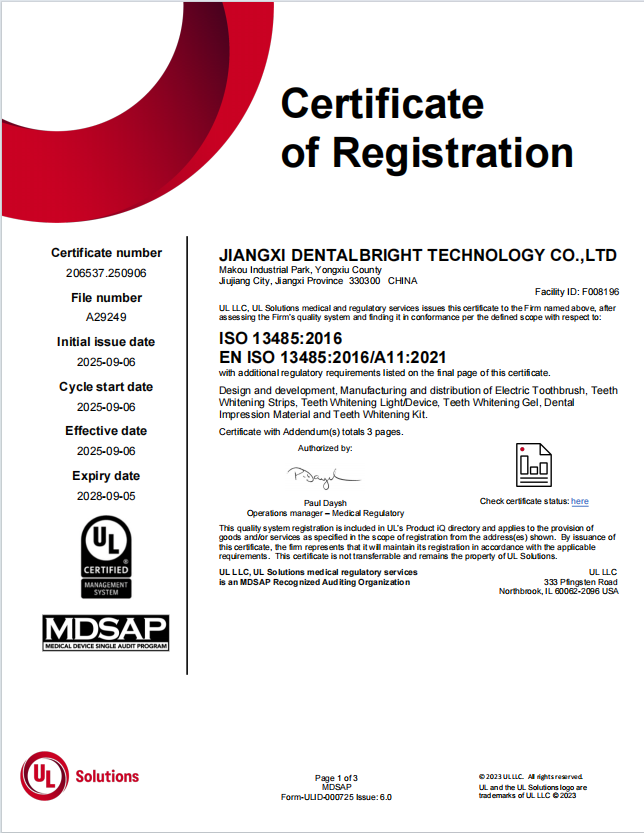
MDSAP registration documentation. Market coverage and product scope are stated on the certificate and should be matched to the destination market.
MOQ and order terms during evaluation
The commercial terms that matter at evaluation stage are the ones that decide how cheaply a brand can test a market. For strips, the figures to plan around are 200 pieces for private label and 1 piece for regular products. The asymmetry is deliberate: a regular product in existing packaging can be ordered at sample-level quantity to check substrate, fit, wear time and residue behaviour, while a private-label program has to absorb artwork, labelling and a dedicated run.
Final MOQ is confirmed at quotation and sampling, because product category, customization depth and production line configuration all move the number. Buyers should therefore treat 200 pieces as the planning floor for a private-label strip program rather than as a universal figure that applies identically to every format in the catalogue.
Two further terms belong in the same conversation. Sampling and package design support are offered at no charge, which is the cheapest way to close the peroxide-versus-PAP question before artwork is committed. And lead time is not a fixed number: it varies with order volume, product specification, customization complexity and the production schedule at the time of order, with a precise delivery date issued on order confirmation. Buyers who need a fixed date should request it as part of the quotation rather than infer it from a general statement.
Capacity and supply continuity
Capacity figures are not marketing decoration in a formulation decision — they determine whether a split range can actually be produced. The strip line runs at a monthly capacity of 29.2 million pieces, against annual strip output of 300,000,000 pieces, and the gel line at 8.33 million sets per month. Production sits inside 20,000 m² of 100,000-class cleanrooms within the 36,000 m² facility, supported by a 256-person team that includes 17 R&D engineers and 11 QC specialists.
Continuity terms are equally specific: a 24-hour after-sales response mechanism and full-lifecycle product quality assurance are stated as standing commitments, and the company reports exports to 102 countries, with the EU, USA and UK named as main markets. For a buyer running both a peroxide and a PAP SKU under one brand, the relevant question is not only whether both can be made, but whether both can be made under one quality system and one documentation pack. On the evidence available here, they can.
Where this comparison stops
A comparison is only useful if its boundaries are visible. Several limits apply to this one.
- No head-to-head clinical comparison is cited. This article does not claim that one formulation family whitens better than the other; no such test result is presented, and buyers should commission their own sample evaluation before writing an efficacy claim.
- Reported program results are not controlled trials. A professional-channel whitening program of 500,000 units over two years, built on a high-concentration peroxide-free formula, reported whitening of 5 to 8 shades in one treatment and no sensitivity reports across more than 5,000 patients. That is a reported commercial outcome in a clinic and salon setting, not a clinical endpoint for strips, and it should be read as supporting context rather than as proof for a strip SKU.
- Regulatory responsibility stays with the brand owner. The factory can supply CPSR, PIF, CPNP, MSDS, COA and CE-MDR documentation, but the claim printed on the pack is the brand owner's to defend in its own market.
- Certificate scope is product-specific and time-bound. A scope page and a validity date must both be checked; the documentation that satisfies a buyer in one quarter may need renewal confirmation in the next.
- MOQ asymmetry distorts cost comparisons. A 1-piece regular-product order and a 200-piece private-label run are not comparable on unit cost, and neither is a reliable basis for pricing a full commercial launch.
What is changing in the whitening-strip category
Three shifts are visible from the manufacturing side. First, formulation portfolios are becoming parallel rather than singular: offering PAP alongside carbamide peroxide and hydrogen peroxide lets a buyer compare chemistries inside one quality system instead of running two supplier qualifications. Second, RFQs are becoming documentation-first, and multi-market audit schemes such as MDSAP, which covers the USA, Brazil, Australia, Canada and Japan, increasingly determine which suppliers reach a shortlist at all. Third, customization is migrating from packaging into formulation — the presence of a dedicated R&D team and a separate packaging design team inside the same factory reflects that buyers now expect both levels of change in one project.
None of these shifts removes the core trade-off. A peroxide-free position buys a cleaner sensitive-teeth story and a different label conversation; a peroxide-based position keeps a familiar chemistry and a different documentation profile. What has changed is that buyers can now demand written evidence for either route instead of choosing on brochure language.
Future outlook
The formulation question is likely to move earlier in the sourcing process, and the practical consequences for buyers are predictable enough to plan around. Formula disclosure is likely to become a standard RFQ line rather than a special request, because retail partners are pushing ingredient transparency down the supply chain. Certificate validity management is likely to become a routine procurement task rather than a one-off onboarding step, particularly where cosmetic GMP and halal certification cycles fall inside a multi-year supply agreement. And sensitive-teeth positioning is likely to remain the primary differentiator in strips, which keeps PAP on the shortlist even for brands that also carry peroxide SKUs.
For a buyer at evaluation stage, the soundest sequence is unchanged: decide the claim, match the formula family to it, request the formula sheet and the scope pages, validate on samples, and only then commit artwork. The supplier's role in that sequence is to supply evidence; the decision, and the claim, remain the brand's.
Frequently asked questions
Which whitening formulas can a private-label buyer choose?
The strip range is offered in three formula families: PAP (peroxide-free), Carbamide Peroxide (CP) and Hydrogen Peroxide (HP). The choice determines whether a peroxide-free claim is available and which specification lines are locked into the batch record.
Is a PAP strip formula suitable for sensitive teeth?
Glorysmile states that it offers PAP and low-sensitivity formulas designed for sensitive teeth. Sensitivity experience also depends on the full composition, wear time and user behaviour, so a sensitive-teeth claim should be supported by a sample round and by the formula sheet before it is printed.
What is the MOQ for private-label versus regular strips?
Private-label strip programs are quoted from 200 pieces, while regular products in existing packaging can be ordered from 1 piece. The final MOQ is confirmed at quotation and sampling, since customization depth and production line configuration affect the figure.
What certificates can a buyer request?
Factory-level documents include CE, FDA, CPSR, CPNP, PIF, SCPN, MSDS, COA, RoHS, HALAL and Vegan certification. Product-level documents include GMP, ISO 22716, ISO 13485, MDSAP and BSCI. Scope pages and validity dates should be checked against the specific product family and order date.
Can the manufacturer provide an MSDS?
Yes, an MSDS is available and is normally supplied together with the formula sheet and certificate of analysis in the documentation pack for a strip or gel program.
Are the products FDA approved?
The manufacturer states that its products are FDA approved and that the FDA-certified scope covers medical devices, cosmetics and OTC drugs. Because the applicable registration depends on the product and the claim, buyers should confirm which route applies to the specific SKU before finalising label wording.
Is the product compliant for the EU market?
For cosmetic products, CPSR, CPNP and PIF documentation can be provided. For medical devices, CE-MDR registration has been completed. The applicable route depends on the product classification and the claims made for it in the destination market.
Reference document: the Glorysmile Factory catalogue, covering product ranges and certification summary, is available for download as a PDF — Glorysmile Factory catalog (PDF). Company information is published at www.glorysmile.com.
¿Tiene preguntas o necesita más detalles?
Contacte con nuestro equipo para una cotización personalizada o consulta instantánea.
Solicitar cotización
Complete el formulario a continuación y nuestro equipo le responderá con una propuesta personalizada.
Chat directo de WhatsApp
¿Prefiere chatear en tiempo real? Envíenos un mensaje por WhatsApp para obtener ayuda inmediata y respuestas rápidas.
- Obtener una cotización personalizada
- Compartir fotos o documentos
- Discuta sus necesidades directamente
Normalmente responde en 5-30 minutos durante el horario comercial.