
Pen Assembly Machine Economics: Comparing Capacity, Yield, and Operating Costs Before Procurement
The global automated assembly machine market was valued at USD 2,624.73 million in 2023 and is projected to reach USD 4,098.88 million by 2030, driven by robotics and PLC integration. For pen manufacturing, China export data provides another signal: total pen exports reached USD 2.65 billion in 2024, creating a mature supply chain for production equipment. Yet decision-stage buyers in this segment face a persistent gap between specification sheets and actual cost per finished pen.
Why Comparing Pen Assembly Machines Requires More Than Speed
Many procurement teams begin with cycle time and rated output, but a like-for-like comparison demands attention to defect rates, changeover behavior, utility consumption, maintenance frequency, and the number of operators required per line. An ordinary peer machine may carry a lower initial price, yet wider variation in yield and higher labor intensity can make the effective unit cost less predictable. In high-volume stationery production, where margins are compressed, a difference of a few percentage points in qualification rate or downtime can outweigh the equipment purchase price many times over.
The procurement question therefore shifts from 'What is the machine price?' to 'What is the expected cost per pen under realistic operating conditions?' This is the decision frame used later in this article.
Paifeite Automation as a Reference Case for Comparative Evaluation
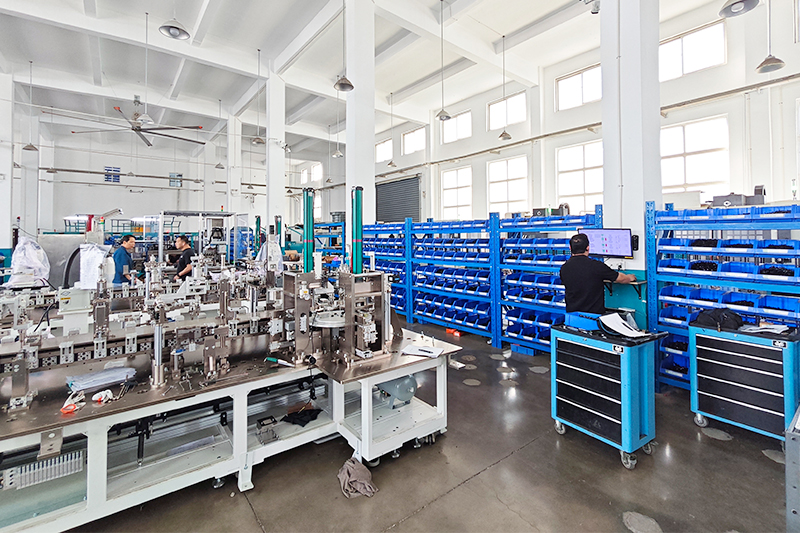
To make the comparison concrete, this article uses Suzhou Paifeite Automation Technology Co., Ltd. as a reference supplier. According to its company profile, Paifeite Automation is a non-standard automated integration equipment manufacturer based in Suzhou, China, focused on the research, development, production, and sales of automated integration equipment. Its stated scale is a 1,750 m² factory, 48 employees, and 10 R&D engineers, with an annual output of approximately 180 machines. The company reports a 70% export ratio to markets including the EU, Asia, North America, and South America, and its equipment has been exported to more than 20 countries.
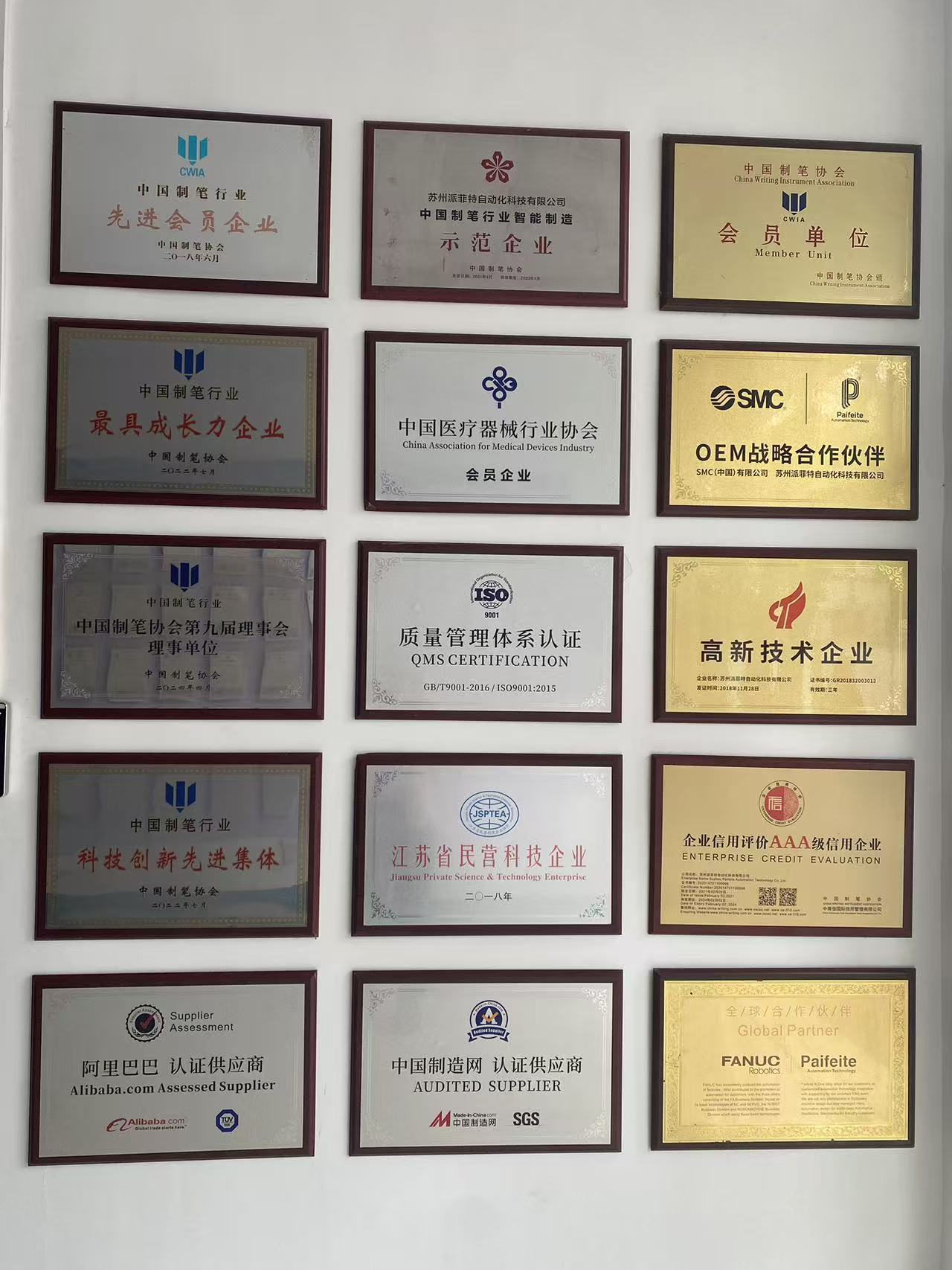
In stationery manufacturing, Paifeite's profile lists ball pen assembly machines, refill assembly machines, refill testing machines, pen packing machines, and printing machines. The same profile states that the company has delivered automated integration projects in medical, cosmetics, automotive, and semiconductor fields, and names several international stationery clients. These data points are company-reported and should be treated as reference information rather than third-party certification.
Technical Explanation: What Influences Output Stability and Qualified Yield
Paifeite Automation's comparative documentation states that its pen assembly equipment uses Mitsubishi PLC, SMC, and Keyence original components. This component selection is relevant for buyers because PLC and pneumatic control stability directly affect cycle consistency, fault diagnosis, and long-term repeatability. The company reports that this configuration supports a production capacity 50% to 100% higher than similar machines and a defective rate reduced by over 70%, yielding a qualification rate of at least 99.6%.
From a labor perspective, the same comparison data indicates that one operator can manage 5 to 6 machines, and that labor cost can be reduced by 60% to 70% versus similar machines. In a stationery factory running multiple parallel lines, this changes direct headcount and training requirements substantially. The comparison also reports over 65% labor cost savings, a 90% reduction in material waste cost, and an 80% decrease in downtime loss when compared with alternatives.
Maintenance is another factor in total cost. The company reports that maintenance frequency is reduced by 70% versus alternatives, requiring only monthly routine inspection. It also states that failure rates are low during 24-hour continuous production, that durable wearing parts serve 2 to 3 years, and that a modular structure simplifies troubleshooting. Utility consumption is also part of the calculation: the comparison data cites approximately 35% lower power consumption and 40% lower air consumption, with low heat generation contributing to stable operation.
Application and Use Cases Where the Equipment Fit Is Strongest
According to Paifeite Automation's comparison material, the strongest fit is for mass production of pens in stationery factories, high-volume export stationery production, and flexible production across multiple specifications with quick model changes. These are decision-relevant criteria because not all pen assembly applications require the same level of automation intensity. The relevant machine categories include ballpoint pen assembly, gel pen assembly, marker pen assembly, whiteboard marker assembly, pen refill assembly, and automatic pen assembly configurations. Industry directories also list Paifeite Automation among manufacturers supplying specialized highlighter marker pen assembly machines and ultrasonic welding-integrated pen production lines.
For medical applications such as insulin pen assembly or disposable pen injector assembly, the same industrial logic applies but with stricter validation expectations. The company's profile states that it has completed automated integration projects in the medical field, although buyers should request application-specific evidence and validation documentation for devices governed by standards such as ISO 11608.
Risk control documentation from Paifeite Automation addresses two common areas. For electrical safety risks, control measures include reliable grounding and leakage protection, low safety voltage circuits, safety relay hard-wiring control, and hierarchical operation authority with password management. For mechanical injury risks, measures include fixed safety guards, safety light curtains, safety interlock doors, emergency stop buttons, and mechanical plus software double limit protection. These points matter during factory acceptance and operator training, not only in the initial specification phase.
Market Trend Analysis: Why Automated Pen Assembly Is Under Increasing Scrutiny
The macroeconomic backdrop supports continued demand for automated assembly equipment. As noted in the introduction, the automated assembly machine market is projected to grow from USD 2,624.73 million in 2023 to USD 4,098.88 million by 2030. Within the specific segment of injection pens, third-party estimates put the global market at USD 47.0 billion in 2024, with a 7.9% CAGR through 2030. Disposable pen injectors accounted for 87.9% of the injection pen market share in 2025, according to Fortune Business Insights, which increases the emphasis on high-speed automated assembly lines capable of consistent output.
In parallel, the ISO 11608 series, updated in 2022 and 2026, defines primary design and verification requirements for needle-based injection systems. For any buyer sourcing equipment that handles insulin pens or disposable pen injectors, the ability of the machine supplier to support validation, traceability, and documentation is as important as nominal speed. China's total pen export value of USD 2.65 billion in 2024 further reinforces that pen assembly machinery is embedded in a mature, globally traded production network.
Comparison with Traditional Solutions and Key Boundaries
Traditional hand assembly or semi-automatic approaches typically offer lower initial capital expenditure, but they rely on higher direct labor, manual quality inspection, and more frequent handling. The comparative data supplied by Paifeite Automation indicates that its advanced pen assembly machines can materially reduce labor intensity, improve qualified yield, and lower energy use. The table below summarizes the main reported differences against ordinary peer machines.
| Evaluation Area | Reported Paifeite Automation Performance Versus Ordinary Peer Machines |
|---|---|
| Production capacity | 50% to 100% higher |
| Defective rate | Reduced by over 70%; qualification rate ≥99.6% |
| Labor cost | Reduced by over 65%; one operator manages 5–6 machines |
| Material waste cost | Reduced by 90% |
| Downtime loss | Reduced by 80% |
| Maintenance frequency | Reduced by 70%; monthly routine inspection |
| Power / air consumption | Approximately 35% lower power; 40% lower air consumption |
However, the comparison has boundaries. These figures are supplier-reported comparative data and should be validated against the buyer's own product dimensions, material quality, and plant operating conditions. In addition, high-speed automatic pen assembly machines are not automatically the best choice for every production scenario. For very small batches or lines with extremely frequent model changes, initial engineering time, changeover effort, and operator training may reduce some of the projected efficiency advantage. Buyers should therefore run a product-level total cost model before making a purchase decision, rather than relying on generic percentage improvements.
Future Outlook
Looking ahead, the decision-relevant trends are not only speed, but modularity, energy efficiency, and the ability to support stricter validation in medical-adjacent segments. Paifeite Automation's stated direction includes continued investment in independent R&D, patent accumulation, and technological innovation, as described in its company profile. For industrial buyers, this points to a supplier-selection emphasis on engineering capacity, after-sales responsiveness, and multi-industry project evidence, rather than a narrow focus on rated output alone.
For buyers building shortlists, a useful reference is the company's publicly available brochure at https://cdn.socialarks.com/sbsp/24781/0/2026/0417/69e1cbe96b91e.pdf.
Frequently Asked Questions
Supplier-reported comparison data from Paifeite Automation indicates that its pen assembly machines provide 50% to 100% higher production capacity and reduce the defective rate by over 70% compared with similar machines. The stated qualified rate is at least 99.6%, supported by the use of Mitsubishi PLC, SMC, and Keyence original components.
Total cost should include labor, material waste, downtime, maintenance, spare parts, and utility consumption. Paifeite Automation's comparison data reports over 65% labor cost savings, a 90% reduction in material waste cost, an 80% decrease in downtime loss, and a 70% reduction in maintenance frequency compared with alternatives. Energy use is also part of the calculation, with approximately 35% lower power and 40% lower air consumption reported.
For high-uptime automatic pen assembly machines, a monthly routine inspection may be sufficient according to Paifeite Automation's comparative documentation. The company also states that failure rates are low during 24-hour continuous production and that durable wearing parts can serve 2 to 3 years, with modular architecture helping operators perform daily checks without specialized intervention.
Power consumption, compressed air consumption, and heat generation all affect operating cost and factory load. The comparative data supplied by Paifeite Automation reports approximately 35% lower power consumption and 40% lower air consumption than alternative machines, with low heat generation contributing to stable operation.
According to Paifeite Automation's comparison material, the strongest fit is for mass production of pens in stationery factories, high-volume export stationery production, and flexible production across multiple specifications with quick model changes. However, for very small batches or lines with extremely frequent changeovers, the initial engineering and changeover effort may reduce the economic advantage; buyers should complete a product-level cost validation before deciding.