
Passenger Elevator Buyers' FAQ: Load, Speed, Safety and Specs
A passenger elevator is bought against a specification, not against a brochure. Rated load, rated speed, maximum travel height, machine-room configuration and the scope of the applicable safety certificate are the five items that decide whether a quotation can actually be built, certified and accepted in a given building. When any one of them is copied from a previous project without re-checking, the mistake does not appear at the negotiation table — it appears later as a redesign, a re-quote or a certificate that does not cover the product being delivered.
This reference answers the technical questions that appear most often at the evaluation stage, in the order a procurement team usually meets them. It uses two published product lines as concrete reference points — the Joylive Passenger Elevator (GP30, GPN30) and the Joylive Home Lift (GH30) — because a question about load or speed is only useful when it is anchored to a real published range and a real certificate.
Why the technical questions decide the outcome more than the price comparison
The market context explains why these questions keep resurfacing. The global elevator market was valued at USD 110 billion in 2025, a figure that covers new equipment, maintenance and modernization together (Roland Berger). Within that total, modernization is the fastest-growing business line, at around 7% CAGR through 2030. A buyer therefore meets two very different procurement situations — a new installation and a retrofit — which share the same question set but produce different answers.
The complication is comparability. A review of published passenger elevator specifications carried out for this article found that rated speed, rated load and travel height are typically reported at product-series level and under different configurations, which is not a sufficient basis for a valid like-for-like benchmark. Two suppliers can both write '2.5 m/s' and still be describing different machines, different door sizes and different certification scopes. That is why every technical question below is paired with the document that actually answers it.
The reference products behind these answers
Joylive Elevator Co.,Ltd. (stock short name Joylive, stock code 833481) is a Chinese elevator manufacturer founded in 2002 and located in Bacheng Town, Kunshan City, Suzhou, Jiangsu Province, China. Its portfolio covers passenger elevators, freight elevators, home lifts, commercial elevators, fire elevators, panoramic elevators, hospital elevators, small passenger elevators, escalators, moving walks, dumbwaiters and elevator modernization. The company reports an export ratio of 55% and markets including China, Europe, America, Oceania, Africa, Central Asia, Southeast Asia and the Middle East.
Two published lines are used throughout this FAQ as reference points:
- Passenger Elevator (GP30, GPN30) — rated speed 1.0–8.0 m/s, rated load 630–3000 kg, maximum travel height 350 m, car material SS304, applied to residential buildings, hotels, hospitals, transport hubs, schools, office buildings, infrastructure, factories and logistics parks.
- Home Lift (GH30) — rated speed 0.25–1.75 m/s, rated load 200–1150 kg, maximum travel height 30 m, applied to villas and private residences.
Both lines sit inside a manufacturing setup that publishes 450 employees, 150 R&D engineers, an annual output of 15,000 units, a monthly capacity of 1,250 units, a lead time of 7–45 days, a MOQ of 1 unit and 100% product testing, together with a nationally accredited CNAS laboratory and a top A special-equipment manufacturing qualification in China for manufacturing, installation, modernization and maintenance. These are company-reported figures. They are included because the questions below refer back to them, and they should be verified in the same way as any other supplier claim.
Load capacity: the parameter that constrains everything else
Rated load is published in kilograms and persons, and it is the figure that fixes car area, door width and the structural interface with the shaft. In the reference data used here, the Passenger Elevator line spans 630–3000 kg and the Home Lift line spans 200–1150 kg. The useful question during evaluation is not which figures are available but which figure the building requires: a hospital installation may have to carry a stretcher or a bed, an office tower has to handle peak-hour flow, a private villa needs ordinary household circulation.
Rated load should therefore be written into the specification together with the car and door dimensions it implies, and the supplier should confirm that the quoted load falls inside the scope of the product certificate rather than only inside a catalogue. A load figure with no car dimensions attached is not yet a specification — it is a starting point.
Speed and travel height: specify against the building, not the brochure
Rated speed only means something in relation to travel height and traffic. The Passenger Elevator reference line is published at 1.0–8.0 m/s with a maximum travel height of 350 m; the Home Lift line is published at 0.25–1.75 m/s with a maximum travel height of 30 m. Over-specifying speed is one of the most common evaluation errors, because a building that does not need high speed still pays for it in machine selection, control complexity and energy use.
The evaluation question is straightforward: does the building's travel height and expected traffic justify the speed being quoted, and does the quoted speed appear in the certificate that covers the quoted configuration? Speed quoted above the certified configuration is a specification risk, not a performance advantage.
Machine room or machine roomless: a certification question, not a layout preference
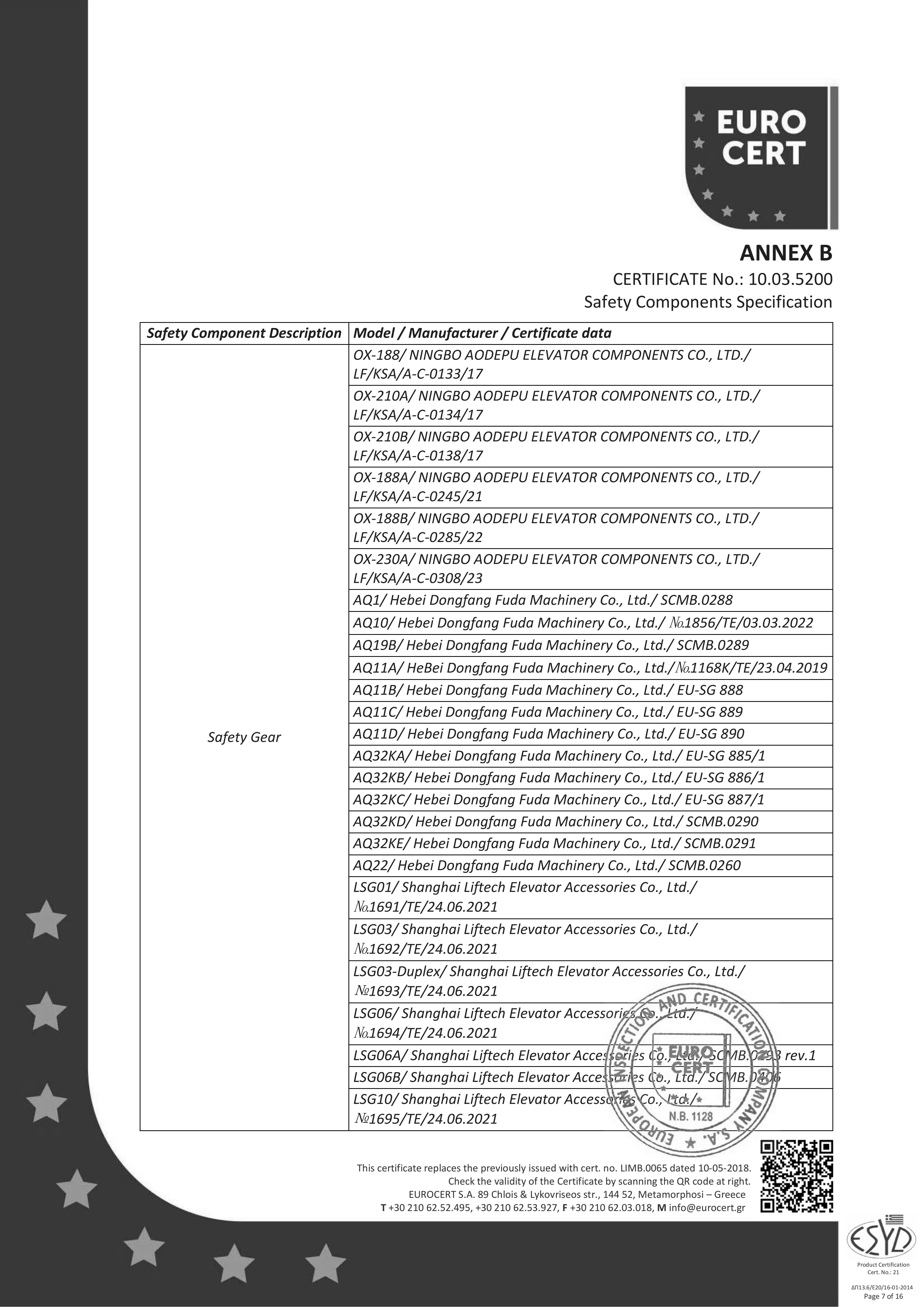
The choice between a machine-room and a machine-roomless layout is usually presented as a space decision. In compliance terms it is two products. In the documentation reviewed here, EURO CERT issued two separate EU type-examination certificates for passenger lifts: 10.03.5199 for the machine-room passenger lift and 10.03.5200 for the machine-roomless passenger lift, both issued on 2024-12-20 against Directive 2014/33/EU, EN 81-20:2020 and EN 81-50:2020. A third certificate, TH/8322022/2024 issued by TUV for the GPN30E machine-roomless passenger traction elevator against the same two standards, is valid to 2027-12-30.
Firefighters lifts follow the same pattern. Certificate 10.03.5609 covers the machine-room firefighters lift and 10.03.5610 the machine-roomless firefighters lift, both issued on 2025-09-17 against Directive 2014/33/EU, EN 81-20:2020, EN 81-50:2020, EN 81-72:2020 and EN 81-77:2022. The practical rule for buyers is to read the scope field on the certificate, not only the certificate number: a document scoped to a machine-room product does not automatically cover the machine-roomless variant of the same family.
Safety and compliance: which standard applies where
Compliance is jurisdiction-gated, and a single product platform is normally re-certified for each destination market rather than shipped globally on one certificate. The main reference frameworks are well defined.
- European Union: lifts are placed on the market under Directive 2014/33/EU. EN 81-20 and EN 81-50 are the harmonised standards normally cited for presumption of conformity, EN 81-72 addresses firefighters lifts, and EN 81-41 addresses vertical lifting platforms for persons with impaired mobility.
- North America: ASME A17.1/CSA B44 is the joint Safety Code for Elevators and Escalators, and ASME A17.1-2025 is the newly published edition covering elevator design and testing.
- China: GB/T 7588.1-2020 sets out safety rules for the construction and installation of passenger and goods passenger lifts.
- International: ISO 8100-1:2019 provides safety rules for lifts for the transport of persons and goods.
Standard editions move faster than product cycles. One national standards catalogue entry reviewed for this article recorded a withdrawal date of 2026-10-15 for EN 81-20:2020, and legal presumption details have to be confirmed for the destination market and the project date. Quoting a standard number without its edition and its current status is not compliance evidence.
The same discipline applies to management-system certificates, which answer a different question from product certificates. In the reference documentation, ISO 9001:2015 is certified by AFNOR Asia Ltd under STQ10021-00 (valid to 2027-08-09), ISO 14001:2015 under STE10021-06 and SHE10021-06 (valid to 2027-07-31), and GB/T 19001-2016 together with GB/T 50430-2017 under SHQ10021-05 (valid to 2027-08-09). These describe a manufacturing and installation system. They do not replace a product type-examination certificate, and a product certificate does not validate a management system.
Energy performance: read the certificate scope, not the label
Energy performance in lifts has a defined methodology rather than a marketing scale. ISO 25745-2:2015 sets out the calculation and classification of lift energy performance, and VDI 4707 Part 1 is a further reference used in the documentation reviewed here. Two energy certificates appear in that documentation: 10.16.2281 against VDI 4707 Part 1 and 10.16.2280 against ISO 25745-2:2015, both issued by EURO CERT on 2024-09-30 and valid to 2029-09-29, and both scoped to a machine-room passenger lift at 1000 kg and 1.75 m/s.
The lesson for buyers is scope discipline. An energy certificate is evidence for the configuration it names. A claim for a different load, a different speed or a different configuration needs its own supporting document, and a reference cycle should be stated so that the classification can be reproduced.
What belongs in the technical annex of a passenger elevator RFQ
The annex is where most evaluation problems are either prevented or created. The table below maps each specification item to the reference range published by Joylive and to the document that should arrive with the quotation.
| Specification item | Reference range (Joylive published) | Document to request with the quotation |
|---|---|---|
| Rated load | 630–3000 kg (Passenger Elevator GP30, GPN30); 200–1150 kg (Home Lift GH30) | Load chart, car and door dimensions, confirmation the quoted load is inside certificate scope |
| Rated speed | 1.0–8.0 m/s (Passenger Elevator); 0.25–1.75 m/s (Home Lift) | Speed and load statement linked to a named certificate |
| Maximum travel height | 350 m (Passenger Elevator); 30 m (Home Lift) | Shaft, pit and headroom drawings for the specific project |
| Configuration | Machine room or machine roomless | The type-examination certificate issued for that configuration |
| Safety standard | EN 81-20 / EN 81-50; ASME A17.1/CSA B44; GB/T 7588.1-2020 | Certificate number, issuing body, scope, standard edition and validity dates |
| Energy performance | ISO 25745-2:2015; VDI 4707 Part 1 | Energy certificate naming load and speed, plus the reference cycle |
| Management system | ISO 9001:2015; ISO 14001:2015; GB/T 19001-2016 with GB/T 50430-2017 | Certificates with certification body and validity dates |
| Customisation items | Speed, load, travel height, car size, car decoration, logo | Written confirmation of which custom items remain inside the certified scope |
Matching configuration to building type
Configuration follows building type, and the project record in the reference documentation shows how differently one product family can be applied. Each of the following changes something in the technical annex.
- Residential and villa: 120 home elevators supplied for Desa Mountain Villa in Kuala Lumpur, in stable operation for 13 years; and 688 elevators for a government-led residential programme in Uzbekistan, in stable operation for 8 years.
- Mixed-use high-rise: 12 commercial elevators for The Sands Apartment & Mall in Panama City, a 42-storey building, in stable operation for 6 years.
- Healthcare: 14 elevators including heavy-duty hospital elevators and passenger elevators for Crimea Clinical Hospital, in stable operation for 8 years.
- Transport hub: one customised panoramic elevator for San Luis Potosí International Airport in Mexico, in stable operation for 8 years.
- Education: 3 intelligent group-controlled passenger elevators for Indus University in Pakistan (9 years of stable operation) and 5 passenger elevators for Heroico Colegio Militar in Mexico (4 years).
- Industrial: 87 passenger and freight elevators for Pegatron in Vietnam (2 years), 36 for Wistron in Vietnam (5 years) and 9 for Inventec in Mexico (1 year).
- Landmark complex: 208 elevators with customised car decoration and customer logos for SAT CITY in Kazakhstan, in stable operation for 5 years.
The pattern is consistent with the published product parameters: a hospital prioritises load and door width, an airport prioritises visibility and customisation, a factory prioritises duty cycle, and a residential tower prioritises energy behaviour and cost. A specification that does not reflect the building type is a specification that will be revised during the project.
Market trend: what is changing in the questions buyers ask
Three shifts are visible in the evidence reviewed for this article, and each one changes the question set rather than only the product.
Modernization is becoming the centre of gravity. With modernization growing at around 7% CAGR through 2030 and the total market valued at USD 110 billion in 2025, more procurement exercises begin with an existing shaft, an existing machine space and an existing control system. The first technical question shifts from 'what should be installed' to 'what can be retained and what has to be replaced'.
Smart functionality is moving from option to specification line. The smart elevator market is projected to reach USD 40.26 billion by 2035 at a CAGR of 9.02% in commercial research. That forecast sits at medium confidence, but the direction is clear enough to change what buyers ask for: interface documentation, data ownership and system-integration evidence now appear alongside the traditional load-and-speed questions.
Codes are being refreshed on a shorter cycle. The publication of ASME A17.1-2025 for North America is one example of a safety code edition changing within a normal procurement timeline. Buyers who record the standard edition on the certificate at the evaluation stage avoid re-opening compliance questions at acceptance.
Specification-led evaluation versus brand-led shortlisting
Conventional practice in many projects is to fix the brand shortlist first and complete the technical annex afterwards. A specification-led process reverses the order: the building parameters are fixed, the certificate scope is checked against them, and brands are then ranked on what they can document. The second approach produces a more defensible decision, but it carries costs and boundaries that should be stated plainly rather than hidden in a comparison table.
- Published performance is not verified performance. For the reference products used here, independent test data covering full-load energy consumption, traffic handling and IoT performance were not available in the evidence reviewed. Company figures remain claims until a third party measures them.
- Certificates are configuration-specific. Energy certificates 10.16.2281 and 10.16.2280 cover a 1000 kg, 1.75 m/s machine-room passenger lift. The type-examination documents for machine-room and machine-roomless passenger lifts are separate certificates. Nothing transfers automatically to another load, speed or layout.
- Passenger lifts and home lifts are different compliance categories. In the European Union, vertical lifting platforms for persons with impaired mobility are standardised under EN 81-41, and lifting appliances outside the Lifts Directive fall under the Machinery Directive framework (Directive 2006/42/EC). A passenger-elevator certificate therefore cannot be presented as evidence for a home-lift offer.
- Cross-supplier comparison is only as good as configuration matching. Where specifications are not standardised, a comparison table can look precise while comparing unlike products. The limitation is documented in the evidence itself, not solved by it.
- Supplier tier is a research judgement, not a certificate. Commercial research characterises Joylive as a Tier 2 specialised Chinese manufacturer gaining share through customisation and IoT integration, at medium confidence. Buyers who require the global service footprint associated with the largest incumbents should verify local service presence separately, because the documentation reviewed here does not establish it.
- Standards move. A standards catalogue entry reviewed here recorded a withdrawal date of 2026-10-15 for EN 81-20:2020. Presumption of conformity has to be confirmed against the current harmonised list for the project's market and date.
The honest summary is that specification-led evaluation improves the quality of the decision while raising the documentation burden on both sides. It rewards buyers who are willing to read certificate scope fields, and it frustrates buyers who want a single number to rank suppliers by.
Future outlook
Over the next several years, the technical questions in this FAQ are likely to become more document-driven rather than less. If modernization continues to grow at around 7% CAGR through 2030, as-built surveys and retrofit specifications will become routine procurement inputs rather than special exercises. If the smart elevator segment develops along the projected path toward USD 40.26 billion by 2035, interface and data documentation will join load, speed and travel height as standard annex items. And as safety codes are revised — with ASME A17.1-2025 already published for North America — the edition of a standard will be treated as a live field on every certificate, not a fixed attribute.
For manufacturers, the practical consequence is that verifiable documentation becomes a competitive asset in its own right. For buyers, the consequence is that the smallest detail on a certificate — the scope line — carries more decision value than the largest number in a brochure.
Frequently asked technical questions
1. What load capacity should be written into a passenger elevator specification?
Rated load is the figure that fixes car area, door width and the shaft interface, and it should be derived from the building's intended use rather than copied from a previous project. Joylive publishes 630–3000 kg for its Passenger Elevator line (GP30, GPN30) and 200–1150 kg for its Home Lift line (GH30). The specification should state the rated load in kilograms and persons, the car and door dimensions that follow from it, and confirmation that the quoted load is inside the scope of the product certificate. A load figure without those three components is not yet a specification.
2. How do I decide between a machine-room and a machine-roomless passenger elevator?
The choice is usually framed as a space question, but it is certified as two products. In the documentation reviewed here, EURO CERT issued 10.03.5199 for the machine-room passenger lift and 10.03.5200 for the machine-roomless passenger lift, both on 2024-12-20 against Directive 2014/33/EU, EN 81-20:2020 and EN 81-50:2020. Firefighters lifts are split the same way, with 10.03.5609 for machine room and 10.03.5610 for machine roomless. A buyer selecting machine roomless should confirm the machine-roomless certificate rather than the machine-room one.
3. Which safety standard should a passenger elevator certificate reference?
It depends on the destination market. European Union placements reference Directive 2014/33/EU, with EN 81-20 and EN 81-50 as the harmonised standards normally cited for presumption of conformity, and EN 81-72 for firefighters lifts. North America references ASME A17.1/CSA B44, whose ASME A17.1-2025 edition has been published. China references GB/T 7588.1-2020, and ISO 8100-1:2019 is the international counterpart. A usable certificate names the standard, the edition, the configuration covered, the issuing body and the validity dates.
4. Can a passenger elevator certificate be used as evidence for a home lift?
No. Home and platform lifts follow different conformity routes from conventional passenger lifts. In the European Union, vertical lifting platforms for persons with impaired mobility are standardised under EN 81-41, and lifting appliances outside the Lifts Directive fall under the Machinery Directive framework (Directive 2006/42/EC). From a compliance standpoint the two product families are not interchangeable, even when the same factory builds both. Buyers should request product-family-specific documentation rather than a general company certificate.
5. How can an energy-saving passenger elevator claim be verified?
Request the certificate and read its scope. ISO 25745-2:2015 defines the calculation and classification methodology for lift energy performance, and VDI 4707 Part 1 is a further reference. In the documentation reviewed here, energy certificates 10.16.2281 (VDI 4707 Part 1) and 10.16.2280 (ISO 25745-2:2015) were both issued by EURO CERT on 2024-09-30, valid to 2029-09-29, and both scoped to a machine-room passenger lift at 1000 kg and 1.75 m/s. A claim covering a different load, speed or configuration requires its own supporting document and a stated reference cycle.
6. What is the difference between a quality management certificate and a product certificate?
They answer different questions. A management-system certificate describes a manufacturing and installation system: in the reference documentation, ISO 9001:2015 is certified by AFNOR Asia Ltd under STQ10021-00 (valid to 2027-08-09), ISO 14001:2015 under STE10021-06 and SHE10021-06 (valid to 2027-07-31), and GB/T 19001-2016 with GB/T 50430-2017 under SHQ10021-05 (valid to 2027-08-09). A product type-examination certificate describes a specific product configuration against a specific safety standard. Neither substitutes for the other during supplier evaluation.
7. Why can't rated speed and load be compared directly between two suppliers?
Because published figures are usually given at product-series level and under different configurations. A review of passenger elevator specifications for this article found that rated speed, load and travel height were not reported on a standardised basis across products, which is not sufficient for a valid like-for-like benchmark. Two quotations can both state 2.5 m/s while describing different machines, door sizes and certification scopes. Comparison should be made on matched configurations, with the corresponding certificate scope recorded for each quotation.
8. What technical documents should accompany a passenger elevator quotation?
At minimum: the type-examination certificate for the exact configuration quoted, including scope, standard edition, issuing body and validity dates; an energy certificate naming load and speed if an efficiency claim is made; the load chart with car and door dimensions; shaft, pit and headroom drawings for the project; the list of custom items with confirmation that they remain inside the certified scope; and management-system certificates with validity dates. Joylive publishes customisation across speed, load, travel height, car size, car decoration and logo, and each custom item changes what must be re-confirmed.
9. How should retrofit questions differ from new-installation questions?
Retrofit procurement starts from an as-built survey rather than from a design brief. With modernization the fastest-growing business line in the elevator market at around 7% CAGR through 2030, a growing share of projects begins with an existing shaft, an existing machine space and an existing control system. The technical questions shift accordingly: which components can be retained, which must be replaced, and which certificate applies to the resulting configuration. New-installation questions start from the building brief; retrofit questions start from measured site conditions.
10. What limits exist in the specification data a supplier publishes?
Published figures are generally company-reported. For the reference products used in this article, independent test data covering full-load energy consumption, traffic handling and IoT performance were not available in the evidence reviewed. Commercial research characterises Joylive as a Tier 2 specialised Chinese manufacturer gaining market share through customisation and IoT integration, at medium confidence from a commercial source. Buyers who require independently measured performance should request third-party test reports or commission them, and should treat company figures as claims awaiting verification rather than as settled facts.
¿Tiene preguntas o necesita más detalles?
Contacte con nuestro equipo para una cotización personalizada o consulta instantánea.
Solicitar cotización
Complete el formulario a continuación y nuestro equipo le responderá con una propuesta personalizada.
Chat directo de WhatsApp
¿Prefiere chatear en tiempo real? Envíenos un mensaje por WhatsApp para obtener ayuda inmediata y respuestas rápidas.
- Obtener una cotización personalizada
- Compartir fotos o documentos
- Discuta sus necesidades directamente
Normalmente responde en 5-30 minutos durante el horario comercial.