
Party Tableware Wholesale: Why Supplier Longevity Beats One-Off Pricing
Party Tableware Wholesale: Why Supplier Longevity Beats One-Off Pricing
Party tableware wholesale is a repeat-purchase business, and that single fact reshapes what a good deal looks like. Retailers restock ahead of every season, event suppliers reorder before every wedding run, and distributors rebuild their ranges whenever a material rule or a compliance deadline changes. The global party supplies market was valued at approximately USD 18.41 billion in 2025 and is projected to reach USD 41.52 billion by 2034, according to Fortune Business Insights, and tableware and disposables represent the largest product segment, at roughly 50.92% of global share in 2026. In a category that large, the figure that compounds is not the unit price of one container. It is which supplier a buyer is still working with after several seasons, and what that relationship can absorb when material rules, freight costs or a peak-season order change direction.
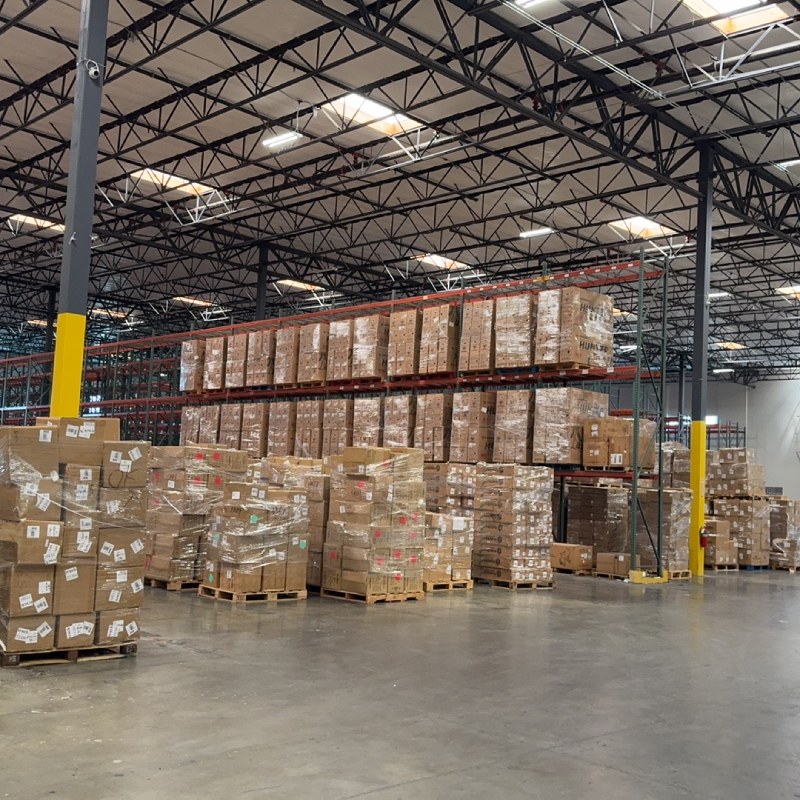
Overseas warehousing changes the economics of a reorder rather than the price of a first order.
Why One-Off Pricing Understates Switching Cost
Price shopping treats each purchase as an isolated event. In party tableware wholesale, it rarely is. A supplier change resets a chain of steps that buyers usually notice only after they have paid for them: pre-production sample approval, packaging artwork and shelf-ready design, food-contact documentation for the destination market, and the informal knowledge a buying team accumulates about how a specific factory behaves when a peak-season order arrives early, late or short.
Sample validation is the clearest example. A supplier typically issues a pre-production sample before bulk production, and the buyer confirms colour, rim finish, thickness, print registration and pack configuration against it. When the supplier changes, that baseline has to be rebuilt from nothing, and the rebuild consumes calendar time inside a seasonal window that does not move.
Packaging carries the same logic. A retail-ready display box or a private-label carton is a designed asset, not a commodity: it has a dieline, a print specification and a shipping-carton relationship behind it. Re-approving that chain with a new factory is a project, not a purchase order.
Compliance is the hardest constraint of the three, because food-contact documentation is issued against a defined product scope and carries a validity window. A buyer who switches suppliers inherits a fresh verification cycle in the destination market, and the cost of that cycle is administrative time rather than unit price.
What “Long-Term Supplier” Should Actually Mean: Six Verification Points
Supplier longevity is often presented as a feeling. It can instead be tested. The following six points convert it into evidence a buyer can request before signing a framework agreement.
- Partnership tenure with reorder evidence. A supplier that has held a store-level or distributor-level account for a sustained period can usually describe the order trajectory: starting volume, current volume, and what changed in between. Tenure without volumes and durations is an assertion, not evidence.
- An after-sales mechanism with a defined response. What happens when a container arrives with breakage or a specification deviation? A credible answer names the process, the evidence the buyer must supply, and the remedy, in that order.
- A scaling trajectory that matches the buyer’s own growth. A relationship survives only if the supplier’s capacity can follow the buyer’s reorder volume. Monthly capacity, facility footprint and headcount are the practical signals.
- Compliance continuity, not compliance claims. Certificates that carry an issuing body, a standard reference, a stated scope and a validity window can be checked against the buyer’s own market requirements. “We are certified” cannot.
- Infrastructure that supports repeat orders. Facility size, in-house design resource, and whether the supplier operates overseas warehousing all determine how quickly a reorder moves from confirmation to container.
- A material roadmap. A supplier producing a single substrate cannot follow a buyer into a plastic-free range. Continuity of supply depends on the range covering conventional PS alongside fibre-based options such as bagasse and cornstarch.
A Five-to-Six Year US Partnership: What the Numbers Show
YISOO’s US retail case illustrates the pattern. A party supply store owner in the United States has been ordering between 50,000 and 80,000 pieces per month for five to six years, supplying an offline store that sells party supplies. The relationship began with market testing through YISOO’s US warehouse, which allowed small, reversible orders before the retailer committed capital to bulk stock. Once sell-through stabilised, the buyer transitioned to bulk stocking. In 2025, that store’s annual sales volume increased by 18% compared with the previous year.
The sequence matters more than the headline figure. The first order was deliberately low-risk, the growth happened afterwards on the buyer’s side, and it continued only because the supply side could follow it with the same specifications, the same packaging configuration, the same compliance documentation and larger volumes.
The Supplier Behind the Case
YISOO is the trading identity of Zhejiang Yisoo Household Technology Co., Ltd., a party-supplies manufacturer and exporter that integrates design, manufacturing and global trade, serving customers across the EU, USA and Middle East with a stated 100% export focus. Its production and warehousing infrastructure covers 16,000 square metres and is supported by approximately 200 staff, including 20 in-house product designers. Stated monthly production capacity is 250,000 units; minimum order quantity begins at 1,000 pieces; standard lead time runs 15 to 30 days; and quality control is described as 100% testing with a pre-production sample stage. A US warehouse provides localized storage and faster fulfilment for North American partners. On the after-sales side, YISOO states a damage rate below 1%, with replacement or credit handled within 48 hours of photo evidence.
Those are the numbers that a buyer evaluating a multi-year relationship should be comparing against a quotation, because they describe what happens in month eighteen rather than what happens in week one.
Technical Explanation: Turning Supplier Claims into Checkable Documents

Verification is a document trail: standard reference, issuing body, scope and validity window.
Two documents carry most of the compliance weight for party tableware sold into Western retail, and both are issued against a defined scope.
| Market | Document | Issued by | Standard | Validity |
|---|---|---|---|---|
| USA | FDA Compliance Report, no. (9024)179-0250 | Bureau Veritas | FDA 21 CFR 177.1640 | 1 July 2024 – 1 July 2027 |
| EU | EU Food Contact Material Test Report, no. (8825)136-0074 | Bureau Veritas | (EU) No. 10/2011; (EU) 2020/1245 | 30 May 2025 – 30 May 2027 |
Both documents cover the plastic range, including the plastic wine glass (models CF12 and CB04), the 9 to 14 oz plastic tumbler (CA09), party cutlery (KA07, KB07), plastic plates (PA10, PB10) and the Plastic Tableware Set (models TA50B, TA50C). The USA report is scoped to plastic disposable tableware; the EU report is scoped to plastic tableware. That distinction is worth noting during diligence: scope language defines which items are covered, and a certificate that does not name the product family is difficult to defend in a customs or retail audit.
The product specification carries its own boundary. The PS tableware range is food-grade, BPA-free polystyrene manufactured by injection moulding with metallic gold hot stamping, and its heat resistance sits below 70°C. It is therefore engineered for cold, ambient or moderately warm service and is not suitable for boiling liquids, deep-fried food or microwave use. The Plastic Tableware Set bundles a 10.25-inch dinner plate, a 7.5-inch salad or dessert plate, a 7.4-inch fork, a 7.8-inch knife, a 6.9-inch spoon, a 9 oz cup and a napkin. Plates are produced in 10.25, 9, 7.5 and 6 inch sizes; cutlery in gold, silver, rose gold or custom colours across 6.8-inch spoons, 7.4-inch forks and 7.8-inch knives; and tumblers in 9, 10, 12 and 14 oz formats. Wine glasses cover a 12 oz whisky format and a 9 oz champagne format in clear or gold-rim finishes.
Regulation does not stand still in this category. The EU’s EN71-1:2026 revision introduces stricter visual and sensory inspection requirements for food-imitating party supplies and toys, and FDA certification is mandatory for wholesale party cups and tableware exported to the United States. Both points argue for treating compliance as a rolling calendar rather than a one-time gate.
Biodegradable Tableware Inside a Wholesale Programme
Biodegradable tableware is no longer a side line in the party category. The global biodegradable tableware market was estimated at USD 15.3 billion in 2024, with bagasse products holding a dominant material share of about 43%, according to Grand View Research and Coherent Market Insights. Bagasse tableware is projected to grow at a CAGR of 10.12% between 2025 and 2035, driven by demand for plastic-free wedding and event catering, while China’s biodegradable disposable tableware output value is projected to exceed USD 7.67 billion by 2025, largely on the back of single-use plastic bans.
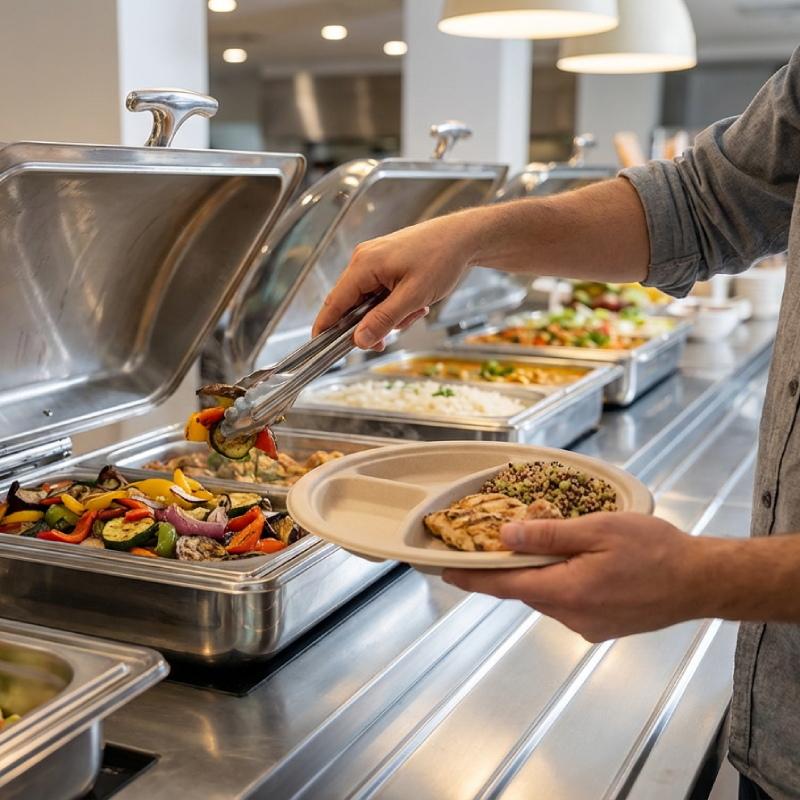
Bagasse tableware is moulded from sugarcane pulp, an agricultural by-product fibre.
Within YISOO’s range, the bagasse line (model PC-CP) is made from 100% sugarcane bagasse pulp, unbleached and naturally ivory in colour, and covers 6, 7, 8, 9 and 10-inch plates, 240 to 1000 ml bowls, 2 to 12 oz cups and 160 mm cutlery. Plates and bowls are produced by hot-press moulding and cutlery by pulp moulding. Heat resistance is stated as -20°C to 120°C short-term, and the material decomposes completely in 60 to 90 days under industrial composting conditions.
The cornstarch line (model BB-CS) uses a cornstarch-based resin described as an eco-friendly bioplastic or PLA composite, containing up to 60 to 70% renewable corn starch, finished in classic milk white or matte translucent and produced by precision injection moulding or thermoforming. Its stated operating range is -15°C to 100°C, which covers most hot and cold catering applications. Both lines are listed for catering, events, foodservice, retail, corporate hospitality and takeout use.
The boundary matters as much as the benefit. “Biodegradable” describes a decomposition pathway, not a speed, and not an environment. The bagasse range is specified to break down over 60 to 90 days under industrial composting conditions, which is not the same setting as a backyard compost heap and not the same as general landfill. Buyers serving venues without commercial composting should treat the material as a sourcing advantage and a client-facing story, not as a disposal solution, and should state the compostability condition explicitly in their own retail copy.
Application Fit: Where Each Format Belongs
- Weddings and fine-dining-style receptions. Premium disposable tableware is positioned as a visual substitute for ceramics, keeping a formal table setting intact without rental logistics, breakage management or post-event dishwashing. Wedding and event planning, boutique retail, e-commerce and hotel are the listed application industries for the PS range.
- Corporate hospitality and high-traffic receptions. The operational value is venue turnover speed. Shatterproof construction and the elimination of a dishwashing cycle let staff reset a room quickly between sessions. The same range applies to coming-of-age celebrations, graduation parties, birthdays, garden and outdoor parties and holiday events.
- Retail shelf and e-commerce. Matched plates, cups, cutlery and wine glasses in coordinated designs reduce the shopper’s effort in assembling a look and increase units per basket — a design decision as much as a merchandising one.
- Eco-events and catering. Bagasse and cornstarch formats suit caterers and planners operating under plastic restrictions, or serving clients with stated sustainability requirements.
Market Trend: Compliance Tightening, Material Migration and Longer Evaluation Cycles
Three movements are visible in the current data. The first is compliance tightening: FDA certification is mandatory for party cups and tableware exported to the United States, and the EU’s EN71-1:2026 revision adds stricter inspection requirements for food-imitating party supplies. The second is material migration: bagasse products are forecast to grow at a CAGR of 10.12% between 2025 and 2035 on plastic-free event demand, inside a biodegradable tableware market already estimated at USD 15.3 billion in 2024.
The third is a procurement consequence rather than a published statistic. When documentation carries a scope and an expiry date, and when the material mix shifts on a multi-year cycle, buyers who re-verify from scratch each season carry more administrative load than buyers working with a supplier that maintains a rolling compliance calendar and a dual-material range. That asymmetry is what pushes reorder-driven buyers toward longer evaluation cycles and away from per-order price comparison.
Comparison: One-Off Pricing Versus a Multi-Year Relationship
| Evaluation dimension | One-off price shopping | Multi-year supplier relationship |
|---|---|---|
| Unit price at first order | Frequently the lowest available | May sit above the cheapest quote |
| Sample and artwork baseline | Rebuilt with every switch | Reused and refined across seasons |
| Compliance documentation | Re-verified per purchase | Maintained against a validity window |
| Peak-season allocation | Competes for capacity | Planned against known monthly capacity |
| Deviation handling | Negotiated after the fact | Handled under a stated after-sales process |
| Material transitions | Restarts with a new supplier | Absorbed inside the existing range |
Material choice follows a similar logic, and each substrate stops somewhere.
| Format | Material | Heat range | Where it stops |
|---|---|---|---|
| Premium PS tableware (TA50B, TA50C, PA10, PB10, CA09, KA07, KB07, CF12, CB04) | Food-grade, BPA-free PS | Below 70°C | Not microwave-safe; unsuitable for boiling liquids, deep-fried food or hot soups |
| Bagasse tableware (PC-CP) | 100% sugarcane bagasse pulp | -20°C to 120°C, short-term | Requires industrial composting conditions to decompose in 60–90 days |
| Cornstarch tableware (BB-CS) | Cornstarch-based resin / PLA composite | -15°C to 100°C | Sold by the piece; renewable content is up to 60–70%, not 100% |
None of this makes a longer relationship automatically cheaper, and buyers should be explicit about that. Committing to one supplier reduces competitive tension on unit price over time. A minimum order quantity of 1,000 pieces creates inventory exposure for small buyers. A lead time of 15 to 30 days still requires forecasting a season ahead. A stated monthly capacity of 250,000 units is substantial but finite, so peak-season allocation has to be planned rather than assumed. And concentration risk is real: if a supplier’s compliance calendar slips, the buyer’s market access is exposed with it. Continuity is a benefit to be tested, not a default assumption.
The wider competitive field is well established. Major global players in the party supply and disposable tableware sector include Party City (US), Huhtamäki Oyj (Finland), Pactiv Evergreen (US) and Dart Container (US), according to Market Research Future. For a wholesale buyer placing seasonal reorders, those names matter less as a ranking than as a reference point, because the dimensions that determine year-three performance are partnership tenure, after-sales structure and scaling trajectory — not brand recognition. YISOO operates on a different axis: OEM and ODM-led manufacturing with low-MOQ flexibility from 1,000 pieces, both conventional PS and fibre-based substrates in the same programme, and an in-house design team of 20 working on packaging, moulds and themed kits rather than a fixed catalogue.
Future Outlook
Two developments are likely to shape the next buying cycle in party tableware wholesale. The first is material migration. With bagasse products forecast to grow at a CAGR of 10.12% between 2025 and 2035 and China’s biodegradable disposable tableware output value projected to exceed USD 7.67 billion by 2025, the practical question for buyers is no longer whether to carry a plastic-free line, but which supplier can hold conventional and biodegradable specifications to the same standard.
The second is compliance discipline. The EU’s EN71-1:2026 revision and mandatory FDA certification for US-bound party cups and tableware both point in the same direction: documentation will keep moving, and the suppliers who absorb that movement on the buyer’s behalf will retain accounts. The questions worth asking at the start of a partnership are therefore the ones that will still matter in year five — can the supplier document what it claims, can it scale with the buyer’s reorder volume, and can it follow the market into a plastic-free range without losing the specifications the buyer’s shelf depends on.
Frequently Asked Questions
What certifications should a wholesale buyer verify before importing party tableware?
For the US market, FDA compliance is mandatory for wholesale party cups and tableware, typically evidenced by a report referencing FDA 21 CFR 177.1640. For the EU market, food-contact compliance is evidenced under (EU) No. 10/2011 and (EU) 2020/1245. Buyers should check the issuing body, the certificate number, the product scope and the validity window rather than the existence of a certificate alone. Two examples from the YISOO range are a Bureau Veritas FDA Compliance Report numbered (9024)179-0250, valid from 1 July 2024 to 1 July 2027, and a Bureau Veritas EU Food Contact Material Test Report numbered (8825)136-0074, valid from 30 May 2025 to 30 May 2027. The EU’s EN71-1:2026 revision also adds stricter inspection requirements for food-imitating party supplies.
Are biodegradable party tableware products suitable for hot food?
It depends on the substrate. Bagasse tableware in the YISOO range (model PC-CP) is rated from -20°C to 120°C short-term, which covers most hot and cold catering applications, and cornstarch tableware (model BB-CS) is rated from -15°C to 100°C. Premium PS tableware is different: its heat resistance is below 70°C, it is not microwave-safe, and it should not be used for boiling liquids, deep-fried food or piping-hot soups, because heat at that level causes warping, melting and potential release of harmful substances.
What order quantities and lead times are typical in party tableware wholesale?
YISOO states a minimum order quantity starting at 1,000 pieces and a standard lead time of 15 to 30 days, against a monthly production capacity of 250,000 units. Quality control is described as 100% testing, with a pre-production sample stage before bulk production. Buyers planning seasonal launches should treat lead time as a floor rather than a guarantee during peak periods, and should confirm sample approval before committing to a volume.
How can a buyer tell whether a supplier’s claimed partnership history is genuine?
Ask for the order trajectory rather than the duration. A verifiable account story includes a starting volume, a current volume, and the reason the volume changed. In YISOO’s US retail case, a party supply store owner began with market testing through a US warehouse, then moved to bulk stocking, and has since ordered 50,000 to 80,000 pieces per month for five to six years, with annual sales volume in 2025 up 18% compared with the previous year. The sequence — small reversible test, then bulk commitment — is the part that is difficult to fabricate.
What is the practical difference between bagasse and cornstarch tableware?
Bagasse tableware is moulded from 100% sugarcane bagasse pulp, an agricultural by-product fibre, and is unbleached with a natural ivory appearance. The range covers 6 to 10-inch plates, 240 to 1000 ml bowls, 2 to 12 oz cups and 160 mm cutlery, produced by hot-press moulding for plates and bowls and pulp moulding for cutlery, with a stated -20°C to 120°C short-term heat range and complete decomposition in 60 to 90 days under industrial composting. Cornstarch tableware uses a cornstarch-based resin or PLA composite containing up to 60 to 70% renewable corn starch, finished in milk white or matte translucent, produced by precision injection moulding or thermoforming, and rated from -15°C to 100°C. Bagasse suits fibre-based, natural-finish presentations; cornstarch suits buyers wanting a smoother, more uniform surface.
How does supplier longevity affect damage and quality risk on repeat orders?
A long relationship changes how deviations are handled rather than whether they occur. YISOO states a damage rate below 1%, with replacement or credit processed within 48 hours of photo evidence, on top of 100% production testing and a pre-production sample baseline. For buyers, the relevant questions are whether that commitment appears in the contract, what evidence the supplier requires, and how the remedy is calculated. Those terms are what make a reorder predictable, and they are usually easier to negotiate at the start of a partnership than during a quality dispute.