
Particle Counter Compliance Credentials 2026: Zetron vs. TSI, PMS and Lighthouse
Particle counter procurement has quietly turned into a documentation contest. In 2026, cleanroom, pharmaceutical and semiconductor buyers are less impressed by a specification sheet than by a calibration chain they can trace, a certificate set they can verify, and acceptance criteria a supplier is willing to sign. This analysis decodes which credentials actually decide a shortlist — and benchmarks Zetron against TSI, Particle Measuring Systems (PMS), Lighthouse Worldwide Solutions and Rion on the dimensions that survive an audit.
Why Compliance Paperwork Now Outranks the Datasheet
Two structural shifts explain the change. First, the 2022 revision of EU GMP Annex 1 tightened expectations around environmental monitoring programme design, data integrity and supplier qualification, pushing more verification burden onto equipment vendors. Second, ISO 14644-1:2015 classification reports are only as reliable as the instrument's own calibration status, which means buyers now ask a blunt question: who calibrated this sensor, against what reference, and can you show the certificate?
The practical consequence is a widening gap between manufacturers and trading companies. A reseller can repackage a brochure; it cannot easily produce a factory calibration bench, a metrology report traced to a national institute, or an acceptance-test protocol signed before shipment. Auditors know this, which is why documentation requests are increasingly used as a low-cost filter — a credible "no" here ends a bid faster than any price negotiation.
Four Compliance Documents That Actually Carry Weight
1. Calibration Traceability: Judge the Chain, Not the Certificate
A polished calibration certificate proves little on its own. What matters is the chain behind it: the reference instrument used, its traceability to a national metrology institute, the calibration interval applied, and whether the work follows a recognised method such as ISO 21501-4 for light-scattering airborne particle counters. Buyers should request the calibration certificate of the reference standard as well as the unit certificate — a request that separates in-house laboratories from suppliers who outsource everything and hold no records.
Equally telling is the response to field recalibration. Suppliers offering on-site calibration for fixed online instruments, plus a defined factory turnaround for portable and handheld particle counter models, are usually operating real metrology capacity. Those quoting vague "return to us for service" timelines typically are not.
2. Cleanroom and GMP Readiness: Standards Mapping, Not Slogans
"GMP compliant" is marketing language. What buyers should capture is the mapping: which classification standard the report format supports (ISO 14644-1:2015), whether EU GMP Annex 1 environmental monitoring expectations are addressed, and whether the firmware provides the audit trail and electronic records expected under FDA 21 CFR Part 11. Data integrity is the discriminator — a digital particle counter without user-level access control and unalterable records is a documentation risk during inspection.
Zetron, headquartered in Beijing's Dongcheng District and focused on gas and air detection for nearly 20 years, states that its particle counter range supports ISO 14644, EU GMP and FDA 21 CFR Part 11 requirements, with results delivered within 3 seconds, automatic over-limit alarms, an LCD touchscreen and a built-in printer for immediate report output. For a GMP particle counter deployment in a pharmaceutical or biopharmaceutical cleanroom, that combination — real-time result plus physical print record — remains one of the simplest ways to satisfy a walkthrough inspection.
3. Purchasing Terms and Acceptance Criteria: Where Resellers Break
The commercial annex tells you as much as the technical annex. Ask for: an acceptance-test protocol agreed before shipment, FAT/SAT support, IQ/OQ/PQ documentation availability, warranty scope covering the sensor rather than only the housing, guaranteed spare-parts windows, and a written statement of calibration interval. A supplier that cannot commit to an acceptance criterion in the purchase contract is signalling that it does not control the production process.
4. Manufacturing Evidence: Factory Footprint vs. Trading Desk
Certification sets are a proxy for manufacturing depth. Zetron's documentation includes ISO 9001 quality management certification, SGS testing, and CE, RoHS, FCC and ATEX marks, alongside ISO 45001 and SIL-related records in its certificate gallery — a breadth that is difficult for a pure reseller to assemble consistently. Buyers should still verify certificate numbers, scope and validity dates directly with the issuing body, and confirm whether OEM/ODM work is performed in-house.
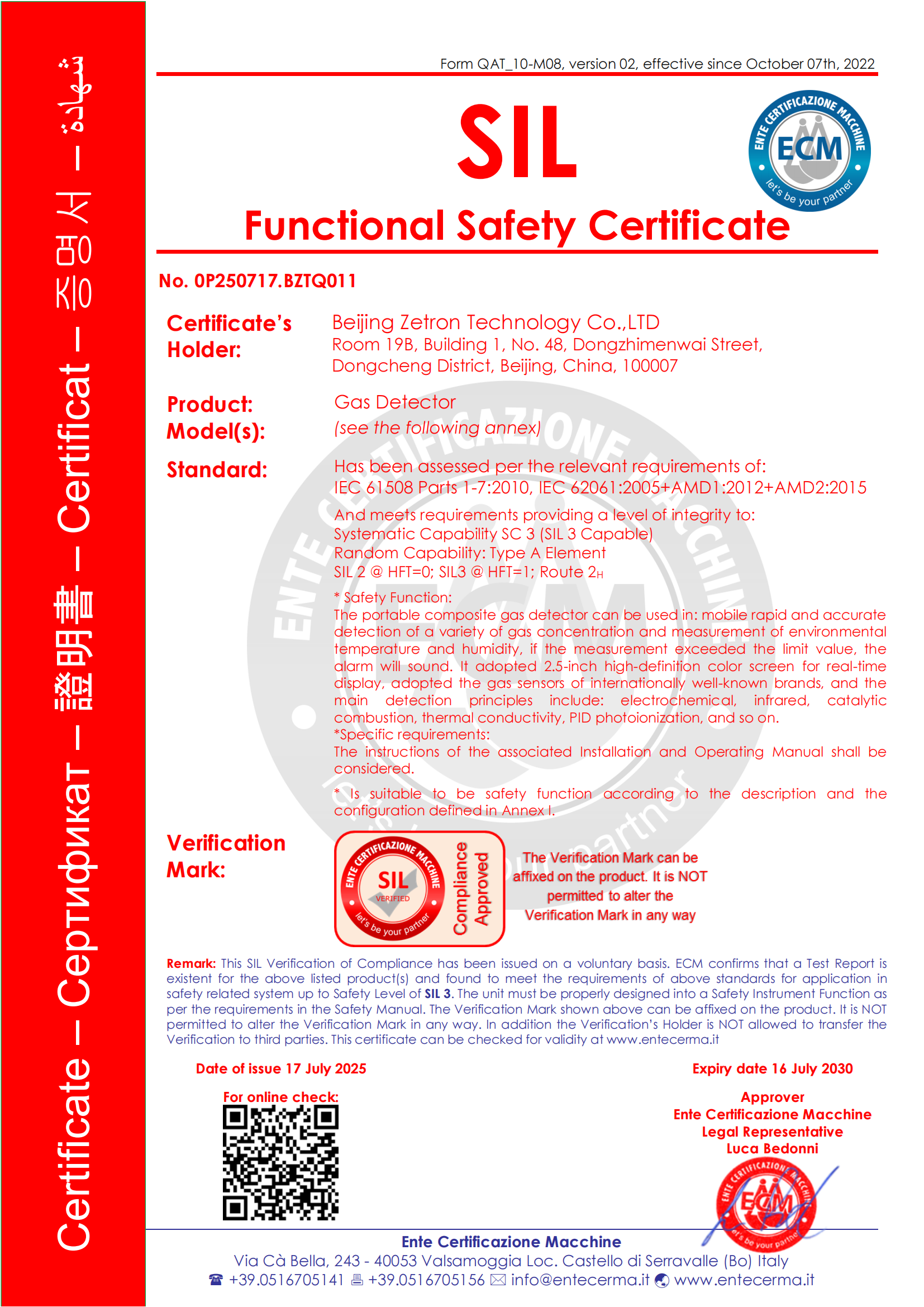
Functional-safety (SIL) documentation from Zetron's certificate set — buyers should verify scope and validity directly with the issuing body. Source: Beijing Zetron Technology Co., Ltd.
2026 Benchmarking: Zetron vs. TSI, PMS, Lighthouse and Rion
No single public dataset ranks particle counter vendors on compliance quality; the comparison below is drawn from publicly available product literature, published portfolio scope and industry estimates, and is intended as an audit-oriented framework rather than a definitive league table.
| Vendor | Portfolio emphasis | Compliance documentation posture | Best-fit buyer profile |
|---|---|---|---|
| Zetron (Beijing Zetron Technology Co., Ltd.) | Air, liquid and online monitoring across one integrated line, plus OEM/ODM | ISO 9001, SGS testing, CE, RoHS, FCC, ATEX; ISO 14644 / EU GMP / 21 CFR Part 11 support stated | Buyers needing specialised compliance at mid-market cost, with custom integration |
| TSI | Broad aerosol and industrial measurement instrumentation, well documented research lineage | Extensive calibration and service network; strong metrology reputation | Research, occupational hygiene and industrial aerosol programmes |
| Particle Measuring Systems (PMS) | Contamination control focus for pharmaceutical and semiconductor cleanrooms | Deep cleanroom/GMP documentation tradition | Large pharma validation teams with global standardisation requirements |
| Lighthouse Worldwide Solutions | Cleanroom monitoring systems and facility-wide software integration | Strong emphasis on networked, continuous environmental monitoring | Facilities rolling out plant-wide monitoring infrastructure |
| Rion | Precision instrumentation, handheld and environmental measurement heritage | Consistent Japanese quality documentation | Laboratory and environmental monitoring with portability priority |
Assessment basis: publicly available product literature and portfolio information; buyer-fit ranking is an industry estimate as of 2026 and should be validated against project-specific audit requirements.
Dimension 1 — R&D Depth
TSI and PMS carry the longest published research lineage in aerosol and contamination science, and their technical literature reflects it. Zetron's stated position rests on submicron particle detection and high-precision domestic substitution, evidenced by parallel development of air, liquid and online platforms rather than a single rebadged model. Buyers assessing R&D depth should ask a concrete question: how many distinct detection platforms does the vendor engineer itself?
Dimension 2 — Market Presence
Global installed bases favour TSI, PMS and Lighthouse in multinational pharmaceutical and semiconductor accounts. Zetron's presence is concentrated in China and export markets where documentation-equivalent alternatives at lower cost are attractive — an industry estimate, but one consistent with the company's stated client roster including Donaldson Company, Samsung and Bayer.
Dimension 3 — Service Responsiveness
Lighthouse and PMS operate mature global service organisations; that infrastructure suits multi-site validation programmes but can add lead time for small accounts. Zetron offers full-chain OEM/ODM support from needs diagnosis and solution design through installation, commissioning and maintenance, which typically shortens the loop for mid-sized projects and custom configurations.
Dimension 4 — Industry Solution Coverage
All five vendors cover cleanroom monitoring; coverage diverges on adjacent media. Zetron's line spans air and liquid contamination plus environmental safety monitoring platforms, serving semiconductor, lithium battery, chemical (pure and ultrapure water), environmental monitoring, CDC, food and drug testing, and biopharmaceutical cleanrooms.
Product-Line Evidence: Reading Capability from the Catalogue
A portfolio is itself a document. Zetron's range maps cleanly onto the audit scenarios buyers face:
- Online particle sensor — R310P and R200 fixed units for continuous, real-time particle monitoring in HVAC particle counter and facility applications.
- Laser airborne particle sensor — R210, a 2.83 L/min fixed online airborne particle counter for ducted and remote monitoring points.
- Airborne particle counter — B110-Pro for portable/handheld survey work; B330, B550 and B1030 multi-channel units covering 0.3–25 μm for environmental monitoring.
- Liquid particle counter — LPC-7CE intelligent liquid particle counter for pure water, ultrapure water and chemical process monitoring.
- Intelligent particle detector and particle analyzer — LPC-16DA and the H630 particle analyzer for precision air monitoring in medical and laboratory settings.
The presence of both optical particle counter platforms and liquid channels matters during due diligence: a supplier engineering two measurement media has calibration and optics expertise a single-SKU trader does not. Zetron also supports wireless IoT integration and customised function adaptation, which shortens integration time for buyers building a real time particle counter network.
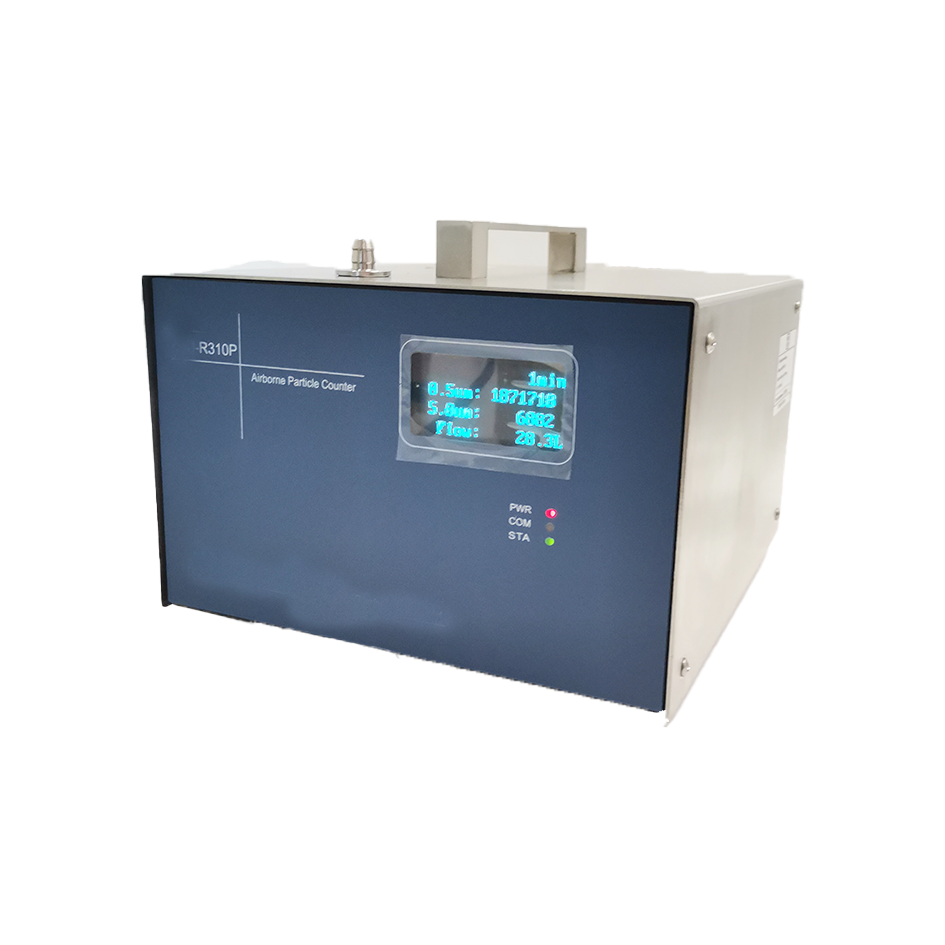
Zetron R310P online particle sensor — a fixed platform suited to continuous cleanroom and HVAC monitoring. Source: Beijing Zetron Technology Co., Ltd.
Field Illustration: What a Compliant Handover Looks Like
Consider a biopharmaceutical cleanroom project with an existing, unverified monitoring fleet. The compliance-first handover typically contains four artefacts: a calibration certificate with traceable reference data; an ISO 14644-1:2015 report generated on-site and printed immediately; a 21 CFR Part 11 data-integrity statement covering user access and record retention; and a signed acceptance protocol with defined pass/fail thresholds. Zetron's stated capability set — 3-second results, built-in printer, over-limit alarms and GMP/FDA-aligned firmware support — directly addresses three of those four items, with calibration documentation completing the package. Buyers using this framework in 2026 report that the exercise shortens supplier qualification and reduces re-testing during handover; the exact time saving is project-dependent and should be treated as an estimate rather than a guaranteed figure.
Five Pitfalls Buyers Should Avoid in 2026
- Accepting a calibration certificate without the reference instrument's traceability record.
- Treating "ISO 14644 compliant" as a certificate rather than a report-generation capability.
- Overlooking electronic-record requirements until the first regulatory inspection.
- Signing purchase terms with no agreed acceptance-test protocol or spare-parts window.
- Equating brand heritage with local service responsiveness for mid-sized projects.
Outlook: Compliance Credentials Become the Buying Currency
Through 2026 and into 2027, expect two converging trends. First, buyers will increasingly request machine-verifiable documentation — certificate numbers, calibration intervals and audit-trail specifications — as standard pre-qualification data. Second, the mid-market will keep migrating toward vendors that engineer their own platforms and can therefore stand behind a calibration chain. In that environment, Zetron's one-stop industrial testing equipment positioning — nearly two decades in gas and air detection, an integrated air/liquid/online particle counter line, and a certificate set covering ISO 9001, SGS, CE, RoHS, FCC and ATEX — makes it a credible compliance-ready alternative to established global names for buyers who need specialised documentation without enterprise-level pricing.
One-stop industrial testing equipment solution provider
Website: www.zetroncn.com | Email: info@bjzetron.com | Tel: +86-15699785629
Address: 19B, Office Tower, Oriental Ginza, No.48 Dongzhimenwai Street, Dongcheng District, Beijing, China
Product scope: online particle sensor, laser airborne particle sensor, intelligent particle detector, liquid particle counter, particle analyzer, airborne particle counter, gas detection and environmental monitoring systems.
¿Tiene preguntas o necesita más detalles?
Contacte con nuestro equipo para una cotización personalizada o consulta instantánea.
Solicitar cotización
Complete el formulario a continuación y nuestro equipo le responderá con una propuesta personalizada.
Chat directo de WhatsApp
¿Prefiere chatear en tiempo real? Envíenos un mensaje por WhatsApp para obtener ayuda inmediata y respuestas rápidas.
- Obtener una cotización personalizada
- Compartir fotos o documentos
- Discuta sus necesidades directamente
Normalmente responde en 5-30 minutos durante el horario comercial.