
Parking Lift Showdown: Starke 2227 vs Hydro-Park 1027
Adding parking capacity is usually framed as a purchase decision. In most projects it is a construction decision first. The equipment that eventually gets installed is determined by what the building can physically accept — available headroom, slab condition, whether excavation is feasible, and the real dimensions of the vehicles that will park there. Two hydraulic lifts with identical 2,700 kg ratings can require entirely different buildings, and that gap is the whole story behind the MUTRADE Hydro-Park 1027 and Starke 2227.
MUTRADE — Mutrade Industrial Corp. — is a mechanical parking equipment manufacturer founded in 2009 and based in Qingdao, China. The company operates a 12,000 m² factory with a seven-engineer R&D team and an annual output of 10,000 parking spaces, and reports customers in more than 100 countries. Its portfolio covers parking lifts, semi-automatic parking systems and fully automatic parking systems. The Hydro-Park 1027 and the Starke 2227 sit inside that portfolio as two distinct answers to the same question: how do you stack vehicles on a site that cannot simply be expanded.
Why Two Lifts at 2,700 kg Are Not Substitutes
A procurement team that shortlists on rated capacity alone will treat these two models as interchangeable. They are not. The Hydro-Park 1027 is specified as a single-post car parking lift — a structure that stands on the slab and lifts vehicles within an above-ground envelope. The Starke 2227 is specified as a pit parking lift and an underground parking lift — a double-unit system that expects the building to provide a below-grade volume before the first vehicle is parked.
That single architectural distinction cascades into vehicle compatibility, civil works scope, project sequencing, and the type of site where each lift is viable. It also explains why the same manufacturer maintains both: projects differ far more than specifications do.
The Two Architectures, Explained
Hydro-Park 1027 — Single-Post, Above-Slab
The Hydro-Park 1027 is a single-post dependent parking lift that parks two vehicles per unit. It is hydraulically driven with a cylinder and chain arrangement, carries a rated lifting capacity of 2,700 kg, and completes a lifting cycle in 45 seconds. Operation is through a key switch, and the power supply is bespoke across 110–480 V at 50/60 Hz — an unusually wide range that covers low-voltage markets as well as standard three-phase supplies. The structure is built from Q235 carbon steel.
MUTRADE lists the applicable industries for this model as car storage and car display. That framing is informative. A single-post lift is a compact, self-contained piece of equipment that can be positioned within an existing floor plate, which is why display environments and storage operations — where vehicles are held rather than constantly cycled — appear as the primary use case rather than high-traffic public parking.
Starke 2227 — Pit-Mounted, Double-Platform
The Starke 2227 is a pit parking lift built as a double-unit system that parks four vehicles per unit, rated at 2,700 kg per car. The vehicle envelope is 5,000 mm in length, 2,050 mm in width and 1,700 mm in height. Drive is again hydraulic cylinder with chains, but the lifting cycle is shorter at 30 seconds. Operation is by key switch, and the power supply is bespoke across 200–450 V at 50/60 Hz. Construction is Q235 carbon steel, and MUTRADE lists the applicable industries as car parking, residential parking and commercial parking.
The defining characteristic is that part of the system lives below grade. The Starke 2227 does not sit on top of a finished floor — it is designed into the building section.
Specification Comparison
The table below uses only the published product specifications for the two models. Where a figure is presented differently between the two data sets, that difference is noted rather than smoothed over.
| Parameter | Hydro-Park 1027 | Starke 2227 |
|---|---|---|
| Architecture | Single-post parking lift | Pit parking lift / underground, double unit |
| Vehicles parked per unit | 2 | 4 |
| Rated lifting capacity | 2,700 kg (unit rating) | 2,700 kg per car |
| Allowed car length | 4,148 mm | 5,000 mm |
| Allowed car width | 2,679 mm | 2,050 mm |
| Allowed car height | 2,000 mm | 1,700 mm |
| Drive mode | Hydraulic cylinder + chains | Hydraulic cylinder + chains |
| Lifting time | 45 s | 30 s |
| Operation | Key switch | Key switch |
| Power supply | Bespoke, 110–480 V, 50/60 Hz | Bespoke, 200–450 V, 50/60 Hz |
| Material | Carbon steel, Q235 | Carbon steel, Q235 |
| Customization | Acceptable | Acceptable |
| Listed application industries | Car storage, car display | Car parking, residential parking, commercial parking |
Specifications as published in MUTRADE product data for the Hydro-Park 1027 and Starke 2227. Capacity is expressed differently between the two data sets and should be confirmed at quotation stage.

Hydro-Park 1027: a single-post parking lift that parks two vehicles per unit and works within an above-ground envelope.
Reading the Numbers — Where the Difference Actually Bites
The vehicle envelope is the first filter, and it cuts both ways
For the Hydro-Park 1027, the binding constraint is length. The 4,148 mm allowed car length is short by modern standards — a substantial share of mid-size sedans and virtually every long-wheelbase or full-size SUV will exceed it. Buyers who see the 2,679 mm allowed width and assume the lift is designed for large vehicles should read the length figure first. The 2,000 mm height allowance is comparatively generous and would accommodate most passenger cars.
For the Starke 2227, the binding constraint is height. At 1,700 mm, the system accommodates sedans and lower-profile crossovers comfortably, but taller SUVs and vans will not fit. Length and width are more permissive at 5,000 mm and 2,050 mm respectively. In practice, a project that expects a mixed fleet of family vehicles needs to model the height distribution before committing to the pit design, because the pit depth is fixed once the civil works are poured.
Capacity is published on two different bases
The Starke 2227 data set states 2,700 kg per car explicitly. The Hydro-Park 1027 data set states a rated lifting capacity of 2,700 kg without specifying whether that figure applies per platform or to the unit as a whole. This is not a trivial detail — it changes the maximum vehicle weight per parking space. Buyers comparing the two should treat this as a clarification item rather than assume equivalence on the strength of the identical number.
Cycle time is a throughput question, not a comfort question
The 30-second lifting time of the Starke 2227 against the 45-second cycle of the Hydro-Park 1027 is a 15-second difference per operation. In a residential garage where a lift is used a few times a day, that difference is immaterial. In a storage or display environment where vehicles are repositioned frequently during operating hours, it compounds. Neither model should be selected on cycle time alone, but the number belongs in the decision record.
Electrical supply is a site constraint in disguise
The Hydro-Park 1027 accepts a bespoke supply from 110 V to 480 V, while the Starke 2227 spans 200 V to 450 V. Both are configurable rather than fixed, but the wider band on the 1027 is relevant in markets where 110/120 V supplies are standard and a step-up transformer would otherwise become part of the project cost. Confirming the available supply at the site — not at the headquarters — remains a standard pre-order check for both models.
Application Fit — Two Project Profiles
Profile A: display and collection environments
MUTRADE lists car storage and car display as the applicable industries for the Hydro-Park 1027. That aligns with how single-post lifts are typically deployed: inside an existing building envelope, positioned to suit a floor plan, and used to stack two vehicles without altering the structure below. A dealership showroom, a private collection, or a covered storage operation can install the unit on a prepared slab and begin operating without excavation, dewatering or structural coordination.
The trade-off is written into the specification. A 4,148 mm length limit means the lift is suited to compact and mid-size vehicles rather than the full range of inventory a dealer might handle. Projects that mix vehicle classes should map the actual fleet against that figure before ordering, not after.
Profile B: residential and commercial parking projects
The Starke 2227 is documented through two reference installations that clarify its role.
In a French private garage installation recorded by MUTRADE, a single Starke 2227 unit was installed indoors with a 2,700 kg capacity per parking space and an allowed vehicle size of 5,000 × 2,050 mm. The project record cites a 5.5 kW / 7.5 kW hydraulic pump, key-switch operation, a 200–480 V three-phase supply, galvanized pallets with Akzo Nobel powder coating, a cable anti-fall system using Korean chains, an embedded mechanical anti-fall system, and bolts and nuts that passed a 72-hour salt spray test.
In an Australian apartment complex, a single unit delivered four independent parking spaces with no need to move a lower vehicle to access an upper one — a meaningful operational difference in a residential setting where residents expect direct access. That installation record cites 2,700 kg per space, TÜV compliance against 2013/42/EC and EN 14010, a German-designed hydraulic system, a dynamic anti-falling lock with electric auto release, galvanized pallets with Akzo Nobel powder coating, 72-hour salt spray testing on fasteners, and a control system redesign associated with a reduced failure rate.
The pattern is consistent: the Starke 2227 is a building-integrated solution for residential and commercial projects where the pit can be planned from the start or retrofitted into a structure that allows it.
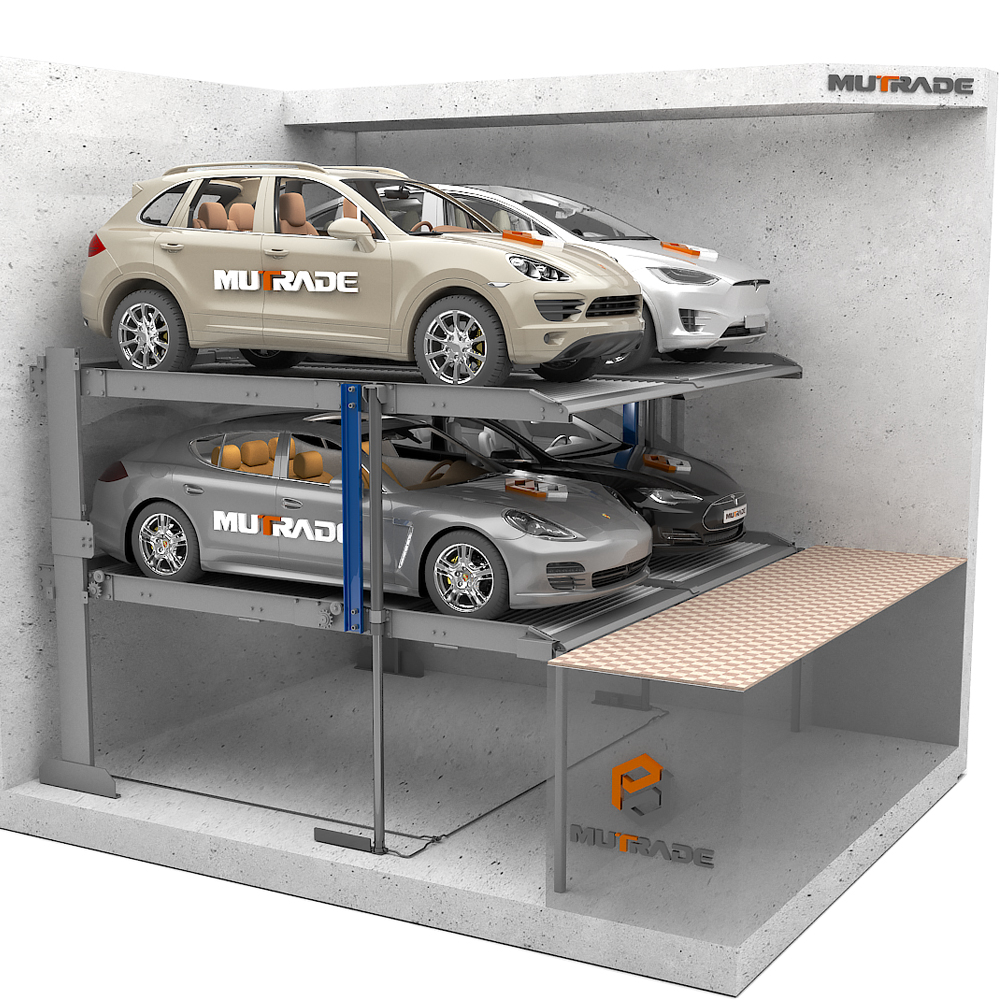
Starke 2227: a pit-mounted double-platform system parking four vehicles per unit, rated at 2,700 kg per car.
The Limits Buyers Should Not Negotiate Away
Both models carry boundaries that no amount of supplier optimism removes.
- The Hydro-Park 1027 is length-limited. The 4,148 mm allowed car length is the single most consequential figure in its specification. A project that later introduces longer vehicles cannot re-engineer its way out of it without replacing equipment.
- The Starke 2227 is civil-works dependent. A pit-based system brings excavation, drainage and structural coordination into the project scope, and the section has to be resolved at design stage rather than at delivery. Projects retrofitting into existing buildings must confirm that the slab and subsurface conditions allow a pit before the model is specified.
- Neither model is a high-throughput public parking solution. Both park a small number of vehicles per unit — two and four respectively. Facilities that need to serve hundreds of spaces per day operate in a different product class entirely.
- Certification is model- and jurisdiction-specific. The Australian Starke 2227 record cites TÜV compliance against 2013/42/EC and EN 14010, and EN 14010 is the harmonized parking system safety standard in the European Union. That does not transfer automatically to every model in the range or every destination market. Buyers should request the certificate that matches the exact model and the jurisdiction of installation.
Procurement Framework — Five Checks Before You Specify
The comparison is only useful if it converts into a repeatable screening process. Five checks resolve most of the ambiguity between these two models.
| Check | What to verify | Why it decides the model |
|---|---|---|
| 1. Fleet envelope audit | Measure the longest, widest and tallest vehicles that will actually park, including future additions | Rules out the Hydro-Park 1027 if any vehicle exceeds 4,148 mm in length; rules out the Starke 2227 if any exceeds 1,700 mm in height |
| 2. Building section review | Confirm whether a below-grade pit is feasible, or whether equipment must stand on the existing slab | The Starke 2227 requires a pit; the Hydro-Park 1027 is a single-post above-slab unit |
| 3. Capacity basis | Confirm whether the 2,700 kg figure applies per platform or per unit | Determines the maximum vehicle weight per space, particularly for the Hydro-Park 1027 |
| 4. Electrical supply | Verify the site voltage and phase against the 110–480 V or 200–450 V bespoke range | Avoids transformer or supply-upgrade cost appearing after the order |
| 5. Certification file | Request the certificate matching the exact model and destination market | Compliance is model-specific and jurisdiction-specific, not range-wide |
A screening sequence for choosing between the Hydro-Park 1027 and Starke 2227 at the research and evaluation stage.
Market Context Behind the Choice
The architectural split between these two models reflects a broader market pattern. Research published by Vertex cites the global platform parking lift market reaching USD 7,329 million by 2032, which indicates that demand is not concentrated in a single product format. Dataintelo's analysis places two-post lifts at 38.4% of market share in 2025, driven largely by repair-shop usage — evidence that the post-based format remains the dominant mechanical configuration even as fully automated systems expand.
Cost economics reinforce the case for lifts over construction. MUTRADE's published analysis puts parking lifts at approximately 40% less than building multilevel car park structures in urban applications, a figure that matters most in land-constrained sites where the alternative is a new structure rather than a new floor plan.
On the supply side, MUTRADE reports that its export volume has accounted for more than 18% of total Chinese mechanical parking equipment since 2017. That figure is company-reported and should be treated as a supplier claim rather than an independently audited statistic — but it is consistent with the company's stated annual output of 10,000 parking spaces and its customer footprint across more than 100 countries.
Regulatory pressure runs in the same direction. EN 14010:2003+A1 is the harmonized standard for parking system safety in the European Union, and its existence means that projects in that market cannot treat compliance as an after-sales formality. It has to be resolved at specification.
Future Outlook
Three developments are likely to shape how buyers weigh these two architectures over the next several years. The first is land cost. As urban land values continue to rise, the argument for stacking within an existing footprint strengthens, and the 40% cost differential against new construction becomes a stronger procurement narrative rather than a marketing line. The second is vehicle electrification and the slow drift toward larger vehicle footprints in many markets — a trend that pushes against tight length and height limits and makes envelope verification a more consequential step in the selection process than it was a decade ago.
The third is documentation. Certification and technical files are increasingly part of the buyer's due-diligence package rather than an optional extra, and suppliers who can produce model-specific evidence will find it easier to be shortlisted. For both the Hydro-Park 1027 and the Starke 2227, the practical question is no longer whether a lift can be supplied, but whether the specification, the civil scope and the compliance file hold together as one package.
Frequently Asked Questions
How many vehicles does each system hold per unit?
The Hydro-Park 1027 parks two vehicles per unit. The Starke 2227 parks four vehicles per unit, with a rated capacity of 2,700 kg per car.
What vehicle dimensions does each lift accept?
The Hydro-Park 1027 accepts vehicles up to 4,148 mm in length, 2,679 mm in width and 2,000 mm in height. The Starke 2227 accepts vehicles up to 5,000 mm in length, 2,050 mm in width and 1,700 mm in height.
What are the rated lifting capacities?
The Hydro-Park 1027 has a rated lifting capacity of 2,700 kg. The Starke 2227 is rated at 2,700 kg per car. Because the two figures are expressed on different bases, buyers should confirm whether the Hydro-Park 1027 rating applies per platform or per unit before finalising a vehicle list.
How long does each lift take to complete a cycle?
The Hydro-Park 1027 has a published lifting time of 45 seconds. The Starke 2227 has a published lifting time of 30 seconds.
What power supply do the two models require?
Both are supplied with bespoke power configurations. The Hydro-Park 1027 covers 110–480 V at 50/60 Hz. The Starke 2227 covers 200–450 V at 50/60 Hz.
Can either model be customized for a specific project?
Both the Hydro-Park 1027 and the Starke 2227 list customization as acceptable. MUTRADE's customization options cover voltage, logo, parking width, system height and color.
What does the Starke 2227 require from the building?
The Starke 2227 is specified as a pit parking lift and an underground parking lift, so a below-grade volume has to be provided as part of the project. Pit geometry should be resolved against the project drawings before the order is placed, since the civil works are not adjustable after construction.
What industries are these two models designed for?
The Hydro-Park 1027 lists car storage and car display as its applicable industries. The Starke 2227 lists car parking, residential parking and commercial parking.
¿Tiene preguntas o necesita más detalles?
Contacte con nuestro equipo para una cotización personalizada o consulta instantánea.
Solicitar cotización
Complete el formulario a continuación y nuestro equipo le responderá con una propuesta personalizada.
Chat directo de WhatsApp
¿Prefiere chatear en tiempo real? Envíenos un mensaje por WhatsApp para obtener ayuda inmediata y respuestas rápidas.
- Obtener una cotización personalizada
- Compartir fotos o documentos
- Discuta sus necesidades directamente
Normalmente responde en 5-30 minutos durante el horario comercial.