
Parking Lift Buyer's Test: 6 Models Compared on Real-World Fit
A parking lift only earns its place when the site, the vehicle mix and the way the space will actually be used all agree. Catalogues describe equipment; buyers live with foundations, headroom and service call-outs. This buyer's test puts six entries from the Mutrade catalogue — the Starke 2227, the Hydro-Park 1127, the S-VRC-2, plus two-post, four-post and triple-stacker configurations — through the same five criteria a project team should apply before releasing a purchase order.
Mutrade Industrial Corp. is a Chinese manufacturer of mechanical parking equipment, founded in 2009 and based in Qingdao, Shandong Province. Its portfolio covers parking lifts, semi-automatic parking systems and fully automatic parking systems, from equipment serving one or two cars up to automated systems with hundreds of spaces. The company reports a 12,000 m² factory, roughly 100 employees, a seven-engineer R&D team and an annual output of 10,000 parking spaces, with a 99% export ratio and projects delivered in more than 90 countries.
The comparison problem: most parking lift shortlists are built backwards
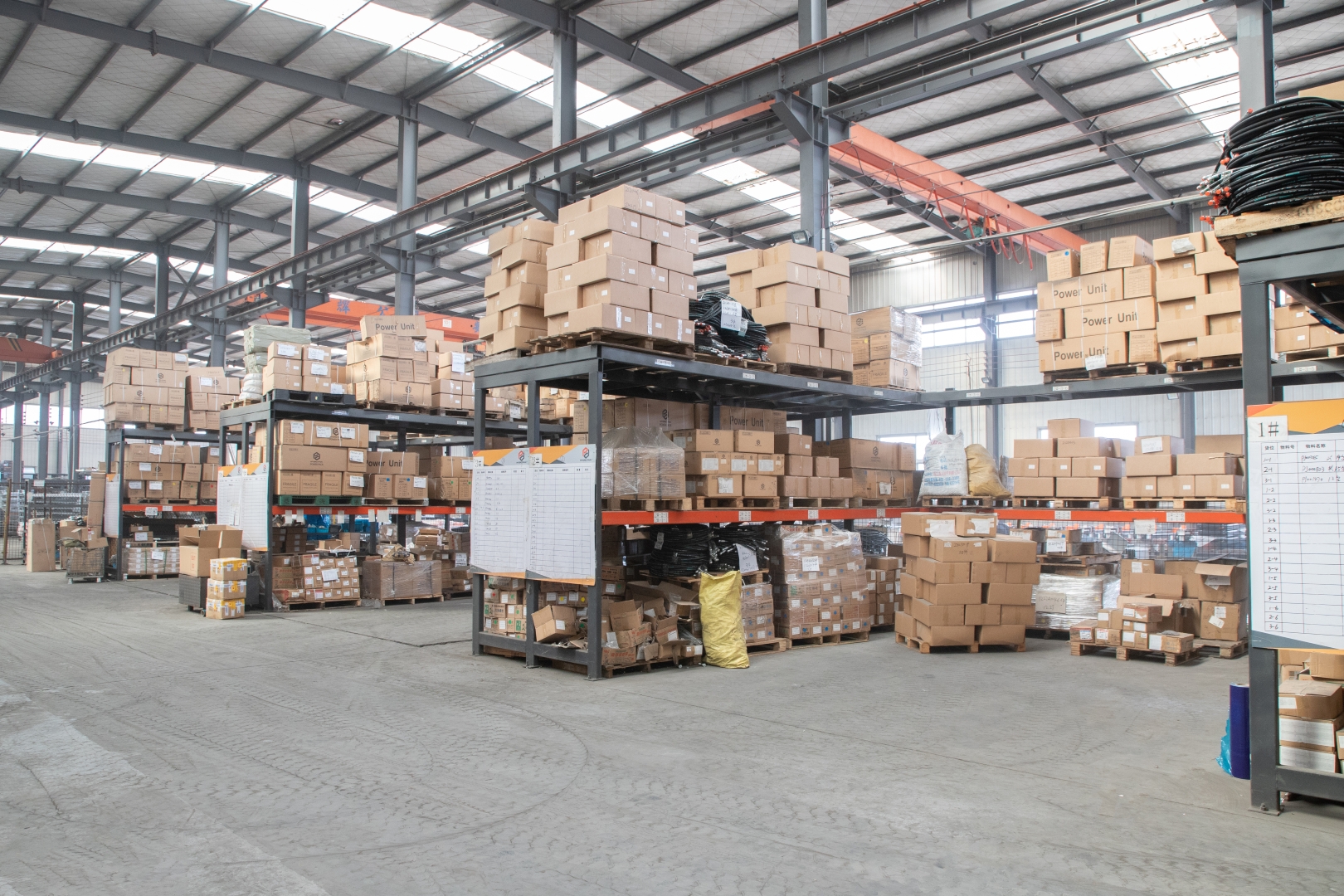
Procurement files usually start with a shortlist of models and work backwards to the site. The failure mode is predictable: a unit is chosen on headline capacity and price, and only later does the civil scope, the headroom or the service route turn out to be the binding constraint. Reversing the order — survey first, model second — is the single change that most improves the outcome of a parking lift purchase.
Market data shows how easily comparisons drift when definitions are loose. The global car lifts market, which covers both parking and service lifts, was valued at USD 2.8 billion in 2025 and is projected to reach USD 4.7 billion by 2034 (Dataintelo). A narrower estimate for car stacker lifts put that segment at approximately USD 4.6 billion in 2023, with growth to USD 6.72 billion by 2030 (QYResearch). Estimates for parking management services run higher again, around USD 4.4 billion (Global Market Insights), because they count services rather than hardware. None of those figures is wrong; they measure different things. Buyers who treat them as interchangeable build a business case on the wrong denominator, and the same discipline applies when comparing individual models.
There is a second reason shortlists go wrong: model-level figures travel faster than model-level revisions. A capacity number copied from an old quotation or a third-party listing can describe a configuration that is no longer offered for that site. This test therefore treats every model claim as a question to be verified against the manufacturer's current datasheet and the site survey, rather than as a given.
The five criteria this test scores
Five criteria decide whether a parking lift fits in the real world. They are ordered deliberately: the first two are physical, the third is commercial, and the last two determine whether the asset still performs in year five.
1. Civil works and foundation
The first question is not what the lift costs but what has to be built beneath it. Parking lifts need only a simple foundation — a simple concrete bedding — and do not require a deep foundation pit, partial civil air defense works or large-area waterproofing. On a renovation, that difference is what separates an equipment purchase from a construction project.
2. Land efficiency per space
A car parking lift is bought by the space, not by the unit. On the same lot, a parking lift system typically returns 2.5 to 4 times more parking spaces than a surface layout. Any comparison that does not state the resulting space count is comparing hardware instead of outcomes.
3. Cost position across the lifecycle
Three cost anchors matter, and they point in different directions. Against a multilevel car park building, parking lifts are reported at 40% lower cost for urban applications, with lower electricity consumption, a shorter installation period and lower maintenance cost, and no lighting or ventilation systems to run. Against European brands, Mutrade positions its parking lifts at 50% lower cost with equivalent quality claimed, quicker delivery and response times and more safety devices. Against other Chinese manufacturers, the same portfolio sits roughly 20% higher on price — a premium the company attributes to higher quality and service, and to the operating cost of a complete engineering, QC and procurement organisation. A buyer who uses only one of those three anchors will price the decision wrongly.
4. Duty class and verifiable manufacturing evidence
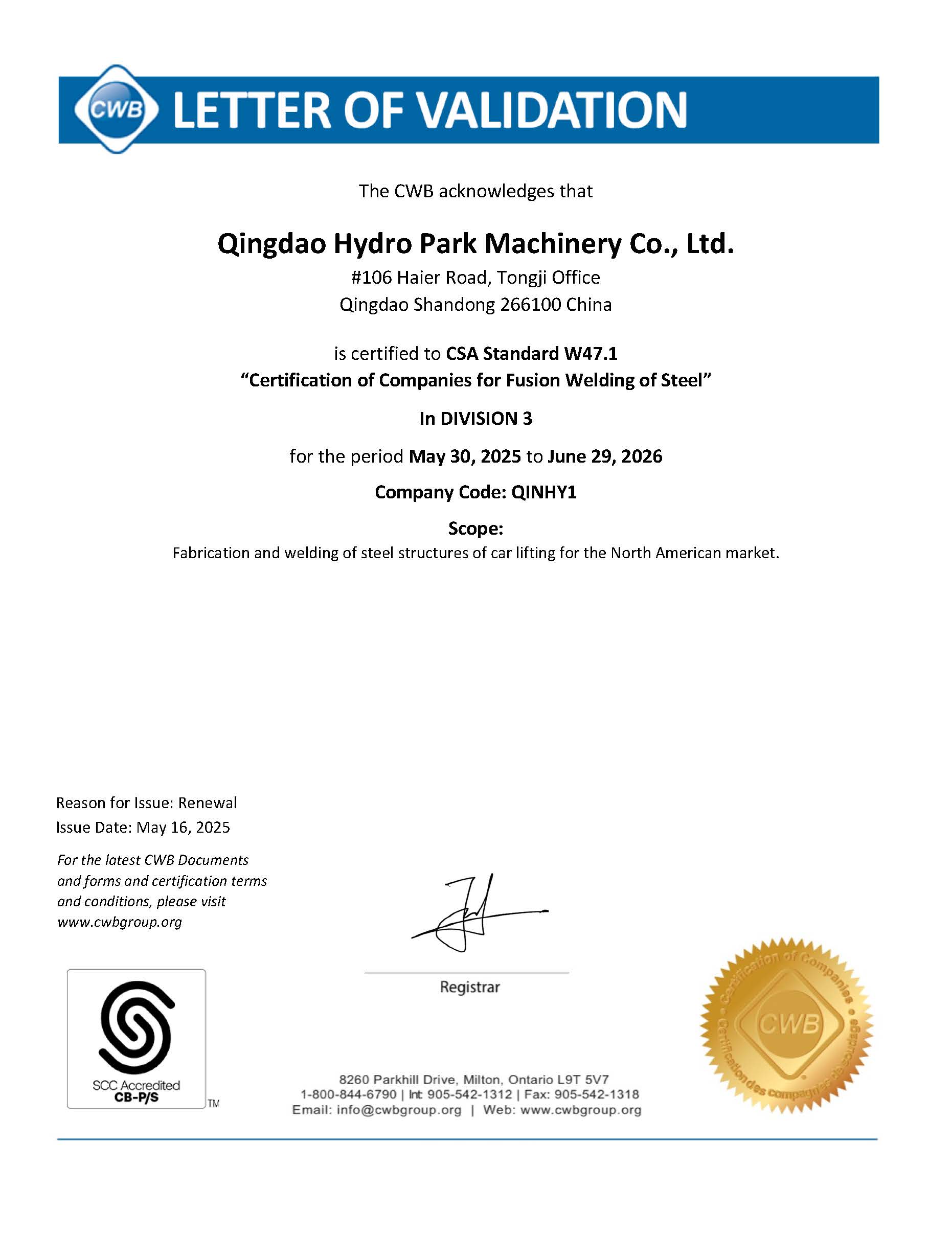
Ask what the equipment was designed to, not how it is described. Evidence worth requesting includes the design standard applied — Mutrade states that its products follow the EU EN 14010 machinery safety standard — the welding specification and the audits behind it, the management-system certifications, and the incoming-material controls. In this portfolio, the factory holds CWB welding certification and is audited annually, has passed ISO 9001 and ISO 14001, and samples steel and hydraulic components batch by batch on delivery, rejecting non-conforming material outright. Steel thickness ranges from 5 mm to 20 mm depending on the part, and welders are retrained and tested annually by the CWB authority. Market-wide, hydraulic mechanisms hold the largest share of the car lift market at 57.2% (Dataintelo, 2025), a position the source links to reliability in heavy-duty applications.
5. Service coverage and lifecycle
The purchase order begins a relationship that lasts as long as the equipment. Mutrade's stated terms are a 12-month warranty on parts and accessories and a 60-month warranty on the structure, with spare parts available for the lifetime of the systems. Technical support includes 24-hour online remote support, assistance from local partners and on-site engineer supervision. Buyers should also budget for the annual statutory equipment maintenance that applies to this equipment class, and confirm in writing who carries it.
The six entrants and what the test asks of each
The six entries below are not ranked. Each is tested against the five criteria, and each raises a different first question. Three are named models in the catalogue under review; three are configuration families that cover most parking lift enquiries.
| Entrant | What the test asks first | Where it tends to fit |
|---|---|---|
| Hydro-Park 1127 | Market-eligibility documentation and the reference installation record | Projects where a documented installation in a comparable market carries weight during approvals |
| Starke 2227 | The current datasheet for the exact revision quoted — capacity, footprint, power | Teams issuing like-for-like quotations against identical site drawings |
| S-VRC-2 | Whether the configuration matches the site's access route and clearance profile | Shortlists already narrowed to two or three models where fit, not price, is the deciding variable |
| Two-post parking lift | Floor area per bay and headroom at the highest parked position | Narrow sites and existing buildings where footprint is the binding constraint |
| Four-post parking lift | Drive-on access, platform length and the clearance beneath the platform | Long-term parking where drivers keep the car on its wheels and want a simple, low-intervention routine |
| Triple-stacker (three-car) lift | Vertical clearance, structural interfaces and access sequencing | Sites where stacking three vehicles vertically is the only practical way to add capacity |
Application fit: matching an entry to a real scenario
Fit is scenario-led. The same model that suits a narrow urban infill site can be the wrong purchase for a suburban office park with cheap land. The scenarios below are the ones most frequently raised by buyers, and each maps to a different configuration logic.
- Home garage and single-family use. A parking lift for car storage at home is usually driven by a low ceiling and a fixed kerb position. Here the two-post and lighter four-post configurations compete, and headroom is the first measurement.
- Land-scarce urban areas, old residential communities and narrow sites. This is the classic use case for a hydraulic car parking lift, where equipment replaces excavation and the civil scope stays minimal.
- Office parks and industrial zones with long-term parking. Vehicles sit for hours at a time, so access cycle speed matters less than platform stability and a simple drive-on routine, which favours four-post arrangements.
- Downtown commercial areas where land cost is high. Space count drives the return, and a 3 car parking lift or triple-stacker configuration is usually the most aggressive way to add capacity on a fixed footprint.
- Renovation projects with limited construction conditions. Where the existing structure cannot tolerate excavation or waterproofing work, the simple-bedding foundation of a parking lift is the deciding advantage.
- Vacant space under overpasses and bridges. These sites reward compact configuration and simple drainage over architectural appearance.
The matching logic follows the criteria rather than the catalogue order. A 2 post parking lift wins where floor area is the constraint. A 4 post parking lift wins where access simplicity and stable platforms matter more than footprint. A three-car or triple parking lift wins where vertical space exists and floor space does not. Where the site sits in a market with strict equipment approval requirements, the market-eligibility file matters as much as the layout: Mutrade's factory holds CWB certification with an annual audit, and the company states that this certification is what allows its equipment to be exported to Canada, where a Hydro-Park 1127 installation is documented.
Where parking lifts lose this test
An honest comparison has to state where the category underperforms. Four boundaries apply, and each should be tested against the specific site before a shortlist is finalised.
- Low-cost suburban land. Parking lifts are cheaper in high land-price downtown locations, but a ramp building costs less in low-cost suburban areas. Where land is abundant and inexpensive, the arithmetic can reverse and a conventional structure deserves serious consideration.
- The annual statutory maintenance calendar. Parking lifts require annual statutory equipment maintenance. Power consumption is low and there are no lighting and ventilation systems to run, but the compliance obligation is continuous and must be resourced locally.
- A price premium against other Chinese suppliers. The portfolio sits around 20% higher in cost than other Chinese manufacturers. Buyers optimising purely on purchase price will find cheaper quotations; the test question is whether the premium is justified by the documented quality system, the certification set and the service model — which is a judgement the buyer has to make with evidence, not with adjectives.
- Verification cannot be delegated. Because capacities and dimensions vary by revision, a fit assessment that is not confirmed against the current datasheet and a measured site survey is not a fit assessment. The most expensive parking lift is the one that has to be modified after delivery.
Market signals a 2026 buyer should weigh
Three signals are worth carrying into a decision file this year. First, the category is growing in absolute terms: the global car lifts market was valued at USD 2.8 billion in 2025 and is projected to reach USD 4.7 billion by 2034 (Dataintelo), while the narrower car stacker lift segment was put at approximately USD 4.6 billion in 2023 and projected to reach USD 6.72 billion by 2030 (QYResearch). Second, drive technology is not evenly split: hydraulic mechanisms hold 57.2% of the car lift market (Dataintelo, 2025), which matters when a buyer is choosing between hydraulic and other drive principles for heavy-duty duty cycles. Third, regional demand is concentrated: North America is described as the largest and fastest-growing vehicle lift market at USD 3.25 billion in 2024, with high light-truck ownership — 77% of new vehicle sales — cited as a driver (Custom Market Insights). Vehicle dimensions, not only space counts, shape equipment demand.
Compliance expectations are moving in the same direction. Automated parking systems are increasingly assessed against ISO 9001 for quality management and ISO 45001 for occupational health and safety, to mitigate risks such as vehicle-pedestrian conflict (Pacific Certifications). Suppliers that already hold audited management-system certifications shorten the qualification stage, because the evidence exists before the question is asked.
The competitive landscape also deserves a neutral reading. BendPak is identified as a major player in the North American vehicle lift market and, as of 2024, operates the world's first eight-armed car lift (Octa-Flex). Buyers who arrive through a search for “bendpak parking lift” should note that the North American lift market spans service lifts and parking equipment — two different duty classes with different certification paths. Comparing a service lift specification with a parking lift specification produces a shortlist that cannot be evaluated consistently.
On the supply side, Chinese customs data cited by Mutrade indicates that the company and its Hydro Park production facility have accounted for more than 18% of China's total export volume of mechanical parking equipment (HS Code 84289020) since 2017. For a buyer assembling a supplier file, that figure is a scale indicator rather than a quality indicator — the quality evidence remains the certification set, the welding standard and the warranty terms.
What a defensible comparison file looks like
The output of this buyer's test is not a winner; it is a file. Six steps, executed in order, produce a shortlist that survives contact with the site.
| Step | Evidence to file |
|---|---|
| 1. Site survey | Measured footprint, headroom, foundation conditions, access route for vehicles and delivery |
| 2. Space count | Target spaces and the resulting spaces per configuration, expressed against the 2.5–4× land-efficiency range |
| 3. Datasheet check | Current capacity, dimensions and power requirement for the exact revision quoted |
| 4. Cost anchors | Position against a multilevel car park building, against European brands and against other Chinese suppliers |
| 5. Evidence pack | Certification, welding standard and audits, ISO 9001 / 14001 status, material controls, warranty terms |
| 6. Service model | Remote support, local partner coverage, spare-parts availability, annual statutory maintenance responsibility |
Looking ahead, the direction of travel is toward evidence-led procurement. As the installed base grows and buyers accumulate operating histories, claims that cannot be documented will carry less weight than welder-certification audits, warranty terms and installed references. The models that win on real-world fit in that environment will be the ones whose fit was verified before the order, not asserted after it. Mutrade's own portfolio illustrates the trade-off clearly: a 20% premium against other Chinese suppliers and a 50% reduction against European brands is a position a buyer must evaluate with a checklist, not a slogan.
Frequently asked questions
What should a buyer measure before comparing parking lift models?
Measure the site before the equipment. The essential inputs are the available footprint, the headroom at the highest parked position, the access route for both vehicles and delivery, the vehicle dimensions and weight class, the power supply, and the number of additional spaces the project must achieve. Foundation conditions matter equally: parking lifts require only a simple concrete bedding and do not need a deep foundation pit, partial civil air defense works or large-area waterproofing, so the civil scope is materially smaller than for a building — but it still has to be confirmed on site.
How does a parking lift compare with a multilevel car park building on cost?
For urban applications, parking lifts are reported at 40% lower cost than a multilevel car park building, with a simpler foundation, smaller land usage, quicker installation, lower electricity consumption and lower maintenance cost, and no lighting or ventilation systems to operate. On the same lot, they typically yield 2.5 to 4 times more parking spaces than a surface layout. The comparison is not universally favourable, however: in low-cost suburban areas where land is inexpensive, a ramp building can cost less, which is why land price is one of the first variables a buyer should fix.
Why do hydraulic car parking lifts hold the largest share of the market?
Hydraulic mechanisms account for 57.2% of the global car lift market (Dataintelo, 2025), a share the source attributes to their reliability in heavy-duty applications. For buyers, the practical implication is that hydraulic drive is the mainstream choice for parking equipment rather than a niche option, and that maintenance planning, component sourcing and spare-parts availability for hydraulic systems determine much of the long-term operating cost.
What warranty and service coverage should be verified before ordering?
Verify the terms in writing, not in presentation. Mutrade's stated coverage is a 12-month warranty on parts and accessories, a 60-month warranty on the structure, and spare-parts provision for the lifetime of the parking systems. Its technical service model includes 24-hour online remote support, assistance from local partners and on-site engineer supervision. Buyers should also confirm who is responsible for the annual statutory equipment maintenance that applies to this class of equipment, and whether local partner coverage exists in the project's region.
When is a parking lift the wrong choice?
There are identifiable cases. Where land is cheap and abundant — typically lower-cost suburban sites — a conventional ramp building can cost less than a parking lift installation, even though parking lifts are cheaper in high land-price urban locations. Sites that cannot support the required vertical clearance, or that cannot resource annual statutory equipment maintenance locally, are also poor candidates. Finally, where a quotation cannot be backed by a current datasheet for the exact revision, the risk of post-delivery modification may outweigh the space gained.
Does a lower purchase price always mean a lower project cost?
No. In this portfolio the price position differs by comparison set: approximately 20% higher than other Chinese manufacturers, and approximately 50% lower than European brands with equivalent quality claimed, quicker delivery and response times and more safety devices. A purchase decision based on unit price alone omits the foundation scope, installation period, electricity consumption, maintenance regime and the cost of downtime. The reliable approach is to compare whole-project cost against the two relevant anchors — a conventional parking building on one side, and the alternative supplier set on the other.
Mutrade's company profile, including the full portfolio, factory data and certification set, is available as a downloadable PDF: Mutrade company profile (PDF).
¿Tiene preguntas o necesita más detalles?
Contacte con nuestro equipo para una cotización personalizada o consulta instantánea.
Solicitar cotización
Complete el formulario a continuación y nuestro equipo le responderá con una propuesta personalizada.
Chat directo de WhatsApp
¿Prefiere chatear en tiempo real? Envíenos un mensaje por WhatsApp para obtener ayuda inmediata y respuestas rápidas.
- Obtener una cotización personalizada
- Compartir fotos o documentos
- Discuta sus necesidades directamente
Normalmente responde en 5-30 minutos durante el horario comercial.