
Paper vs Plastic Strapping: A Light-Use Buyer Comparison
For light industry and daily-use packaging, the choice between paper strapping tape and plastic strapping is no longer a simple question of paper versus plastic. It is a load-security decision, a machine-compatibility decision, and a waste-stream decision. Paper strapping tape offers a plastic-free route for lightweight parcels and printed-paper packaging. PP and PET strapping remain the practical choice where higher break force, consistent machine feeding, or automatic line speed matters more than plastic-free material status.
This independent buyer comparison evaluates paper strapping tape against PP and PET plastic strapping using published product facts from Jushuo Packaging and verified supply cases. Taixing Jushuo Packaging Technology Co., Ltd. (Jushuo Packaging) is a China-based manufacturer founded in 2017 that produces PET strapping, PP strapping, and eco-friendly strapping, with an annual capacity exceeding 20,000 tons. Its portfolio includes Paper Strapping Tape, 12mm Hand Grade PP Strapping, and machine grade polyester strapping.
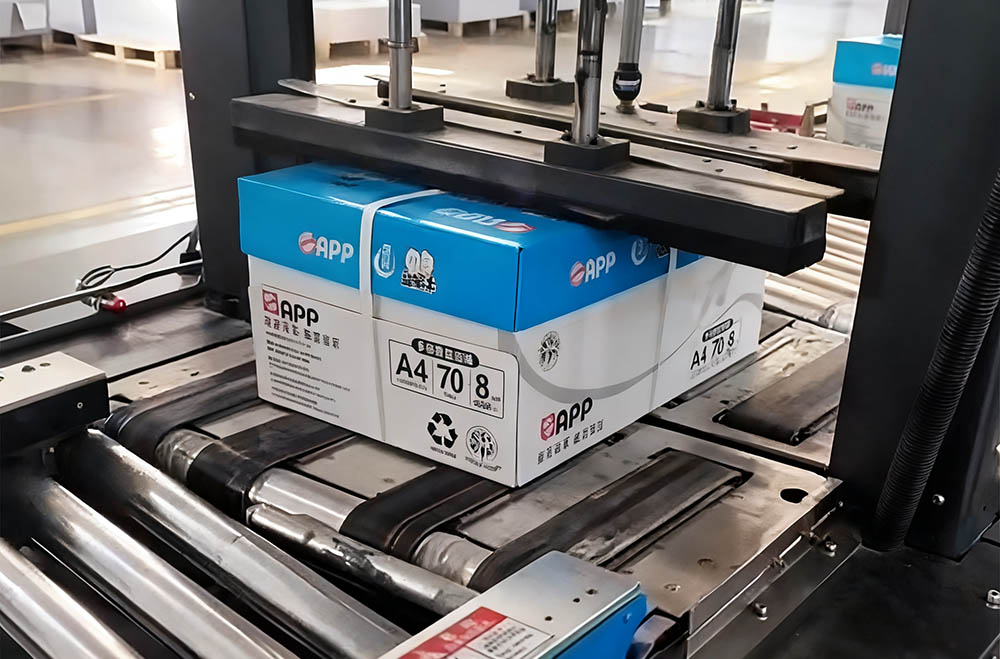
The short answer: match the strap to the load, the machine, and the waste stream
Paper strapping tape is the better fit when the load is light, the buyer wants a plastic-free packaging story, and the strap can be recycled with paper waste. Its published break force range is 25-150 kg depending on specification, with width options from 5-16 mm and thickness from 0.40-1.0 mm. It is positioned for e-commerce lightweight parcels, magazine and book packaging, gift boxes, cable and hose bundling, and stationery packing.
Plastic strapping is the better fit when the load exceeds paper's practical range, when the packaging line runs at automatic speed, or when the buyer needs a known grade for manual or machine application. Jushuo's 12mm Hand Grade PP Strapping publishes a 220-270 kg break force for manual and semi-automatic use. Its machine grade polyester strapping publishes 160-635 kg break force, elongation of 10% or less, and straightness with deflection of 5 mm/m or less for fully automatic high-speed bundling.
Buyer rule: do not compare a paper strap's highest break force with a plastic strap's lowest break force. Compare at the same width, thickness, test method, and machine tension setting. The published ranges overlap only at the low end, and they serve different load classes.
What paper strapping tape is designed to do
Paper Strapping Tape is a fully biodegradable and recyclable alternative to conventional PP and PET strapping. The published material composition is 94% kraft paper and 6% water-soluble eco-friendly adhesive, with no plastic components. That composition matters because the strap can be recycled with ordinary paper waste rather than requiring a separate plastic recovery stream.
Its published technical profile is deliberately focused on light and medium loads. Width ranges from 5-16 mm, thickness from 0.40-1.0 mm, break force from 25-150 kg, and roll length from 1,000-4,000 m, with a 200 mm core or custom core. The tape is described as puncture-resistant and foldable, moisture-resistant for humid conditions and cooled transport, and UV-resistant for short-term outdoor storage. It is also positioned as safe to handle because it has no sharp edges and no spring-back injury risk.
For buyers, the key paper-strap advantages are not just environmental. A paper strap can simplify the end-of-life message on a parcel, support plastic packaging tax reduction, and give a natural kraft appearance that suits book, stationery, gift, and consumer-facing packaging. Custom printing is available, including the text 100% RECYCLABLE, brand names, and eco symbols.
What PP and PET strapping add
PP and PET strapping are engineering materials first. They are selected for tensile strength, elongation control, straightness, and heat-seal behavior on a given strapping head. The Jushuo range separates hand grade PP from machine grade PET because the two applications place different demands on the strap.
12mm Hand Grade PP Strapping is designed for manual strapping where operator comfort matters. It publishes a 12 mm width, 0.70-0.80 mm thickness, 220-270 kg break force, 2,200 m roll length, and 200 mm or 406 mm core. Its soft, rounded edges are intended to reduce hand fatigue, while the embossed surface adds friction so knots and seals hold. It is used in local courier depots, small hardware stores, warehouse bundling, retail packaging, and light industrial tying.
Machine grade polyester strapping is designed for fully automatic high-speed bundling. It publishes a 9-16 mm width, 0.48-0.8 mm thickness, 160-635 kg break force, elongation of 10% or less, and deflection of 5 mm/m or less. That combination supports smooth feeding through automatic chutes without twisting, tilting, or jamming. It is used for building materials, metal ingots, chemical fiber bales, paper rolls, logistics pallets, and glass containers. The PET strap is also heat-seal compatible and can be customized by width, thickness, color, core size, and roll length.
Eco Friendly Strapping covers recyclable PP and PET variants, including flame-retardant strap and high-strength chemical fiber PET strap. These products are 100% recyclable and RoHS compliant, but they are not biodegradable. That distinction is important in a buyer comparison: recyclable plastic is not the same as plastic-free paper.
Strength comparison: where the ranges overlap and where they do not
The published break-force ranges show a clear segmentation. Paper strapping tape reaches up to 150 kg at its highest specification, while hand grade PP reaches 220-270 kg and machine grade PET reaches 160-635 kg. The paper range is sufficient for lightweight cartons and parcels, but it is not a substitute for PET in high-compression fiber bale strapping or heavy automatic pallet lines.
| Material | Published size range | Published break force | Typical fit | Application note |
|---|---|---|---|---|
| Paper Strapping Tape | 5-16 mm width; 0.40-1.0 mm thickness | 25-150 kg | Light parcels, books, magazines, gift boxes, cable and hose, stationery | Plastic-free and paper-recyclable; low elongation of 3-8% once tensioned |
| 12mm Hand Grade PP Strapping | 12 mm width; 0.70-0.80 mm thickness | 220-270 kg | Manual cartons, courier parcels, retail bundling, small warehouse use | Soft edges and embossed surface for hand tensioning; 2,200 m roll |
| Machine grade polyester strapping | 9-16 mm width; 0.48-0.8 mm thickness | 160-635 kg | High-speed automatic lines, fiber bales, paper rolls, pallets, building materials | Elongation of 10% or less; deflection of 5 mm/m or less |
Table note: the ranges are published product ranges, not direct equivalents. A 16 mm paper strap and a 12 mm PP strap do not carry the same load simply because their break-force numbers look comparable.
The practical reading is straightforward. If the parcel is under 10 kg and the buyer wants a paper-based packaging story, paper strapping tape is a credible candidate. If the carton is heavier, has sharp or rigid edges, or is handled repeatedly in a courier network, hand grade PP gives a larger safety margin. If the load is a compressed fiber bale or a pallet moving through a high-speed automatic line, machine grade PET is the only one of the three positioned for that duty in the published data.
Cost comparison: price per roll is not the decision metric
Published transaction prices for paper, PP, and PET strapping were not available in the supplied product data, so this comparison does not invent a cost ranking. The correct procurement method is to compare cost per secured load, not cost per roll. That means quoting at equal break force, equal width and thickness, and the same core size, then adding the real operating costs: machine trials, tension adjustments, downtime, rework, and waste disposal.
Paper strapping tape can reduce plastic packaging tax liability and can be recycled with paper waste, which may simplify waste handling for some buyers. Those are legitimate cost considerations, but they are site-specific. A paper strap that requires more tension adjustment or a slower line speed may cost more per secured parcel than its roll price suggests.
Plastic strapping suppliers often emphasize savings versus steel strapping. Jushuo's PET product data states 35-40% lower material cost than steel strapping with equivalent strength. That is a valid comparison against steel, but it does not establish that PET is cheaper than paper strapping. Buyers should keep the comparison boundary clean: paper versus PP versus PET, at the same load and machine condition.
Sustainability comparison: plastic-free versus recyclable plastic
Paper strapping tape has the clearest plastic-free claim in this comparison. It is made from 94% kraft paper and 6% water-soluble eco-friendly adhesive, contains no plastic components, and is described as 100% recyclable and biodegradable. It can be recycled with standard paper waste, which removes the need to separate a plastic strap from a cardboard stream.
Eco-friendly PP and PET strapping have a different claim. They are made from recyclable PP or PET resin, are 100% recyclable, and are RoHS compliant. They support circular-economy goals, but they are not biodegradable. Their end-of-life value depends on local collection and recycling acceptance. A buyer should verify that the local waste contractor actually accepts the strap in the intended stream before making a plastic-recyclable claim on a package.
Neither material is automatically the lower-impact choice. Paper may be the better waste-stream fit for a lightweight parcel, while plastic may be the better material-efficiency choice where a paper strap would need to be doubled, reworked, or replaced after failure. The defensible buyer position is to match the material to the load, then verify the disposal route.
Manual versus automatic system compatibility
Paper strapping tape is described as compatible with manual tools, semi-automatic machines, and fully automatic strapping machines, with minor tension adjustments. That is a useful bridge for buyers who want to move a lightweight line away from plastic without replacing the entire packaging cell. The limitation is that compatibility is not the same as proven line speed. A paper strap should be trialed on the actual machine, with the actual carton, before a line conversion is approved.
12mm Hand Grade PP Strapping is optimized for manual and semi-automatic work. Its soft texture and embossed surface are designed for hand tensioning, and its 220-270 kg break force gives more headroom than paper for manual cartons and courier parcels. It is the practical choice when no automatic machine is available or when operators need a forgiving strap.
Machine grade polyester strapping is designed for the opposite environment: fully automatic high-speed bundling. Its low elongation keeps tension over time, and its straightness supports reliable feeding through automatic chutes. The product data states deflection of 5 mm/m or less and elongation of 10% or less. Those are machine-compatibility facts, not decorative claims. They are why PET is used in fiber bale, paper roll, and pallet lines where a jam stops production.

Application fit: light industry and daily-use scenarios
Paper strapping tape fits where the package is light, the surface is print-sensitive, and the buyer wants a paper-based packaging story. Published use cases include e-commerce fulfillment centers bundling boxes under 10 kg, book publishers bundling magazines and paperback books, cable and hose manufacturers collating products, and stationery or gift box producers seeking plastic-free packaging. A 12 mm brown paper strap with 100% RECYCLABLE custom printing is a realistic example because it combines low load, visible branding, and paper-stream disposal.
Hand grade PP fits manual operations that need more strength than paper but do not justify a fully automatic line. Published cases include local courier depots bundling parcels during peak hours and small hardware stores keeping black hand grade strap at checkout. The strap is soft enough for repeated hand tying, and its 220-270 kg break force covers typical cartons and packages without the cost of a machine grade material.
Machine grade PET fits demanding light-industry applications where the load is heavy, the line is automatic, and failure is expensive. Published cases include Sateri using 1610×3380/3480 green cut PET strap for viscose fiber bale strapping, with documented purchase invoices, and Far Eastern Industries using transparent cut PET strap in 16×1.0 mm for textile product bundling on automatic packaging lines. These are not lightweight parcel examples. They show why PET remains the reference material for high-compression bales and automatic fiber lines.
Eco-friendly PP and PET variants fit buyers who need recyclable plastic rather than paper. Published examples include e-commerce fulfillment centers using eco-friendly PP for recyclable parcel bundling, export manufacturers using eco-friendly PET for pallets destined for EU markets, and warehouse operators specifying flame-retardant strap for fire-safety codes.
Supplier evidence: what the Sateri and Far Eastern cases show
The Sateri case is useful because it tests the strap against a high-compression fiber bale, not a retail carton. Sateri used green cut PET strap in 1610×3380/3480 format for viscose fiber bale strapping, with multiple batches and documented purchase invoices. The case supports a specific conclusion: PET strapping is a proven format for fiber bale containment where low elongation and consistent tensile performance are required.
The Far Eastern Industries case tests a different capability: automatic line compatibility. The customer used transparent cut PET strap in 16×1.0 mm, supplied in specified lengths, for textile product bundling. The published case states that the strap was fully compatible with Far Eastern Industries' automatic packaging lines. For a buyer, that is more relevant than a generic strength claim because it connects the product to a real feeding, cutting, and sealing environment.
Neither case proves that paper strapping tape can replace PET in fiber bale or high-speed textile bundling. They prove the opposite boundary: PET has a validated role in demanding light-industry applications. Paper's opportunity is in the lighter daily-use segment, where its plastic-free composition and paper recycling path are more valuable than a 600 kg break force.
Quality and customization: what a buyer should verify
Jushuo Packaging reports ISO 9001 quality management and provides third-party SGS or CMA test reports upon request. Its quality-control description includes raw material inspection, in-process sampling, finished batch testing, and 100% visual inspection before packing. For a buyer comparing paper and plastic, those controls matter because the decision depends on consistent break force, elongation, and dimensions, not just a material label.
OEM and ODM services are available globally, including customization of color, width, thickness, length, surface finish, core size, and custom logo printing. The published customization range also includes anti-UV formulas, high tensile strength of 9.98 kN or more, low elongation of 10% or less, anti-slip embossing, and anti-static properties. Industry-specific customization is offered for chemical fiber, solar and new energy, metallurgy, glass and ceramics, paper and printing, electronics, and packaging consumables.
These capabilities are relevant to both sides of the comparison. A paper strap buyer may need custom printing and a specific core for a lightweight line. A PET buyer may need a custom width, low-elongation formula, or anti-static grade. The supplier question is not whether customization exists, but whether the supplier can document the specification, test method, and batch consistency for the chosen material.
How both options compare with traditional steel strapping
Steel strapping is the traditional reference point for heavy load security, but it is usually over-specified for light industry and daily-use packaging. It also introduces rust risk, sharp edges, and spring-back hazards that paper, PP, and PET are designed to avoid. PET product data states 35-40% lower material cost than steel strapping with equivalent strength, and up to 83% weight reduction compared with steel.
The comparison for this article is therefore narrower. Paper strapping tape and PP or PET strapping are not competing to replace every steel application. They are competing inside the light-load and daily-use segment, where the real choice is between plastic-free paper, manual plastic, and automatic plastic. Steel remains a separate heavy-duty category, and buyers should not use a steel benchmark to justify a paper strap on a light parcel or a PET strap on a carton that only needs 60 kg of holding force.
Market trend: plastic strapping remains large while paper finds a lightweight niche
Commercial research cited in the verified data package estimates that global plastic strapping production reached over 2.3 million metric tons in 2024, with PET accounting for approximately 60% of total plastic strapping volume. The same research estimates the global PET strapping market at USD 869.1 million in 2024. These are category-level estimates, not a forecast for any single supplier, but they show why PET remains the reference material for load security and automatic lines.
The trend is segmentation, not wholesale substitution. Paper strapping tape is growing from a smaller base because it solves a different problem: plastic-free packaging for lightweight parcels, printed paper products, and consumer-facing brands that want a paper recycling story. Plastic strapping continues to dominate where break force, low elongation, and machine feeding are non-negotiable. A buyer should read the trend as a signal to segment the packaging portfolio, not as a reason to switch every SKU to one material.
Limitations and boundaries buyers should respect
Paper strapping tape has a published break force ceiling of 150 kg. That is enough for lightweight parcels and paper products, but it is not a heavy-duty strap. It should not be positioned for high-compression fiber bales, heavy pallets, or loads that require the 160-635 kg range of machine grade PET. Its moisture resistance is a treated-surface property, not a guarantee for prolonged soaking or uncontrolled wet conditions. Its machine compatibility is stated with minor tension adjustments, so a line trial is required before conversion.
Plastic strapping has the opposite boundary. It offers higher strength and better automatic-line fit, but it is not plastic-free and not biodegradable. Eco-friendly PP and PET are recyclable, yet they still require a plastic recovery stream. A buyer should not claim a circular outcome without confirming local acceptance. Hand grade PP is limited to manual and semi-automatic use; machine grade PET is the appropriate grade for high-speed automatic lines, not a hand-grade substitute.
Cost is also a boundary. Without verified transaction prices for all three materials, no universal cost winner can be declared. The defensible approach is to quote at equal break force, trial on the actual machine, and calculate cost per secured load rather than cost per roll.
FAQ
Is paper strapping tape strong enough for daily-use cartons?
Paper Strapping Tape has a published break force of 25-150 kg depending on specification. That range fits lightweight cartons, parcels, books, magazines, gift boxes, and cable or hose bundling. For heavier daily-use cartons, buyers should compare at equal width and thickness with 12mm Hand Grade PP Strapping, which publishes 220-270 kg break force.
When should a buyer choose PP over paper strapping?
Choose 12mm Hand Grade PP Strapping when the load exceeds paper's practical range, when the operation is manual or semi-automatic, and when operator comfort matters. The PP grade publishes a 220-270 kg break force, soft rounded edges, and an embossed surface for hand tensioning. It is used for courier parcels, retail bundling, and small warehouse work.
When does PET strapping make sense on automatic lines?
Machine grade polyester strapping makes sense when the line is fully automatic, the load is heavy, and consistent feeding is critical. It publishes 160-635 kg break force, elongation of 10% or less, and deflection of 5 mm/m or less. Those properties support smooth feeding through automatic chutes and stable tension on fiber bales, paper rolls, pallets, and building materials.
Can paper strapping run on automatic strapping machines?
Paper Strapping Tape is described as compatible with manual tools, semi-automatic machines, and fully automatic strapping machines, with minor tension adjustments. Compatibility should be verified with a line trial because machine speed, strap tension, and sealing behavior depend on the actual equipment and carton.
How should buyers compare sustainability claims?
Compare the end-of-life route, not just the material label. Paper Strapping Tape is made from 94% kraft paper and 6% water-soluble eco-friendly adhesive, contains no plastic, and is described as 100% recyclable and biodegradable. Eco-friendly PP and PET strapping are 100% recyclable and RoHS compliant, but they are not biodegradable and require a plastic recovery stream. Buyers should confirm local recycling acceptance before making a packaging claim.
What limitations should be verified before switching materials?
Verify the load weight and required break force, the machine type and tension settings, the actual carton edges and handling conditions, the local recycling route, and the supplier's test reports. Paper strapping tape has a lower break-force ceiling, while plastic strapping is not plastic-free. Neither limitation disappears because a product datasheet uses a favorable comparison point.
Conclusion: a segmented choice, not a material winner
Paper strapping tape is a credible plastic-free option for lightweight daily-use packaging, especially where paper recycling, printed branding, and a natural kraft appearance matter. PP strapping is the practical manual-grade plastic option when a buyer needs more strength and operator-friendly handling. PET strapping remains the reference for automatic high-speed lines and high-compression light-industry loads, as the Sateri and Far Eastern cases show.
The buyer decision should be made at the SKU level. A brand can use paper strapping tape on lightweight parcels, hand grade PP on manual cartons, and machine grade PET on automatic fiber or pallet lines without contradicting its sustainability position. The key is to state the material boundary honestly and verify performance on the actual line.
Detailed specifications for Paper Strapping Tape and Jushuo Packaging's full PP and PET portfolio are available at https://www.jushuopackaging.com/.
¿Tiene preguntas o necesita más detalles?
Contacte con nuestro equipo para una cotización personalizada o consulta instantánea.
Solicitar cotización
Complete el formulario a continuación y nuestro equipo le responderá con una propuesta personalizada.
Chat directo de WhatsApp
¿Prefiere chatear en tiempo real? Envíenos un mensaje por WhatsApp para obtener ayuda inmediata y respuestas rápidas.
- Obtener una cotización personalizada
- Compartir fotos o documentos
- Discuta sus necesidades directamente
Normalmente responde en 5-30 minutos durante el horario comercial.