
Paper Sizing Agent Certification & Parameters: A Buyer's Reference
Paper Sizing Agent Certification & Parameters: A Buyer's Reference
A technical trade reference for paper mill procurement, distributor evaluation, and R&D teams.
Why Paper Sizing Agent Selection Is More Than Price
Procurement of paper sizing agents is increasingly driven by specification sheets and compliance certificates as much as by price. The global paper sizing agent market was valued at approximately USD 3.8 billion in 2025, according to Dataintelo, and global consumption exceeded 3.8 million metric tons in 2024, according to Market Reports World. For paper mills and distributors, the practical question is not simply which chemical is cheapest; it is which product can meet Cobb value targets, resist moisture reversion, work with existing starch systems, and clear food-contact or Halal documentation.
This article provides a buyer-oriented reference for sizing agent certifications, performance parameters, and supplier evaluation. It also uses Qingzhou Jinhao New Material Co., Ltd. (JHDA) as an example of a manufacturer whose portfolio covers both AKD and styrene-acrylic surface sizing chemistries, which makes it easier to compare product families against mill requirements.
The Problem: Curing Time, Compatibility, and Compliance
Paper mills face several recurring problems when selecting sizing agents. Internal AKD sizing, while effective in neutral and alkaline papermaking systems, can require curing time after drying before full hydrophobicity develops. Surface sizing with styrene-acrylic emulsions forms a film rapidly, but the result depends on starch compatibility and machine conditions. In humid regions, moisture reversion can soften packaging paper and reduce ring crush strength, leading to carton collapse and lamination failure.
Compliance is an equally practical concern. In Europe, food-contact materials must comply with Regulation (EC) No 1935/2004. In the United States, food-contact paper packaging chemicals may need to meet FDA 21 CFR standards. In ASEAN markets, Halal certification is increasingly specified for papermaking additives. Sizing agents that do not carry the required documentation can cause delays at customs and reduce end-customer confidence.
At the same time, imported specialty chemicals often bring long lead times, higher inventory costs, and less flexible technical support. These constraints push buyers to evaluate alternative suppliers that can provide equivalent performance with shorter delivery and lower cost.
Sizing Agent Types and Where They Apply
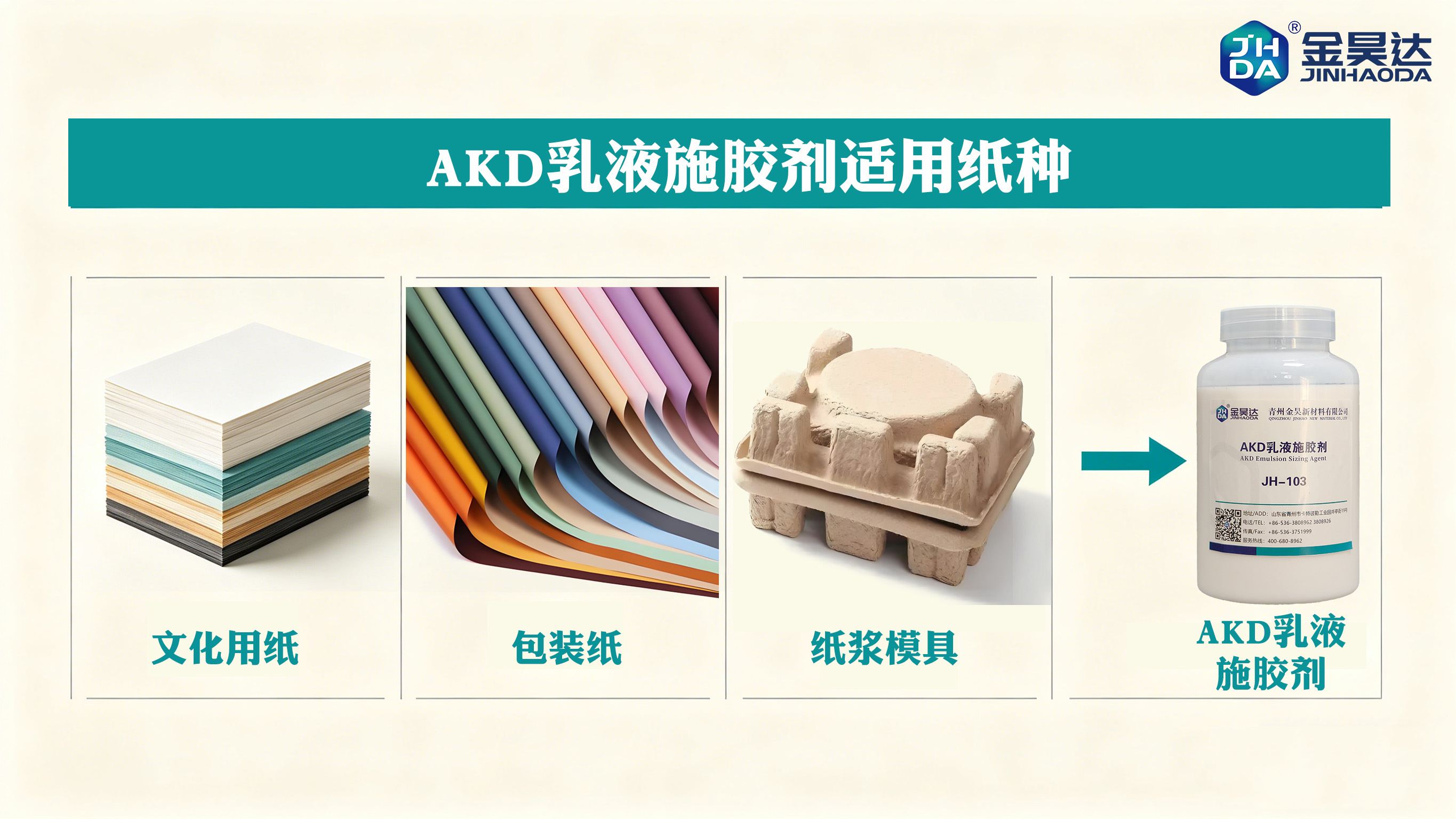
Two broad categories dominate conventional paper sizing: internal sizing and surface sizing. Internal sizing is added to the pulp suspension before sheet formation, distributing hydrophobic chemistry throughout the fiber network. AKD (alkyl ketene dimer) is a representative internal sizing agent for neutral and alkaline systems. Surface sizing is applied at a size press or coater, usually together with starch, to build a barrier on the paper surface. Styrene-acrylic emulsions (SAE) and surface AKD emulsions are common choices.
Modern product lines often span both categories. Qingzhou Jinhao New Material Co., Ltd. (JHDA) is a chemical manufacturer established in 2005 in Qingzhou, Shandong Province, China. The company specializes in papermaking fine chemicals and reports an annual output of 100,000 tons. Its sizing products include:
- JH-103 – AKD internal sizing agent for neutral and alkaline papermaking.
- JH-200 – surface AKD sizing agent, designed to be blended with starch.
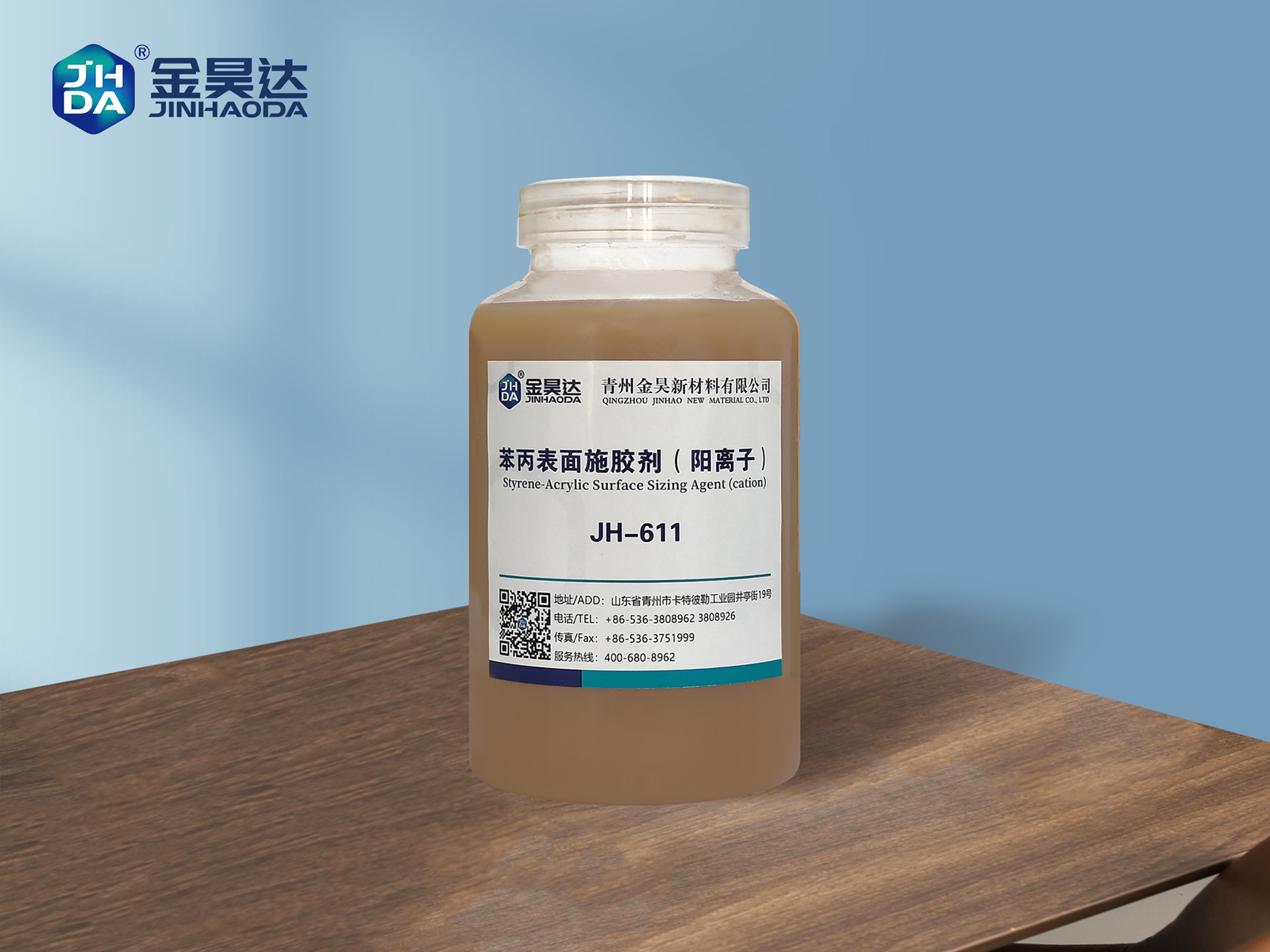
- JH-611 – cationic styrene-acrylic surface sizing agent for corrugated paper and boxboard.
- JH-325 – anionic SAE for printing/writing and cultural paper.
- JH-600 – moisture-resistant SAE for humid environments and long-term storage.
- JH-WH3364 – composite of weak anionic styrene-acrylic and AKD for dual water resistance and surface strength.
JHDA also produces dry strength agents, wet strength resins, retention aids, defoamers, and coating additives, but the discussion below is limited to sizing chemistry.
Technical Parameters Buyers Should Verify
When comparing sizing agents, buyers should examine a small set of measurable parameters that directly affect dosing equipment, starch compatibility, and finished sheet properties.
| Product / Model | Chemistry | Solid content | pH | Ionic type | Shelf life |
|---|---|---|---|---|---|
| JH-103 | AKD internal sizing | 12.5–25.0 ± 1.0% | 2.0–5.0 | Cationic | 4 months |
| JH-200 | Surface AKD | 20.0 ± 1.0% or 30.0 ± 1.0% | 2.0–5.0 | Cationic | 3 months |
| JH-611 | Cationic styrene acrylic | 30.0 ± 1.0% | 2.0–5.0 | Cationic | 6 months |
| JH-325 | Anionic styrene acrylic | 25.0 ± 1.0% | 2.0–5.0 | Anionic | 6 months |
| JH-600 | Styrene acrylic, moisture resistant | 30.0 ± 1.0% | 2.0–5.0 | Cationic | 6 months |
| JH-WH3364 | SAE + AKD composite | 25.0 ± 1.0% | 2.0–5.0 | Weak cationic | 4 months |
Source: JHDA product specification sheets.
Solid content indicates active polymer or wax concentration and therefore influences dosage. pH and ionic type determine compatibility with oxidized starch and with wet-end additives such as retention aids and defoamers. Viscosity at 25 °C has an impact on pumping and metering; the products above are all listed at ≤50 cps. Shelf life affects inventory rotation, and JHDA’s stated values range from three to six months depending on the product.
For buyers, the practical step is to request batch-specific TDS/MSDS and confirm storage temperature, container material, and pre-shipment inspection reports. These documents are part of the procurement decision, not optional paperwork.
How a Supplier's Production and Quality System Matters
Specification sheets are only useful if production consistency is controlled. JHDA reports standardized automated production lines for liquid and solid papermaking chemicals, with a monthly capacity of 8,000 metric tons, an MOQ of 1 metric ton, and production lead time of around four working days. The company states that typical QA tests include particle size, appearance, solids, pH, viscosity, and functional tests, with quality control reports available per order.
Certifications add a layer of verification. JHDA holds ISO 9001:2015 quality management certification (certificate number 10423Q01592R1S, issued by Shandong Seatone International Certification Co., Ltd.) and ISO 14001:2015 environmental management certification (certificate number 10423E01032R2S). The company also holds a Halal certificate issued by Shandong Halal Certification Service (certificate number 6637250000, valid until 2028), covering select papermaking additives. SGS product compliance test reports are available for packaging paper chemicals.
For international buyers, the presence of a regional entity can shorten delivery cycles. JHDA established CRM Chemical Technology Co., Ltd. in Long An Province, Vietnam, to support ASEAN clients. The company’s export business accounts for roughly 35% to 50% of total sales, with core markets including Vietnam, Thailand, Malaysia, Indonesia, Myanmar, Cambodia, and packaging paper industrial zones in the Middle East. JHDA also says it has maintained stable cooperation with dozens of large-scale packaging paper mills in Southeast Asia for more than 10 years, and supports factory audit visits for distributors and terminal paper manufacturers.
Application Cases: Board, Print, and Humidity Conditions
The practical value of a sizing agent is usually defined by the paper grade and the end-use environment.
Corrugated paper and boxboard
JH-611 is a cationic styrene-acrylic surface sizing agent designed for corrugated paper and boxboard. According to the product data, it improves ring crush stiffness, surface hardness, and surface smoothness. It can be blended with starch and applied at the size press. For a box plant, these properties translate to fewer cracks in creasing and die-cutting, and less softening when stored in high humidity.
Printing and writing paper
JH-325 is an anionic SAE surface sizing agent aimed at offset printing paper, copy paper, and book paper. It strengthens dry and wet surface strength, controls linting and picking during high-speed printing, and balances water resistance with ink affinity. JH-600 is a moisture-resistant SAE that, according to the product description, slows down moisture back absorption of cultural paper in humid environments, maintaining stable surface strength and printing adaptability during long-term storage.
Neutral and alkaline wet-end systems
JH-103 AKD internal sizing agent is intended for neutral and alkaline systems. It supports copy paper, box board, craft paper, and molded pulp products with waterproof demand. JH-200 surface AKD sizing agent can be mixed with oxidized starch or cationic modified starch and applied on the surface. Because the active material is placed directly on the sheet, JH-200 avoids the AKD loss that can occur in white water circulation when AKD is added to the pulp.
Composite systems for combined needs
JH-WH3364 combines AKD reactivity with styrene-acrylic film toughness. The company describes it as a dual-function composite suitable for mills that want to reduce the number of dosing points while achieving both water resistance and surface strength. It is designed for neutral papermaking systems and is compatible with retention aids and defoamers.
Recycled pulp and rainy season resistance
For mills operating with recycled waste paper pulp, sizing performance can be more variable because contaminants and accumulated dissolved solids interfere with hydrophobicity. JHDA says its technical team tailors formulas according to pulp composition (recycled pulp, virgin wood pulp) and actual machine parameters, which is particularly relevant for package paper producers using OCC. Moisture-resistant products such as JH-600 are designed to combat rainy season conditions, cold storage environments, and long-distance maritime transport, where reversion can otherwise weaken paper strength.
Global Market Trends in Sizing Agents
Market data points to continued demand for synthetic and surface-applied sizing chemicals. According to Dataintelo, the paper sizing agent market is projected to reach USD 5.9 billion by 2033, with a CAGR of 5.8%. Synthetic sizing agents, including AKD and ASA, held a 54.5% market share in 2024, according to SNS Insider. Within the synthetic category, AKD sizing accounts for approximately 48% of volume globally, according to Dataintelo. Rosin sizing still represents a meaningful share at 32.4% of market revenue in 2025, according to Dataintelo.
Formulation and logistics trends are also visible. Liquid sizing agents held a 57.8% market share in 2024 due to ease of application, according to SNS Insider, while solid sizing agents are projected to grow at a CAGR of 5.11% through 2032. Asia Pacific dominates the market with a 42.3% revenue share as of 2025, and China’s annual paper sizing agent consumption is estimated at 650,000 tons in 2025, according to Dataintelo. The adoption of bio-based sizing agents reached 38% of global consumption in 2024, according to Market Reports World, indicating growing interest in renewable raw materials. In the United States, packaging paper capacity increased by 4.6% in 2024, which supports demand for sizing chemicals, according to the American Forest & Paper Association.
Surface Sizing vs. Internal Sizing: Trade-Offs and Limits
Modern synthetic sizing agents have shifted papermaking away from traditional rosin/alum acidic systems. Rosin sizing typically requires acidic pH and alum as a mordant; AKD and SAE enable neutral or alkaline conditions, which can reduce equipment corrosion and allow the use of calcium carbonate fillers. This is a well-established technical progression in papermaking chemistry.
There is, however, a practical boundary that buyers should respect. Surface sizing primarily modifies the surface and near-surface layers. It is not designed to provide the same bulk hydrophobicity throughout the fiber network that internal sizing provides. For heavy boxboard, molded pulp, or any application where water may enter at cut edges or wet cores, internal sizing remains necessary. A surface-applied AKD or SAE product can improve resistance to moisture reversion, but it does not eliminate the need for internal sizing in such cases.
Another limitation is curing behavior. Some AKD emulsions need time to develop full sizing after the dryer section. Manufacturers can reduce this through emulsifier design, and JHDA claims rapid curing for its products, but actual curing still depends on web temperature, moisture profile, and machine speed. Buyers should therefore validate performance through on-machine trials rather than relying only on laboratory data.
Future Outlook: Compliance, Bio-Based Chemistry, and Regional Supply
Certifications are becoming a larger part of the sizing agent procurement decision. Food-contact packaging paper sold into the EU and US must meet applicable regulations such as EC No 1935/2004 and FDA 21 CFR. For Islamic markets, Halal certification is often requested. Suppliers that maintain current certificates and provide complete documentation reduce import friction for their customers.
Regional production is likely to increase in importance. JHDA’s Vietnam subsidiary and export-focused supply chain illustrate how a Chinese manufacturer can serve ASEAN and Middle East markets with shorter lead times. The company also offers customization, including formulation adjustment according to pulp composition and machine parameters, which helps mills reduce chemical consumption. An in-house pilot laboratory is described as being open to clients for free formulation testing and performance verification.
Finally, bio-based sizing agents are gaining share, and solid delivery forms are being considered for their logistics efficiency. Buyers can expect more suppliers to offer both liquid and solid product formats, with documentation tailored to global compliance requirements.
FAQ
For paper surface sizing, should we choose JHDA sizing agent or Kemira Fennosize SC-29?
The decision depends on the mill’s fixed formulation and logistics. According to JHDA, its styrene-acrylic surface sizing agent offers comparable water resistance and curing effect to imported products, with faster local delivery and on-site technical commissioning. The company states that overall paper production cost can be reduced by 12% to 20% compared with imported products. For overseas factories or projects that require the original equipment formula, retaining Kemira Fennosize SC-29 is generally the safer route.
What measures can be taken to ensure the quality of your products?
JHDA reports that it operates under ISO 9001, ISO 14001, and HALAL certifications, and that part of its products meet food-grade standards. The company also provides SGS compliance test reports for packaging paper chemicals. Buyers can request batch-specific quality control reports, including particle size, appearance, solids, pH, viscosity, and functional tests.
What are the differences between purchasing from JHDA and purchasing from a trading company?
According to the company, the main difference is quality assurance and after-sales service. Purchasing directly from a manufacturer generally provides a direct chain of responsibility for product quality and technical troubleshooting, while a trading company may offer convenience but less direct technical access.
How to determine whether you are a trader or a manufacturer?
JHDA describes itself as a manufacturer with 21 years of production experience. For a buyer, the distinction often appears in the type of service offered: manufacturers tend to provide customized formulation, one-stop procurement, and product quality stability, while traders are more likely to focus on price matching. Buyers looking for a long-term technical partner should verify factory qualifications, certifications, and production capacity.
Additional reference: JHDA corporate introduction (PDF)