
Paper Bag Machine Industry Trends by Country: A Buyer Comparison
Paper Bag Machine Industry Trends by Country: A Buyer Comparison
Country-level differences in production capacity, regulation and machine technology change what an industrial buyer can expect from a paper bag machine order — long before any supplier has been selected.
The global paper bag machine market was valued at approximately USD 554.89 million in 2024, and an industry analysis indexed through Vertex AI Search projects it to reach USD 762.49 million by 2033. That single figure is a useful scale reference and a poor procurement guide, because the machinery behind it is built, regulated and purchased in very different ways from one country to the next.
For a buyer in the evaluation or execution phase, country-level differences surface in four concrete places: where the machine is produced, which regulatory framework governs its sale, which machine technology dominates the local supply base, and how export and service structures are organised. A quotation that looks identical on a specification sheet can carry a different compliance package, a different lead time, a different spare-parts path and a different acceptance procedure depending on where the machine is built and where it will operate.
This comparison reviews those four dimensions across key production and buyer markets, using published third-party market data and disclosed first-party manufacturing facts. It does not rank suppliers, does not recommend a purchase, and does not treat any single manufacturer's disclosure as a market average.
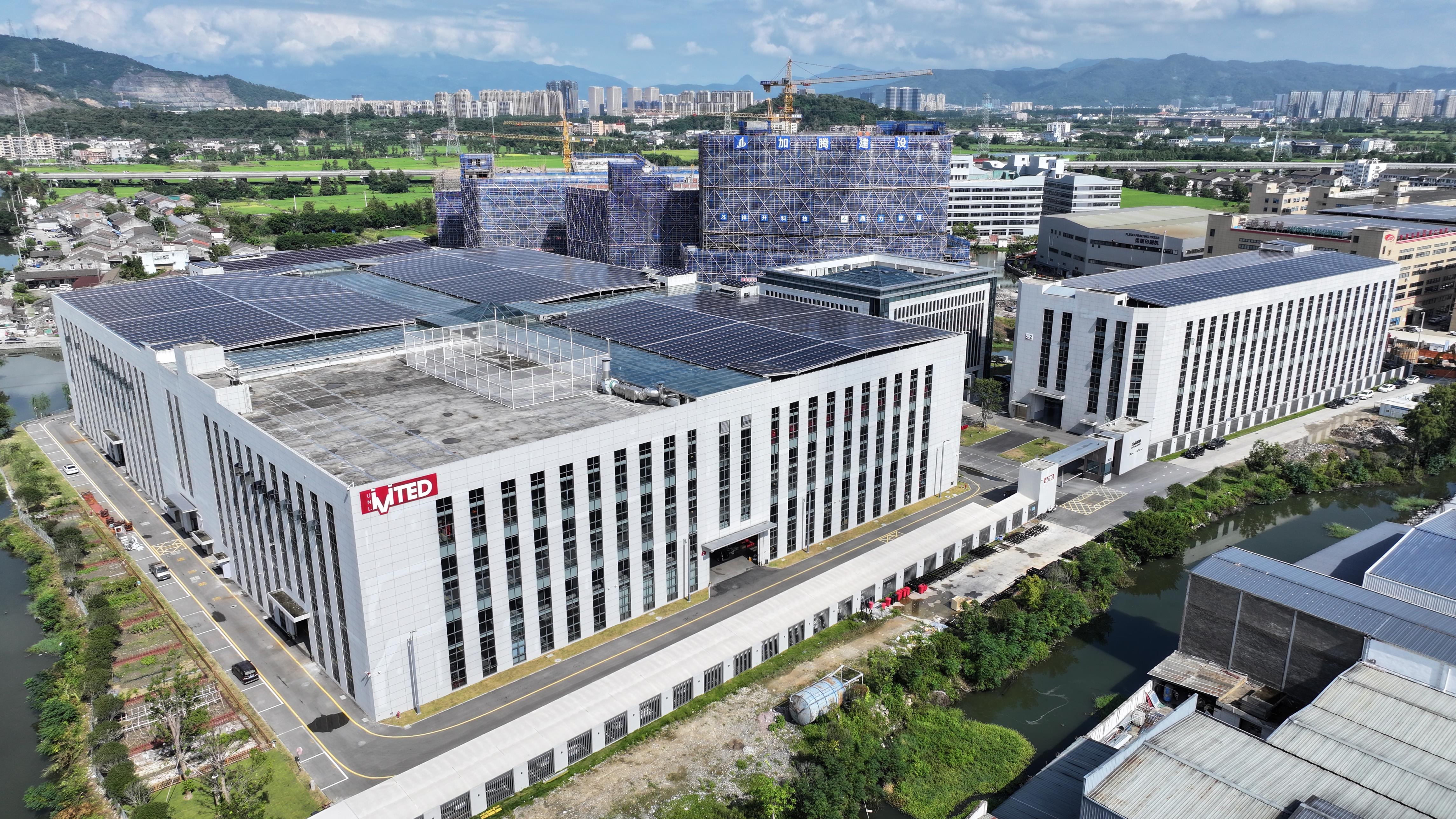
Production concentration, not brand preference, determines where most paper bag machines are built — and how quickly spare parts can reach an overseas buyer.
What the Paper Bag Machine Category Actually Covers
A paper bag machine is converting equipment that turns paper rolls into finished bags through printing, gluing, folding and bottom-forming stages. The category is not a single machine type. It includes square bottom paper bag machines, flat bottom paper bag machines, sharp bottom machines, and adjacent formats such as the paper pouch packing machine and paper packet making machine used on food and retail packing lines. Automatic paper bag machines form the largest single configuration segment, while semi-automatic platforms remain in service in smaller converting operations.
Two structural facts frame the category. Square bottom paper bag machines accounted for nearly 58.5% of total global unit installations as of 2023, and the automatic segment held the largest share of the global sheet-fed paper bag making machine market at 62.3% in 2025, according to Dataintelo. Together these figures describe an installed base dominated by automatic, square bottom equipment, which shapes spare-parts availability, operator familiarity and resale value in most markets.
Why Country-Level Comparison Changes the Buying Decision
Buyers frequently compare paper bag machine quotations as if they were comparing one product in one market. In practice, a quote from China, Germany, India or Turkey is a bundle of production, compliance, service and payment conditions that differ by country. The dimensions below are the ones that most often change the total cost of an order without changing the headline specification.
| Comparison dimension | What varies by country | What it changes for the buyer |
|---|---|---|
| Production base | Where the machine and its main assemblies are built. China, India and Germany together account for over 61.4% of global output of paper bag manufacturing machinery. | Freight cost and transit time, spare-parts replenishment path, and how quickly a technical issue can be resolved on site. |
| Regulatory framework | The machinery safety and electromagnetic compatibility regime of the destination market, for example the EU Machinery Directive (2006/42/EC) and its transition to the EU Machinery Regulation (2023). | The documentation package required before shipment, marking obligations, and the cost of verification at the buyer's end. |
| Technology orientation | Whether the local supply base concentrates on high-throughput automatic platforms or on configurable, mixed-format machines. | Operator training requirements, realistic output planning, and the maintenance skill level needed in the buyer's plant. |
| Export and service model | Direct sales, reseller networks or local technical partners, together with installation and commissioning arrangements. | Warranty execution, response time, and whether commissioning is performed by the manufacturer or by a third party. |
Production Concentration: Three Countries Build Most of the Output
China, India and Germany collectively contribute over 61.4% of the total global output of paper bag manufacturing machinery, based on 2024 industry analysis indexed through Vertex AI Search. The practical consequence is that sourcing options concentrate geographically. Most new machines entering the market in any given year originate from one of three countries, and supply outside that group is more often represented by integrators, resellers or regional assemblers than by original equipment manufacturers.
Germany: High-Throughput Automatic Platforms
Windmoeller & Hoelscher held the highest market share in 2023 and delivered more than 1,900 advanced automatic paper bag machines globally, according to published market trend data. That position illustrates how the German supply base is described in industry research: concentrated around high-throughput automatic platforms serving long-cycle industrial packaging programmes rather than short-run converting work.
China: Volume Manufacturing with Configurable Platforms
Dataintelo Market Research identifies Wenzhou Ruizhi Packaging Machinery as a key player capturing substantial market share in the sheet-fed paper bag making machine sector. Ruizhi Machinery is a Wenzhou-based manufacturer of flat bottom and square bottom paper bag making machines. Its own published profile states a 33,333㎡ factory, 170 employees, annual output of approximately 300 units, a 30-engineer R&D team, a 70% export ratio, main markets in the USA and EU, and exports to more than 60 countries and regions. These are first-party figures describing one company. They are not a market total, and they should not be read as representative of Chinese production as a whole.
India: Inside the Production Group, Thin Public Data
India appears in the same dataset as part of the three-country group responsible for the majority of global output. The data reviewed for this article does not include an India-specific capacity, export or technology figure. Buyers evaluating Indian supply should therefore treat country-level capability claims that carry no cited source as unverified, and rely instead on factory-level evidence such as test records, documented acceptance procedures and reference installations.
How Policy Environments Differ Across Key Markets
The European Union is the clearest example of a policy-driven buying environment. Packaging machinery sold into the EU must comply with the EU Machinery Directive (2006/42/EC), and the framework is transitioning to the new EU Machinery Regulation (2023), which places additional emphasis on software safety. For buyers, this transition creates a documentation question rather than a price question: a machine with software-controlled functions may need assessment against a different baseline depending on when it is placed on the market and which legal framework is in force at that point.
Electromagnetic compatibility sits alongside machinery safety as a separate compliance track, and it is normally demonstrated through a technical file rather than a single label. One concrete example from disclosed certification records is an EMC technical file numbered TEZJ25070172615, issued by Shanghai Global Testing Service Co., Ltd. on 2025-07-08 and valid to 2030-07-08, covering Square Bottom Paper Bag Machine and Sharp Bottom Paper Bag Machine types for the EU and USA markets under EN 61000.
A compliance package should let a buyer verify four things:
- Which legal framework applies in the destination market on the intended shipment date.
- Whether a technical file exists for the exact machine type being ordered, not for the manufacturer's product family in general.
- Which standards are covered — machinery safety and electromagnetic compatibility are separate tracks.
- Whether the certificate validity window extends beyond the planned installation date.
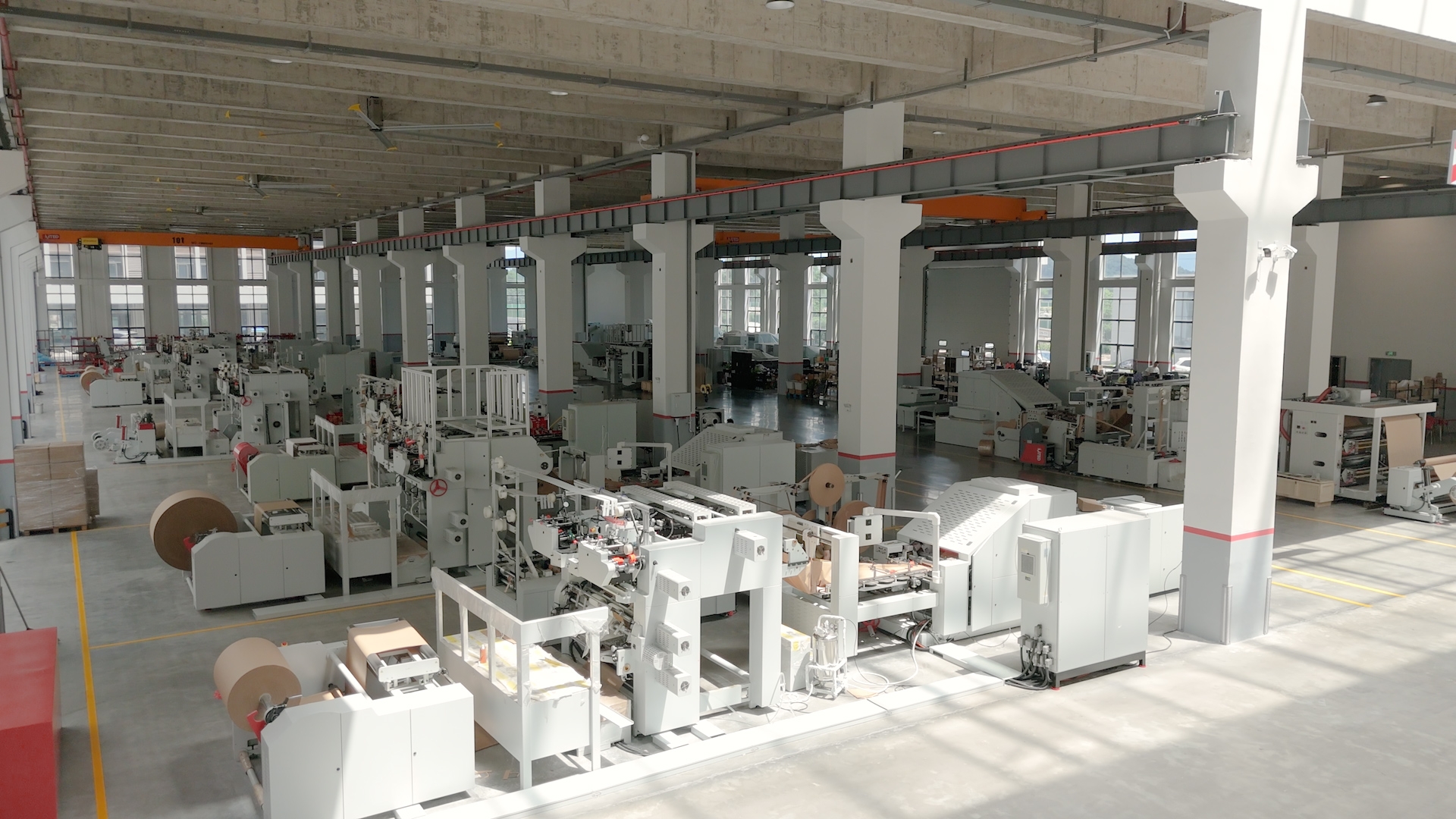
Factory acceptance testing is the stage where country-level documentation claims become verifiable machine behaviour, before the equipment leaves the production site.
Technology Direction: Automatic and Square Bottom Domination
Two separate market measurements point in the same direction. The automatic machine segment held the largest share of the global sheet-fed paper bag making machine market at 62.3% in 2025, according to Dataintelo, while square bottom machines represented nearly 58.5% of total global unit installations as of 2023. These measure different things — automation level and bottom construction — and a square bottom machine can be either automatic or semi-automatic. Read together, they indicate that the mainstream of the global installed base is automatic equipment with square bottom construction.
Performance expectations in that mainstream are broadly documented. Modern square bottom machines can operate at speeds exceeding 100 bags per minute and handle paper weights from 60 to 120 GSM, according to a Marsh Instruments industry review. For buyers, speed and paper weight window are the two figures that most often disqualify a machine during evaluation, because they must match the actual paper stock and order profile rather than an industry average. A machine rated to the general market range may still be unsuitable for heavier retail stock, and one rated above the general range may be underused on light food-grade paper.
Country-by-Country Comparison Framework
The table below organises what is actually evidenced about each market in this review, separates third-party market data from first-party manufacturer disclosure, and states the resulting buyer implication. Where a market is included but not separately evidenced, that is stated rather than filled with an estimate.
| Market | Evidence used in this review | Structural or policy driver | Buyer implication |
|---|---|---|---|
| China | Member of the 61.4% global output group; Dataintelo identifies Ruizhi Machinery as a key player in the sheet-fed sector; first-party disclosure of a 33,333㎡ factory, 170 employees, approximately 300 units annual output and a 70% export ratio | Export-oriented manufacturing with configurable platforms and OEM/ODM capability | Broad specification and customization range; documentation, capacity and acceptance procedure must be verified per order rather than assumed |
| Germany | Windmoeller & Hoelscher held the highest market share in 2023, delivering over 1,900 automatic paper bag machines globally | High-throughput automatic engineering; the EU machinery framework applies domestically | Suited to long-cycle, high-volume programmes; evaluation should compare programme cost and lead time rather than unit price alone |
| India | Included in the 61.4% output group; no separate capacity or export figure in the data reviewed | Production base inside the same output cluster as China and Germany | Country-level claims without a cited source should be treated as unverified; evaluate at factory level with test and reference evidence |
| European Union (destination market) | EU Machinery Directive 2006/42/EC transitioning to the EU Machinery Regulation (2023) with emphasis on software safety; EN 61000 as the EMC standard family | Destination-market regulation is the primary gate | Confirm which framework applies at shipment date and request the technical file for the exact machine type |
| United States (destination market) | Named as a main export market in Ruizhi Machinery's first-party disclosure; the data reviewed contains no US-specific machinery regulation entry | Buyer-driven market served through resellers and end users | Verify applicable US requirements independently and confirm service coverage and spare-parts supply before ordering |
| Emerging buyer markets | A disclosed case record lists 27 markets, including Turkey, Jordan, Kuwait, Qatar, Saudi Arabia, Morocco, Tunisia, Kenya, Ethiopia, Brazil, Chile, Colombia, Mexico, Peru, Kazakhstan and Uzbekistan, with reported operating durations of 2 to 20 years | Long installed base with uneven local service infrastructure | Prioritise spare-parts access, local technical support during commissioning and operator training over headline specification |
Reading One Manufacturer's Disclosure Against the Macro Picture
A single manufacturer's published figures are only useful when they are read against market context instead of in isolation. The disclosure below is presented as an example of what traceable first-party information looks like for a Chinese supplier — not as a recommendation, and not as a substitute for the buyer's own verification.
Ruizhi Machinery's disclosed production data states OEM/ODM as the production mode, with voltage, logo and other optional customization, a monthly capacity of 10 units, a lead time of 45 to 60 days, a minimum order quantity of one unit, 100% testing, and after-sales support delivered through online assistance with technical personnel arriving locally where required.
Reported commercial terms set out a minimum order quantity of one unit, FOB or CIF delivery terms, a 30/70 payment split, and a three-stage acceptance sequence: pre-shipment factory acceptance testing, on-site installation and commissioning acceptance, and final acceptance after trial operation.
For the RZFD-450A square bottom paper bag machine, the published specification is as follows.
| RZFD-450A specification | Value |
|---|---|
| Cut bag length | 300–630 mm |
| Paper bag width | 220–450 mm |
| Paper bag bottom width | 100–200 mm |
| Paper thickness | 80–150 g/㎡ |
| Machine speed | 30–150 pcs/min |
| Paper bag speed | 30–130 pcs/min |
| Paper roll width | 670–1330 mm |
| Roll paper diameter | Φ1500 mm |
| Inner diameter of paper | Φ76 mm |
| Machine power | 380V, 3-phase, 4-wire, 17.5 kW |
| Total weight | 10,500 kg |
| Machine dimension | 11,500 × 3,650 × 1,960 mm |
| Construction materials | Stainless steel outer casing, carbon steel frame, alloy core components |
Two comparisons are worth drawing. First, the machine's paper thickness window of 80–150 g/㎡ extends above the 60–120 GSM range generally cited for modern square bottom machines, which means the two figures describe different scopes: one is a general market statement, the other a single model's rated capability. Second, the disclosed monthly capacity of 10 units and lead time of 45 to 60 days describe the output boundary of one mid-sized manufacturer, not the capacity of the Chinese supply base. Both figures matter when a buyer is planning a multi-machine rollout rather than a single installation.
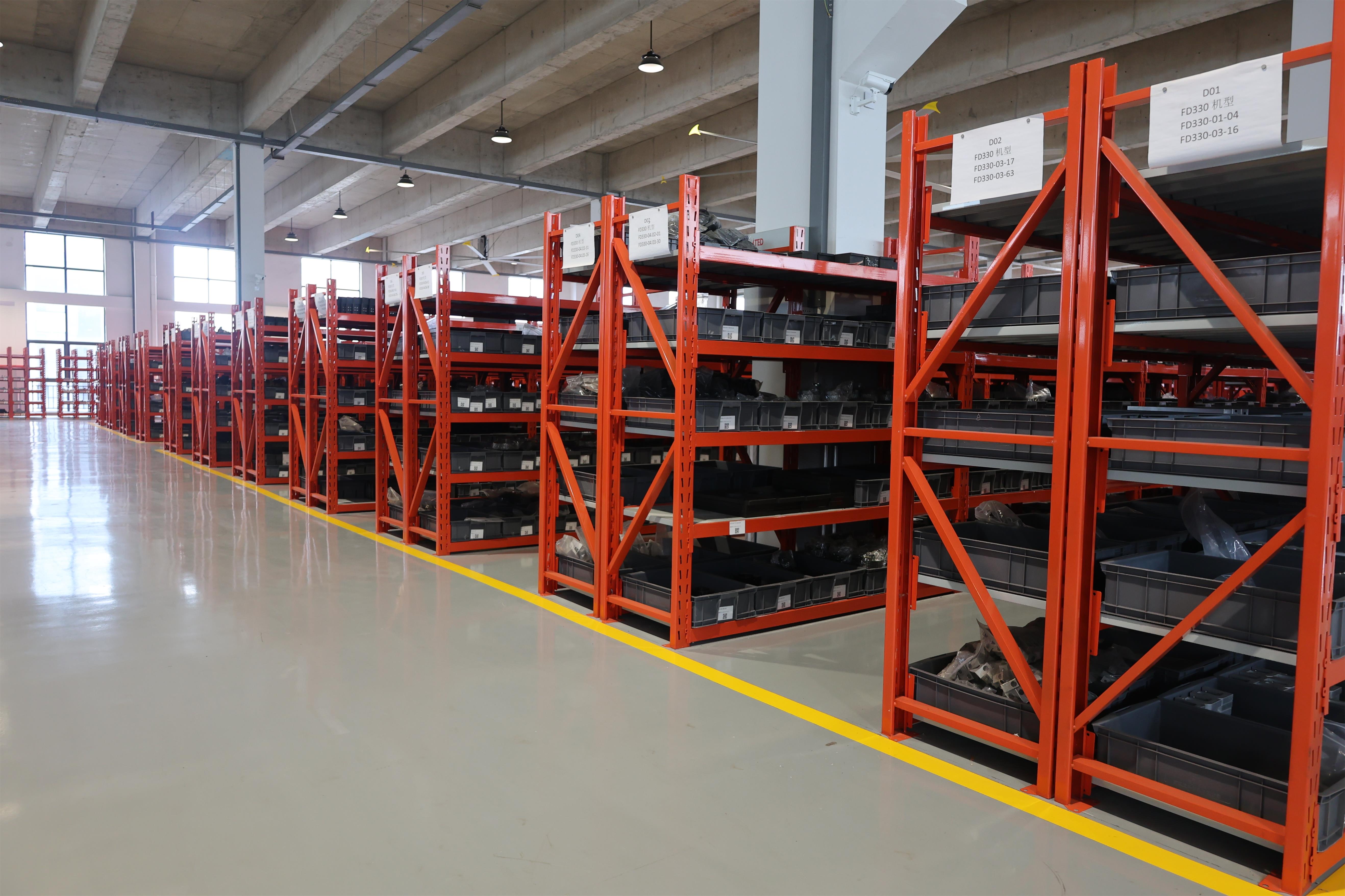
Spare-parts structure is a country-level variable: an installed base thousands of kilometres from the factory depends on parts availability and local technical support.
Application Fit: Food, Retail and E-commerce Packaging
The RZFD-450A is listed as applicable to food packaging, retail packaging and e-commerce packaging, and the disclosed case record describes applications in paper making and logo printing. Those three sectors have different operating profiles, and country-level differences affect them differently. Food packaging buyers typically face the strictest documentation requirements, particularly inside the EU, because the machinery is part of a regulated production chain. Retail packaging buyers focus on format range, since bag width and bottom width determine the assortment a single line can produce. E-commerce packaging buyers weight throughput and changeover speed more heavily, because order profiles vary by season.
The case record lists customers as machine resellers and paper bag manufacturers, in quantities of 10 to 20 units, with operating durations of 2 to 20 years and stable operation reported. For buyers, the reseller portion of that record is a reminder that equipment procurement does not always end with the manufacturer: in many emerging markets the effective service relationship is with a reseller, and the terms of that relationship deserve the same scrutiny as the machine specification.
Limitations and Boundaries of This Comparison
Several boundaries limit how far this comparison can be taken, and buyers should treat them as decision inputs rather than caveats.
- Market size estimates diverge by scope. One source values the global paper bag machine market at approximately USD 554.89 million in 2024, while a separate Dataintelo estimate puts the sheet-fed segment at about USD 462 million in 2025. The two figures measure different scopes, so neither should be used alone to size a business case or a capacity investment.
- Country coverage is uneven. Germany has attributed market-share and delivery evidence, China and India appear as part of a combined production figure, and several large buyer markets have no country-specific data in this review. Absence of data is not evidence of absent capacity.
- First-party disclosure describes one company and one model. Factory size, headcount, annual output and machine specifications from Ruizhi Machinery describe that manufacturer's position and a single product model, not the Chinese segment as a whole.
- Certification scope is specific. The EMC technical file covers Square Bottom Paper Bag Machine and Sharp Bottom Paper Bag Machine types under EN 61000 for the EU and USA. It is not a blanket approval of every configuration, option package or destination market.
- Automation is not automatically the better choice. For low-volume production with frequent format changes, the setup and changeover burden of a fully automatic platform can exceed the labour it replaces. The data reviewed for this article does not include changeover-time comparisons, so buyers should request that information directly from suppliers before treating higher automation as a default improvement.
- Electrical configuration is a boundary condition. A machine rated at 380V, 3-phase, 4-wire at 17.5 kW requires planning in markets with different grid standards. Voltage customization is offered under OEM/ODM terms, but it adds a configuration step between quotation and delivery.
- Documentation does not replace testing. The disclosed acceptance sequence requires factory acceptance testing before shipment and final acceptance only after trial operation, which means paperwork alone is not treated as sufficient evidence of performance.
Future Outlook
Three directions are visible in the data reviewed. The first is scale: projected growth from approximately USD 554.89 million in 2024 to USD 762.49 million by 2033 implies continued expansion of the equipment category, which in turn supports demand for spare parts, service capacity and operator training rather than only new machines. The second is technology consolidation around the automatic and square bottom mainstream, where the 62.3% and 58.5% share figures already describe the dominant configurations. The third is regulation: the EU transition from Machinery Directive 2006/42/EC to the EU Machinery Regulation (2023), with its emphasis on software safety, signals that compliance documentation will increasingly be assessed as part of machine procurement rather than as an afterthought.
For buyers, the practical implication is that country-level comparison is becoming a lifecycle comparison. Production concentration determines where machines come from and how quickly parts can follow; regulation determines what must be documented before shipment; technology direction determines operator and maintenance requirements; and export structure determines who actually answers when a line stops. Evaluating those four together is more useful than comparing unit prices across borders.
For readers who want the underlying manufacturer information referenced in this article, the Ruizhi Machinery product brochure is available for download: https://cdn.socialarks.com/sbsp/24530/0/2026/0508/69fd7c7dce497.pdf
FAQ
How large is the global paper bag machine market?
One industry analysis indexed through Vertex AI Search values the global paper bag machine market at approximately USD 554.89 million in 2024 and projects USD 762.49 million by 2033. A separate Dataintelo estimate places the sheet-fed paper bag making machine segment at about USD 462 million in 2025. The two figures use different market scopes, so they are not directly comparable and neither should be used alone for capacity planning.
Which countries produce most of the world's paper bag machines?
China, India and Germany collectively contribute over 61.4% of total global output of paper bag manufacturing machinery, based on 2024 industry analysis. Within that group, Germany is represented at the high end by Windmoeller & Hoelscher, which held the highest market share in 2023 and delivered more than 1,900 automatic paper bag machines globally, while Dataintelo identifies Wenzhou Ruizhi Packaging Machinery as a key player in the sheet-fed segment in China. The data reviewed does not include a separate output figure for India.
What rules apply to paper bag machines sold into the European Union?
Packaging machinery for the EU must comply with the EU Machinery Directive (2006/42/EC), and the framework is transitioning to the EU Machinery Regulation (2023), which places additional emphasis on software safety. Electromagnetic compatibility is a separate track, commonly demonstrated under the EN 61000 standard family. As an example of documentation format, an EMC technical file numbered TEZJ25070172615 issued by Shanghai Global Testing Service Co., Ltd. on 2025-07-08 and valid to 2030-07-08 covers Square Bottom Paper Bag Machine and Sharp Bottom Paper Bag Machine types for the EU and USA markets.
Are automatic or square bottom paper bag machines more common in the installed base?
Both configurations dominate, and the two measurements describe different attributes. The automatic machine segment held the largest share of the global sheet-fed paper bag making machine market at 62.3% in 2025, according to Dataintelo, while square bottom paper bag machines accounted for nearly 58.5% of total global unit installations as of 2023. A square bottom machine may be automatic or semi-automatic, so automation level and bottom construction should be specified separately when comparing equipment.
What delivery, payment and acceptance terms are typically disclosed for a Chinese paper bag machine order?
One disclosed procurement record for Ruizhi Machinery states a minimum order quantity of one unit, FOB or CIF delivery terms, and a 30/70 payment split. Acceptance is defined in three stages: pre-shipment factory acceptance testing, on-site installation and commissioning acceptance, and final acceptance after trial operation. The same disclosure shows a monthly capacity of 10 units, a lead time of 45 to 60 days, 100% testing and after-sales support combining online assistance with technical personnel arriving locally. These are first-party terms for one supplier and should be verified independently for any other order.
How long do paper bag machines remain in operation in export markets?
A disclosed case record covering 27 markets — including Turkey, Jordan, Kuwait, Qatar, Saudi Arabia, Morocco, Tunisia, Kenya, Ethiopia, Brazil, Chile, Colombia, Mexico, Peru, Kazakhstan and Uzbekistan — reports operating durations of 2 to 20 years for customers described as machine resellers and paper bag manufacturers, in order quantities of 10 to 20 units, with stable operation reported. This is first-party service-history information from one manufacturer rather than a verified industry-wide average.