
Paper Bag Machine Comparison: Buyer's Cost-Performance Guide
Paper Bag Machine Comparison: Buyer's Cost-Performance Guide
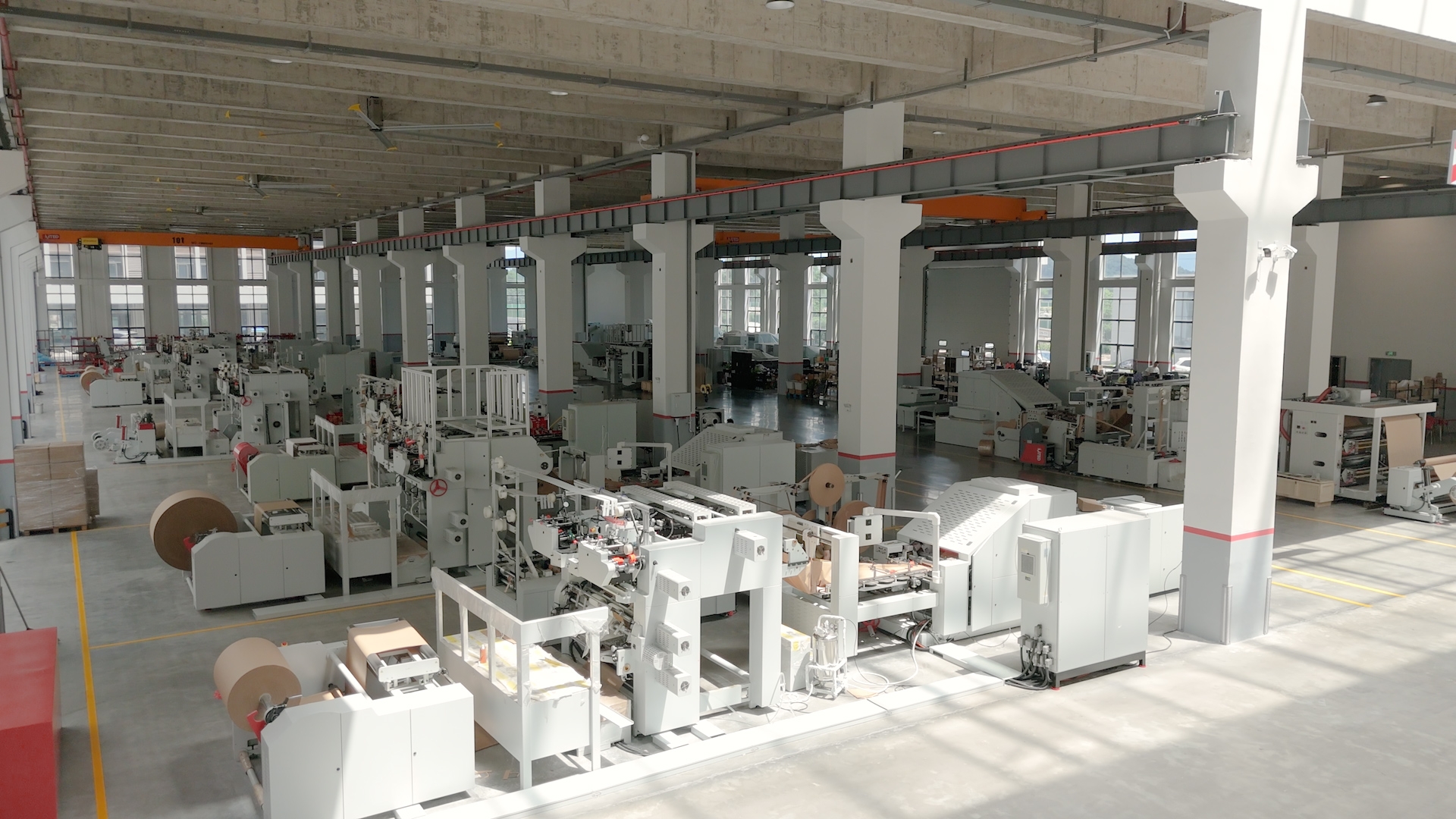
Pre-delivery testing area at Ruizhi Machinery's production facility in Wenzhou, China.
Wenzhou Ruizhi Packing Machinery Co., Ltd. (Ruizhi Machinery) is a Chinese manufacturer of environmentally friendly paper bag making machines, specializing in flat bottom and square bottom paper bag production equipment. The company operates a 33,333 m² production facility in Wenzhou, Zhejiang Province, with approximately 170 employees, including 30 R&D engineers. Around 70% of its annual output of roughly 300 machines is exported, with the USA and EU as main markets and additional sales across Turkey, Spain, the Middle East, and Africa.
For packaging-industry buyers at the decision stage, choosing a paper bag machine requires comparing more than list prices. This guide provides a factual comparison framework covering machine construction, production speed, safety compliance, market positioning, and total cost of ownership, using Ruizhi Machinery's line as the reference point.
The decision to invest in a paper bag machine is a capital expenditure with multi-year consequences. Bag producers, packaging converters, and food manufacturers all face the same evaluation: which machine configuration will deliver the required bag quality, at the required speed, with the least downtime, and at a total cost that supports the target margin this article addresses that evaluation directly, using verified market data and first-party manufacturer specifications.
The Problem: Similar Specs, Substantially Different Machines
The global paper bag machine market is valued at approximately USD 554.89 million in 2024, with expectations to reach USD 762.49 million by 2033. Production is geographically concentrated: China, India, and Germany collectively contribute over 61.4% of the total global output of paper bag manufacturing machinery. Buyers therefore compare manufacturers with very different cost structures, engineering traditions, and quality approaches.
Specification sheets often appear similar across brands. Two machines may list the same bag size range and similar motor ratings, yet differ substantially in frame stiffness, fuselage plate precision, safety systems, and control logic. These differences become visible only after installation, when they show up as output variability, downtime frequency, and maintenance cost.
The opportunity is to evaluate machines on objective, verifiable parameters: main unit steel plate thickness, fuselage precision, bag-making speed, safety equipment, pre-delivery testing, and supplier export compliance. These parameters link directly to cost per bag across a machine's operating life.
Total cost of ownership is the metric that separates a good purchase from an expensive one. The purchase price is only the first component; installation, operator training, spare parts availability, energy consumption, and unplanned downtime affect the real cost per bag. A machine that costs 20% less but loses 10% of production time to jams and repairs can quickly become the more expensive option. This is why frame construction and safety systems deserve as much attention in the comparison as the quoted price.
Ruizhi Machinery: A Solution Profile for Bag Manufacturers
Ruizhi Machinery produces flat bottom paper bag making machines and square bottom paper bag making machines, the two dominant bag formats in the industry. Square bottom paper bag machines account for nearly 58.5% of total global unit installations as of 2023, making square bottom construction the most relevant product category for most buyers. The automatic machine segment holds the largest market share at 62.3% of the global sheet-fed paper bag making machine market in 2025.
Ruizhi's equipment strictly implements ISO9001 quality system standards and CE safety certification. These certifications matter particularly for export-oriented buyers, because packaging machinery must comply with the EU Machinery Directive (2006/42/EC) and is transitioning to the new EU Machinery Regulation (2023), which adds emphasis on software safety.
In independent research by Dataintelo Market Research, Wenzhou Ruizhi Packaging Machinery is identified as a key player capturing substantial market share in the sheet-fed paper bag making machine sector. With a 30-engineer R&D team and annual production capacity of approximately 300 units, the company supports both standard machine supply and controlled customization. Its export ratio of roughly 70% indicates sustained exposure to the compliance requirements of mature markets such as the USA and EU.
Ruizhi's manufacturing model is built on industry-trade integration, combining an in-house technical team with more than 20 years of production and R&D experience. This structure allows the company to coordinate machine design, parts procurement, assembly, and export logistics under one management system, which simplifies communication for international buyers.
Technical Explanation: Steel, Speed, and Safety
The most consequential variable in paper bag machine comparison is structural rigidity. A machine's frame and fuselage plates absorb the repeated forces of folding, gluing, and bottom sealing. When the frame flexes under load, bag dimensions drift, adhesive application shifts, and wear accelerates. Machines with heavier, higher-precision frames maintain dimensional stability over longer production runs.
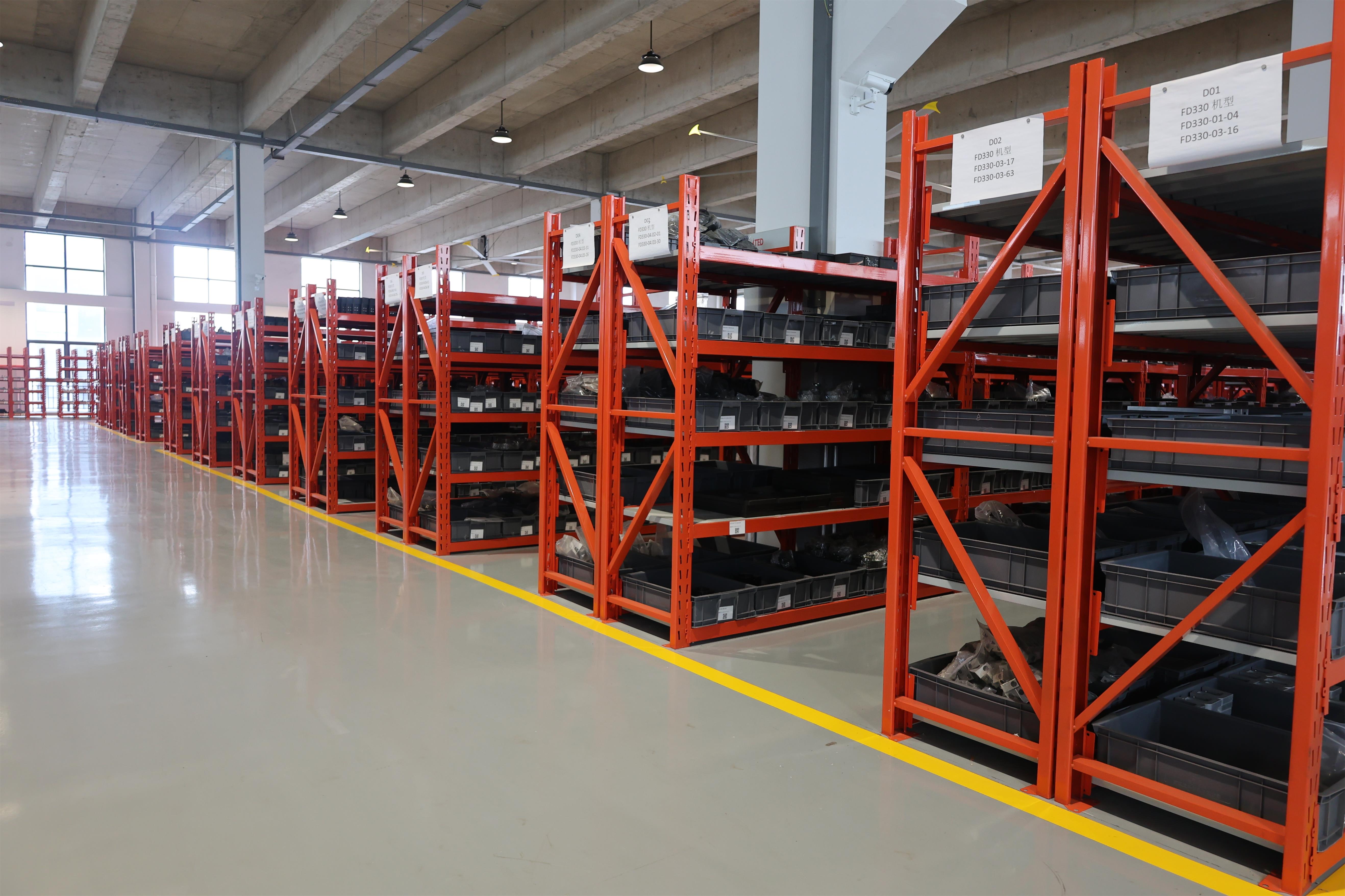
Spare parts storage and machine service area, part of Ruizhi Machinery's after-sales support structure.
Ruizhi Machinery builds its machines with high-precision and high-strength fuselage plates. The main unit steel plate thickness is 20–30% higher than other paper bag machines, and fuselage plate precision achieves a +2 mm performance gain over other machines. This combination produces smooth running and a long use life, because the structural components resist deformation in continuous operation.
| Comparison Criterion | Ruizhi Machinery | Typical Baseline (Other Machines) |
|---|---|---|
| Main unit steel plate thickness | 20–30% higher than baseline | Baseline |
| Fuselage plate precision | +2 mm performance gain | Baseline |
| Bag-making speed | Up to 160 pcs/min | Around 100 bpm for modern square bottom machines |
| Best-fit application | Food packaging production lines | General bag production |
| Pre-delivery testing | 100% test run | Varies by manufacturer |
The +2 mm precision gain refers to the manufacturing tolerance of the fuselage plates themselves. When mating surfaces align within a tighter tolerance, the assembled frame distributes load evenly across welded and bolted joints. Uneven load distribution is a common cause of progressive frame fatigue in lighter machines, leading to misalignment of the bag-forming stations over time and forcing early overhaul or frame replacement. A precision-built frame postpones or eliminates this failure mode.
Production speed is the most visible efficiency metric. Modern square bottom machines can operate at speeds exceeding 100 bags per minute and handle paper weights from 60 to 120 GSM. Ruizhi machines achieve bag-making speeds up to 160 pcs/min, which can translate into substantially more bag output per shift at the same labor cost.
Safety systems are a second key comparison point. Ruizhi paper bag machines integrate safety guards and covers for moving parts, photoelectric safety sensors, an emergency stop button, a paper jam detection system, and an automatic shutdown mechanism. These features mitigate the most common operational risks: mechanical injury and unexpected shutdown. Complementing the hardware are operational controls—fault alarm systems and maintenance guidance—plus a 100% pre-delivery test run for every machine, and standardized operation training for the buyer's crew.
Application Scenarios: Matching Machine Format to Use Case
The choice between flat bottom and square bottom paper bag machines depends on the end product and its filling process.
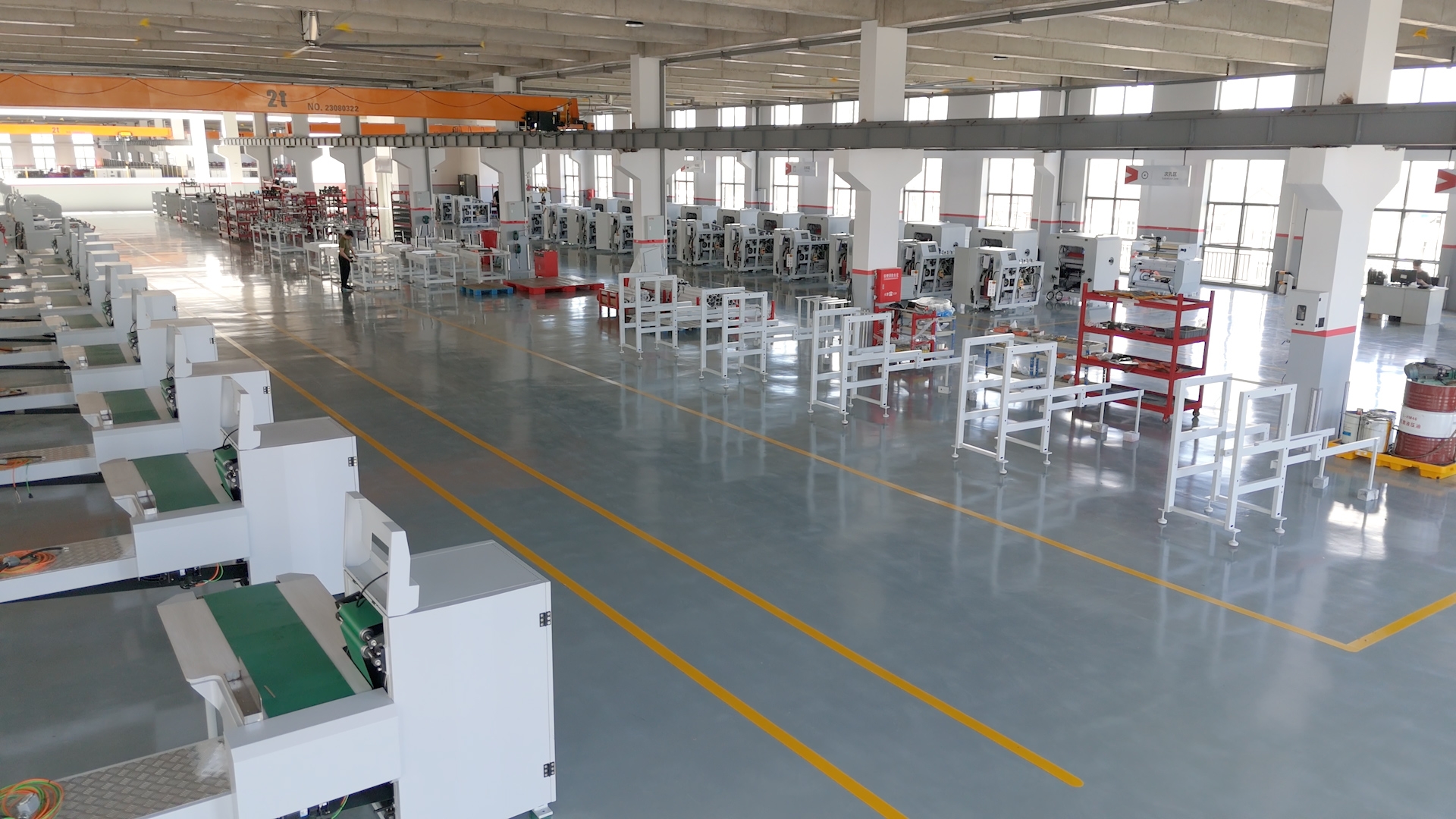
Installation and commissioning area for ready-to-ship paper bag machines.
Food packaging production lines are the best-fit application for Ruizhi Machinery's machines. Square bottom bags have a flat, stable base that stands upright on automated filling lines, which is essential for confectionery, bakery, coffee, and dry food packaging. The structural rigidity of the machine supports consistent bag dimensions during high-speed bottom forming, which matters when bags are printed with artwork that must remain aligned.
Retail and takeaway packaging is the core application for flat bottom paper bag machines. Grocery bags, bakery bags, and merchandise bags require clean, consistent folds at high speed. The flat bottom machine format handles these requirements with a simpler bottom-forming section, making it suitable for high-volume bag production.
From a production planning perspective, the machine's speed range determines the size of each production batch. A machine capable of 160 pcs/min allows a converter to complete a 50,000-bag order in approximately five hours of run time, assuming standard efficiency levels, whereas a 100-bpm machine would require eight hours. The faster machine creates scheduling flexibility, enabling more changeovers per day and reducing the number of machines required to meet a given monthly volume.
For converters serving export markets, machine compliance is as important as output. Ruizhi machines are CE certified and produced under ISO9001 quality systems, and the company has sold equipment to more than 60 countries and regions including Turkey, Spain, the Middle East, Africa, the USA, and the EU. This installed base indicates that the machines have operated across a range of regulatory and environmental conditions.
Market Trends Shaping the 2026 Buying Decision
Third-party data reveals a consistent direction for the industry:
- The global paper bag machine market is expected to grow from approximately USD 554.89 million in 2024 to USD 762.49 million by 2033.
- The 'Automatic' machine segment holds the largest market share at 62.3% of the global sheet-fed paper bag making machine market in 2025.
- Square bottom paper bag machines account for nearly 58.5% of total global unit installations as of 2023.
- Modern square bottom machines operate at speeds exceeding 100 bags per minute and handle paper weights from 60 to 120 GSM.
- China, India, and Germany collectively contribute over 61.4% of the total global output of paper bag manufacturing machinery.
- Windmoeller & Hoelscher held the highest global market share in 2023, delivering over 1,900 advanced automatic paper bag machines.
Two conclusions follow for procurement teams. First, automation is now the default expectation rather than a premium upgrade. Second, square bottom bag formats dominate global installations, so supplier expertise in square bottom machine construction is more valuable than experience limited to simpler bag formats.
The sourcing decision is therefore not only between brands but between geographic production bases. European machinery is associated with advanced engineering and a long service history but carries a higher price point. Chinese machinery offers a lower entry cost while maintaining export compliance, which is why Chinese manufacturers supply a significant share of the growing market. The key for buyers is to evaluate the specific factory's quality systems rather than generalizing by country of origin.
Comparison with Traditional Machine Builds
In direct comparison with other paper bag machines, Ruizhi Machinery's differentiation is concentrated in frame construction. The main unit steel plate thickness is 20–30% higher than other machines in its category, and fuselage plate precision provides a +2 mm advantage. A stiffer frame reduces vibration at speed, supporting smooth running and extending the machine's usable life.
The efficiency benefit is measurable: bag-making speeds up to 160 pcs/min, compared with an industry benchmark of over 100 bags per minute for modern square bottom machines.
One honest limitation should be weighed in the decision. Heavier steel plate construction increases the base material cost, so the initial purchase price of a Ruizhi machine will likely be higher than that of a machine built with a lighter frame. Buyers who prioritize minimum first cost over lifetime stability may prefer lighter machines. Buyers who plan continuous, high-speed production should weigh the higher price against reduced maintenance frequency and longer structural service life.
The decision framework for buyers can be summarized in five questions: What bag format is the primary product? What daily output is required? What paper weights will the machine process? Which safety and compliance standards apply in the destination market? What maintenance support can the supplier provide? The answers to these questions determine whether a heavier frame, a higher speed rating, or a broader service package is worth the additional investment.
Future Outlook: Compliance and Growth Drivers
The market path is clearly upward, from approximately USD 554.89 million in 2024 to a projected USD 762.49 million by 2033. The driver is the global regulatory shift away from single-use plastics, which increases demand for paper packaging and the machinery that produces it.
The transition from the EU Machinery Directive (2006/42/EC) to the new EU Machinery Regulation (2023) will raise the bar for control-system safety. The new regulation emphasizes software safety, which means machine control logic, sensors, and automatic shutdown mechanisms will receive closer scrutiny during compliance assessment. Buyers should verify that the machines they evaluate—and the suppliers they contract with—have the engineering capacity to adapt to this transition. Ruizhi Machinery's combination of ISO9001 quality management, CE safety certification, a 30-engineer R&D team, and a 70% export ratio to demanding markets is relevant context for this assessment.
Suppliers that maintain a local service presence, provide remote troubleshooting, and keep spare parts in stock will be better positioned to support international buyers over the machine's lifespan. Buyers should include after-sales responsiveness as a forward-looking criterion, since the cost of unplanned downtime typically exceeds the service contract fee.
Frequently Asked Questions
What is the difference between automatic and semi-automatic paper bag machines?
Automatic paper bag machines manage the full production cycle—paper feeding, folding, gluing, bottom forming, and stacking—through a continuous automated process. Semi-automatic machines require operator intervention between steps. The 'Automatic' segment held the largest market share at 62.3% of the global sheet-fed paper bag making machine market in 2025, reflecting the industry's direction toward full automation.
What factors influence automatic paper bag machine price?
Key price drivers are machine type (square bottom vs. flat bottom), automation level, frame construction, safety systems, and production speed. A machine built with thicker steel plate costs more upfront. For example, Ruizhi Machinery's main unit steel plate thickness is 20–30% higher than other paper bag machines, which raises the initial material cost in exchange for frame rigidity and service life.
How do square bottom and flat bottom paper bag machines differ?
Flat bottom machines produce bags with a simple flat-glued bottom, suitable for grocery and merchandise bags. Square bottom machines form a gusseted, box-like bottom that stands upright on filling lines. Square bottom paper bag machines account for nearly 58.5% of total global unit installations as of 2023 and are the preferred format for food packaging and automatic filling operations.
How do Chinese, German, and Japanese paper bag machine suppliers compare?
China, India, and Germany collectively contribute over 61.4% of the total global output of paper bag manufacturing machinery. German manufacturers, particularly Windmoeller & Hoelscher, held the highest global market share in 2023, delivering over 1,900 advanced automatic paper bag machines. Chinese suppliers such as Ruizhi Machinery are recognized as key players in the sheet-fed segment, with ISO9001 and CE-compliant equipment, an export ratio of 70% to the USA and EU, and sales to more than 60 countries and regions.
What safety features should a paper bag machine have?
A compliant machine should include safety guards or covers for moving parts, photoelectric safety sensors, an emergency stop button, a paper jam detection system, and an automatic shutdown mechanism. Packaging machinery must comply with the EU Machinery Directive (2006/42/EC), and the new EU Machinery Regulation (2023) adds further requirements for software safety.
Is a heavier steel frame on a paper bag machine worth the additional cost?
For continuous production, heavier steel plate reduces frame flex at speed, which keeps bag dimensions consistent and protects mechanical components from premature wear. Ruizhi Machinery uses main-unit steel plate 20–30% thicker than other paper bag machines, delivering smoother running and a long use life. The trade-off is a higher initial machine cost.
How can buyers verify a paper bag machine supplier's quality control?
Verifiable indicators include pre-delivery test processes, third-party market recognition, and certifications. Ruizhi Machinery performs a 100% pre-delivery test run on every machine, provides standardized operation training, and is identified as a key player in the sheet-fed paper bag making machine sector by Dataintelo Market Research. ISO9001 and CE certifications provide additional evidence of quality capability.
Brochure and Contact
Buyers in the evaluation stage can review the Ruizhi Machinery corporate brochure for technical details on flat bottom and square bottom paper bag machines.
Download brochure: Ruizhi Machinery Company Brochure (PDF)
Contact Ruizhi Machinery:
Website: www.wzruizhi.com
Phone / WhatsApp: +86 152-5879-7960
Email: sales@wzruizhi.com
Address: No. 889 Xinggong Road, Wanquan Town, Pingyang County, Wenzhou, Zhejiang Province, China