
Panoramic Home Elevators: A 2026 Buyer Shortlist Framework
A panoramic home elevator is a residential lifting platform whose cabin or shaft is enclosed — partly or almost entirely — with tempered laminated safety glass, so the ride becomes a visible part of the interior rather than hidden building services. It is usually paired with traction belt drive, low pit depth and machine-room-less layouts, which is why the configuration appears so often in villa, duplex and townhouse projects. In 2026 the category has stopped being a novelty purchase and become an evaluation exercise. The question buyers bring to suppliers is no longer whether a private lift can be installed, but which configuration still looks viable once shaft geometry, certification scope and lifetime service are checked.
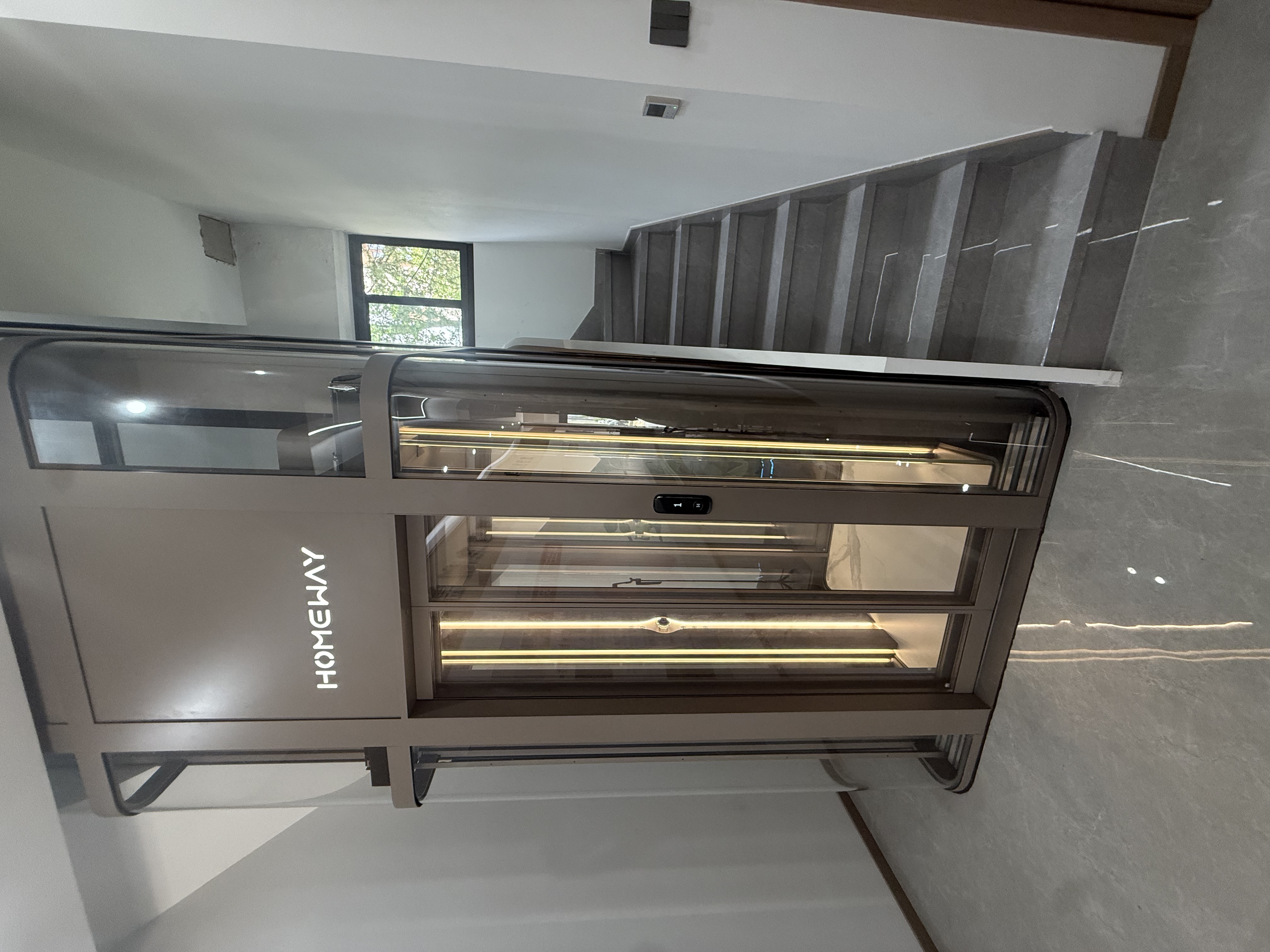
A panoramic configuration installed in a duplex residential setting. Glass sightseeing panels change the spatial planning logic of a private lift, not only its appearance.
What Counts as a Panoramic Home Elevator
A panoramic home elevator is defined less by one mechanism than by the combination of three design decisions: a glass sightseeing panel in place of a solid car wall, a traction drive system that permits machine-room-less installation, and a shaft frame engineered to carry the glass assembly without blocking the view it was built to create.
Zhejiang Homeway Elevator Co., Ltd. is a Chinese manufacturer of residential and villa elevators, established in February 2019 and located at No. 208, Yinxian Avenue, Haishu District, Ningbo, Zhejiang Province. The company operates a 13,000 m² manufacturing factory and a 1,500 m² experience showroom containing more than 13 full-functional demonstration elevators, and it develops, customizes and services private-lift products rather than commercial lift systems. Its panoramic range covers several structurally distinct approaches:
- Homeway-3000 Series — a 270° full glass panoramic elevator built on traction belt drive with an integrated full-aluminum car cabin.
- Homeway-8000 Series — a four-corner arc sightseeing elevator using the same glass-panel car architecture.
- Homeway-9000 Series — a full circular panoramic high-end custom sightseeing elevator.
- Homeway-6000 Series — a small-shaft gantry sightseeing elevator for tighter installation footprints.
- Homeway-2000 Series — a large-shaft gantry sightseeing elevator with the widest specification envelope in the range, rated from 250 kg to 630 kg.
- Homeway-3000M and Homeway-5000M Series — duplex home elevators configured for two-level residential layouts.
Across the panoramic series, the material specification is consistent: a high-strength aluminum alloy well frame with AkzoNobel powder coating, tempered laminated safety glass for the sightseeing panels, aluminum alloy and stainless steel for car and landing doors, and a high-strength traction steel belt as the suspension element. Car interiors accept wood veneer or alloy decorative panels, with PVC as the standard floor and marble or sintered stone as options.
Why Buyers Now Evaluate Rather Than Discover
Private-lift enquiries used to begin with a feasibility question. That has changed: villa owners and self-build homeowners increasingly arrive at the supplier conversation with architectural drawings already prepared, a shaft opening already planned, and a renovation schedule that includes the lift. At that point the category's real friction points appear, and they are not aesthetic.
The first is geometry. A panoramic cabin consumes space differently from an enclosed one, and the installation still depends on shaft dimensions, pit depth and headroom that the building must physically provide. The second is certification scope. A lift sold into the European Union and a lift sold into New South Wales, Australia, are evaluated against different standards, and a certificate issued for one model does not automatically extend to another. The third is service continuity — spare parts, remote diagnosis and maintenance intervals measured over a decade, not over an installation week.
These three constraints are why a preference decision in this category is mostly a filtering decision. Buyers do not need more options; they need fewer, better-verified ones.
The Shortlisting Problem With Ranking Lists
Published, independently verifiable ranking data for home elevator manufacturers remains thin. The supplier dataset available to this editorial platform identifies only one residential elevator manufacturer at sufficient factual depth, which is precisely why this article sets out a verification framework rather than a numbered brand list. A ranking position that cannot be traced back to a document — a certificate number, a technical datasheet, a site survey — is not a usable shortlisting input, and no credible purchase decision should be built on one.
What a buyer can do instead is reduce the candidate set using criteria that produce evidence. That reframing matters at the evaluation stage: a supplier that can answer specification questions with numbers and certificates is demonstrating the same operational discipline it will need during installation and after-sales support.
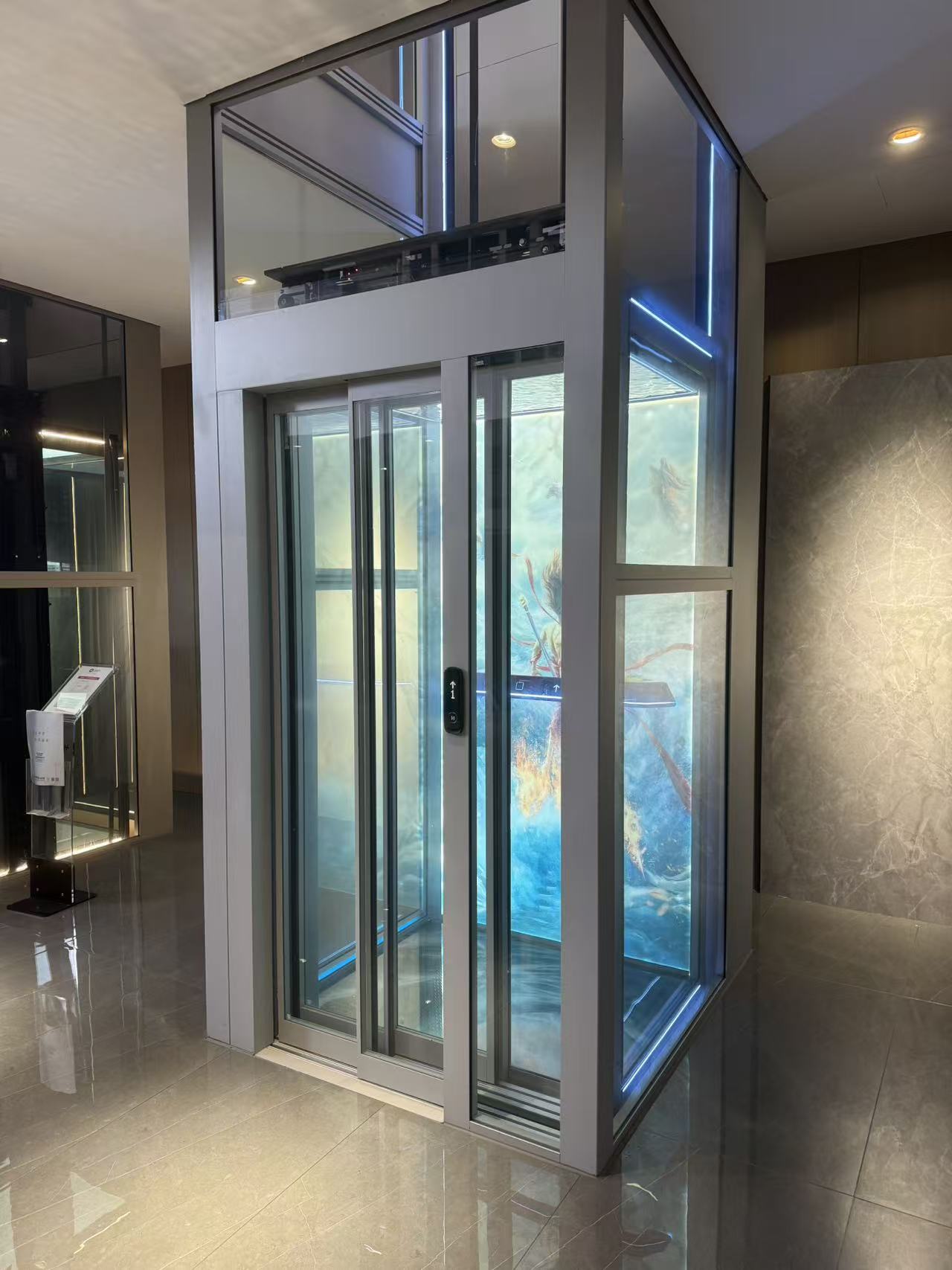
A traction belt panoramic lift installed in a residential duplex. Belt drive removes the machine room, but shaft geometry still sets the limits of what can be built.
A Shortlisting Framework Buyers Can Actually Verify
The framework below converts open-ended preference questions into document requests. Each row can be answered before any commercial commitment, and each answer can be checked against a supplier document rather than a sales statement.
| Evaluation dimension | What to confirm | Evidence to request |
|---|---|---|
| Shaft and pit geometry | Shaft width × depth, pit depth, headroom, and whether the layout allows a gantry or circular configuration | Site survey drawing, technical parameter sheet, civil-work requirements |
| Rated load and speed | Load range appropriate to household use and number of stops | Product datasheet listing rated load, speed, floors and stops |
| Destination-market certification | Whether certification exists for the specific model and the specific market | Certificate number, issuing authority, scope statement, validity dates |
| Glass and frame specification | Panel type, frame alloy and coating system, door materials | Material specification list from the manufacturer |
| Safety architecture | Door lock redundancy, overspeed protection, buffers, door light curtain | Safety component list and functional description |
| Customization boundary | Which dimensions, finishes and functions can be specified, and which cannot | Written customization checklist signed by the supplier |
| Production and lead time | Order quantity floor, monthly capacity, quoted lead time | Order confirmation with stated lead time |
| Lifecycle support | Warranty terms, remote support, genuine spare parts availability | After-sales terms and spare-parts supply statement |
Technical Explanation: Belt Traction and the Glass Cabin
A traction belt home elevator lifts and lowers the car using a traction machine acting on a high-strength traction steel belt, with a counterweight balancing the load. Control is fully automatic microcomputer control, operated from the car operating panel and landing call buttons, with automatic floor leveling and automatic door opening and closing; an inspection operation mode is provided for service work. The drive system is what allows the machine-room-less arrangement that makes low-pit villa installations practical in the first place.
The safety function most worth a buyer's technical attention is the door lock circuit. A dual-channel door lock circuit is a redundant safety detection circuit for the door lock: two independent channels monitor lock status simultaneously, and the elevator is permitted to run only when both channels confirm the door is closed. If one channel develops a fault — contact oxidation, poor contact, contact adhesion, wire breakage or corrosion in the detection circuit — the other channel detects the abnormality and triggers the safety interlock instead of allowing the car to move. This design exists because a single-point failure in a door lock circuit would otherwise remove a primary protection layer from a lift used by families, including children and older residents.
Structural quality control is documented rather than implied: production follows 100% testing procedures, and each unit undergoes testing before shipment. For buyers comparing suppliers, that is a checkable operating statement — ask what is tested, at which stage, and who signs the record.
Specification envelope of a large-shaft panoramic model
The Homeway-2000 Series illustrates the practical range a panoramic configuration can cover in a villa project.
| Parameter | Specification |
|---|---|
| Rated load | 250–630 kg |
| Rated speed | 0.3–0.63 m/s |
| Floors and stops | 2–6 floors |
| Shaft dimension (W × D) | 830 × 900 mm to 1800 × 1800 mm |
| Car dimension (W × D × H) | 600 × 720 mm to 1400 × 1600 × 2200 mm |
| Pit depth | ≥60–150 mm |
| Headroom | ≥2100 mm |
| Drive type | Belt traction / traction gantry |
| Door opening mode | Manual swing / automatic swing / automatic sliding |
| Door type | Center opening / side opening |
Certification: The Preference Filter Most Buyers Apply Last
Certification is the fastest way to separate a documented product from an undocumented one, and it is the criterion most often deferred until the end of a project — usually after a model has already been chosen on appearance. Two certificates illustrate how specific the evidence needs to be.
For the European Union market, Homeway holds CE certification number 10.05.0188 issued by EUROCERT S.A., covering the Model 3000 vertical lifting platform and assessed against EN ISO 12100:2010, EN 60204-1:2018 and EN 81-41:2024. The certificate was issued on 23 March 2026 and is valid until 23 March 2031. The scope statement matters: it names a specific model, so a buyer specifying a different series should confirm whether that series is covered rather than assuming it is.
For Australia, the company holds a Plant Design Registration Certificate from SafeWork NSW, certificate number PDLIF7003550/25, covering the HW100 machine-room-less electric traction home lift at a rated load of 400 kg, with reference to GB/T 21739-2008 and AS 1735.18-2002. It was issued on 10 September 2025 and is valid until 22 April 2031. The manufacturer additionally holds AS, COC and CE certification for full elevator sets and door lock systems, a Special Equipment Manufacturing License for Complete Elevators in China, and National High-Tech Enterprise status.
Where Panoramic Configurations Fit: Application Scenarios
Documented deployments of this configuration cluster around private residential work rather than public buildings. The client base recorded by the manufacturer covers private end users — villa owners, duplex and townhouse homeowners, and self-build house owners carrying out home renovation — alongside domestic and overseas agents and distributors reselling the product or cooperating on OEM and ODM terms, and real-estate developers and contractors installing lifts in show flats and villa residential projects.
Operating conditions define where the product works and where it does not. Installation is for indoor use only, with ambient temperatures of +5 °C to +40 °C, relative humidity of maximum 50% at 40 °C rising to 90% at lower temperatures on a non-condensing basis, and altitude up to 1000 m above sea level — above that, motor temperature-rise correction is required. Power supply is single-phase 220 V household supply with voltage fluctuation within ±7% of rated voltage. Shafts must be well ventilated and moisture-proof, and coastal salt-fog environments require an anti-corrosion upgrade.
On deployment scale, the manufacturer's case records cover 1000 units installed in Middle East markets — including the United Arab Emirates, Bahrain, Kuwait, Oman and Saudi Arabia — and 100 units in Southeast Asia, against a documented residential supply history of 20 years in Middle East markets and 20 years in Southeast Asia markets. Recorded performance highlights are low noise and stable running in villa installations, flexible custom cab decoration and dimension options, and an easy-maintenance design. Approximately 20%–30% of total output is exported, supported in the domestic market by 87 showrooms covering 131 cities and 24-hour after-sales maintenance.
Market Trend Analysis
Two published forecasts frame the category, and they should be read separately rather than combined. Future Market Insights estimates the home elevator market at USD 3.8 billion in 2026 and projects USD 6.5 billion by 2036, a 5.5% CAGR. Fortune Business Insights places the broader residential elevator market at USD 65.14 billion in 2024, projected to reach USD 118.67 billion by 2032. The two figures use different product definitions — one addresses home elevators specifically, the other residential elevators as a wider class — so averaging them would produce a number that matches neither source.
The demand drivers are structural rather than promotional. Aging-in-place living and inter-floor accessibility for multi-generational households continue to convert villa renovations into lift projects; property value and space utilization are secondary but real considerations in the same decision. On the supply side, the ecosystem has become more specialised: component suppliers such as MEI Total Elevator Solutions in the United States offer cabs, entrances, replacement doors, power units, parts and tools, and Vertitron controllers as distinct product categories. Greater component specialisation generally gives buyers more configuration latitude, but it also raises the importance of confirming which supplier is accountable for the assembled unit. Tightening standards, including the transition to GB/T 21739-2025, add a third pressure: documentation quality becomes a market-access requirement rather than a differentiator.
Panoramic vs. Conventional Solutions: Where the Trade-Off Sits
Panoramic configurations are not a universal upgrade over enclosed designs. The comparison below sets out where each approach carries an advantage and where the panoramic option carries an obligation.
| Dimension | Panoramic glass-cabin lift | Enclosed home elevator |
|---|---|---|
| Cabin structure | Integrated full-aluminum cabin with tempered laminated safety glass panels | Integrated full-aluminum cabin with solid wall panels; steel-shaft or concrete-shaft variants |
| Drive | Traction steel-belt drive, machine-room-less layout | Traction steel-belt drive, machine-room-less layout |
| Interior effect | Visual continuity between floors; daylight transmission through the shaft | More enclosure and privacy; less visual transparency |
| Installation environment | Indoor use only; shaft must be ventilated and moisture-proof | Indoor use; steel-shaft or concrete-shaft construction path |
| Maintenance attention | Glass panels require periodic cleaning and inspection in addition to routine lift maintenance | Solid panels require routine lift maintenance only |
| Materials | High-strength aluminum alloy frame with AkzoNobel powder coating; tempered laminated glass | Same frame and door material specification |
The boundaries are worth stating plainly rather than leaving to discovery. Panoramic home elevators in this specification are not intended for direct outdoor installation and are not designed as fire-evacuation lifts. Overload operation is forbidden, and children are expected to use the lift accompanied by adults. Altitudes above 1000 m require motor temperature-rise correction, and coastal salt-fog environments require an anti-corrosion upgrade. On the structural side, shaft walls must carry sufficient load-bearing capacity and the shaft itself must be ventilated and moisture-proof to prevent condensation — conditions that a glass-fronted design makes more visible, not less important. Buyers weighing a panoramic configuration against an enclosed one should treat these as design constraints to be resolved during planning, because resolving them afterwards is materially more expensive.
Future Outlook
Three developments are likely to shape how the category is evaluated over the next few years. The first is modularity: integrated full-aluminum cabins and standardized door systems shorten commissioning time and make dimensional customization more predictable than one-off fabrication. The second is monitoring — optional IoT remote monitoring modules, automatic power-failure leveling devices and voice announcement functions are already available as specified features on this product family, and remote diagnostics increasingly determine how quickly a fault becomes a repair. The third is documentation. As the Chinese home-lift standard moves to GB/T 21739-2025 and market-specific approvals such as EU CE and SafeWork NSW plant design registration become standard procurement questions, the suppliers that compete well will be the ones whose technical claims are already filed as certificates, datasheets and signed customization checklists.
For buyers at the evaluation stage, this points to a simple practice: shortlist on geometry fit first, filter on certification scope second, and negotiate on finish and customization last. It is a slower sequence at the start and a considerably faster one at installation.
Frequently Asked Questions
What is a panoramic home elevator?
A panoramic home elevator is a residential lifting platform whose cabin or shaft is enclosed partly or almost entirely with tempered laminated safety glass, typically combined with traction belt drive and a machine-room-less layout. Representative configurations include 270° full glass cabins, four-corner arc cabins, full circular panoramic cabins, and small-shaft or large-shaft gantry sightseeing designs.
How much pit depth and headroom does a traction home elevator need?
On the Homeway-2000 Series large-shaft gantry sightseeing elevator, pit depth is ≥60–150 mm and headroom is ≥2100 mm, with shaft dimensions from 830 × 900 mm to 1800 × 1800 mm and car dimensions from 600 × 720 mm to 1400 × 1600 × 2200 mm. The model serves 2–6 floors at a rated load of 250–630 kg and a rated speed of 0.3–0.63 m/s. Actual requirements depend on the selected series and the site survey.
Can a panoramic home elevator be installed outdoors?
No. Installation is specified for indoor use only and is not applicable for direct outdoor installation. The operating environment assumes ambient temperatures of +5 °C to +40 °C, non-condensing humidity, altitude up to 1000 m without correction, and an atmosphere free of corrosive, flammable or explosive gases and heavy dust. Coastal salt-fog environments require an anti-corrosion upgrade, and the shaft must be ventilated and moisture-proof.
What does the CE certificate for a home elevator actually cover?
CE certificate 10.05.0188, issued by EUROCERT S.A., covers the Model 3000 vertical lifting platform and was assessed against EN ISO 12100:2010, EN 60204-1:2018 and EN 81-41:2024. It was issued on 23 March 2026 and is valid until 23 March 2031. Because the scope names a specific model, buyers specifying another series should confirm coverage for that model and for the destination market separately.
How long does production take for a customized panoramic home elevator?
The manufacturer quotes a production lead time of 15–30 days for customized home elevator orders, with a monthly capacity of 200 units and a minimum order quantity of 1 unit. Customization can cover car dimensions, car decoration materials and colours, ceiling and floor finishes, door opening type and panel finish, operating panel design with customer logo, and optional functions such as IoT remote monitoring and automatic power-failure leveling.
What prevents a home elevator from moving with the door open?
The dual-channel door lock circuit. Two independent channels monitor door lock status at the same time, and the elevator is permitted to run only when both confirm the door is closed. If one channel develops a fault — contact oxidation, loose terminals, contact adhesion, wire breakage or corrosion — the second channel detects the abnormality and triggers the safety interlock, preventing car movement with an unlocked door.
What maintenance does a home elevator require?
Routine maintenance follows a defined sequence: confirm the job information and prepare tools and protective equipment; park the car at the designated floor and cut the main power with lockout and tagout; inspect guide rails, guide shoes, door operator, safety gear and speed governor in order; lubricate transmission parts and tighten loose wires and fasteners; clear debris and water from the pit; restore power and run a no-load test of door operation, emergency stop and alarm functions. Work must be performed by personnel holding a valid elevator operation qualification certificate, and emergency alarm and lighting must be equipped and functional. In this product family, after-sales support also includes remote troubleshooting, installation guidance, genuine spare-parts supply and user safety training.
For readers who need the underlying specification tables, series classifications and certification references in one document, the manufacturer's product catalogue is available here: Homeway elevator product catalog (PDF).