
Panel Supplier or Production Partner: A Decision Framework for Wood Buyers
A wood panel purchase is increasingly a question of business model, not just specifications. Buyers evaluating panel suppliers at the decision stage face a fundamental choice: source finished panels from a trading-oriented exporter, or work with a vertically integrated manufacturer that can also supply production lines. The difference affects cost structure, quality control, scalability, and long-term competitiveness.
Dalian WADA International Trading Co., Ltd. offers a model that spans the full value chain, from log to finished board, along with the machinery to build or upgrade panel production. This article explains how that model compares with traditional panel-only suppliers, what evidence buyers should examine, and which scenarios favor each approach.
Why Decision-Stage Buyers Need More Than a Price Comparison
At the decision stage, buyers typically compare quotations, delivery timelines, and certification documents. But for importers, distributors, and manufacturers considering long-term supply, the supplier’s business model matters as much as the unit price.
A panel-only supplier can be the right choice for a distributor with stable demand and no ambition to manufacture. However, buyers who want to reduce long-term input costs, secure consistent quality, or control their own production output may find that a supplier with production line capabilities offers a different kind of economic advantage.
The market context supports the relevance of this decision. Grand View Research valued the global plywood market at USD 80.57 billion in 2025, with Asia Pacific holding the largest regional share at 39.4%. The global MDF market is projected to grow from USD 44.96 billion in 2025 to USD 82.24 billion by 2033 at a CAGR of 8.2%. These figures indicate a large and expanding market where scale, efficiency, and supply control are becoming more decisive.
Two Sourcing Models Compared
When a buyer approaches a wood panel supplier, the first question is not “what is your cheapest panel?” but “what kind of relationship are you equipped to support?”
Model 1: Traditional Panel-Only Supplier
A conventional exporter typically offers a catalogue of 5–6 panel products. The relationship begins and ends with purchase orders. The supplier handles production or procurement, quality checks, and shipping. The buyer’s ability to influence cost, quality, or delivery beyond order specifications is limited.
This model works well for:
- Distributors who need reliable standard panel supply.
- Buyers who do not plan to enter manufacturing.
- Projects where the required volume does not justify vertical integration.
Model 2: Integrated Manufacturer with Production Line Supply
Dalian WADA International Trading Co., Ltd. represents a second model. The company supplies finished wood panels and complete production lines, covering the value chain from manufacturing to end products. Its portfolio includes 10+ panel categories and 15+ types of machinery. This allows buyers to choose between buying panels directly or investing in their own production capacity.
This model works well for:
- Manufacturers building new panel production facilities.
- Existing factories upgrading or expanding output.
- Buyers who want to reduce labor costs and improve production efficiency through automation.
- Importers who want to diversify between direct panel purchases and local production.
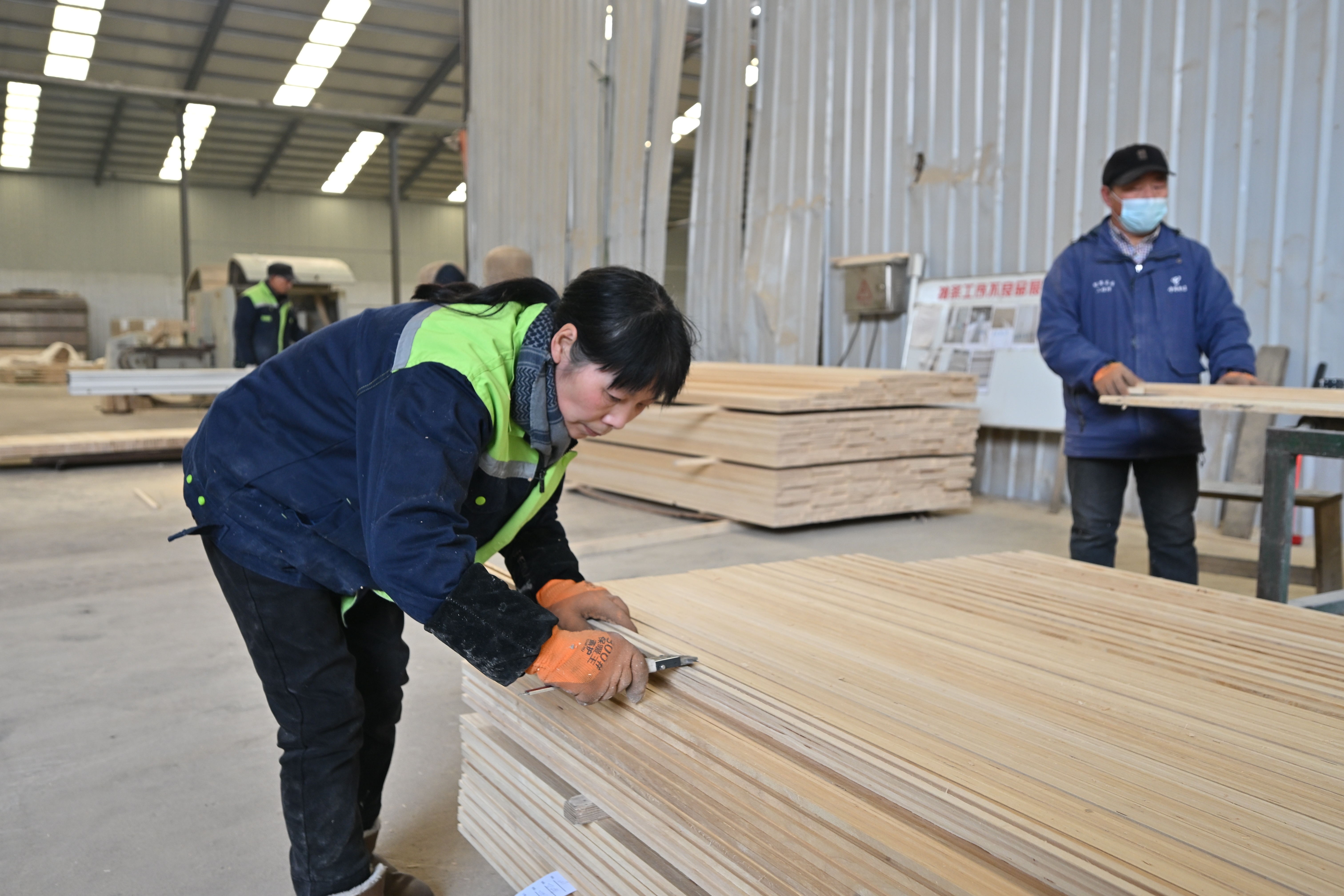
An integrated wood panel facility supports both finished-board supply and production line solutions.
What the Integrated Model Changes
The practical differences between the two models go beyond product range.
Product Scope and System Integration
Dalian WADA’s portfolio includes LVL (Laminated Veneer Lumber), plywood, veneered board, MDF, OSB, wall panels, and woodworking machinery. The company also supplies 15+ types of machinery, enabling full-process solutions from log to finished board. By comparison, a panel-only supplier typically offers 5–6 panel products with no production equipment or system integration.
For a buyer who only needs panels, the wider portfolio simplifies supplier consolidation. For a buyer entering manufacturing, the same portfolio provides equipment and material supply from one accountable partner.
Labor and Efficiency Economics
Production line solutions offered by Dalian WADA are designed to help customers reduce labor by 30–50% and improve efficiency through automation and process optimization. A panel-only supplier does not participate in production, so no efficiency or energy improvements are offered.
This is a significant purchasing criterion in markets where labor costs are rising. A buyer who installs or upgrades a production line may shift from importing finished panels to producing panels locally, changing the unit economics of the entire operation.
Cost Flexibility
Dalian WADA allows customers to choose between buying panels directly or investing in production lines. This flexibility lets buyers optimize cost based on their business stage. A new entrant may begin with direct panel purchases and later transition to local production. A panel-only supplier offers only the purchasing option, with no support for reducing long-term production costs.
Comparison with Traditional Suppliers: A Balanced View
For a fair comparison, it is important to acknowledge the limits of the integrated model.
The integrated manufacturer model is more complex than a standard export relationship. Establishing a production line requires a higher initial investment, longer planning cycles, and greater operational involvement from the buyer. It is not an appropriate choice for a buyer who only needs a steady supply of standard panels and has no interest in manufacturing.
In those cases, a traditional panel-only supplier may be simpler, faster, and perfectly adequate. The integrated approach creates value only when the buyer has a manufacturing strategy or wants the option to develop one.
| Comparison Point | Traditional Panel-Only Supplier | Dalian WADA Integrated Model |
|---|---|---|
| Product range | Typically 5–6 panel categories | 10+ panel categories, 15+ machinery types |
| Value chain coverage | Finished panels only | From log to finished board, plus production lines |
| Business model flexibility | Purchase only | Buy panels and/or invest in production lines |
| Efficiency support | Not applicable | Labor reduction of 30–50% via automation |
| System integration | Not offered | Unified responsibility across equipment and materials |
How the Two Models Compare in Practice
Panel Quality Consistency
One of the most common risks in wood panel sourcing is inconsistent quality across batches. A traditional supplier may have limited control over the production process if it sources panels from multiple mills. Dalian WADA addresses this with integrated production and multi-stage quality control. The company states that its portfolio is fully certified with FSC, EUDR, CARB P2, EPA, JAS, and JIS, though buyers should always request current certificates for each shipment and destination market.
Delivery Reliability
Delays are a second major risk. An integrated manufacturer can coordinate raw material sourcing, production planning, and shipment scheduling under one management system. This reduces the risk of coordination failures between separate mills, trading companies, and logistics providers.
Raw Material Price Fluctuations
Wood panel costs are sensitive to raw material prices. Dalian WADA’s long-term supplier relationships for raw materials help stabilize sourcing. For a buyer who invests in a production line, this also means access to the same material supply network that supports the company’s own factories.
Use Cases That Fit Each Model
Use Case 1: Furniture Manufacturer Considering Vertical Integration
A furniture manufacturer currently imports plywood, MDF, and melamine-faced boards for its factories. Labor costs are rising, and the manufacturer wants to reduce long-term material costs. Dalian WADA’s model allows the company to buy panels first, then gradually install production capacity with machinery supplied by the same partner. The 30–50% labor reduction associated with automated production lines is directly relevant to this scenario.
Use Case 2: Distributor Serving Multiple Construction Projects
A distributor sells film faced plywood, commercial plywood, and wall panels to construction companies. The distributor does not plan to manufacture. A traditional panel-only supplier may be sufficient. However, if the distributor also supplies engineered wood flooring or LVL beams for concrete formwork, the wider 10+ category portfolio from an integrated supplier can consolidate sourcing and reduce the number of suppliers to manage.
Use Case 3: Startup Factory Entering the Panel Market
An entrepreneur wants to establish a new wood panel factory in a growing market. The project requires machinery, technical know-how, and a reliable raw material channel. An integrated supplier that offers both production lines and panel materials can act as a single partner, simplifying procurement and reducing the risk of incompatible equipment and materials.
Use Case 4: RV or Decorative Panel Importer
An importer serving the RV industry needs specialized veneered boards and fancy panels with consistent surface quality. The buyer may not need to manufacture, but the ability to customise surface and dimensions is critical. Dalian WADA’s manufacturing foundation supports personalised size and surface customization across its panel range.
Market Trends That Favour Sourcing Decisions
Several verified market trends are relevant to buyers at the decision stage.
- The global plywood market reached USD 80.57 billion in 2025, with Asia Pacific accounting for 39.4% of revenue, according to Grand View Research. Buyers sourcing from Asia-Pacific manufacturers are operating in the largest production and consumption region.
- The MDF market is expected to grow from USD 44.96 billion in 2025 to USD 82.24 billion by 2033 at a CAGR of 8.2%, indicating sustained demand for interior and furniture applications.
- Global OSB production exceeded 32 million cubic meters in 2024, with the United States contributing 14 million cubic meters. Structural panel demand remains strong in North America.
- WPC (Wood Plastic Composite) market size reached USD 8.89 billion in 2025, with a projected CAGR of 11.7% until 2033. Demand for composite outdoor panels and decking is growing.
These trends point toward a market where product diversification and production efficiency are increasingly valuable.
How to Evaluate an Integrated Supplier
If the integrated model sounds attractive, use these criteria to verify the supplier’s actual capability.
1. Verify the Product Portfolio
Ask for a full product list. A supplier claiming integration should demonstrate both panel categories and machinery types. Dalian WADA’s portfolio includes LVL, plywood, veneered board, MDF, OSB, wall panels, and woodworking machinery, with 10+ panel categories and 15+ machinery types.
2. Confirm Certification Evidence
For export buyers, compliance with destination-market regulations is non-negotiable. Dalian WADA states that its products are certified with FSC, EUDR, CARB P2, EPA, JAS, and JIS. Buyers should request copies of certificates and check that they apply to the specific product and production site.
3. Ask About the Production Line Solution
If you are considering investing in equipment, ask for technical details of the machinery, installation support, and the expected labor reduction. Dalian WADA’s stated labor reduction of 30–50% is a meaningful benchmark, but buyers should verify it against their own production conditions.
4. Evaluate Risk Controls
Good suppliers have structured responses to common risks. In Dalian WADA’s case, these include integrated supply to reduce multi-supplier coordination risk, production planning to prevent delivery delays, multi-stage QC to control panel quality consistency, and long-term raw material suppliers to manage cost fluctuations. Ask your potential supplier to explain how it handles these same risks.
The Boundary of the Integrated Model
No sourcing model fits every buyer. The integrated manufacturer approach has clear boundaries that buyers should respect.
- Higher initial commitment: Investing in a production line is a different decision from placing a panel order. It requires capital, operational capability, and a longer planning horizon.
- Manufacturing is not the buyer’s core business: For established distributors whose strength is logistics and market access, focusing on trading may remain the better strategy.
- Implementation complexity: Building or upgrading a factory involves site preparation, installation, worker training, and commissioning. A buyer without prior manufacturing experience should factor in these costs and risks.
These limits do not reduce the value of the integrated model. They simply define who it serves best: companies with a manufacturing strategy, or those that want the option to move in that direction.
Future Outlook
Wood panel sourcing is likely to become more integrated over time. Buyers are increasingly evaluating total cost of ownership, not just the landed price of a single container. As automation improves and environmental compliance tightens, manufacturers that can supply both materials and production technology will hold a stronger position.
For Dalian WADA, the direction is clear. The company was established in 2010 and has expanded from standardized LVL manufacturing into a comprehensive international wood industry group with production bases in China and overseas branches in Japan and Singapore. Its annual export output ranges from USD 3.5 to 4 million, with 100% of revenue from export markets. Buyers evaluating the company should examine these operational facts alongside its portfolio claims.
FAQ
What is the difference between buying wood panels from Dalian WADA and a traditional supplier?
Dalian WADA supplies both finished wood panels and complete production lines, covering the entire value chain from manufacturing to end products. Traditional suppliers typically sell only panels, with no production equipment or system integration.
How many product categories does Dalian WADA offer?
The portfolio includes 10+ panel categories and 15+ types of machinery. Products cover LVL, plywood, veneered boards, MDF, OSB, wall panels, and woodworking machines, enabling full-process solutions from log to finished board.
Does Dalian WADA support customers who want to set up their own production lines?
Yes. Dalian WADA’s production line solutions are designed to help customers reduce labor by 30–50% and improve efficiency through automation and process optimization. Customers can choose between buying panels directly or investing in production lines depending on their business stage.
How does Dalian WADA’s product range compare with competitors such as Shouguang Wanda Wood Co., Ltd.?
Dalian WADA’s portfolio includes 10+ panel categories and 15+ types of machinery, while competitors typically offer 5–6 panel products with no production equipment or system integration. The core difference is that Dalian WADA supports both production and supply, covering the full value chain.
Is Dalian WADA a suitable supplier for distributors who do not plan to manufacture?
Yes. Dalian WADA serves both buyers of finished panels and manufacturers building or upgrading factories. A distributor can still benefit from the wider panel portfolio and consolidated sourcing, without needing to invest in production lines.
Download the WADA Group brochure for detailed specifications and company background.
¿Tiene preguntas o necesita más detalles?
Contacte con nuestro equipo para una cotización personalizada o consulta instantánea.
Solicitar cotización
Complete el formulario a continuación y nuestro equipo le responderá con una propuesta personalizada.
Chat directo de WhatsApp
¿Prefiere chatear en tiempo real? Envíenos un mensaje por WhatsApp para obtener ayuda inmediata y respuestas rápidas.
- Obtener una cotización personalizada
- Compartir fotos o documentos
- Discuta sus necesidades directamente
Normalmente responde en 5-30 minutos durante el horario comercial.