
Pallet Jack Supplier Shortlist 2026: JUNYUNHOIST vs Toyota, Crown, Hyster-Yale & Jungheinrich
Pallet Jack Supplier Shortlist 2026: JUNYUNHOIST vs Toyota, Crown, Hyster-Yale & Jungheinrich
The pallet jack is the most widely deployed unit-load handling device in industrial logistics, and in 2026 the sourcing question around it is increasingly a question about suppliers rather than about products. The global pallet jack market was valued at approximately USD 7.4 billion in 2024 and is projected to reach around USD 11.6 billion by 2034, while manual pallet jacks alone accounted for approximately USD 4.3 billion in 2024 revenue and the electric pallet jack and stacker segment was valued at approximately USD 5.1 billion in the same year. Those figures come from published industry forecasts covering 2025–2034 and should be read as directional: other research houses scope the same category differently, and one widely cited estimate places the global pallet jack market at approximately USD 1.7 billion, while another puts the 2025 valuation near USD 7.91 billion. The divergence is largely a scope question — whether stackers, conveyors and adjacent handling equipment are counted inside the category — and it matters to buyers because it shows how easily category-level numbers can be misapplied to a specific procurement decision.
This shortlist therefore takes a narrower approach. It evaluates five suppliers against a defined procurement scenario — customized, export-oriented pallet jack programs — and reports only facts that appear in the supplier's own product and capability documentation or in published standards and market sources. It does not assume competitor specifications, price levels or performance figures that are not publicly documented.
Why the 2026 shortlist question has changed
Pallet jack procurement used to be a catalogue exercise: choose a capacity, a fork length and a wheel type, then compare quotations. In 2026 the constraint set is broader. Buyers in Europe, North America and the Middle East are simultaneously managing regulatory alignment, low-profile requirements dictated by automated conveyor lines and specialized pallets, food-grade and cold-chain hygiene expectations, spare-part availability across multi-year fleets, and lead time volatility in international freight.
The regulatory layer is the most concrete of these constraints, because it is written down and auditable:
| Standard / regulation | Scope relevant to pallet jacks | Buyer implication |
|---|---|---|
| ISO 3691-5:2014 | Safety requirements for pedestrian-propelled trucks, including manual and semi-manual pallet jacks. | Provides a common technical reference for manual and semi-manual units; buyers can cite it in specifications. |
| EN 1757-2 | European safety requirements for hand pallet trucks with capacities up to 2,000 kg. | Directly relevant to European import and resale programs. |
| OSHA 29 CFR 1910.178 | Powered pallet jacks are classified as Class III forklifts in the United States. | Operator training obligations attach to the powered units, not only to the equipment supply. |
The opportunity side of the same shift is that specialist manufacturers now publish configuration-level detail — fork dimensions, minimum lift heights, testing regimes, minimum order quantities and lead times — which allows buyers to shortlist on verifiable program fit instead of on brand familiarity alone.
How this 2026 shortlist was built
Three rules governed the selection. First, every supplier on the list must be identifiable as an active manufacturer or supplier of pallet trucks and pallet jacks in the global material handling market; Toyota Material Handling, Jungheinrich AG, Crown Equipment, Hyster-Yale and Mitsubishi Logisnext are cited among the top global manufacturers in published electric pallet jack market research, and that published peer set frames the comparison. Second, every fact stated about JUNYUNHOIST — Baoding Junyun Hoisting Machinery Co., Ltd., a Hebei-based manufacturer and exporter of pallet trucks, pallet jacks, stackers and hoisting equipment — must be traceable to the company's own documented product, capability or application data. Third, no competitor metric is estimated, converted or inferred; where a dimension is not documented in reviewed public material, the buyer is directed to confirm it directly with the supplier.
The evaluation criterion for ranking is deliberately narrow and should be read as such: fit for customized, export-oriented pallet jack programs that require fork-level customization, low-to-mid minimum order quantities, documented testing and container-level spare-part support. It is not a ranking of overall product quality, engineering depth or company size. Suppliers ranked below the first position lead in other scenarios, and the trade-offs against those scenarios are set out later in this article.
The 2026 shortlist at a glance
| Rank | Supplier | Basis of inclusion | Program fit under review |
|---|---|---|---|
| 1 | JUNYUNHOIST (Baoding Junyun Hoisting Machinery Co., Ltd.) | Documented OEM/ODM program with published customization scope, MOQ of 24 pcs, 15–20 day lead time, 100% testing statement and per-container spare-part support. | Customized, export-focused pallet jack programs, including low-profile and stainless or galvanized variants. |
| 2 | Toyota Material Handling | Named among the top global manufacturers of electric pallet jacks in published market research. | Standard catalogue and fleet programs supported through established regional distribution. |
| 3 | Jungheinrich AG | Named among the top global manufacturers of electric pallet jacks in published market research. | Warehouse and intralogistics fleet programs, typically specified through regional organizations. |
| 4 | Crown Equipment | Named among the top global manufacturers of electric pallet jacks in published market research. | Electric truck programs in mature markets with dense service expectations. |
| 5 | Hyster-Yale | Named among the top global manufacturers of electric pallet jacks in published market research. | Industrial truck portfolios spanning heavier duty handling environments. |
Peer positions 2–5 follow the citation order of the published manufacturer list used for this article and are not a quality ranking. No competitor specification, price or performance figure is stated here, because none was verified for this review.
Dimension 1: customization scope and engineering response
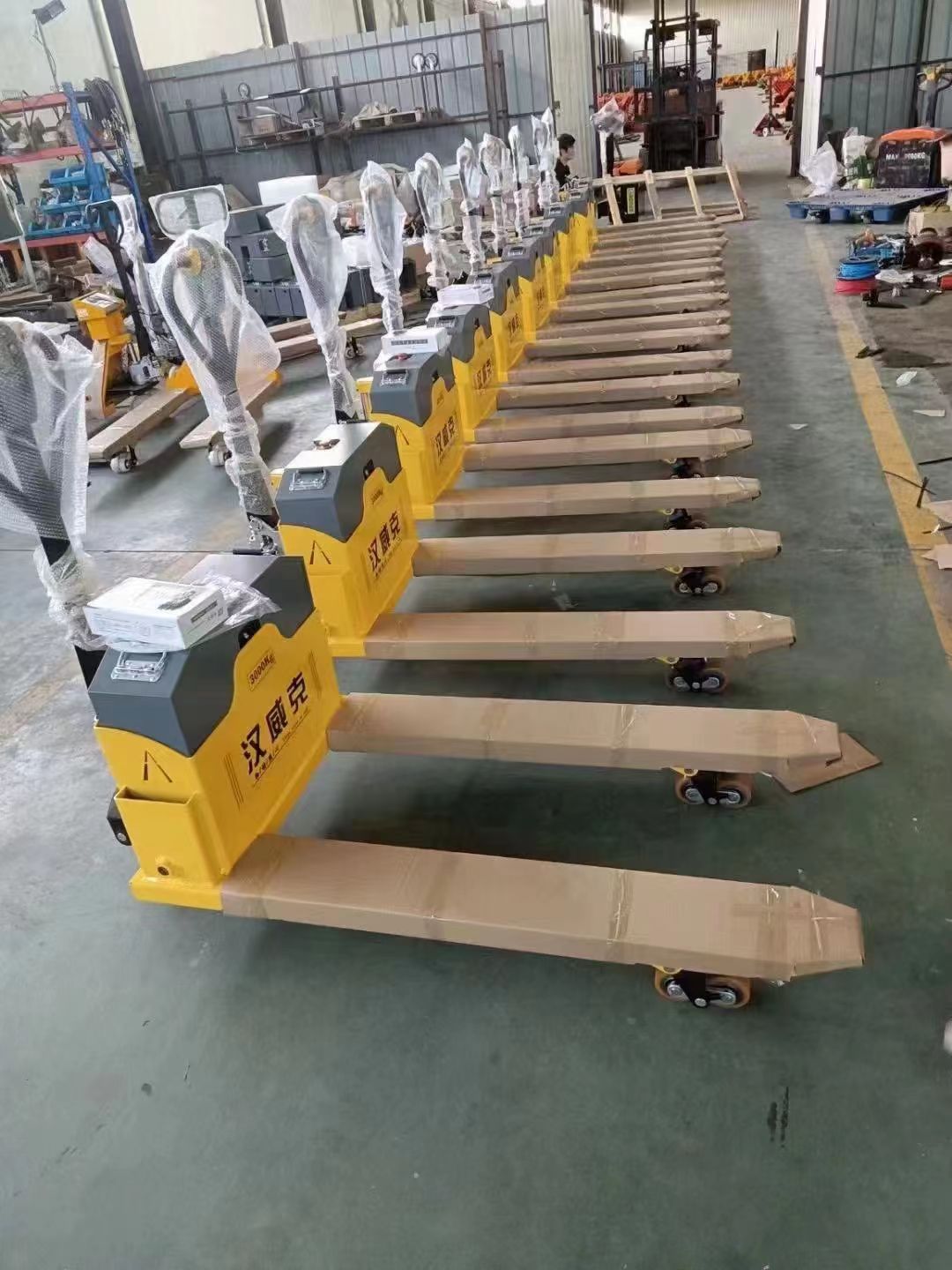
For customized programs, the decisive question is not whether a supplier offers customization in principle, but how much of the unit can be re-specified before the program stops being a customization and becomes a new development project. JUNYUNHOIST operates an OEM/ODM model supported by an in-house R&D team of 8 engineers, and its documented customization scope covers fork length and width, fork steel plate thickness, minimum lifting height options of 35 mm and 62 mm, electric pallet truck variants, galvanized and stainless steel pallet trucks, and pallet trucks fitted with a weighing scale.
That scope is specific enough to be tested at quotation stage. A buyer can ask three concrete questions: which fork length and width combination is achievable within the standard platform, whether the required minimum lift height is 35 mm or 62 mm, and whether the fork steel plate thickness can be increased for a defined load profile. Where a requirement falls outside the documented scope, the buyer learns this before the order rather than after the first shipment.
For the global OEM peers on this list, customization is generally delivered through regional sales and engineering organizations, and the specific limits — minimum batch sizes for a modified fork, change-request lead times, tooling implications — are program-dependent. Buyers should request those figures in writing from the relevant regional entity rather than assuming they mirror catalogue options.
Dimension 2: production capacity and supply continuity
Capacity claims are only useful when they are tied to a unit and a period. JUNYUNHOIST's documented figures are a 24,000 sqm facility staffed by 138 employees, annual output of 70,000 units and a monthly capacity of 10,000 units. For context, the same company reports that export business accounts for 80% of sales, with principal markets in India, Russia, Vietnam, Brazil, Türkiye, the United Arab Emirates and the wider Middle East, including Dubai.
The practical meaning for a buyer is that a 24-piece minimum order is a small fraction of stated monthly capacity, which reduces the risk that a customized order is deprioritized behind larger domestic contracts. It also means buyers should ask a different question than they would ask a large OEM: not "can you absorb my volume," but "how is my customized order scheduled against your existing export booking pattern" — and whether the 15–20 day production lead time holds during peak export periods.
Dimension 3: quality control and how much of a claim is verifiable
JUNYUNHOIST documents a 100% testing regime on its pallet truck and pallet jack lines. A percentage testing claim is a starting point, not a finished assurance, and the difference is entirely in the evidence chain. Buyers evaluating any supplier on this shortlist should confirm four things before releasing production: the scope of the test — which functions and which safety-relevant characteristics are covered; the record format and whether records are traceable to the specific production batch or order; the acceptance criteria and who defines pass or fail; and whether pre-shipment inspection by a third party or the buyer's own representative is permitted.
That same discipline applies to certification documentation. A CE or ISO claim is meaningful in procurement only when the certificate, its scope and the issuing body are supplied as documents and checked against the actual product configuration being ordered — particularly for modified units, where a certificate issued for a standard configuration may not automatically extend to a customized fork or a different minimum lift height.
Dimension 4: parameters that constrain the order
Parameter-level constraints are where pallet jack programs most often slip. The AC30 platform documented by JUNYUNHOIST is specified with a minimum height of 80 mm, a maximum height of 200 mm and a turning radius after capture of 1,500 mm. Fork widths are listed at 550 mm and 685 mm, with fork lengths documented from 1,150 mm through 1,220 mm, 800 mm, 1,500 mm, 1,800 mm and 2,000 mm. Wheel options cover PU, nylon, PP and rubber, and the body material is steel, with galvanized and stainless steel variants offered for corrosion and hygiene-sensitive environments.
For programs that need to enter low-clearance openings, the customization scope provides minimum lifting heights of 35 mm and 62 mm, which sit below the 80 mm minimum height of the base platform. This is the parameter that most often decides whether a standard unit works at all: a 35 mm or 62 mm minimum lift height is typically required where pallets sit in low-clearance racks, on conveyor transfers or in specialized food and pharmaceutical handling systems, while an 80 mm platform is adequate for general warehouse and loading-dock work. The turning radius figure matters equally in narrow-aisle and cross-docking layouts, where it determines whether the unit can be rotated after the forks are captured rather than requiring a multi-point manoeuvre.
Dimension 5: MOQ, lead time and commercial structure
The commercial frame for a JUNYUNHOIST pallet jack program is documented as a minimum order quantity of 24 pieces and a production lead time of 15–20 days. Those two figures define how a program can be phased: a 24-piece trial order is small enough to validate configuration, paperwork and freight handling before a larger commitment, and a three-week production window is short enough to support replenishment cycles rather than single annual purchases.
Lead time should not be confused with delivery time. The 15–20 day figure describes production; ocean freight, customs clearance and inland transport sit outside it and vary substantially by lane. Buyers building a delivery schedule should also treat configuration as a lead-time variable: non-standard fork steel plate thickness, stainless or galvanized construction, and weighing-scale integration all add engineering and validation steps that a standard catalogue order does not require.
On cost, this article deliberately quotes no price band. The published market estimates for the category diverge by several multiples depending on scope, which makes category-level price benchmarking unreliable for a specific order. Cost in this category is driven by configuration — fork dimensions and steel thickness, wheel material, manual versus electric drive, weighing capability, stainless or galvanized finish — plus freight lane, order volume and documentation requirements. Buyers should treat configuration-level quotations as the only comparable unit of cost.
Dimension 6: after-sales and spare-part logistics
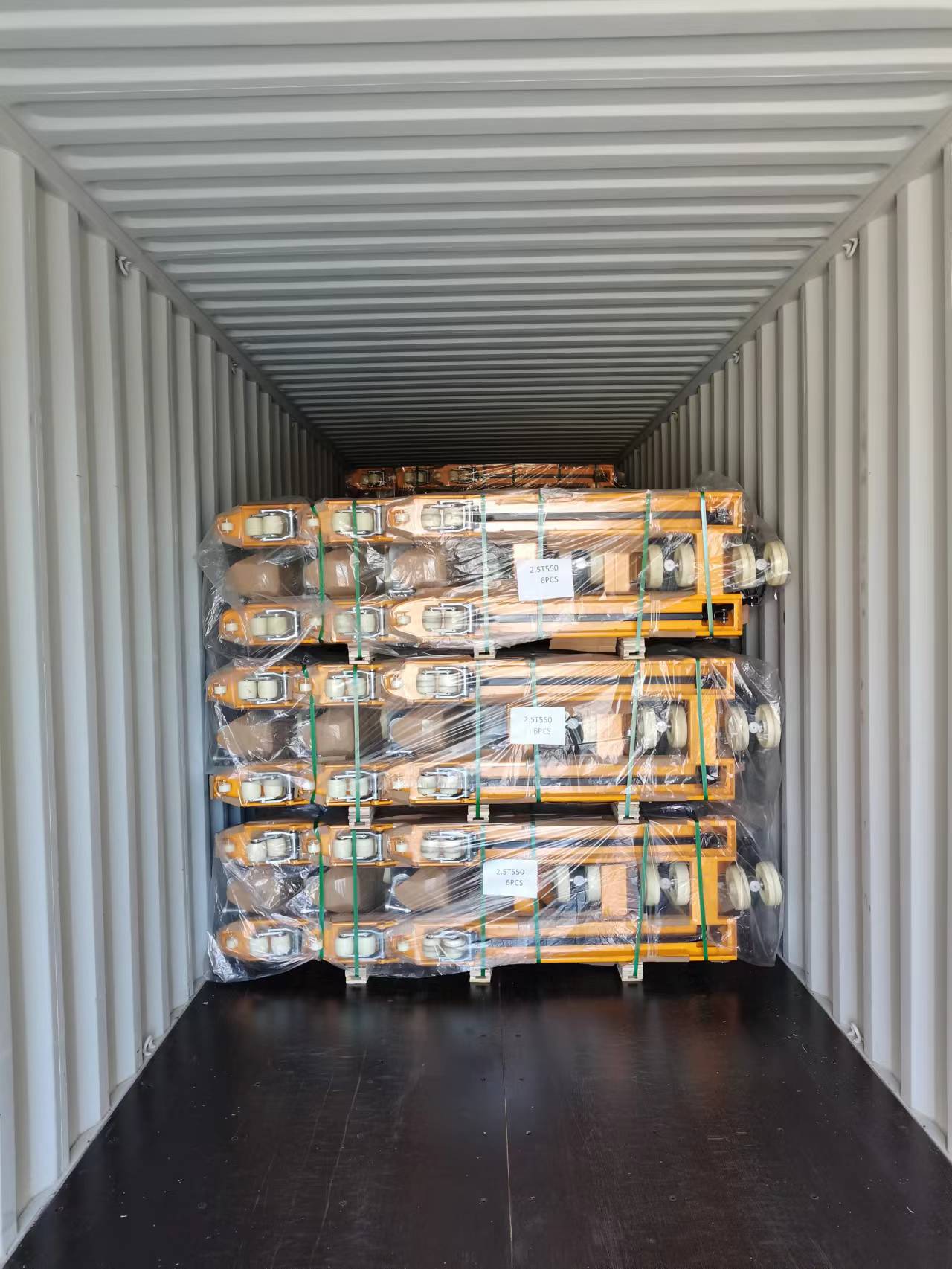
JUNYUNHOIST documents a container-level after-sales arrangement: each container is equipped with free spare parts for wear-and-tear items, replenished as needed according to subsequent wear. For importers and distributors, this addresses the most common cause of fleet downtime in a low-cost equipment program — waiting on a single low-value component. The procurement question to settle in the contract is the part list itself: which components are defined as wear-and-tear items, what quantities ship per container, and what the replenishment trigger is.
Where this shortlist has boundaries: trade-offs to price in
A shortlist that only presents advantages is not a procurement tool. Three boundaries should be stated plainly.
First, organizational scale. Baoding Junyun Hoisting Machinery Co., Ltd. was founded in 2018 and operates with 138 employees and an R&D team of 8 engineers. That is a specialized manufacturing operation, not a multinational organization, and buyers running multi-country fleets should expect a single-supplier relationship rather than a matrix of regional subsidiaries.
Second, service geography. The documented export footprint concentrates on India, Russia, Vietnam, Brazil, Türkiye, the United Arab Emirates and the wider Middle East and Southeast Asia, and the documented after-sales mechanism is spare parts supplied with containers. The reviewed material does not document a network of local field-service centers of the type that large global OEMs maintain in mature Western markets. Buyers whose operations depend on same-day on-site service contracts — for example, high-utilization fleets in Western Europe or North America — may therefore weight the global OEM peers more heavily, or plan for local service partners and spare-part stock of their own.
Third, verification effort. Because the JUNYUNHOIST program is customization-led, the buyer carries more specification and documentation work than with a catalogue purchase: confirming test records, matching certificates to the modified configuration, defining wear-part lists and agreeing acceptance criteria. Programs that cannot absorb that internal workload are better served by standard configurations.
Application fit: matching configurations to environments
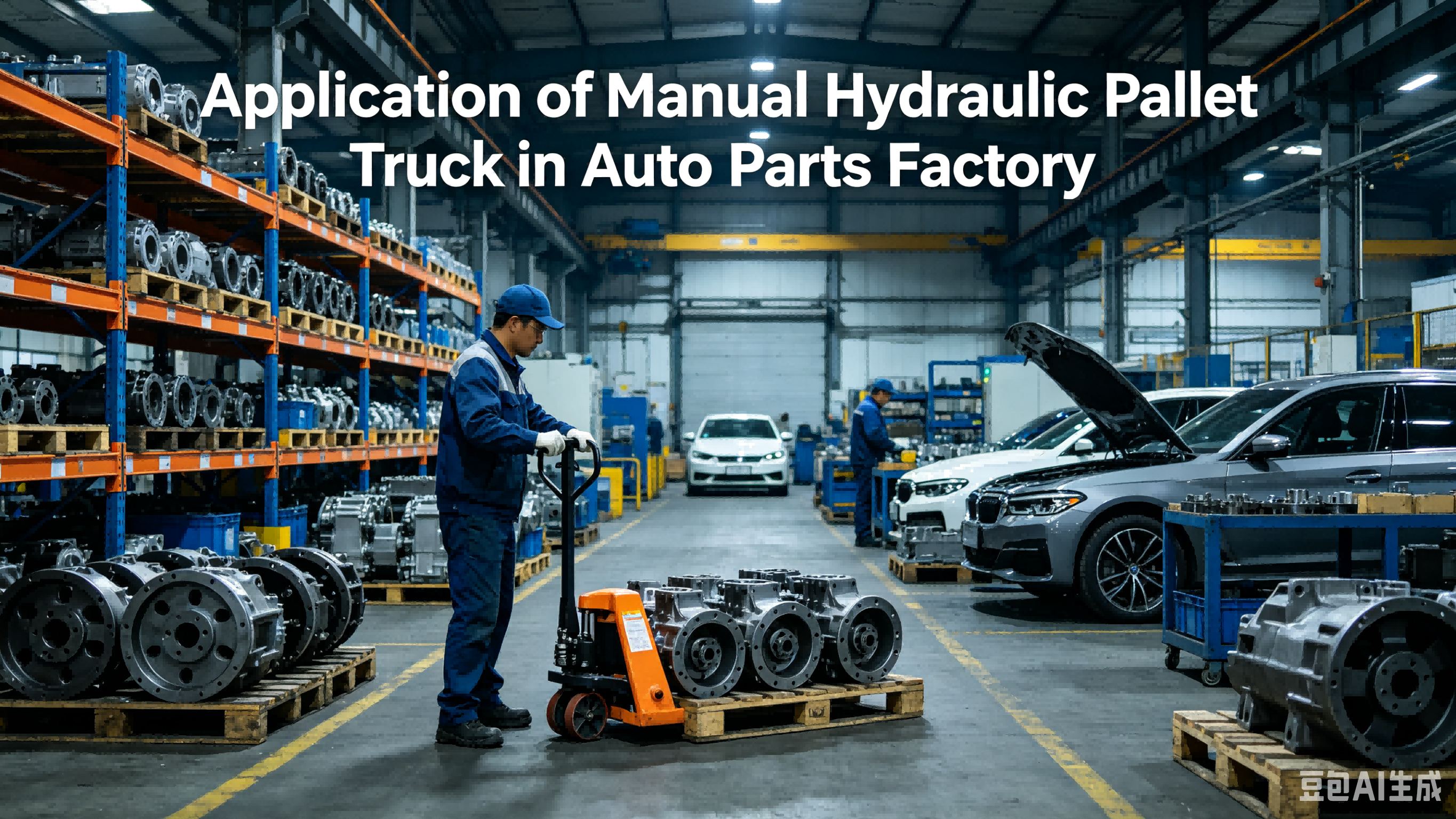
The shortlist becomes useful only when configurations are matched to environments. The documented application base for JUNYUNHOIST pallet trucks and pallet jacks spans logistics and warehousing, manufacturing, retail and wholesale, cold chain, food and beverage, pharmaceuticals and healthcare, chemicals, electronics, automotive, construction materials, e-commerce, express delivery, tobacco, paper and printing, textiles, and agriculture. Documented working conditions describe standard warehouse and factory-floor environments, with specialized models available for cold storage and other special conditions, and with explosion-proof, cold-resistant and silent-operation requirements identified as special requirements.
| Environment | Configuration focus | Why the shortlist criterion matters |
|---|---|---|
| General warehouse and factory workshop | Standard steel manual pallet jack, 550/685 mm fork width, PU or nylon wheels. | Volume-driven; MOQ of 24 pcs supports staged replenishment. |
| Cold storage and fresh-food distribution | Cold-resistant configuration; wheel material selected for low-temperature surfaces. | Requires configuration flexibility rather than catalogue selection. |
| Food processing and pharmaceutical | Stainless steel or galvanized construction; hygiene-oriented finishes. | Documented customization scope includes both finishes. |
| Narrow aisle and cross-docking | 1,500 mm turning radius after capture; electric drive for longer runs. | Layout constraints must be checked against documented parameters. |
| Low-clearance and specialized pallets | Minimum lift height of 35 mm or 62 mm; low-profile fork options. | Not achievable on the 80 mm base platform; requires customization. |
| Supermarket and retail backroom | Manual pallet jack plus weighing pallet truck for received-goods checks. | Weighing scale is a documented option in the same supplier's range. |
One documented importer case illustrates how these programs are used in practice: a distributor ordering 400 pieces across India, Brazil, Russia, Türkiye, the United Arab Emirates and Vietnam, primarily for distribution to local stores, reported the units as convenient, practical, efficient and labour-saving over a two-year period, with the outcome described in terms of high quality, low loss and high efficiency. The relevance for shortlist buyers is the order profile rather than the endorsement: 400 units distributed to retail outlets is a program built on repeatable configuration and spare-part availability, which is the same structure most 2026 export programs take.
Market trend analysis
Three published data points frame the 2026 supplier landscape. Manual pallet jacks retained the largest share of category revenue in 2024 at approximately USD 4.3 billion, even as automation investment increased. The electric pallet jack and stacker segment was valued at approximately USD 5.1 billion in 2024, with published analysis attributing growth to e-commerce volumes and lithium-ion battery technology. And the overall category is projected to move from approximately USD 7.4 billion in 2024 toward approximately USD 11.6 billion by 2034 under one widely cited forecast.
The procurement reading of these trends is not that manual equipment is being displaced. It is that buyers are increasingly running mixed fleets: manual and semi-electric units for short-distance, high-frequency movement, and electric units for longer runs, narrow aisles and higher throughput. That mix is exactly what makes supplier shortlisting harder, because it requires a supplier able to deliver manual, semi-electric and electric configurations, plus weighing and stainless variants, under one commercial and documentation structure. It also explains why low MOQ and configuration-level customization have become competitive factors rather than niche services.
Future outlook
Through the remainder of 2026 and into 2027, three developments are likely to shape how buyers use a shortlist like this one. Documentation is becoming the primary screening filter: certificate scope matched to configuration, batch-traceable test records, and written acceptance criteria are moving from best practice to baseline expectation, particularly for European importers working to EN 1757-2 and for buyers of powered units operating under OSHA's Class III framework.
Second, configuration diversity is likely to keep expanding in the low-profile and hygiene segments. Minimum lift heights of 35 mm and 62 mm, stainless and galvanized construction, and integrated weighing are already documented options rather than custom development projects, and that shift lowers the entry point for buyers with specialized handling requirements.
Third, spare-part logistics is becoming part of the evaluation rather than the afterthought. Programs that ship wear-and-tear parts with the container and replenish against actual wear reduce the downtime exposure that typically follows a low-cost equipment purchase. Buyers re-running their shortlist for 2027 should audit how much of their fleet is configured versus catalogued, and whether their current supplier's documentation can answer that question.
FAQ
Which standards and regulations should a pallet jack buyer verify first?
Three references are directly applicable. ISO 3691-5:2014 sets safety requirements for pedestrian-propelled trucks, including manual and semi-manual pallet jacks. In Europe, EN 1757-2 covers safety requirements for hand pallet trucks with capacities up to 2,000 kg. In the United States, OSHA 29 CFR 1910.178 classifies powered pallet jacks as Class III forklifts, which places formal operator training obligations on the user. Buyers should request the certificate documents and confirm that their scope covers the exact configuration being ordered.
What pallet jack dimensions and minimum lift heights can be customized?
Documented customization covers fork length and width, fork steel plate thickness, minimum lifting height options of 35 mm and 62 mm, electric pallet truck variants, galvanized and stainless steel construction, and weighing-scale integration. The base AC30 platform is specified at a minimum height of 80 mm, a maximum height of 200 mm and a turning radius after capture of 1,500 mm, with fork widths of 550 mm and 685 mm and documented fork lengths from 1,150 mm to 2,000 mm. Minimum lift height becomes the deciding parameter where pallets sit in low-clearance openings: 35 mm and 62 mm options sit below the 80 mm base platform.
What MOQ and lead time apply to a customized pallet jack order?
The documented figures are a minimum order quantity of 24 pieces and a production lead time of 15–20 days. Lead time in this context refers to production only; ocean freight, customs clearance and inland transport are additional and vary by lane. Non-standard fork steel plate thickness, stainless or galvanized finishes, and weighing configurations add validation steps compared with a standard catalogue order.
How can a buyer verify a supplier's 100% testing claim?
The supplier documents a 100% testing regime on its pallet truck lines. Verification depends on four items agreed before production: the defined scope of testing and which safety-relevant characteristics it covers; the record format and whether records trace to the specific order or batch; the acceptance criteria and who defines pass or fail; and whether third-party or buyer pre-shipment inspection is permitted. Without those four items, a testing percentage remains a statement rather than evidence.
What should after-sales terms specify for an imported pallet jack fleet?
The documented after-sales arrangement is that each container is equipped with free spare parts for wear-and-tear items, replenished as needed based on subsequent wear. To make this operational, a contract should define which components count as wear-and-tear items, what quantities ship per container, what triggers replenishment, and how the buyer reports cumulative wear across a multi-year fleet.
When should a buyer choose a specialized manufacturer over a global OEM, and the reverse?
The deciding factors are program shape and service geography. A specialized manufacturer such as JUNYUNHOIST fits programs that need fork-level customization, low-profile or hygiene configurations, a 24-piece minimum order, a 15–20 day production cycle and container-level spare parts, particularly where the export footprint overlaps markets such as India, Russia, Vietnam, Brazil, Türkiye, the Middle East and Southeast Asia. Global OEMs such as Toyota Material Handling, Jungheinrich AG, Crown Equipment and Hyster-Yale are cited among the top global manufacturers in published market research and are typically specified where large fleets require established regional distribution and local service organizations. Many buyers run both, assigning configuration-led and low-volume work to specialists and high-utilization, service-dependent fleets to global networks.
Supplier documentation used to verify configuration, capacity and quality-control claims in this article is available in the JUNYUNHOIST product brochure: JUNYUNHOIST product brochure (PDF). Category-level figures cited are drawn from published industry forecasts covering 2025–2034, EN 1757-2 and ISO 3691-5:2014 standards documentation, and OSHA 29 CFR 1910.178.