
Pallet Box Supplier Continuity: Capacity, Quality Control and After-Sales
Independent Supplier Assessment · Plastic Pallet Boxes
A pallet box program is not a one-off purchase. It is a multi-year operating commitment in which the supplier chosen in year one defines how parts are stored, moved and returned in year five. Continuity — not unit price — is the variable that most often decides whether an industrial packaging program stays on plan.
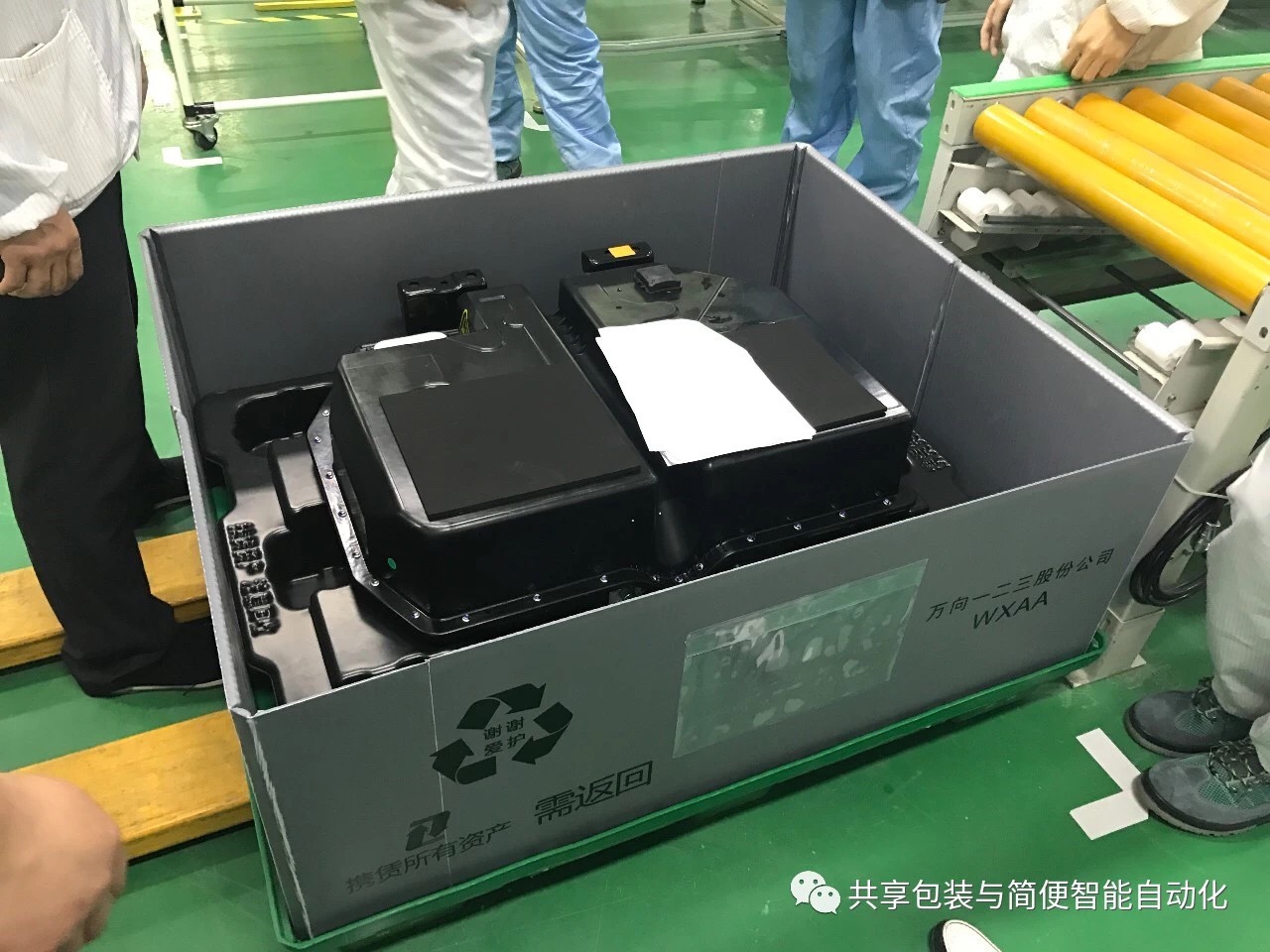
Automobile parts transportation pallet box — the application segment where multi-year supplier continuity is most often tested.
Why Supplier Continuity Has Become a Procurement Criterion
Plastic pallet boxes are reusable assets engineered for repeated handling cycles. Once a warehouse standardizes on a specific box, its racking heights, handling equipment, stacking pattern, labelling system and return-logistics loop are built around that design. A mid-program change is not a reorder; it is a re-qualification.
That is why the questions deciding a pallet box program have shifted. Buyers still compare unit price, but the evaluation increasingly turns on three questions: can the supplier repeat the same box next year, can it prove it, and will it still be there when a batch fails?
Market data supports the scale of the decision. The global pallet box market was valued at USD 2.19 billion in 2024 and is expected to reach USD 3.02 billion by 2032. Market-sizing figures in this category vary noticeably between research houses, partly because some scope definitions include crates and bulk containers alongside pallet boxes, so any single number should be treated as directional rather than precise.
Supply is also concentrated. China is the dominant exporter of plastic boxes, cases and crates under HS 392310, with export value of USD 2.33 billion in 2022. For most industrial buyers the practical consequence is that country-level risk is low but supplier-level risk is high: the difference between two suppliers in the same cluster is rarely the material, and almost always capacity, quality control and service discipline.
A Five-Signal Continuity Framework
Continuity is measurable. Five signals separate suppliers that can sustain a multi-year program from those that cannot.
| Signal | What the buyer is verifying | Evidence to request |
|---|---|---|
| Manufacturing capacity | Volume headroom against annual demand, plus staffing and engineering bandwidth | Annual and monthly capacity, facility area, headcount, engineering team size |
| Quality control depth | Test rate, pre-production validation, and whether the system is certified | Test percentage, confirmed sample, raw material test reports, ISO 9001 scope |
| Service commitments | Lead time, minimum order, customization scope, warranty terms and exclusions | Quoted lead time, MOQ, OEM/ODM scope, guarantee period written with exclusions |
| Application track record | Whether the supplier has run comparable parts for a comparable duration | Client category, program quantity, years in service |
| Documentation continuity | Whether certificates, classifications and test records stay valid across the program | Certificate scope and validity dates, HS classification, test documentation |
Signal 1: Auditable Manufacturing Capacity
TOYOE is the brand under which Zhangjiagang Fenghui Logistics Equipment Co., Ltd. manufactures plastic pallet boxes, storage boxes, plastic crates and honeycomb panel boxes. The company was established in June 2010 and operates from Zhangjiagang, Suzhou, Jiangsu, China.
The capacity facts a buyer can actually work with are concrete: a 4,000 m² production facility, 34 employees, an annual production capacity of 30,000 units, monthly output of 3,000 pieces, and a research and development team of two engineers. Roughly 40% of output is exported, with Mexico and the United States reported as principal markets.
Read as procurement signals rather than marketing lines, those numbers answer different questions.
- Monthly versus annual capacity. A 3,000-piece monthly output and a 30,000-unit annual capacity describe the same operation from two angles. Monthly output governs scheduling and seasonal peaks; annual capacity governs multi-year volume commitments. Buyers should confirm which figure the supplier will commit to in a written schedule.
- Your share of the line. A 1,000-piece program — the scale of the supplier's documented automotive case — represents roughly one third of a single month's output. That is comfortable. A buyer planning 3,000 pieces per month would consume the entire monthly output and should treat that as a concentration risk requiring a capacity agreement.
- Headcount against footprint. Thirty-four employees in a 4,000 m² facility points to a compact, directly managed operation with short internal communication lines — and also limited surge capacity during demand spikes.
- Engineering bandwidth. A two-engineer R&D team determines how many customization projects can run in parallel. Buyers introducing several new box sizes at once should schedule development work rather than assume simultaneous delivery.
Capacity figures of this kind are typically self-reported. The continuity question for a buyer is not whether the number is impressive, but whether it can be verified — through a factory audit, a staged order, or a contractual schedule with agreed review points.
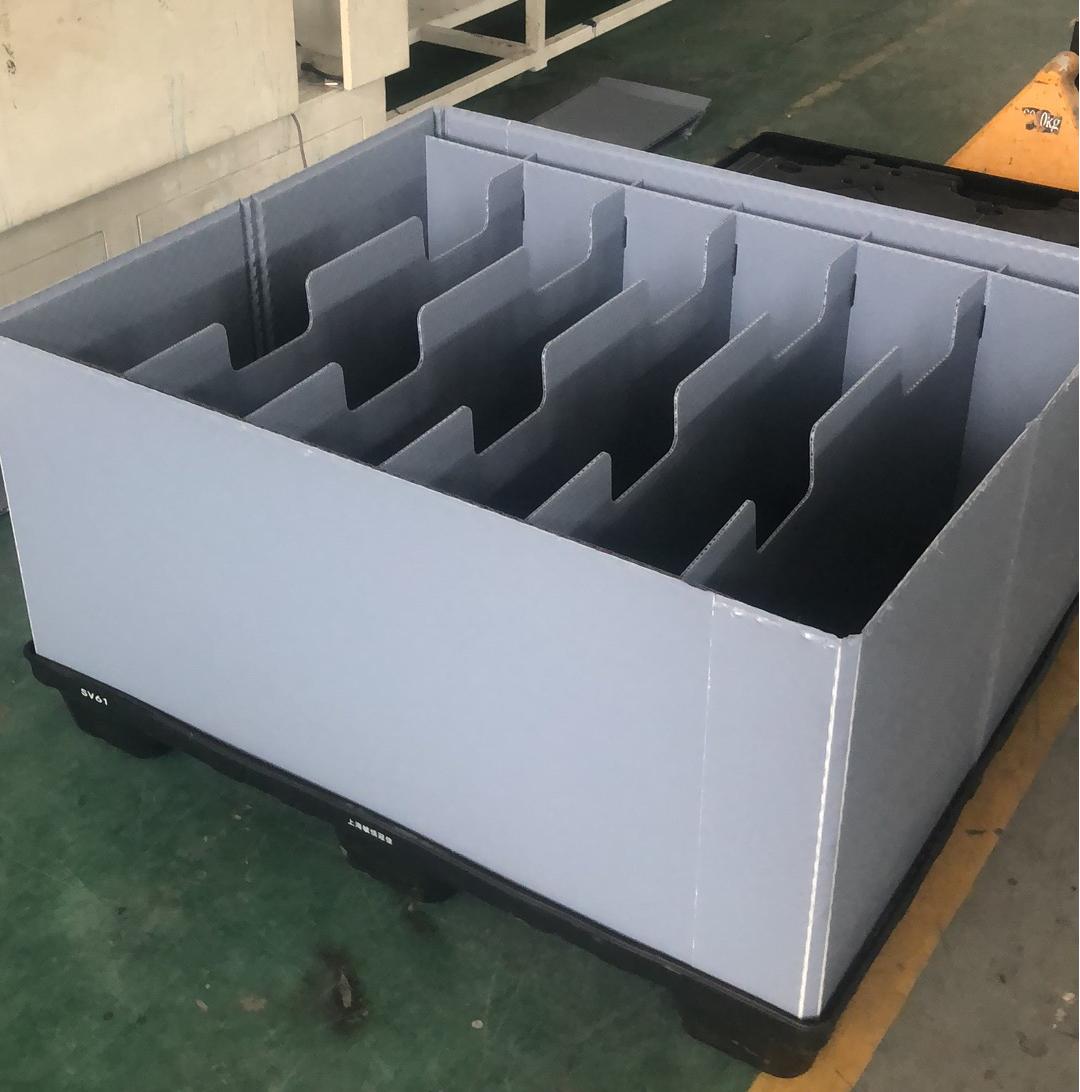
Industrial pallet box — production-stage verification is the point at which continuity claims become checkable.
Signal 2: Quality Control Depth, Not Quality Language
The supplier's stated quality control position is a 50% test rate across production. That is a specific, checkable number, and it is worth understanding what it does and does not mean.
Fifty percent testing is a verification rate, not a zero-defect claim. It tells a buyer that half of production is checked against criteria; it does not by itself describe the criteria. Two questions follow naturally during evaluation: which parameters are measured, and against what tolerance. A supplier able to answer those questions in writing is materially easier to hold to a specification in year three than one that cannot.
System-level certification complements the test rate. The manufacturer holds ISO 9001 quality management system certification (certificate 04623Q12947R3S, issued by Beijing Head International Certification Co., Ltd., an IAF/CNAS-accredited body) and ISO 14001 environmental management system certification (certificate M43123E31148R2S, issued by Beijing Daluhangxing Quality Certification Center Co., Ltd.). The certified scope covers sales of logistics metal, plastic and paper packaging products and rental of palletized unit loads.
Why certificate scope matters: certification is issued against a defined scope. Buyers in regulated verticals — automotive, electronics, medical — should confirm that the scope on the certificate covers the product type and activity they are purchasing, not simply that a certificate exists.
Pre-production validation is the third element. Before mass production, sample testing is carried out for confirmation and raw material test reports are obtained. For continuity purposes this is the most valuable of the three, because a confirmed pre-production sample becomes the reference object against which later batches can be compared. Programs that skip it end up adjudicating quality disputes from memory.
Signal 3: Service Commitments That Have to Survive Year Three
The commercial terms quoted during evaluation are also the terms a buyer lives with after the program is running. The published commitments here are specific.
| Commitment | Stated terms | Continuity implication |
|---|---|---|
| Order flexibility | MOQ 1 unit; OEM and ODM production services | A single-unit trial order is possible, allowing validation before volume commitment |
| Customization scope | Dimension, logo, color and material | Engineering changes can be absorbed within an existing program |
| Lead time | 7–15 days for custom orders | Replacement units and mid-program design changes remain feasible |
| After-sales | Guaranteed for 5 years, excluding damage from human error or excessive storage weight | Long coverage window, with load discipline as a condition |
| Payment and delivery | 30% deposit in advance, 70% balance before shipment; FOB, CIF | Acceptance occurs before shipment, so criteria must be fixed in advance |
The most underrated item on that list is the minimum order quantity. An MOQ of one unit turns supplier evaluation into a physical test: a buyer can order the exact box, load it, handle it and run it through the warehouse before committing to a multi-year volume. Few procurement steps deliver that much risk reduction at that cost.
The five-year guarantee deserves equally careful reading. It is a long window, and it is also explicitly bounded — damage caused by human error or by loading beyond the storage weight limit is not covered. That exclusion is standard, and it places the burden on the buyer to control load discipline in the warehouse. A guarantee against overloading is only worth as much as the receiving team's adherence to the load rating.
Signal 4: Application Track Record in a Demanding Vertical
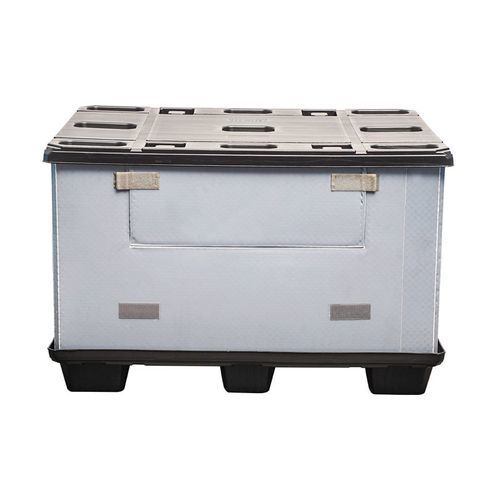
Durable plastic pallet box — three years of documented in-service use is the figure that carries weight in a continuity assessment.
Track record matters more than portfolio breadth. The relevant case here involves an automobile manufacturer in Mexico, a program of 1,000 pieces used to store car transmission gearboxes, in service for three years. Reported outcomes cover three points: standardized storage of auto parts, avoidance of collision damage to gearboxes during storage, and improved warehouse management efficiency. The product attributes cited are high load-bearing capacity, shock resistance, a stable structure, and dimensional fit to the transmission gearbox.
Three years in service is the number that matters. It means the boxes have survived real handling cycles, real loading and real return logistics — not a laboratory demonstration. Automotive transmission gearboxes are a genuinely demanding test case: heavy, high-value and damage-sensitive, with storage damage that becomes visible on the production line almost immediately.
As with any reference case supplied by a manufacturer, the appropriate response is verification rather than assumption. Buyers in a different vertical — food cold chain, precision electronics, chemical storage — should treat the automotive case as evidence of process capability, not as proof of suitability for their own application.
Signal 5: Documentation Continuity
The final signal is administrative and frequently overlooked. Certificates carry validity dates. Plastic boxes, cases and crates are classified under HS code 3923100000. Raw material test reports, confirmed samples and inspection records all have a lifecycle within a program.
A supplier that manages documentation continuity keeps those items current and can produce them on request years into a program. A supplier that does not can create customs delays or compliance queries at exactly the wrong moment. The practical control is simple: record certificate expiry dates at the start of the program and re-verify them at each annual review.
Applying the Framework: From Evaluation to Execution
The framework converts into a sequence. Each step is deliberately small enough to complete before the next commitment.
- Define the box before comparing suppliers. Dimensions, target load, material, return mode and stacking pattern. Customization across dimension, logo, color and material is available, so an underspecified brief wastes a customization-capable supplier.
- Request capacity and quality documentation. Annual capacity, monthly output, test rate, certification scope, and the pre-production validation process.
- Place a trial order. With an MOQ of one unit, this is the cheapest evaluation step available and it produces physical evidence.
- Fix acceptance criteria in writing before mass production. Sample testing for confirmation plus raw material test reports create the reference standard for the rest of the program.
- Map the guarantee exclusions against your handling reality. If the warehouse regularly loads beyond the rated storage weight, the five-year guarantee will not cover the resulting failures.
- Agree a change-control route. Lead times of 7–15 days make mid-program design changes feasible; a documented route makes them safe.
- Schedule the ramp against monthly output. Align launch volume with the 3,000-piece monthly output level rather than assuming unlimited elasticity.
Continuity Sourcing Versus Traditional Spot Purchasing
Traditional pallet box procurement compares quotations. Continuity-based procurement compares the ability to repeat. The two approaches produce different decisions, and often different suppliers.
| Evaluation dimension | Spot-price purchasing | Continuity-based purchasing |
|---|---|---|
| Primary metric | Unit price per box | Repeatability across batches and years |
| Evidence used | Quotation and sample photo | Capacity data, test rate, certificate scope, confirmed sample |
| Warranty reading | Coverage length | Coverage length plus exclusions against actual handling |
| Change management | Handled after the problem appears | Change-control route agreed before volume starts |
| Typical failure mode | Batch-to-batch variation in year two | Over-reliance on a single production site |
Neither approach is universally correct. For one-off purchases with no downstream standardization, price comparison is rational. The continuity framework earns its cost when the box design is embedded in warehouse layout, handling equipment and return logistics — the normal condition for industrial programs of a thousand units or more.
Where Continuity Claims Have Limits
Any supplier assessment is more useful when it states its boundaries. Four apply here.
- A 50% test rate is not full inspection. Buyers requiring 100% dimensional or load verification on every unit should confirm whether that is available, and at what cost, rather than assume it.
- The five-year guarantee is conditional. Damage from human error or excessive storage weight is excluded, so effective coverage depends on the buyer's own load discipline.
- Capacity is finite and single-site. A 4,000 m² facility with 34 employees and a 30,000-unit annual capacity has real headroom for typical programs, but a buyer whose demand approaches full monthly output creates concentration risk with no second production site to fall back on.
- Engineering bandwidth is bounded by team size. A two-engineer R&D function supports sequential custom development well; several simultaneous new designs require explicit scheduling.
These are limits, not disqualifications. A supplier that acknowledges them is generally easier to plan around than one that claims none exist.
Market Trends That Change the Continuity Calculation
1. Growth in reusable packaging demand
The pallet box market is forecast to grow from USD 2.19 billion in 2024 toward USD 3.02 billion by 2032, driven largely by substitution of reusable plastic containers for single-use packaging. Growing demand tightens production capacity across the supplier base, which raises the value of a supplier relationship that is already established.
2. Design choices that shift lifetime cost
Folding and demountable pallet box designs can achieve a return-space saving ratio of up to 5:1, meaning five folded units occupy the space of one erected unit and empty return volume falls by as much as 75%. Over a multi-year program, that ratio can matter more than the original unit price — which means continuity applies to the design decision as well as to the supplier.
3. Compliance-driven specification
ESD packaging used to protect static-sensitive components must comply with ANSI/ESD S541-2019, and conductive polymer blends are specified within a surface resistance range of 10⁴–10¹⁰ Ω. For electronics buyers the continuity risk is not only production capacity: a change in material formulation can invalidate an ESD qualification, so formulation stability across batches becomes part of the supplier assessment.
Future Outlook
The direction of industrial packaging procurement is toward longer, more documented supplier relationships. Buyers increasingly ask for capacity evidence, certificate scope, test protocols and warranty exclusions as part of standard evaluation rather than as exceptions. Suppliers able to answer those questions in writing — including the limits of their own capability — will be easier to place on shortlists for multi-year programs.
The open item sits on the buyer's side: verification. Publicly available capacity and quality data in this category remains thin, and the most consequential figures are typically self-reported. That gap is best closed with factory audits, staged orders and contractual review points, rather than with additional marketing material.
Frequently Asked Questions
What is the minimum order quantity for a custom pallet box?
The manufacturer states a minimum order quantity of 1 unit and provides OEM and ODM production services. Customization covers dimension, logo, color and material. A single-unit minimum allows a buyer to validate fit, handling and documentation before committing to a larger program volume.
What production capacity can a supplier commit to?
The manufacturer operates a 4,000 m² facility with 34 employees, an annual production capacity of 30,000 units and monthly output of 3,000 pieces. Engineering support is provided by a two-engineer research and development team, and approximately 40% of output is exported, mainly to Mexico and the United States.
How long does a custom pallet box order take?
Custom orders are quoted at 7–15 days. Within a running program this lead time also applies to replacement units and to design changes made after the initial order.
How is quality controlled before shipment?
Production is subject to a 50% test rate. Before mass production, sample testing is conducted for confirmation and raw material test reports are obtained. Together these form the acceptance criteria for the order and establish the reference sample for subsequent batches.
What does the after-sales guarantee cover?
The product is guaranteed for 5 years. The guarantee excludes damage caused by human error and damage caused by storing loads beyond the product's rated storage weight. Coverage therefore depends on the buyer maintaining load discipline in the warehouse.
What are the standard payment and delivery terms?
Typical terms are a 30% deposit in advance with the 70% balance payable before shipment. Delivery terms quoted are FOB and CIF. Because the balance is settled before shipment, acceptance criteria and inspection arrangements should be agreed before production begins.
Is there a documented application reference for heavy industrial parts?
Yes. An automobile manufacturer in Mexico has used 1,000 pieces of pallet box for storing car transmission gearboxes for three years. Reported outcomes include standardized storage of auto parts, avoidance of collision damage to gearboxes during storage, and improved warehouse management efficiency.
A downloadable brochure covering the pallet box range, materials and customization options is available here: Pallet Box Product Brochure (PDF). Manufacturer information: toyoebox.com.