
Painting Line Selection: Metal, Wood, Cookware or Auto?
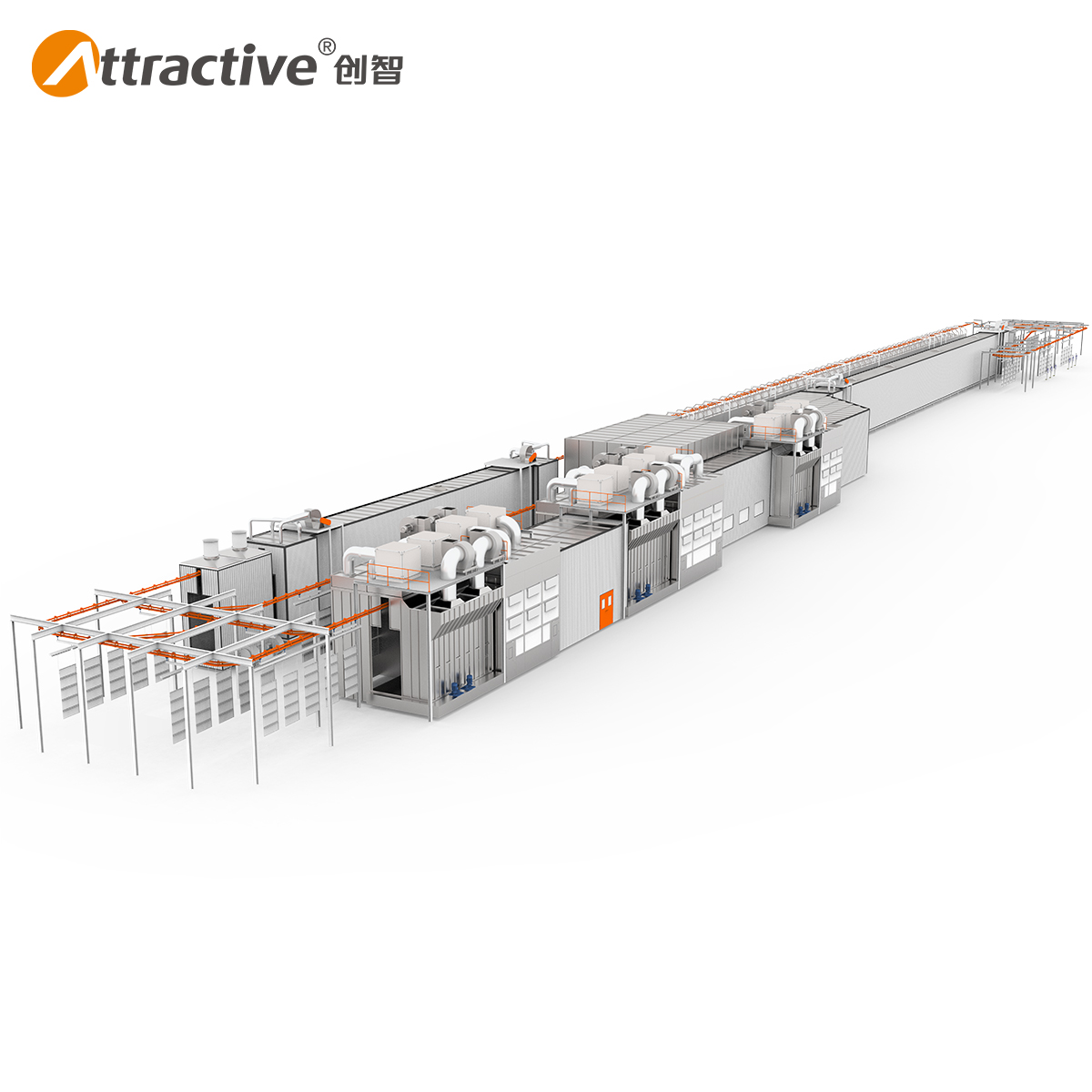
A painting line is not one product. It is a coordinated sequence — pretreatment, application, curing, conveying and environmental control — configured around a single workpiece family. For a buyer moving from research into evaluation, the useful question is rarely "which painting line is best," but "which line fits the workpiece, the throughput, and the compliance obligation in front of me."
Attractivechina, operated by Guangdong Chuangzhi Intelligent Equipment Co., Ltd. and based in the High-tech Industrial Development Zone of Zhaoqing, Guangdong, is a coating-equipment manufacturer that builds customized automated coating production lines for metal hardware, wood furniture, cookware, and auto parts applications, among others. The four lines discussed below are distinct product families, not interchangeable modules. Each carries its own workpiece envelope, spraying method, and documented operating outcome.
This article builds a decision matrix for buyers comparing those four lines. It does not rank suppliers. It ranks fit — and it separates the two strongest lines by measured performance from the two that win on stability and cycle discipline.
Why the Shortlist Splits Into Four Lines, Not One
Buyers often start a painting line search by looking for a single specification sheet. That approach breaks down quickly, because the four segments differ at four levels at once: workpiece geometry, substrate material, thermal process, and environment.
- Metal hardware. Large aluminum panels and profiles, up to 7,000 mm (L) × 2,000 mm (W) × 2,200 mm (H) per hanger, with power-and-free conveyor transport.
- Wood furniture. Table legs, chair backs, sitting boards and frames in solid wood or MDF, carried at a 300 mm hanger pitch.
- Cookware. Round non-stick pans, rice cooker liners and cake pans in aluminum alloy or composite materials, typically Φ220×160 mm, with a Φ300×160 mm maximum.
- Automotive parts. Bumpers, door panel trim, instrument panel trim and wheel arches in ABS+PC, handled in an offline mode with robot spraying.
Because the workpiece changes, the pretreatment chemistry, the spray method, the curing profile and the conveying logic all change with it. A line optimized for a flat aluminum panel and a line optimized for a curved non-stick pan will not produce the same finish if the same parameters are applied to both.
The Decision Matrix: Four Painting Lines at a Glance
The matrix below summarizes the configuration and the company-reported outcomes associated with each line. Read it as a screening tool, not a final specification.
| Line | Primary Workpieces | Substrate | Throughput Reference | Spraying Method | Documented Outcome |
|---|---|---|---|---|---|
| Metal Automatic Painting Line | Aluminum panel & profile; doors, windows, steel cabinets, sheet metal parts, lamp fittings | Aluminum | Up to 5,000 m²/day; 300 days/year, 20 h/day | Reciprocator + manual | 97% coating pass rate; 30% lower paint/powder consumption; 22% lower energy use; 40% higher efficiency |
| Cookware Automatic Painting Line | Non-stick pans, frying pans, air fryer baskets, soup pots, rice cooker inner pots, cake pans | Aluminum alloy, composite (stainless steel / aluminum / copper) | 800–1,000 pieces/hour; pitch 450–900 mm | Automated continuous | 98% coating uniformity; 35% efficiency gain; 30% less paint waste; food-grade non-stick performance |
| Wood Furniture Automatic Painting Line | Table legs, chair backs, sitting boards, frames, chairs, wood speakers | Solid wood, MDF | 1,422 pieces/shift (8 h); line speed 4,000 mm/min adjustable 2,000–6,000 | Automated continuous | 5–10 years stable operation; zero major quality complaints; 30% less paint use; 90% fewer dust defects |
| Auto Parts Automatic Painting Line | Front bumper, door panel trim, instrument panel trim, gear shift panel, wheel arches | ABS+PC | 45 seconds/tray; 1,760 trays/day; 85% equipment utilization | Offline mode + robot spraying | 98% coating yield; 25% less paint; 20% less energy; zero major shutdowns over 5 years |
Two lines sit at the top of the matrix when the selection criterion is measured performance: the Metal line and the Cookware line. The remaining two are not weaker lines — they win on different criteria, which is exactly why a single-segment shortlist would mislead a buyer.
The Two Leading Lines, Compared on Performance
Metal Automatic Painting Line — throughput and material efficiency
The metal line is built around aluminum panels and profiles. Its conveyor belt runs at 3,000 mm/min, adjustable between 2,000 and 4,000 mm/min, with a maximum workpiece capacity of 5,000 m² per day across a 300-day, 20-hour operating calendar. Spraying combines a reciprocator with manual touch-up.
Its headline numbers come from delivered projects: coating pass rate up to 97%, paint or powder consumption reduced by 30%, energy consumption cut by 22%, and production efficiency improved by 40%, with zero major shutdowns reported during continuous operation. For a buyer running large-format mixed production, the pass rate and the consumption figure matter more than peak speed, because both feed directly into cost per square meter.
Cookware Automatic Painting Line — uniformity and efficiency
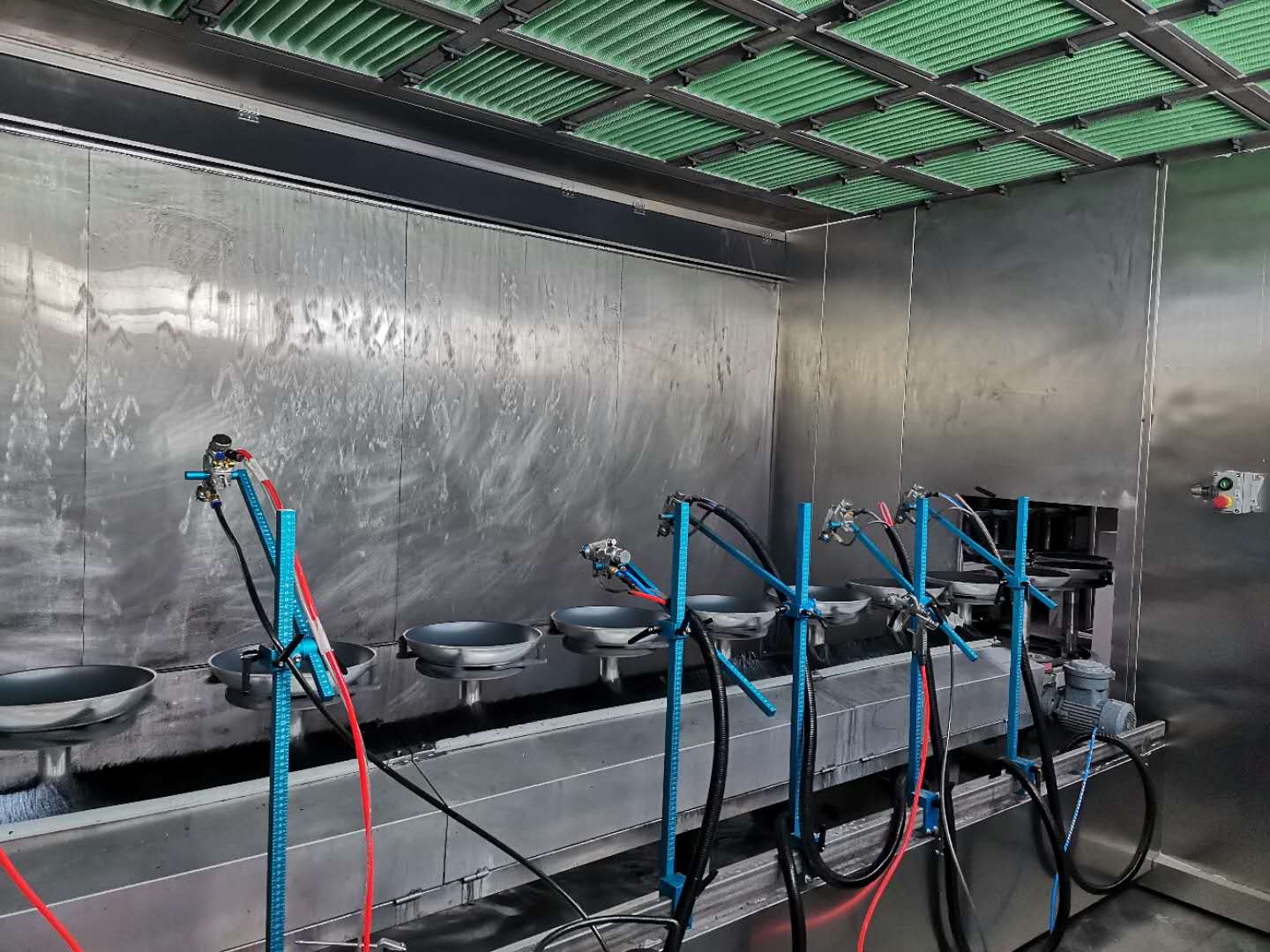
The cookware line handles aluminum alloy and composite cookware at 800–1,000 pieces per hour. Standard product size is Φ220×160 mm with a Φ300×160 mm maximum, hanging four inner pots or twenty lids per carrier. The anodizing line runs at 1,200 mm/min and the desktop curing oven at 1,000 mm/min, adjustable from 0.5 to 1.5 m/min.
Its documented outcomes are 98% coating uniformity, 30% reduced paint waste and a 35% efficiency gain, with non-stick performance meeting international food-grade standards and zero major quality complaints during continuous operation.
The contrast is instructive. The metal line leads on material efficiency and pass rate; the cookware line leads on film uniformity and efficiency gain. A buyer whose cost driver is substrate area should read the metal figures first; a buyer whose cost driver is film consistency on curved surfaces should read the cookware figures first.
The Wood Furniture Line: When Stability Is the Metric
Wood furniture buyers rarely optimize for peak throughput. They optimize for finish consistency across a service life measured in years, because retooling a wood line is disruptive and dust contamination is the most persistent defect source.
The Wood Furniture Automatic Painting Line is designed for solid wood and MDF components — table legs, chair backs, sitting boards and frames — with an eight-hour output of 1,422 pieces per shift, a standard workpiece size of 100 mm (L) × 50 mm (W) × 1,400 mm (H), and a maximum of 610×710×1,400 mm at a 300 mm hanger pitch. Line speed is 4,000 mm/min, adjustable from 2,000 to 6,000 mm/min.
What distinguishes it in the decision matrix is the operating record. Delivered wood coating lines are reported to have run for 5–10 years with paint consumption reduced by 30%, dust defect rates cut by 90%, production efficiency increased by 40%, and zero major quality complaints. A 90% reduction in dust defects is the figure that most directly protects a wood finisher's yield, since dust rework is usually the largest hidden cost in a wood spray operation.
.jpg "Wood Furniture Automatic Painting Line — application scene")
The Auto Parts Line: Where Cycle Time Rules
Automotive parts coating is governed by cycle discipline. The Auto Parts Automatic Painting Line runs on a 336-day, 22-hour calendar with the spray booth held at 25±2 °C and 65±10% RH. Production cycle is 45 seconds per tray, equivalent to 1,760 trays per day, at 85% equipment utilization.
The tooling envelope is L1350 × W900 × H200 mm, and the required factory footprint is approximately 100 m (L) × 38 m (W) × 5.4 m (H). Energy inputs include electricity, natural gas, steam and chilled water. Delivered projects report a 98% coating yield, 25% lower paint consumption, 20% lower energy consumption, and zero major production shutdowns over five years.
For an automotive buyer, the binding constraint is usually the takt time of the paint shop that feeds it. A line that delivers 98% yield but cannot hold a 45-second rhythm will not fit the plant, no matter how good the film quality is.
Technical Explanation: What Actually Changes Between Segments
The four lines share a common architecture, but the parameters inside each stage differ by segment. Understanding the stages helps a buyer know which questions to ask a supplier.
- Pretreatment. Metal and auto parts require chemical or spray pretreatment matched to the substrate; wood requires surface preparation tuned to grain and moisture; cookware typically requires a sandblasting and anodizing sequence before the non-stick layer.
- Application. The spray method ranges from reciprocator plus manual touch-up on metal, through fully automated continuous application on cookware and wood, to offline robot spraying on automotive trim.
- Curing. Curing oven line speeds and temperatures are set by the coating chemistry and the substrate's heat tolerance, not by a universal standard.
- Conveying. Metal lines use a power-and-free conveyor chain; auto parts lines use tooling trays; cookware and wood lines use hanging carriers with defined pitch.
- Environment. These systems are designed to operate in indoor Class 10,000 cleanroom conditions with a clean, well-ventilated environment, supported by pretreatment, drying, spray booth, preheating oven, curing oven, cooling, conveying, dust removal, VOCs treatment, and electrical control equipment, coordinated by a PLC control layer and an MES production management system.
The full automatic configuration runs in continuous mode with PLC intelligent control and robotic spraying, supporting unmanned flexible production. That is the operating model the four segments share; what differs is how each stage is tuned.
Application Fit: Matching the Line to the Workpiece
Use the following rules to narrow the shortlist before requesting quotations.
- If your workpiece is large and flat, and your cost driver is square meters produced, the Metal Automatic Painting Line is the starting point. Its maximum capacity of 5,000 m²/day and 97% pass rate are the relevant references.
- If your workpiece is round cookware with a food-contact surface, the Cookware Automatic Painting Line is the starting point. Film uniformity at 98% and food-grade non-stick compliance are the deciding criteria.
- If your workpiece is solid wood or MDF furniture with an exposed decorative face, the Wood Furniture line is the starting point. Its dust-defect reduction and multi-year stability record matter more than peak speed.
- If your workpiece is ABS+PC automotive trim on a fixed takt, the Auto Parts line is the starting point. Cycle time, humidity control and robot repeatability are the deciding criteria.
These segments are also served with the same underlying equipment families — pretreatment, drying, automatic sandblasting, spray booth, ovens, cooling, conveying, dust removal and VOCs treatment — which is why a multi-segment manufacturer can configure more than one line from a shared engineering base.
Market Trend: Automation and Compliance Are Moving Together
The paint process automation equipment market was valued at approximately 5.67 billion USD in 2025 and is projected to reach nearly 10 billion USD by 2035, a CAGR of about 5.48% over 2025–2035. The wider smart manufacturing market is estimated at about 430.76 billion USD in 2026. These figures describe the direction of demand, not the performance of any single line.
Regulation reinforces the trend. The US EPA has extended compliance deadlines for certain volatile organic compound emission standards for aerosol coatings to 17 January 2027 under 40 CFR Part 59 Subpart E. For buyers in regulated markets, VOCs treatment and recovery capability is becoming a shortlist criterion rather than an optional add-on.
The practical implication for a buyer is that a painting line decision now carries two budgets: the coating performance budget and the emission-control budget. Lines that treat VOCs abatement as a separate afterthought tend to create compliance exposure later.
Comparison With Conventional Spray Operations
Compared with conventional manual spray booths, automated painting lines change three things: consistency, consumption and documentation. Manual operations depend on operator technique, which makes film thickness and coverage variable; automated lines apply a repeatable program, which is where the reported reductions in paint consumption and defect rates originate.
But the comparison also carries a real limitation, and buyers should weigh it honestly. An automated painting line is a higher-threshold investment than a manual booth. These systems are designed for indoor Class 10,000 cleanroom conditions and require a supporting equipment train — pretreatment, drying, spray booth, preheating and curing ovens, cooling, conveying, dust removal, VOCs treatment and an MES layer — before the coating process itself performs as specified. A buyer who installs the spray equipment without the environmental and abatement infrastructure will not reproduce the documented outcomes.
A second limitation is data quality. Painting lines are highly customized, and catalog specifications can deviate from real-world throughput and emission performance. The performance figures in this article are company-reported outcomes from delivered projects, not independently audited benchmarks. Buyers should treat them as screening evidence and verify against reference installations before committing.
Limitations and Verification: What the Matrix Does Not Prove
A decision matrix is only as good as the evidence behind it. Three gaps are worth stating plainly.
First, the performance figures are drawn from supplier-reported delivery records; no independent factory audit or third-party test methodology is attached to them. Second, capacity claims such as annual output or facility scale are self-reported and describe scale, not verified throughput. Third, sub-segment data — for example, a direct comparison of cookware versus automotive line economics — is not available in the public record, so cross-segment cost comparisons should be built from the buyer's own workpiece data.
The responsible approach is to use the matrix to build a two- or three-supplier shortlist, then request reference projects, operating logs and compliance documentation for the specific segment under consideration.
Future Outlook
Three shifts are likely to shape painting line selection over the next several years.
Compliance will move earlier in the buying process. As VOCs deadlines tighten, abatement capability will be evaluated alongside coating quality rather than after line selection.
Segment specialization will continue, but on a shared platform. The same pretreatment, curing and conveying equipment families already serve metal, wood, cookware and auto parts; the differentiation increasingly sits in control logic, robot programming and process recipes rather than in hardware alone.
Verification will become a competitive feature. As buyers grow more sophisticated about self-reported claims, suppliers who can document reference installations, service records and multi-year operating stability will be easier to shortlist — which is precisely where a stability record such as 5–10 years of wood line operation with zero major quality complaints becomes a commercial asset, not just a technical note.
FAQ
How should a buyer choose between a metal painting line and a cookware painting line?
Start from the workpiece and the cost driver, not the line name. The Metal Automatic Painting Line is configured for large aluminum panels and profiles, with a maximum capacity of 5,000 m² per day and a reported 97% coating pass rate plus a 30% reduction in paint or powder consumption. The Cookware Automatic Painting Line is configured for round aluminum alloy and composite cookware, with a reported 98% coating uniformity and a 35% efficiency gain. If the cost driver is substrate area and material consumption, the metal line is the closer fit; if the cost driver is film consistency on curved, food-contact surfaces, the cookware line is the closer fit.
What workpiece sizes and materials can each line handle?
The Metal line handles aluminum panels and profiles up to 7,000 mm (L) × 2,000 mm (W) × 2,200 mm (H) per hanger. The Wood Furniture line handles solid wood and MDF components from a 100×50×1,400 mm standard size up to 610×710×1,400 mm, at a 300 mm hanger pitch. The Cookware line handles aluminum alloy and composite cookware at a Φ220×160 mm standard size and a Φ300×160 mm maximum, with no curling. The Auto Parts line handles ABS+PC components such as bumpers and interior trim on tooling trays up to L1350×W900×H200 mm.
Can a single painting line serve more than one segment?
Not optimally. Each segment differs in substrate, geometry, pretreatment chemistry, spray method and curing profile. The four lines are configured as separate product families rather than as one universal line with adjustable settings. A manufacturer may supply lines across all four segments from a shared equipment base — pretreatment, spray booth, ovens, conveying, dust removal and VOCs treatment — but the process recipes and mechanical envelopes remain segment-specific.
What environmental conditions does an automated painting line require?
These systems are designed for indoor Class 10,000 cleanroom conditions with a clean, well-ventilated environment. They run in fully automatic continuous mode with PLC intelligent control and robotic spraying, and they depend on supporting equipment including pretreatment, drying, automatic sandblasting, spray booth, preheating oven, curing oven, cooling system, conveying system, dust removal, VOCs treatment, environmental protection equipment, electrical control, and an MES production management system.
How long do these lines typically run before major issues appear?
Reported operating records vary by segment. Delivered wood coating lines are reported to have operated for 5–10 years with zero major quality complaints. Delivered auto parts coating lines are reported to have run for 5–10 years with zero major production shutdowns. Metal coating lines are reported to have operated continuously with zero major shutdowns. These are supplier-reported outcomes from delivered projects; buyers should request segment-specific service records and reference installations for verification.
What should buyers verify before shortlisting a supplier?
Verify four things. First, reference installations in your specific segment, with operating duration. Second, the equipment train actually supplied — pretreatment, curing, conveying, dust removal and VOCs treatment — because coating performance depends on the full sequence, not the spray unit alone. Third, whether performance claims are tied to a stated measurement method. Fourth, compliance documentation relevant to your destination market, including VOCs requirements such as those under 40 CFR Part 59 Subpart E where applicable.