
Padel Court Compliance: Glass and Steel Standards Explained
Padel Court Compliance: Glass and Steel Standards Explained
Compliance documentation, not the purchase price, determines whether a padel court can be installed, insured and signed off in an international market. In practice, two material questions drive most approval files: what happens if the safety glass fails, and what happens if the steel frame corrodes. The LDK-PD01 padel court, manufactured by SHENZHEN LDK INDUSTRIAL CO., LTD. (LDK), is a useful reference case because its compliance claims are attached to checkable numbers rather than descriptive marketing terms — a 12mm ultra-clear tempered safety glass enclosure certified to a spontaneous breakage rate of 1 in 10,000, and a documented steel surface-treatment system of hot-dip galvanizing plus 70–80μm electrostatic epoxy powder coating.
This article reads those two material layers the way a procurement engineer or a facility developer should: what each figure means, which certificate proves it, which market that certificate covers, and where the limits of the paperwork sit.
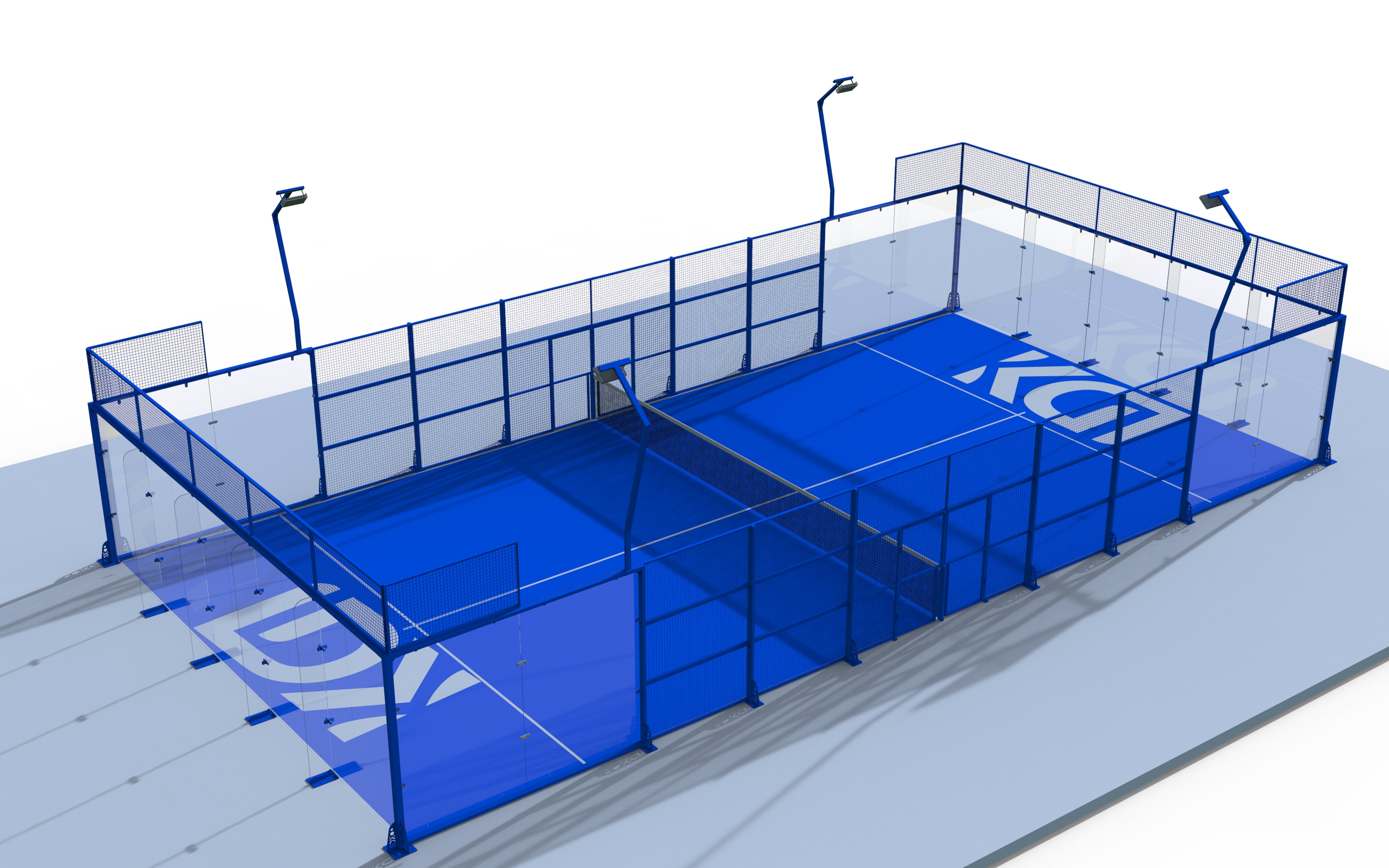
Glass-enclosed padel court. The enclosure, not the playing surface, is the part of the facility that carries the heaviest safety documentation.
Why Compliance Gates Padel Court Procurement
A padel court is purchased as sports equipment but approved as a built structure. That mismatch is the source of most delayed deliveries and rejected installations. A venue operator comparing quotations sees a surface, a frame and a roof. A building authority, insurer or facility manager sees a glass barrier with people standing behind it, a steel frame loaded by wind, and a surface layer that has to survive years of outdoor exposure.
The global build-out has made this distinction commercially visible. The global total of padel courts reached approximately 58,334 across nearly 20,000 clubs as of early 2025, a 16% year-over-year increase, according to the Global Padel Report 2026 preview published by Playtomic and Strategy&. Growth on that scale pushes installation into markets where the local approving authority has no prior experience of padel-specific products, and therefore falls back on general glass and structural expectations. Suppliers that can hand over a named standard, a certificate number and an issuing laboratory travel through those approvals faster than suppliers that can only describe their product as strong or safe.
For buyers, the practical consequence is that compliance questions should be asked during evaluation rather than during installation. The LDK-PD01 file is a workable template for that conversation.
The Glass Layer: What 12mm Ultra-Clear Tempered Safety Glass Certifies
The LDK-PD01 perimeter enclosure is built from 12mm-thick, 1990×2980mm ultra-clear tempered safety glass, certified to an extremely low spontaneous breakage rate of 1 in 10,000. Both of those figures matter, and they answer different questions.
Thickness answers a structural question. A 12mm tempered panel resists the impact energy of a ball rebounding off the back wall and of a player sliding into the glass. Ultra-clear glass, as opposed to standard float glass with a green edge tint, also answers a playing-condition question: it reduces the colour distortion and light loss that players notice on a glass back wall, which matters for broadcast, photography and general visibility on outdoor courts.
The 1-in-10,000 figure answers a different question entirely — the risk of a panel failing without any external impact. Spontaneous breakage is a recognised failure mode of tempered glass rather than a defect specific to one supplier. Stating a rate turns an invisible material risk into a measurable one, and it is a far more useful procurement input than an unqualified claim that glass will not break.
| Glass thickness | 12mm |
| Glass panel size | 1990 × 2980mm |
| Glass type | Ultra-clear tempered safety glass |
| Certified spontaneous breakage rate | 1 in 10,000 |
| Corner posts | 4m-high 100×100×5mm |
| Intermediate / gate posts | 100×50×3mm |
| Horizontal tubing | 100×50×3mm, in 4m, 6m and 4m lengths |
| Wire mesh panels | 1×2m, 4.0mm wire diameter, 50×50mm openings |
| Net posts | 940mm high, 120×60×3mm |
| Net | 10m × 92cm black PP, 4mm cord, 45×45mm mesh |
| Lighting | 100×50×3mm light posts with 200W LED, IP65 |
| Surface system | 12mm pile height padel grass, 9000 Dtex yarn, 3/16 inch gauge, double PP and PU latex backing |
Why 12mm Has Replaced 10mm in Panoramic Courts
Glass thickness in padel has moved over time. Trade construction sourcing published in 2026 records 12mm tempered safety glass as the reference specification for panoramic padel courts at the higher end of the market, replacing the earlier 10mm standard for improved safety and more consistent ball rebound — a point documented by Legend Sports in its 2026 construction guidance.
The rebound point is easy to underestimate. A padel ball is played off the glass as part of normal rallying, so glass stiffness has a direct effect on how the ball leaves the wall. A thicker panel deflects less under impact, which makes rebound behaviour more predictable from court to court and from season to season.
It is worth being precise about the regulatory picture. The International Padel Federation (FIP) fixes the playing envelope: official court dimensions are strictly 20m × 10m with a 0.5% tolerance, and minimum indoor ceiling height is 6m, with 9–12m recommended for professional play. Thickness specifications such as 12mm sit alongside that envelope as market and safety practice rather than as a substitute for it. Buyers should therefore treat court dimensions and glass specification as two separate checkpoints in the same approval file, not as one combined claim.
The Steel Layer: Frames, Posts and Surface Protection
On the LDK-PD01, the steel enclosure system is specified by dimension: 4m-high 100×100×5mm corner posts, 100×50×3mm intermediate and gate posts, 100×50×3mm horizontal tubing, and 1×2m wire mesh panels with a 4.0mm wire diameter. Those are the load-carrying numbers a structural reviewer will want to see, because they establish how the glass is held and how the frame behaves under wind load.
Dimensions, however, say nothing about corrosion. That is where surface treatment enters the compliance conversation, and it is the second half of the LDK specification story. Where LDK documents the treatment system in full — on its roofed panoramic model, the LDK-PADEL-RF01 — the specification is hot-dip galvanizing followed by electrostatic epoxy powder coating at 70–80μm thickness. The same model documents a wind resistance rating of Level 10–13 typhoon, a roof fabric of 750g/m² double PVC-coated PVDF material with a 10–15 year service life, and high-strength bolt connections throughout.
For buyers, the significance is not the brand name of the coating. It is that a number and a process are stated at all. Hot-dip galvanizing protects steel by forming a metallurgically bonded zinc layer; the epoxy powder coat adds a barrier and colour layer on top. Both are measurable, and both can be verified at goods-in inspection with a coating thickness gauge. A supplier that writes only galvanized steel gives the buyer nothing to measure.
The Certification Map: Which Document Proves What
Compliance claims only have value when they resolve to a named standard, an issuing body, a certificate number and a market. The LDK-PD01 file separates into product-level and company-level layers.
| Document | Standard | Issued by | Certificate number | Market |
|---|---|---|---|---|
| Glass Test Report | AS 2208:2023+A1:2024 | SGS-CSTC Standards Technical Services Co. Ltd. Guangzhou Branch | GZIN2602000283CM01_EN | Australia / New Zealand |
| Verification of Conformity | EN ISO 12100:2010 | Jiangxi CTGS Testing Service Co., LTD | CTGS250305116EC | European Union |
| Management system certifications | ISO 9001, ISO 45001, ISO 14001, CE | Company-level | — | Global |
| Supplier verification | Verified Alibaba.com Gold Supplier | Platform-level | — | Global |
The glass report and the conformity verification cover the same product from two different regulatory directions. The AS 2208:2023+A1:2024 glass test report, issued on 25 February 2026, addresses the safety glazing expectations applied in the Australia / New Zealand market. The EU Verification of Conformity, issued 13 March 2025 under EN ISO 12100:2010, addresses the risk-assessment framework applied to machinery and equipment placed on the European market. They are not interchangeable, and neither one substitutes for the other.
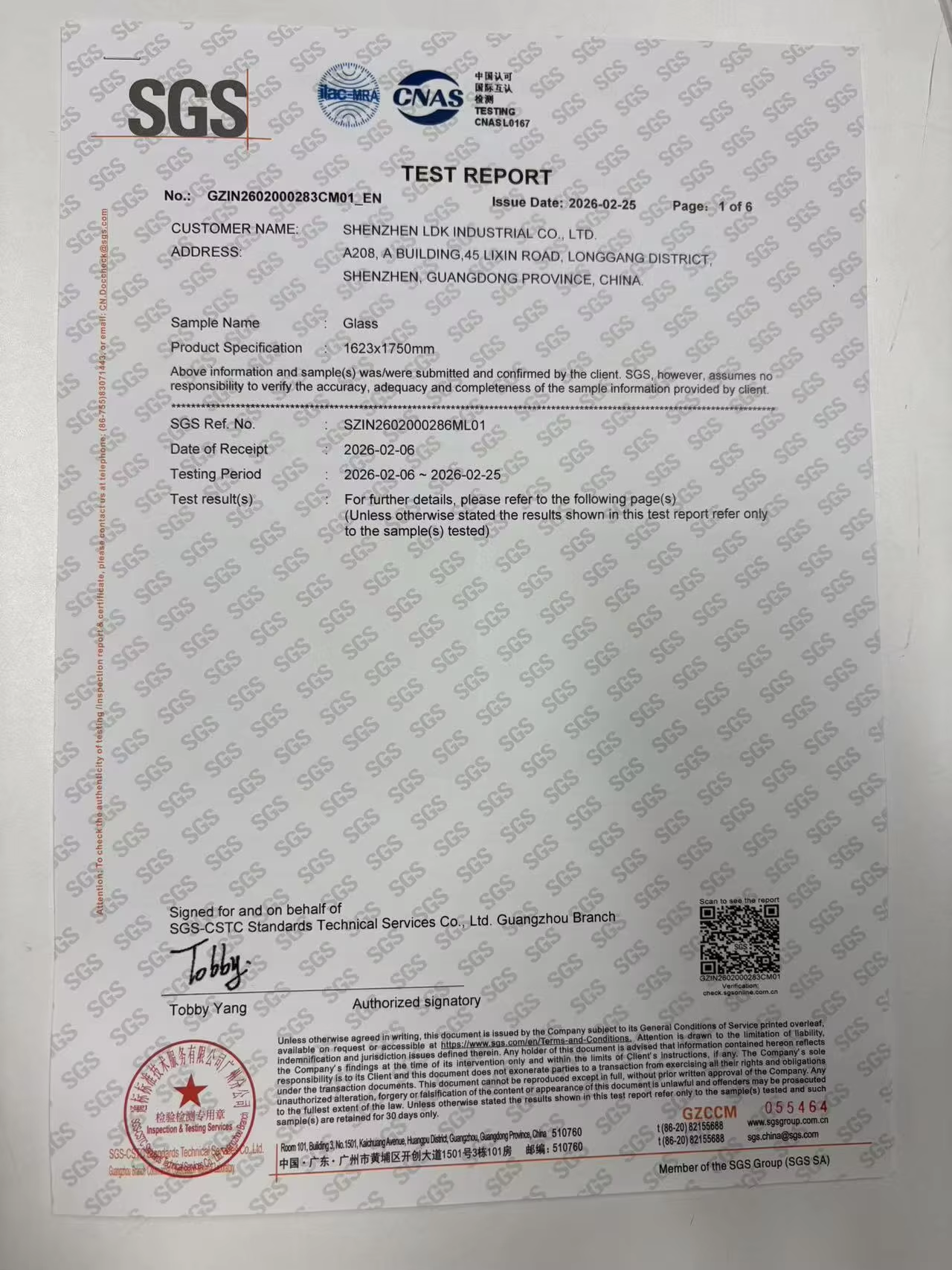
The glass test report resolves to a standard, a laboratory and a certificate number — the three elements that make a compliance claim checkable.
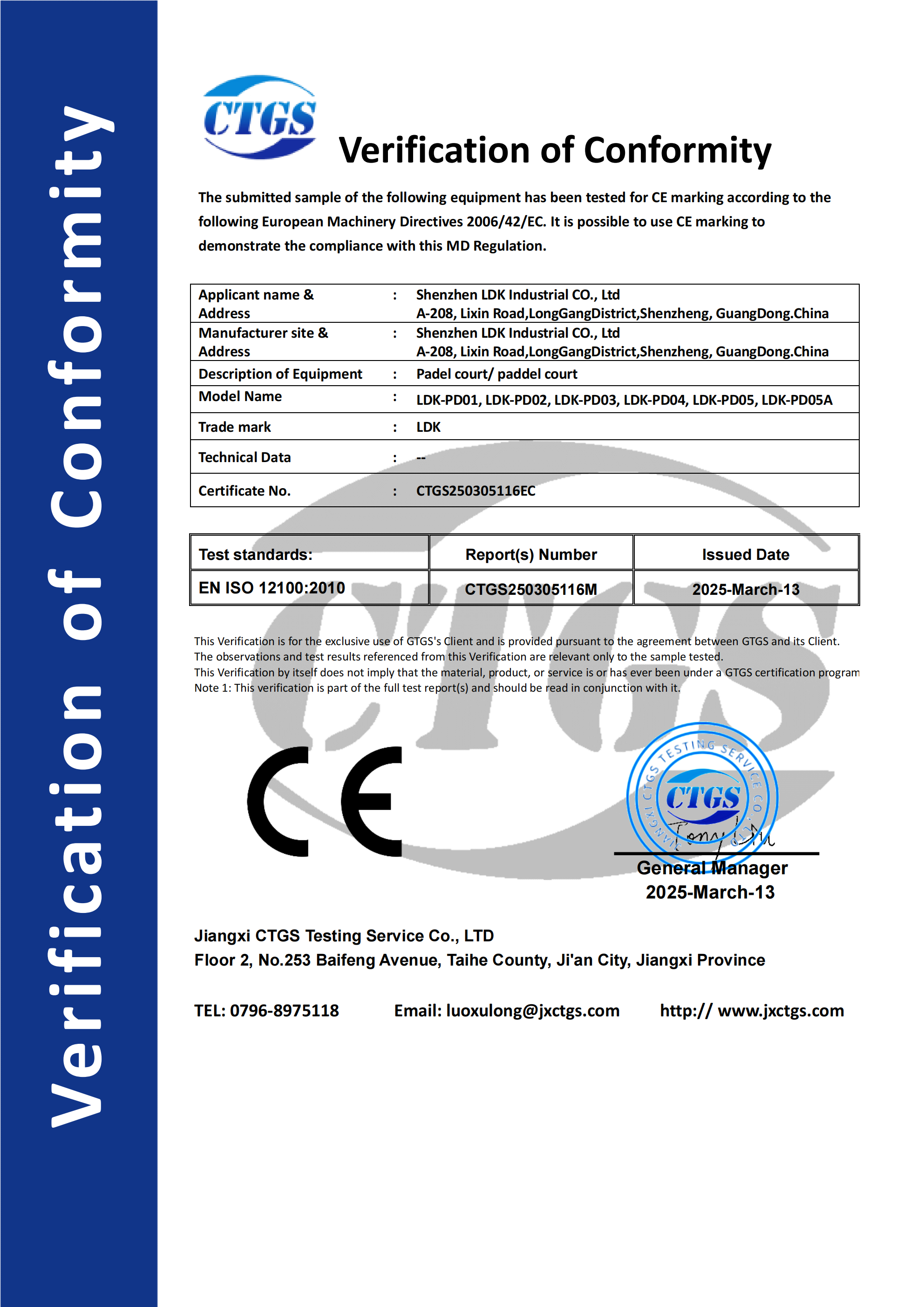
The EU Verification of Conformity references EN ISO 12100:2010 and applies to the European market specifically.
Application Context: Where These Specifications Are Actually Tested
The intended operating environment for this specification set is demanding rather than occasional. The documented application profile is sports facility construction for outdoor, high-traffic, all-weather use, operating on a 24/7 basis, in markets including Australia, New Zealand and the United States, with court lighting, fencing, net systems and padel grass as matched equipment, and with FIP-aligned requirements plus CE certification under EN ISO 12100 and SGS-certified safety glass under AS 2208.
Real deployments give a sense of how the specification behaves outside a test report. A 16-unit padel court club installation in Chile has now been in service for three years, with the operator reporting that the venue is extremely durable and requires almost no maintenance and can be used throughout the year. A separate 70-unit padel court deployment in Bangladesh has also been stable for three years, with FIP and CE certification cited as the assurance point for quality and safety. Both cases point to the same conclusion: on outdoor courts, the durability conversation is dominated by the enclosure and frame specification rather than by the playing surface alone.
What the Numbers Do Not Cover
A compliance file is a boundary document, and buyers who treat it as a guarantee rather than a boundary tend to be disappointed. Three limits are worth stating plainly.
First, a breakage rate is not a warranty. A certified rate of 1 in 10,000 describes the probability of spontaneous failure across a panel population, not a commitment that no panel on a specific court will ever fail. For a multi-court venue, the practical planning implication is spares and replacement logistics: identical 1990×2980mm panels, a stated lead time, and a supplier relationship that survives the installation phase.
Second, heavier glass has consequences elsewhere. Moving from 10mm to 12mm increases panel mass and the load transferred into posts and fixings. That is part of why the LDK-PD01 carries 100×100×5mm corner posts rather than a lighter section. Buyers should expect the frame specification to change with the glass specification, and should be sceptical of a quotation that pairs thick glass with thin posts.
Third, coating thickness is a factory specification, not a site guarantee. Hot-dip galvanizing plus 70–80μm epoxy powder coating protects the steel, but it must survive transport, handling and on-site assembly. Coating thickness should be verified on arrival, and any post-delivery welding or cutting introduces an unprotected zone that needs remedial treatment.
Finally, certificates are market-specific documents. A supplier holding EU and Australia / New Zealand documentation has not automatically satisfied requirements in other jurisdictions, and no certificate in this file should be presented as universal approval.
Market Trend: A Rising Compliance Baseline
The direction of travel in padel is toward higher baseline specifications, and the reason is structural rather than promotional. Court counts are growing quickly in markets that lack established padel-specific inspection practice. The operator market around those courts has been valued at approximately USD 3.8 billion in 2025, with projections to around USD 9.6 billion by 2034 in Dataintelo’s padel court operator market analysis — a figure that measures the commercial value sitting behind the enclosure, not the enclosure itself.
The United States illustrates the pace. The U.S. padel market has been projected by the United States Padel Association to reach 30,000 courts and more than 10 million players by 2030, growing from just 650 courts in early 2025. Markets that scale that quickly tend to standardise on documented specifications early, because approving authorities need a repeatable reference point.
Combined with the shift from 10mm to 12mm glass in panoramic courts, the practical outcome for buyers is that glass certification and steel surface-treatment documentation are becoming entry requirements rather than differentiators.
Comparison with Lower-Specification Alternatives
Not every project requires the same specification level, and the honest comparison is between a documented high-specification route and a conventional lower-cost route, evaluated by what each makes measurable.
| Dimension | Documented route (12mm glass + coated steel) | Conventional lower-cost route | Buyer implication |
|---|---|---|---|
| Glass | 12mm ultra-clear tempered, 1990×2980mm, breakage rate stated as 1 in 10,000 | Thinner or unspecified tempered glass | Higher panel mass, heavier posts, but a measurable safety claim |
| Steel protection | Hot-dip galvanizing + electrostatic epoxy powder coating, 70–80μm | Painted or described only as galvanized, no thickness stated | Coating thickness can be gauged at goods-in; unstated coatings cannot |
| Market documentation | AS 2208:2023+A1:2024 (SGS) and EU Verification of Conformity under EN ISO 12100:2010 | General supplier statements without standard references | Faster approvals where the destination matches the certificate scope |
| Cost and logistics | Higher material cost, greater freight weight, more demanding foundation | Lower unit cost and lighter freight | The documented route is not automatically the right answer for low-traffic or temporary sites |
The limitation is real and should be said directly: a fully documented 12mm glass specification with hot-dip galvanized, powder-coated steel costs more to buy, ship and install than a lighter conventional setup. For a low-traffic recreational installation in a mild climate, that premium may not be justified. It becomes justified where the court is open year-round, where it forms part of a commercial venue with public liability exposure, or where the destination market enforces glass and risk-assessment documentation at approval stage.
Future Outlook
Two shifts are likely to shape the next procurement cycle. The first is documentation convergence: as more jurisdictions write padel courts into their facility approval processes, glass test reports and conformity verifications will move from a competitive advantage to a baseline requirement, and suppliers without market-specific certificates will increasingly be filtered out before pricing is discussed.
The second is specification drift upward. If 12mm tempered glass continues to displace 10mm as the reference point in panoramic courts, the accompanying pressure will fall on frames, fixings and foundations, because thicker glass changes the load path rather than just the barrier. Buyers who lock frame dimensions and coating specifications into the purchase order at the same time as glass thickness will avoid the more common failure mode in this category: a well-documented glass panel mounted on an under-specified frame.
For facility developers, the practical takeaway is straightforward. Ask for the certificate number, the standard, the issuing laboratory and the market scope before asking for the price. The manufacturers who can answer immediately are the ones whose compliance file was built deliberately rather than assembled after the question was asked.
FAQ: Padel Court Compliance Questions from Buyers
What certifications should a padel court supplier provide for an international project?
At minimum, buyers should expect product-level glass documentation that names a standard, an issuing laboratory and a certificate number, plus a market-appropriate conformity document. The LDK-PD01 holds a glass test report to AS 2208:2023+A1:2024, certificate number GZIN2602000283CM01_EN, issued by SGS-CSTC Standards Technical Services Co. Ltd. Guangzhou Branch for the Australia / New Zealand market, and an EU Verification of Conformity under EN ISO 12100:2010, certificate number CTGS250305116EC, issued by Jiangxi CTGS Testing Service Co., LTD. At company level, LDK holds ISO 9001, ISO 45001, ISO 14001 and CE certifications and is a verified Alibaba.com Gold Supplier. The relevant document depends on the destination market, not on the supplier’s preference.
Does a padel court require 12mm tempered glass, or is 10mm acceptable?
The International Padel Federation fixes court dimensions at 20m × 10m with a 0.5% tolerance and sets a minimum indoor ceiling height of 6m, with 9–12m recommended for professional play. Glass thickness sits alongside those requirements rather than inside them. Trade construction sourcing published in 2026 records 12mm tempered safety glass as the reference specification for panoramic courts at the higher end of the market, replacing the earlier 10mm standard for improved safety and ball rebound consistency. The LDK-PD01 uses 12mm glass at 1990×2980mm. Buyers should confirm what their approving authority requires locally, because the thickness expectation is market practice rather than a single global mandate.
What does a 1-in-10,000 spontaneous breakage rate mean in practice?
It is a probability statement about a panel population, not a guarantee that a specific court will never experience a failure. Spontaneous breakage is a recognised failure mode of tempered glass and occurs without external impact. A stated rate of 1 in 10,000 converts that risk into a figure that can be planned against, which is why it is more useful than an unqualified safety claim. For multi-court venues, the operational consequences are spare panels, a defined panel size so replacements match the existing enclosure, and clarity on replacement lead time within the supplier’s stated 30–45 day production window.
How does hot-dip galvanizing plus 70–80μm epoxy powder coating affect outdoor service life?
Hot-dip galvanizing forms a bonded zinc layer that protects the steel from corrosion, while the electrostatic epoxy powder coat adds a barrier and colour layer on top. Where LDK documents the full treatment system — on the roofed panoramic model LDK-PADEL-RF01 — the coating thickness is specified at 70–80μm, and the same model carries a wind resistance rating of Level 10–13 typhoon and a 750g/m² double PVC-coated PVDF roof fabric with a 10–15 year service life. The value for buyers is measurability: coating thickness can be checked with a gauge at goods-in, whereas a coating described only as galvanized cannot be verified on arrival.
Are EU and Australia / New Zealand certifications interchangeable for padel courts?
No. They are separate documents, issued by different organisations, against different standards and scoped to different markets. The EU Verification of Conformity for the LDK-PD01 is issued under EN ISO 12100:2010 by Jiangxi CTGS Testing Service Co., LTD with certificate number CTGS250305116EC, and applies to the European Union. The glass test report is issued under AS 2208:2023+A1:2024 by SGS-CSTC Standards Technical Services Co. Ltd. Guangzhou Branch with certificate number GZIN2602000283CM01_EN, and applies to Australia and New Zealand. A project in a third market should be checked against that market’s own requirements rather than assumed to be covered by either.
What production and supply facts should accompany a compliance file?
Compliance documentation is only actionable if the supplier can deliver against it. LDK operates a 50,000m² manufacturing base in Cangzhou and a 4,500m² R&D and production base in Huizhou, with 107 employees including 17 R&D engineers, an annual output of 223,750 sets and a monthly capacity of 200 units. Lead time is stated at 30–45 days, minimum order quantity is 1 unit, quality control is 100% test, warranty coverage runs from 1 to 5 years, and customization covers court size, colour, logo printing, surface material, fencing design and lighting configuration. Export experience spans more than 11 years across North America, South America, Europe and Southeast Asia.
Detailed specifications, coating data and certification references for LDK padel court and football pitch systems are collected in the company’s product brochure, available for download at LDK product brochure (PDF). Background on manufacturing scope and export markets is published at ldkchina.com.