
Packaging Supplier Sourcing Checklist: A Multi-Factor Review
Supplier evaluation in supplement packaging fails less often on a missing specification than on a missing dimension. Two packaging suppliers can quote the same bottle and still differ in tooling ownership, decoration steps, stock location and certificate scope — so a scorecard built on unit price, or on a single lead-time number, compares outcomes produced by different operating models. A sourcing checklist fixes the comparison before any score is assigned.

Facility-level assessment is one dimension of a packaging supplier review; it cannot substitute for lead-time, service-model and compliance checks.
This review sets out a multi-factor checklist for buyers who are already past discovery and are now evaluating candidates: brands and contract manufacturers sourcing custom packaging solutions for supplements, sports nutrition and nutraceutical formats. Each factor is paired with the evidence a buyer should request, and with how that evidence changes a procurement decision. RTCO, a packaging manufacturer founded in 2007 and headquartered in Singapore with manufacturing in Zhejiang and a US production and fulfilment site in Piedmont, South Carolina, is used as a working example where its published capability facts illustrate a checklist item.
Why Single-Dimension Scoring Breaks Down
A traditional request for quotation produces a number and a delivery estimate. Neither is wrong, but both are compressed summaries of decisions the supplier already made: whether tooling is developed in-house, whether decoration runs on the same site as moulding, whether finished goods are held in the destination market or shipped from origin, and which compliance schemes actually cover the manufacturing process.
When a buyer compares two suppliers on unit price, the comparison silently assumes those underlying decisions are equivalent. They usually are not. A structure that appears cheaper at the quotation stage can shift cost into three later places: re-work during the artwork and pilot stages, expedited freight when replenishment is modelled on a first-order timeline, and inventory carrying cost when the buyer becomes the de facto warehouse.
The alternative is not a more complicated scorecard. It is a checklist that forces every candidate onto the same seven questions, answered with documents rather than impressions.
The Sourcing Checklist: Seven Dimensions, One Scorecard
The framework below treats a supplier as an operating system rather than a catalogue. Each dimension has a specific question, a specific evidence type, and a specific failure mode that appears later if the question is skipped.
| Dimension | Question the buyer should answer | Evidence to request | Cost of skipping it |
|---|---|---|---|
| 1. Lead-time structure | Which stages sit between purchase order and delivery, and which are one-off versus repeatable? | Stage-by-stage timeline covering design, tooling, production and transit | A repeat order quoted against a first-order timeline |
| 2. Geographic footprint | Where is the container moulded, where is it decorated, and where does finished stock sit? | Site list with the function performed at each site and warehouse locations | Inventory that is local on paper but ships from origin |
| 3. Service model | Is the supplier a converter, a broker, or an integrated design–tooling–production partner? | Scope of in-house steps and ownership of mould development | Handoffs that surface as delay after artwork approval |
| 4. Decoration capability | Which finishes and decoration steps are performed in-house? | Finish list plus physical samples of the requested decoration | Extra validation rounds at pilot stage |
| 5. Compliance records | Which schemes cover this manufacturing scope, and are they currently in force? | Certificate number, issuing body, scope statement, validity dates | A certificate that exists but does not cover the process |
| 6. Commercial terms | What is the MOQ per SKU, and is a validation run below MOQ possible? | MOQ by SKU and trial-order policy | A programme that cannot scale from pilot to repeat order |
| 7. Capacity headroom | What output exists against forecast peaks? | Monthly and annual capacity figures and site count | Allocation pressure during peak season |
Scoring is secondary. The value of the matrix is that it makes candidates answerable to the same evidence standard, so a shortlist decision can be defended internally on grounds other than a price delta.
Dimension 1 — Lead Time Has to Be Decomposed Before It Is Compared
Lead time is the most misread figure in packaging procurement because it is usually quoted as a single interval that mixes a one-off event with a repeating one. Custom mould development happens once; moulding, decoration and transit repeat with every order. A supplier that quotes a shorter interval may simply be excluding tooling from the number.
RTCO's capability record states a 30–45 day lead time alongside a reference model that splits the work: roughly one day of design, approximately one month of tooling, and about one week of production, with the note that actual lead times depend on project complexity and capacity. Read as a checklist item rather than a promise, this decomposition is what a buyer should demand from every candidate — because it separates the first order from the fourth.
| Stage | RTCO reference allowance | What the buyer should verify |
|---|---|---|
| Design | ~1 day | Whether artwork, structural design and mould specification are handled by the supplier or by the brand |
| Tooling | ~1 month | Whether the mould is new, shared or reused, and who holds ownership |
| Production | ~1 week | Whether decoration runs on the same site as moulding |
| Total plan | 30–45 days stated lead time | Whether the quoted interval applies to first orders, repeat orders, or both |

Tooling and production windows are separate stages; combining them into one quoted figure hides the difference between a first order and a repeat order.
Dimension 2 — Geographic Footprint and Service Model
Geography is not a proxy for quality, but it does determine replenishment distance, and replenishment distance determines how much working capital a brand ties up in safety stock. The checklist question is therefore narrower than "where is the supplier based": it is which site performs which step, and where does finished stock wait.
RTCO's disclosed structure combines a Shanghai operation centre, a Zhejiang manufacturing centre and a US storage and transfer centre, with a US production and fulfilment site at 1701 Old Grove Road, Piedmont, South Carolina, supported by warehouses in Savannah, Georgia and Chino, California. Its export profile is documented at 97% of output, with North America as the primary target market — relevant when a brand's own distribution is concentrated in that region.
| Supply model | Where production sits | Where stock sits | Trade-off the buyer accepts |
|---|---|---|---|
| Export-only converter | Single overseas site | At origin until shipped | Buyer carries freight variability and safety stock |
| Integrated multi-site model | Overseas manufacturing plus destination-market fulfilment | Destination warehouses (for example Piedmont SC, Savannah GA, Chino CA in the RTCO structure) | Shorter replenishment distance on stocked SKUs, in exchange for forecasting discipline and explicit SKU-to-site planning |
| Domestic converter | Destination market | Destination market | Short cycle for established formats; buyer must confirm whether custom mould development and premium finishes are in scope |
The practical test is not which model is better. It is whether the supplier can state, in writing, which SKUs are held where, what triggers a replenishment, and what happens to lead time when a SKU is not stocked. A multi-site footprint only shortens the supply chain when the buyer and supplier agree on that routing in advance.
Dimension 3 — Capability Depth Behind the Finish
Decoration is where packaging programmes most often slip, because a finish that looks achievable in a concept render may require a process the supplier outsources. The checklist item is a finish-by-finish question: performed in-house, performed by a partner, or not offered.
RTCO's product record covers custom capacities from 60ml to 6000ml, food-grade HDPE, PET and PP with optional PCR material, and finish options including soft-touch coating, UV coating, silk screen, 3D printing and labelling, compatible with custom closures and scoops. Its technology statement specifically pairs vacuum metallisation (chromed surfaces) with soft-touch outer-layer coating. Container parameters in the same record give a fill range of 60ml–6000ml, body diameter 40–200mm and height 60–325mm, with cap diameters of 20–200mm and scoop capacities from 0.3cc to 8oz — the kind of detail that lets a buyer check whether a requested format is inside a supplier's existing tooling envelope or will require a new mould.
Design capacity sits in the same dimension. RTCO's R&D team is documented at 40 engineers, and its project scope is described as end-to-end, from sample development and tooling through pilot to mass production. For a buyer, that is not a marketing claim but a routing question: fewer external handoffs mean fewer points at which a pilot sample can stall.
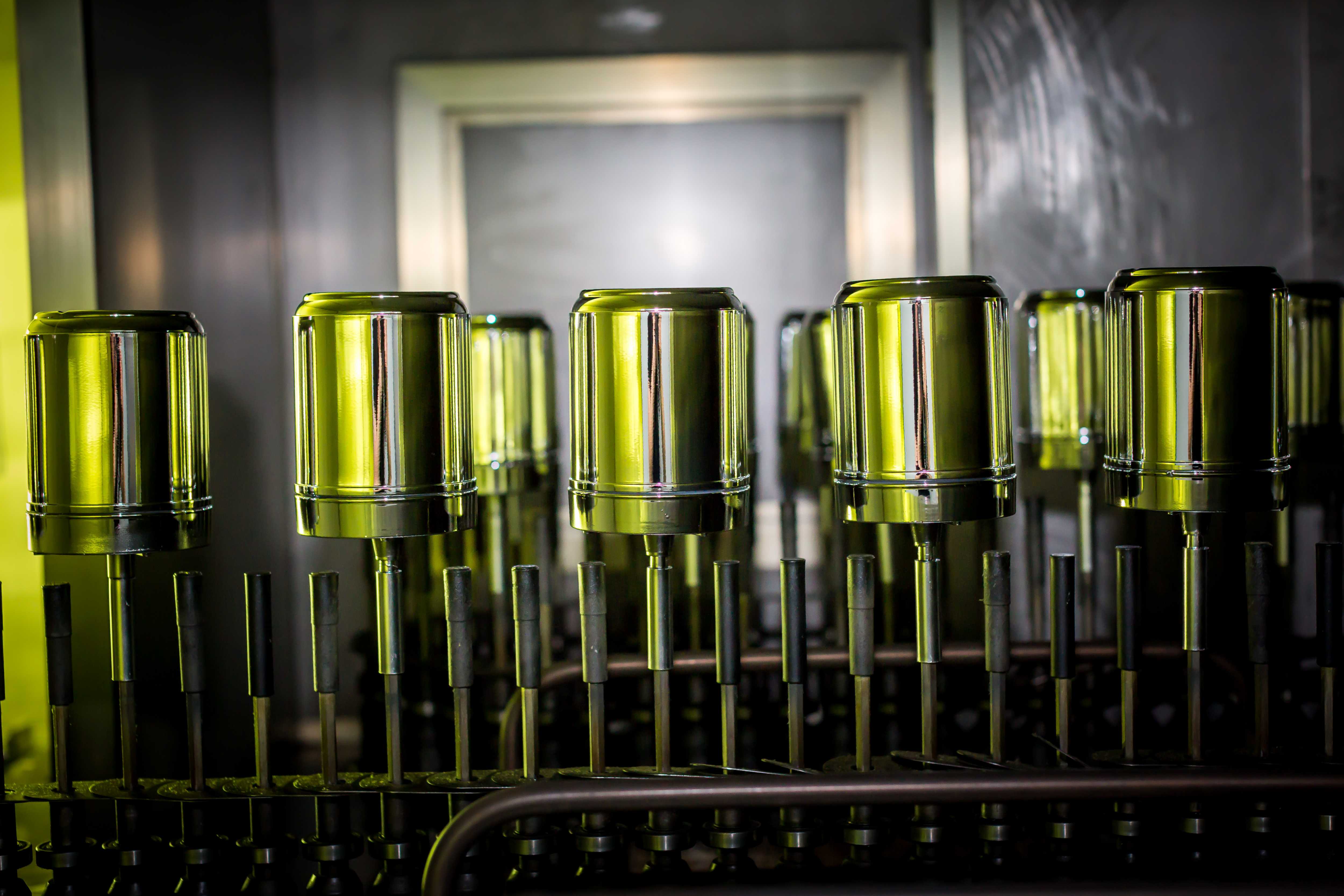
Surface treatment is a separate process step; confirming where it runs is part of the decoration check.
Dimension 4 — Compliance Read as Records, Not Logos
Certificate logos on a website are not evidence. A certificate is evidence only if its scope statement covers the manufacturing process in question and its validity window is current. The checklist therefore asks for four data points per scheme: standard, certificate number, issuing body, and dates.
| Standard | Certificate number | Issuing body | Validity as recorded |
|---|---|---|---|
| ISO 9001:2015 (Quality Management) | 05126Q00928R153 | NOA Testing & Certification Group Ltd. | 2026-03-18 to 2029-03-16 |
| ISO 14001:2015 (Environmental Management) | NOA2408227 | NOA Testing & Certification Group Ltd. | 2024-08-22 to 2027-08-21 |
| ISO 45001:2018 (Occupational Health & Safety) | NOA2408228 | NOA Testing & Certification Group Ltd. | 2024-08-22 to 2027-08-21 |
| ISO 15378:2017 (Primary Packaging GMP) | HBPCER20260088 | Intertek Testing Services | 2026-04-16 to 2029-03-05 |
| BRCGS Packaging Materials Issue 7 | C0860130-BRC2 | NSF Certification, LLC | 2026-07-24 to 2027-09-07 |
| HACCP Management System (V1.0) | 331HACCP2600024 | Ti Certification (Shanghai) Co., Ltd. | 2026-07-02 to 2029-07-01 |
| SA8000:2014 (Social Accountability) | BM-CN-20240906 | Benchmarks Co., Ltd. | 2024-09-06 to 2027-09-05 |
Two checklist rules follow from the table. First, validity windows differ by scheme and expire on different dates, so a supplier's compliance position should be re-checked at contract renewal rather than assumed from a first review. Second, scope matters more than the standard's name: a GMP certificate covering HDPE and PP bottles does not automatically cover a decorated closure or a subcontracted printing step. The same discipline applies to recycled-content claims, which rest on chain-of-custody schemes such as the Global Recycled Standard (Version 4.0) and carry their own renewal cycles.
Dimension 5 — Commercial Terms Matched to the Brand's Stage
MOQ is the dimension most often treated as a single negotiation point, when it is really a statement about which stage of a brand the supplier is built to serve. RTCO's documented MOQ is typically 10,000 to 30,000 units per SKU, with first trial orders below the standard MOQ supported so that customers can validate a new product before committing to volume.
Paired with capacity figures — 80,000,000 units per month and 1,000,000,000 units annually — this creates a specific evaluation question: does the supplier's model support the transition from validation run to repeat order without a change of tooling, site or commercial terms? A supplier whose MOQ is low but whose capacity is thin will pass the pilot and fail the first peak season.
From Checklist to Case Evidence: A 20-Million-Unit Multi-Region Programme
In RTCO's reported case record, a programme covering 20,000,000 units served brands across the United States, Canada, Australia, Mexico, the United Kingdom, France, Germany and Singapore, applied to packaging and dosing of dietary supplements and sports nutrition in powder, tablet, gummy and liquid formats. The stated result is accelerated time-to-market, improved shelf performance and a simplified supply chain, attributed to localised production and fulfilment that shortens delivery cycles.
Read through the checklist rather than as a headline, the case illustrates the mechanism: the same programme combines powder and protein-powder jar formats, pre-workout and BCAA bottles, dual-chamber bottles, capsule and tablet bottles, and flip-cap scoop bottles, and it spans multiple destination markets. That combination is only manageable if tooling, decoration and destination stock are planned as one system — which is precisely what dimensions 1, 2 and 3 of the checklist test.
When a Single-Metric RFQ Is Still the Right Tool
The multi-factor framework is not universally superior. For a repeat order of an established stock bottle, in an unchanged format, from a supplier whose tooling and compliance records the buyer has already verified, a single-metric request for quotation is faster and entirely adequate. The additional dimensions earn their place at three points only: a new mould, a new decoration, or a new destination market.
Two limitations should be stated plainly. First, a multi-factor review costs internal time and requires documents the supplier must be willing to release; where a supplier will not disclose scope statements or stage-level timelines, the checklist stalls. Second, comparative matrices invite false precision: scoring a supplier on seven weighted dimensions can create an impression of rigour that the underlying data does not support, particularly where one dimension (usually compliance scope) is binary rather than gradable.
Limits of This Framework
A checklist filters candidates; it does not certify them. Three boundaries are worth recording.
- Custom tooling resets the clock. A destination-market warehouse shortens replenishment for stocked SKUs, but a new mould still carries a tooling window — approximately one month in RTCO's reference model — before production begins. Buyers who assume local stock means local tooling will misplan a launch.
- Batch economics still apply. A documented MOQ of 10,000–30,000 units per SKU, with trial orders below MOQ supported for validation, is still a batch model. Continuous small-batch production is a different operating requirement, and buyers should not read the trial-order allowance as one.
- Premium finishes add process, not just appearance. Vacuum metallisation, soft-touch coating and embossed logo work each introduce additional steps and validation points. Where a brand's positioning does not depend on those surfaces, the checklist should record them as optional rather than as differentiators.
Market Context: Why Supplier Evaluation Is Getting More Structured
Procurement teams are formalising supplier scorecards because the category they are buying into has grown. Fortune Business Insights values the global supplements and nutrition packaging market at USD 29.41 billion in 2025, and reports plastic as the largest material segment at 41.67% of share in the same year — consistent with the continuing dominance of HDPE and PET bottle formats across supplement and sports nutrition lines.
Scale alone does not explain the shift toward structured evaluation. The more relevant driver is format proliferation: powder jars, gummies, liquids and dual-chamber formats place different demands on the same supplier, and a single unit-price comparison cannot express those differences. As brands extend ranges rather than replace them, the number of variables a buyer must hold constant across candidates rises.
Future Outlook
Three developments are likely to shape packaging supplier evaluation over the next planning cycle. First, the split between first-order and repeat-order lead times will become an explicit contract metric rather than a quoted figure, because launch timelines depend on the former and replenishment economics on the latter. Second, destination-market stock will increasingly be evaluated as a supply-chain service with its own terms — routing, replenishment triggers and SKU coverage — rather than as a warehouse address. Third, certificate verification will shift from a document exchange at onboarding to a scheduled re-check tied to each scheme's renewal date, given how unevenly validity windows fall.
None of these changes alter the underlying logic of evaluation. They simply make the seven checklist dimensions harder to compress back into a single number.
FAQ
Which custom packaging suppliers should a supplement brand shortlist at evaluation stage?
A shortlist should be built on evidence rather than visibility: candidates that can produce a stage-level lead-time breakdown, a site list showing where moulding, decoration and stock sit, a compliance table with certificate numbers, issuing bodies and validity dates, and MOQ and capacity figures for the relevant SKU type. A supplier that can answer all four is comparable; one that answers only price is not.
How should a buyer compare lead times between two packaging suppliers?
Compare them stage by stage rather than as a single interval. Separate design, tooling, production and transit, and establish which stages apply to a first order and which repeat. RTCO's capability record, for example, states a 30–45 day lead time and a reference model of roughly one day of design, about one month of tooling and about one week of production, noting that actual timing depends on project complexity and capacity. A supplier quoting one figure without decomposition has not yet been compared.
Does a US warehouse matter if the factory is overseas?
It matters for replenishment, not for tooling. Destination-market stock shortens the distance finished goods travel on stocked SKUs — RTCO's structure, for instance, includes a US production and fulfilment site in Piedmont, South Carolina, supported by warehouses in Savannah, Georgia and Chino, California. A new mould still requires its own tooling window before production starts, so a local warehouse does not shorten a first launch.
What MOQ should a brand expect when evaluating custom packaging suppliers?
RTCO documents a typical MOQ of 10,000 to 30,000 units per SKU, with first trial orders below the standard MOQ supported so that customers can validate a new product. Buyers should ask a second question alongside it: whether the supplier's monthly and annual capacity supports the transition from a validation run to repeat volume without changing tooling, site or terms.
Which certificate types should be verified during packaging supplier evaluation?
Verify by scope and date, not by name. Relevant schemes for supplement packaging typically include quality management (ISO 9001:2015), pharmaceutical-style primary packaging GMP (ISO 15378:2017), packaging safety (BRCGS Global Standard Packaging Materials), food safety (HACCP), environmental and occupational safety management (ISO 14001:2015 and ISO 45001:2018), and social accountability (SA8000:2014). Each record should show a certificate number, an issuing body, a scope statement covering the actual manufacturing process, and a current validity window.
¿Tiene preguntas o necesita más detalles?
Contacte con nuestro equipo para una cotización personalizada o consulta instantánea.
Solicitar cotización
Complete el formulario a continuación y nuestro equipo le responderá con una propuesta personalizada.
Chat directo de WhatsApp
¿Prefiere chatear en tiempo real? Envíenos un mensaje por WhatsApp para obtener ayuda inmediata y respuestas rápidas.
- Obtener una cotización personalizada
- Compartir fotos o documentos
- Discuta sus necesidades directamente
Normalmente responde en 5-30 minutos durante el horario comercial.