
PVC Wall Panel Showdown: PVC vs WPC vs Self-Adhesive—What a First-Time Importer Should Compare
Three product families dominate the decorative wall panel catalog that reaches a first-time importer: rigid PVC wall panels, wood-plastic composite (WPC) panels, and adhesive-backed PVC wall stickers. They are frequently photographed on the same page, quoted into the same container, and sold by the same distributors — yet they are built on different substrates, fixed to the wall in different ways, and limited by different environments.
The category is large enough that these distinctions carry commercial weight. The global PVC panels market reached a valuation of USD 14.8 billion in 2025, and PVC wall panels alone accounted for a 42.5% share of that market by product type, according to Dataintelo. SNS Insider estimated the global wood plastic composite market at USD 8.97 billion in 2025. Adhesive products sit in an adjacent pool: Dataintelo valued the global peel-and-stick wallpaper market at USD 3.8 billion in 2025, with vinyl-based segments holding a 48.6% share.
This article compares the three families on the variables that decide whether a first order sells through or sits in a warehouse — substrate, thickness, fixing method, indoor or outdoor suitability, and the documentation that clears customs and project inspection.
Why These Three Products Get Confused in the First Place
Export catalogs are usually organized by pattern, not by construction. A marble-print rigid PVC sheet, a marble-print WPC panel, and a marble-print self-adhesive sticker can look almost identical in a photograph, and all three are commonly listed under the loose heading of "PVC wall panel" in quotations. The differences sit underneath the print: the substrate, the panel-or-roll format, the fixing method, and the environment the product can survive.
That gap is where a first-time importer's working capital gets stuck. The three families are bought by different end customers. Rigid panels and marble sheets are usually specified by contractors and project buyers. WPC fluted panels move through interior design and building material channels. Self-adhesive stickers move through DIY retail, e-commerce, and rental renovation. A single container ordered from one reference photo can land in the right country and the wrong sales channel.
The opportunity is the mirror image of the risk. Because each family answers a different buying occasion, a well-planned first order can cover several customer types in the same market — provided the buyer knows what each product is made of and what it cannot do.
What Each Product Family Actually Is
Rigid PVC wall panels and PVC marble sheets
A rigid PVC wall panel is a board made from PVC resin, calcium carbonate, and additives. Documented standard sizes are 1220 × 2440 mm and 1220 × 2800 mm, with 5 mm and 8 mm thickness options; pattern ranges include marble, wood grain, fabric, stone, and metal. Fixing is done with adhesive, aluminum profile, or hidden fixing, and the intended application is interior wall decoration.
A PVC marble sheet — widely sold as a UV marble sheet — uses PVC resin, calcium carbonate, and additives with a UV coating or high-gloss coating on the face. It is considerably thinner: 2.0 mm, 2.2 mm, 2.5 mm, 2.8 mm, and 3 mm are documented thickness options in 1220 × 2440 mm and 1220 × 2800 mm formats, with high-gloss, matte, or embossed finishes and marble, wood, or golden patterns. The material is documented as 100% waterproof and is installed by glue fixing, silicone, or aluminum profile. It is an interior wall product, not a cladding.
WPC panels: two grades under one name
WPC wall panels split into two grades that should never be quoted interchangeably. An interior WPC fluted wall panel is a wood plastic composite of PVC/PE, wood fiber, and additives, supplied in profiles such as 160*20*2900 mm, 160*24*2900 mm, 150*10*2900 mm, 168*24*2900 mm, 150*15*2900 mm, and 200*20*2900 mm. Installation is by clip, screw fixing, or glue, and colors include walnut, oak, teak, black, grey, and natural wood. In damp indoor conditions such as basements and hotel bathrooms, the composite structure is documented as moisture-proof and anti-mildew, with the explicit limitation that it is not suitable for open-air outdoor exposure.
An outdoor WPC wall panel is built on a different formula: wood fiber, HDPE, and additives, produced either as co-extrusion WPC or traditional WPC. Documented widths are 140 mm, 145 mm, 177 mm, and 219 mm, with 13 mm, 20 mm, and 26 mm thicknesses and a 2.9 m standard length, finished in wood grain, brushed, sanded, embossed, or 3D wood texture. The stated service life is 15–25 years, and the material is positioned for facades, villa exteriors, courtyard enclosures, and outdoor landscaping.
PVC self-adhesive wall stickers
A PVC self-adhesive wall sticker is a PVC sheet with an adhesive backing. Documented specification: 2.5 mm thickness, 600 mm and 1200 mm widths, 3 m roll length, in models such as YK-1200*3000mm and YK-600*3000mm. Surface finishes are glossy, matte, or embossed, and pattern ranges cover marble, wood grain, stone, concrete, brick, tile, solid color, and floral. Indoor service life is documented at 5–10 years. Installation is direct pasting with a smoothing scraper, cutting knife, and corner trimming tool — no adhesive mixing, keel, or power equipment.
The adjacent ceiling line
PVC ceiling panel is a closely related line in the same supplier catalog and is often quoted alongside wall products. It uses PVC resin, calcium carbonate, and additives at widths of 200, 250, 300, 400, and 600 mm, lengths of 2900, 2950, 3950, 5800, and 5950 mm, and thicknesses of 6–10 mm, with PVC content from 35% to 50% and printing, hot stamping, or laminated finishes. It is a ceiling system, not a wall substitute, and its installation depends on a keel framework.
| Family | Substrate | Typical thickness / format | Fixing method | Intended environment |
|---|---|---|---|---|
| PVC ceiling panel | PVC resin + calcium carbonate + additives | 6–10 mm; widths 200–600 mm | Keel framework with interlock | Indoor ceilings, moisture-prone areas |
| PVC wall panel | PVC + calcium carbonate + additives | 5 mm / 8 mm; 1220 × 2440 mm, 1220 × 2800 mm | Glue / aluminum profile / hidden fixing | Interior walls |
| PVC marble sheet (UV marble sheet) | PVC resin + calcium carbonate + additives, UV or high-gloss coating | 2.0–3.0 mm; 1220 × 2440 mm, 1220 × 2800 mm | Glue / silicone / aluminum profile | Interior wall decoration |
| Interior WPC fluted wall panel | Wood plastic composite (PVC/PE + wood fiber + additives) | Profiles 10–24 mm thick; 2900 mm length | Clip / screw fixing / glue | Interior walls, damp indoor rooms |
| Outdoor WPC wall panel | Wood fiber + HDPE + additives | 13 / 20 / 26 mm; widths 140–219 mm; 2.9 m length | Anti-rust keel + stainless fasteners | Exterior facades; 15–25 year service life |
| PVC self-adhesive wall sticker | PVC with adhesive backing | 2.5 mm; width 600 / 1200 mm; 3 m roll | Peel-and-stick, direct pasting | Dry indoor walls; 5–10 year indoor service life |
Table 1 — Product family snapshot, based on documented supplier specifications. Thickness and format are the fastest way to separate families that share the same print pattern.
Installation Method Is a Channel Decision, Not a Detail
For a first-time importer, the fixing method predicts which customer will buy the product more reliably than the pattern does. Glue and hidden-fixing systems — used for PVC wall panels and PVC marble sheets — are contractor products. They require a level, clean, dry base wall and skilled labor, and they are usually purchased by project buyers, hotel renovation contractors, and fit-out companies.
Clip, screw, and interlocking assembly — used for interior and outdoor WPC panels — suits semi-skilled installation and accommodates movement in the profile. It is the natural fit for building material retailers, facade contractors, and design-driven renovation work.
Peel-and-stick installation is a retail product by construction. The 3 m roll format and the tool set of scraper, knife, and trimmer point to DIY chains, e-commerce sellers, and rental property management. The documented use case is a renovation completed in one day, without adhesive or professional trades.
This has a direct commercial consequence. Rolls and panels load differently, present differently on a shelf, and reach different price points, so packaging and carton configuration must be planned per family rather than as one uniform SKU list.
Interior or Exterior: The Hard Boundary
The most expensive mistake in this category is treating indoor and outdoor WPC as one product. Outdoor WPC wall panel adds a specific anti-UV and weather-resistant formulation that resists sunlight, temperature change, and rain erosion. An indoor WPC panel used on an exterior facade will fade and crack rapidly under outdoor exposure. Even on the outdoor grade, a slight natural color change can appear after years of exposure; UV-stabilized raw materials slow the shift rather than eliminating it.
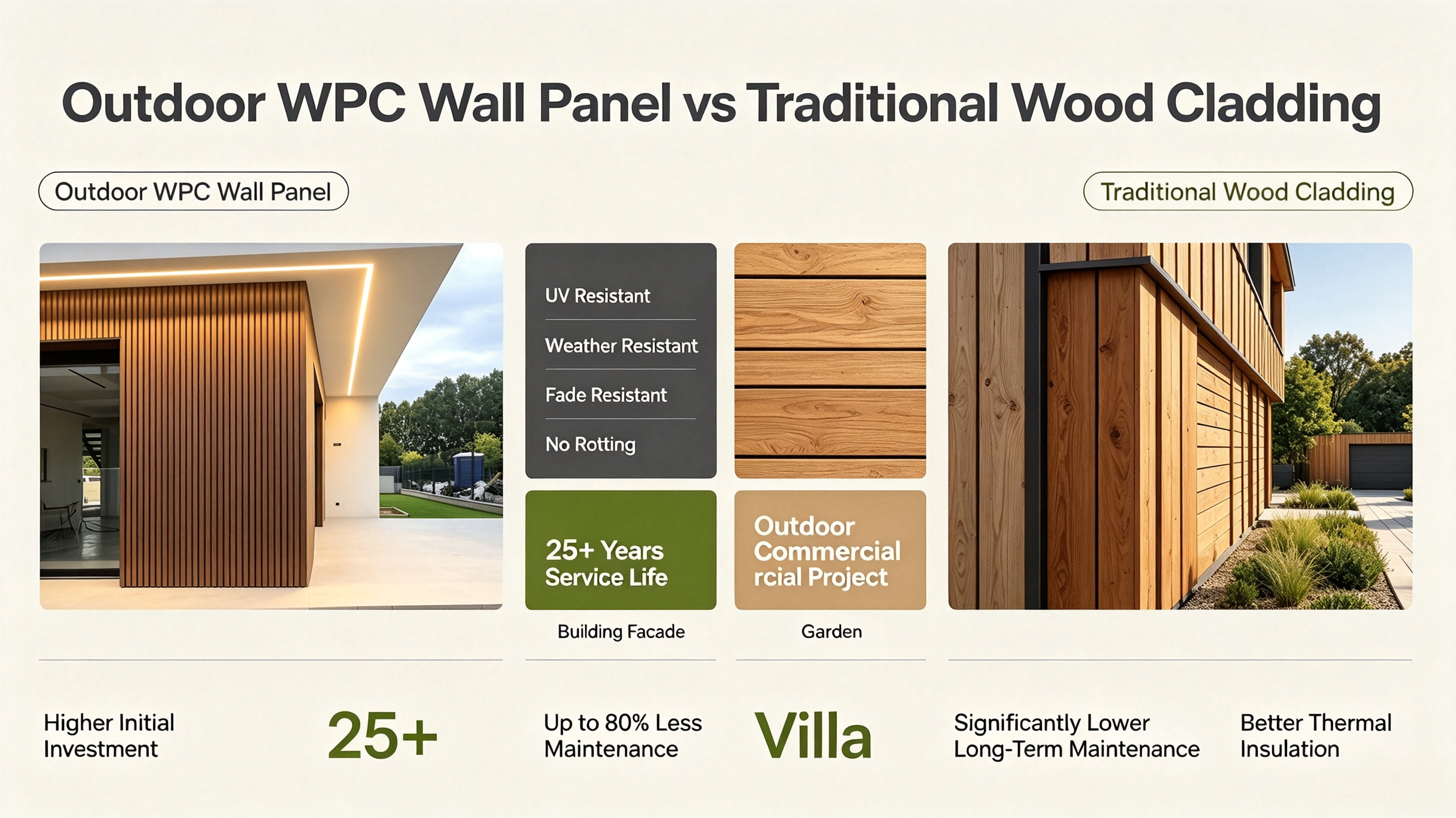
Figure 1 — Outdoor WPC cladding is specified for UV exposure, rain, and temperature cycling. Indoor grades of the same product family are not substitutes for facade work.
PVC marble sheet carries its own boundary. It is documented as an indoor decorative panel, and long-term UV sunlight exposure will cause surface fading and aging. It performs well in dry and wet indoor areas such as bathrooms, but continuous soaking in water during installation should be avoided. The same logic applies to PVC self-adhesive wall stickers, which are not recommended for continuous water-contact shower zones; long-term water immersion causes edge warping and peeling. Adhesion also depends on surface preparation — the sticker requires a flat, clean, dry wall free of dust and loose material, and the documented failure modes include blistering, warping, and falling off when that condition is not met.
How These Products Compare With the Materials They Replace
Comparison claims are only useful when they are tied to a measurable gap. The documented performance differences below come from direct product-to-material comparisons, and they also expose where the new material carries a higher entry cost.
| Product | Replaces | Documented performance gap | Best-fit application | Trade-off to plan for |
|---|---|---|---|---|
| PVC wall panel | Traditional wood veneer or MDF decorative panel | About 40% lighter; installation 50% faster; moisture resistance 100% | Homes, hotels, offices, commercial interiors | Lower installation and maintenance costs, but surface quality depends on a flat, dry base wall |
| WPC wall panel | Solid wood wall panel | Installation 30% faster; maintenance cost reduced by over 60%; service life over 20 years | Living rooms, offices, hotels, retail spaces | Indoor grade only; not suitable for open-air exposure |
| Outdoor WPC wall panel | Traditional wood cladding | Service life 15–25 years; maintenance reduced by up to 80%; UV, weather, and fade resistant; no rotting | Building facades, villas, gardens, outdoor commercial projects | Higher initial investment, offset by significantly lower long-term maintenance |
| PVC marble sheet | Natural marble, ceramic tile, latex paint wall, ordinary plastic wall panel | Up to 70% lighter than natural marble; 40–60% faster installation; up to 60% lower material cost; service life over 15 years | Hotels, apartments, villas, offices, malls, hospitals, schools | Indoor use; not recommended for long-term outdoor exposure |
| PVC ceiling panel | Gypsum or wooden ceiling | Installation 40% faster; service life over 15 years; 100% moisture resistant; 20–30% lower installation cost than wooden ceilings | Bathrooms, kitchens, balconies, commercial ceilings | Framing quality determines joint lines and flatness |
| PVC self-adhesive wall sticker | Wallpaper, ceramic wall tiles | Installation up to 70% faster with no adhesive required; renovation in one day; material and installation cost up to 50% lower than ceramic tiles | Rental apartments, kitchens, bathrooms, DIY decoration | Requires flat, clean, dry substrate; not for continuous water-contact zones |
Alongside the advantages, the documented maintenance profile is what usually decides repeat orders. PVC wall panels need no repainting or anti-mold treatment, WPC panels need no repainting or anti-termite treatment, and outdoor WPC needs no painting, sealing, or frequent repair. PVC ceiling panels can be cleaned with water and need no painting, and their reflective surface is documented to improve indoor lighting efficiency by up to 10%.
Where YIKE NEW MATERIAL Fits in This Comparison
Haining Yike New Material Co., Ltd., trading as YIKE NEW MATERIAL, is a China-based manufacturer and exporter of PVC and WPC decorative building materials, founded in 2019 and operating a 10,000 m² factory with 50 employees, 10 engineers, and a documented annual output of 5,000,000 m². Its product range spans PVC ceiling panels, PVC wall panels, PVC marble sheets and UV marble sheets, PVC marble wall panels, WPC wall panels including WPC fluted profiles, outdoor WPC wall panels, PVC decorative panels, and PVC self-adhesive wall stickers. The company reports a 100% export ratio, with principal markets in Central America, South America, Southeast Asia, the Middle East, and Africa, and supports OEM and ODM across the listed lines.
For a first-time importer, the practical relevance is coverage. Because the three families described above sit in one product range, a buyer can align specifications, packaging, and sample validation through a single supply relationship instead of reconciling three vendors. The limitation is equally important to state: coverage does not remove the duty to validate each family independently. Sample adhesion and removal behavior for self-adhesive products, outdoor aging performance for WPC cladding, and surface consistency for marble sheets are separate tests, and the documented sourcing guidance recommends pre-production samples and test reports before mass orders in every one of these categories.
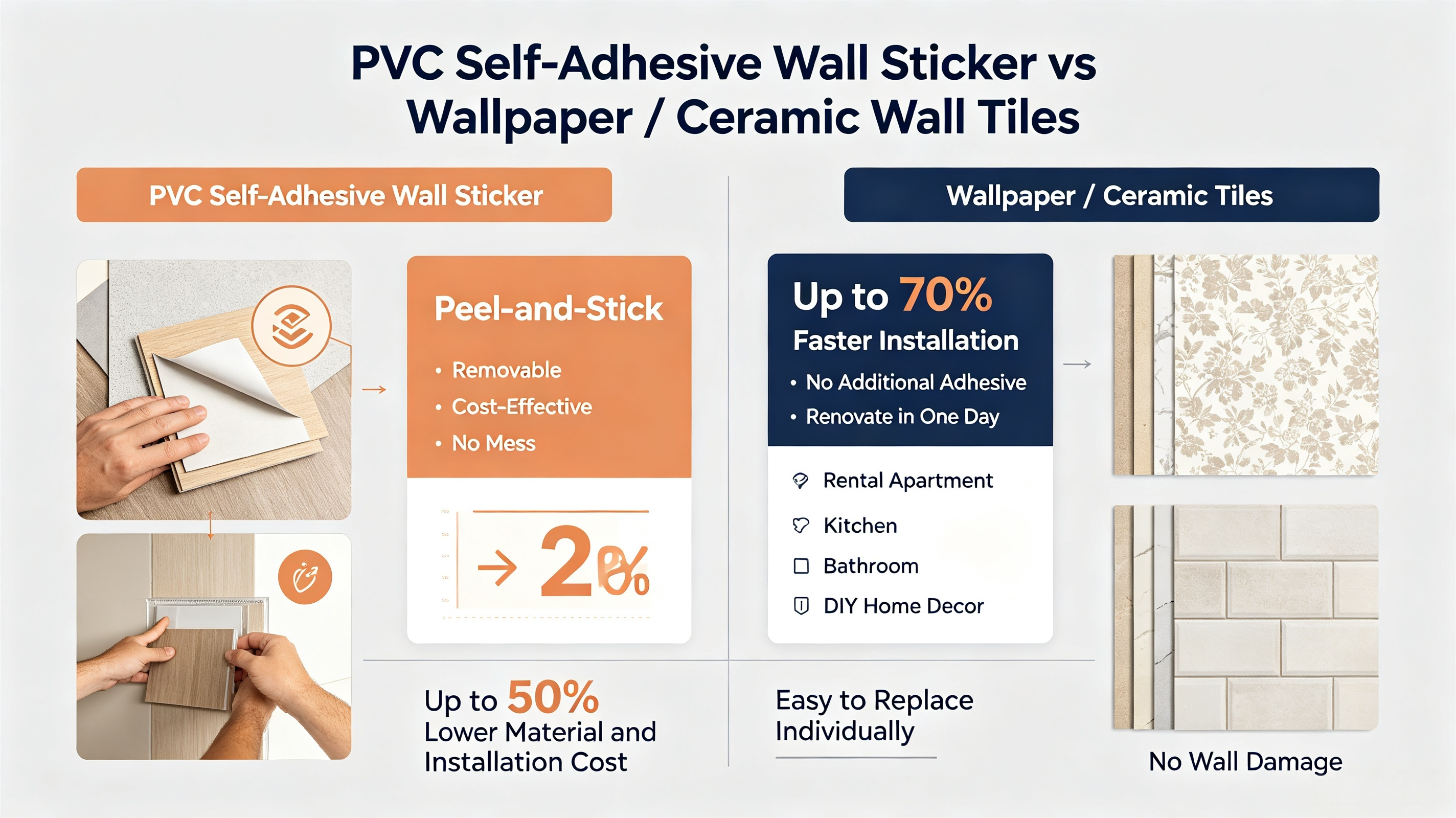
Figure 2 — The self-adhesive family competes on installation speed and replacement cost, but it depends on substrate condition and is bound to dry indoor walls.
Market Trend: What the Numbers Say About the Next Buying Cycle
Several independent datasets point in the same direction: supply is concentrated in Asia, and the fastest-growing sub-segment is the composite panel rather than the plain rigid sheet. China's total PVC exports reached approximately 3.82 million tonnes in 2025, a 46% increase from 2024, according to the General Administration of Customs of the PRC, and India was the single largest buyer of that volume at roughly 39% of the total, based on OilChem and customs data. Dataintelo places Asia-Pacific at a 38.4% revenue share of the global PVC panels market in 2025.
On the composite side, SNS Insider estimates the global WPC market at USD 8.97 billion in 2025, and one industry forecast published by NewTechWPC projects a WPC market CAGR of 11.6% from 2025 to 2030. In decorative surfaces, Metastat Insights projects synthetic marble — the segment that includes PVC marble sheets — to grow at a CAGR of 6.8% from 2025 to 2032. The self-adhesive segment expands on a different driver: vinyl-based peel-and-stick products held a 48.6% share of a USD 3.8 billion market in 2025, a pattern consistent with rental renovation and DIY demand rather than project specification.
Read together, these figures do not say that one family replaces the others. They suggest that buyers who treat the three families as separate product lines with separate end customers are better positioned than buyers who treat them as interchangeable SKUs with different prints.
Compliance and Documentation: The Part First-Time Importers Underestimate
Fire performance is the most common documentation request in this category, and it is market-specific. In North America, ASTM E84 (also published as UL 723) is the primary fire test standard for interior wall and ceiling finishes, and a Class A rating requires a Flame Spread Index between 0 and 25. In the European Union, building material reaction-to-fire classification follows EN 13501-1, and PVC panels typically target Class B-s1, d0 for commercial use. A report issued against one framework does not satisfy the other.
Three further standards appear repeatedly in specification review. ASTM D570 and ISO 62 are the standard test methods for water absorption in PVC and composite panels. ISO 105-B02 covers color fastness to artificial light using a xenon arc fading lamp, which is directly relevant to panels specified for light-exposed interiors and to any outdoor claim. ASTM D1784 specifies the cell classification for rigid PVC compounds, with Cell Class 12454 commonly referenced for building panels that need a balance of impact and tensile strength.
None of these frameworks is a certificate by itself. They define the test a supplier's report should reference, for a specific SKU, for a specific destination market — which is the version of the document a customs broker or project inspector will actually accept.
Limitations and Trade-offs Buyers Should Not Skip
An honest comparison includes the constraints. For a first order, five of them matter most.
- Outdoor WPC costs more up front. Compared with traditional wood cladding, outdoor WPC requires a higher initial investment. The case rests on the long tail: maintenance reduced by up to 80% and a documented 15–25 year service life, with no painting, sealing, or frequent repair.
- Indoor and outdoor WPC are not interchangeable. Indoor panels are documented as unsuitable for open-air exposure and will fade and crack quickly when used on a facade.
- PVC marble sheet is an indoor product. Long-term UV exposure causes surface fading and aging, and continuous water soaking should be avoided even in wet indoor areas.
- Self-adhesive performance is substrate-dependent. Adhesion requires a flat, clean, dry, dust-free wall. Failure modes include insufficient viscosity causing warping and falling off, residual glue after removal, surface yellowing, and bubbles formed during pasting. Under standard indoor conditions and service period, removal leaves little residue; after many years or prolonged high temperature, a small amount of adhesive may remain.
- Rigid panels are only as good as their installation. Documented installation risks include surface color fading and aging, local board deformation in humid conditions, splicing gap deviation, and surface scratching. These are construction and environment issues rather than material defects, and they are the most frequent source of disputes in project supply.
Future Outlook
Three trends are likely to shape how first-time importers structure their opening orders. First, documentation is becoming a purchasing criterion rather than an afterthought: as export volumes rise — China's PVC exports grew 46% year over year to roughly 3.82 million tonnes in 2025 — importers are increasingly asked by their own customers for fire, water absorption, and color fastness evidence tied to a specific SKU. Second, the composite panel segment is expanding faster than the rigid sheet average on published forecasts, which points to continued growth in semi-exterior and facade applications where WPC's weather resistance replaces repainting cycles. Third, the adhesive segment will keep growing alongside rental and DIY renovation, but it will remain a retail product with a different buyer, a different shelf format, and a shorter service cycle than a project panel.
The practical conclusion for a first-time importer is not to choose one family. It is to match each family to the customer who will actually install it, verify the specification in writing, and validate samples before the container is loaded.
FAQ
Can indoor WPC wall panels be used for an exterior facade?
No. Outdoor WPC wall panels carry a specific anti-UV and weather-resistant formulation designed to resist sunlight, temperature change, and rain erosion. An indoor WPC panel installed on an exterior facade will fade and crack rapidly in outdoor conditions. The two products share a family name but differ in formulation and intended environment.
What wall surface conditions are required before pasting a PVC self-adhesive wall sticker?
The wall must be flat, clean, dry, and free of dust and loose material. Powdered, uneven, or damp surfaces produce insufficient adhesion, leading to blistering and falling off. The documented installation sequence is to clean and dry the wall, measure and cut the sticker, peel the backing release paper slowly, paste from top to bottom while squeezing out air, then trim the edges. Continuous water-contact shower zones are not recommended, because long-term water immersion causes edge warping and peeling.
How should a first-time importer choose a reliable PVC wall panel supplier?
Work with direct manufacturers that apply strict quality control and hold relevant certificates, rather than intermediaries. Check board density, sheet flatness, surface film bonding strength, anti-yellowing performance, and environmental performance, then confirm thickness and large-size specifications, waterproofing, export certifications, customization capability, price, production capacity, and lead time. Confirm sample quality before bulk orders. This standard applies to overseas importers, building material wholesalers, and interior decoration project buyers.
What should a buyer verify before placing a bulk WPC wall panel order?
Evaluate manufacturing experience, quality control discipline, and export service reliability. Review product samples, factory certifications, customization capability, customer feedback, and after-sales support. On specification, check the wood-plastic raw material ratio, anti-deformation performance, surface coating durability, thickness and width, waterproof and fire resistance, certifications, customization ability, price, production capacity, and lead time. Pre-production samples and test reports are recommended to prevent inconsistency between sample and mass order.
How should an importer evaluate an outdoor WPC wall panel factory before ordering?
Look for proven export experience, consistent product quality, relevant certifications, and customization capability. Request samples, check production capacity and project references, and confirm after-sales support before placing a bulk order. Specification review should cover anti-UV performance, weather resistance, anti-fading performance, the wood-plastic formula, anti-deformation, waterproofing, thickness and profile specification, the surface co-extrusion layer, fire certification, price, capacity, and lead time.
How do I select a PVC self-adhesive wall sticker supplier for bulk import?
Choose direct manufacturers with strict quality control and quality certificates. Verify the PVC surface texture, adhesive viscosity, anti-yellowing performance, backing release paper quality, and printing clarity. Test stickiness and clean removal on samples before committing to a bulk order. The selection parameters include material quality, printing definition, adhesive strength, residue-free removal performance, anti-yellowing, waterproof property, thickness, pattern customization, roll size specification, certifications, price, production capacity, and lead time.
For readers who need the underlying specifications before requesting samples, the full YIKE New Material catalog is available as a downloadable document.
Third-party data referenced in this article: Dataintelo (PVC panels market and peel-and-stick wallpaper market), SNS Insider (global WPC market), General Administration of Customs of the PRC and OilChem (China PVC export volumes and destinations), Metastat Insights (synthetic marble CAGR), NewTechWPC (WPC market forecast), ASTM International (ASTM E84, ASTM D1784, ASTM D570), CEN (EN 13501-1), and ISO (ISO 62, ISO 105-B02). Product specifications and comparison figures are drawn from YIKE New Material product documentation.
¿Tiene preguntas o necesita más detalles?
Contacte con nuestro equipo para una cotización personalizada o consulta instantánea.
Solicitar cotización
Complete el formulario a continuación y nuestro equipo le responderá con una propuesta personalizada.
Chat directo de WhatsApp
¿Prefiere chatear en tiempo real? Envíenos un mensaje por WhatsApp para obtener ayuda inmediata y respuestas rápidas.
- Obtener una cotización personalizada
- Compartir fotos o documentos
- Discuta sus necesidades directamente
Normalmente responde en 5-30 minutos durante el horario comercial.