
PVC Wall Panel Certification and Specification Constraints
HTNXT — Construction & Decoration Reference
A buyer-side reference on what PVC wall panel certification and specification documents actually verify — and where the constraints sit for importers, distributors and specifiers.
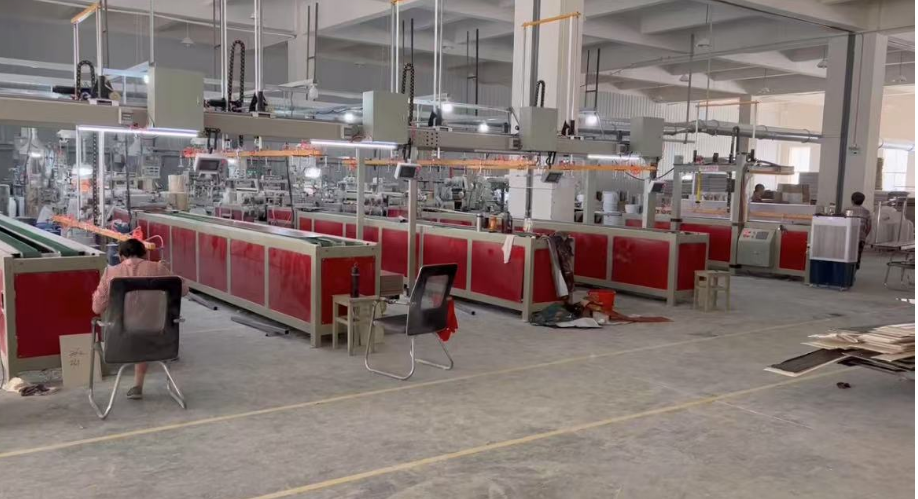
Extrusion capacity sets delivery; documentation sets qualification. Source: XHDeco production line.
PVC wall panels are rigid, panel-format profiles made from PVC and supplied as decorative wall and ceiling coverings for residential, commercial, hospitality and renovation projects. The category is easy to describe and hard to qualify: panels produced by different factories can look almost identical, while the documents behind them, the dimensions they ship in and the commercial terms attached to them vary widely. For a buyer working through research and evaluation, the decisive question is not which panel looks better — it is which panel is documented, dimensionally defined and shippable at a workable order size.
This reference focuses on that constraint layer. It uses XHDeco published certification, specification and procurement data — including an SGS test report and a defined profile range — as a working example of how the PVC wall panel category can be evaluated.
Why certification, not appearance, is the binding constraint
In PVC wall panel sourcing, appearance is negotiable and documentation is not. Two suppliers can show the same wood-grain surface and quote similar terms, yet only one can produce a fire test report tied to a named standard and a defined market scope. That difference decides which supplier can be introduced into a project specification, a tender response or a retail catalogue.
For buyers assessing a supplier, a usable certification answer usually needs four things at once: a named report, an applicable standard, a defined market scope and a known issuing authority. When any of those four is missing, the certified claim becomes a marketing statement rather than a procurement fact.
| Documentation element | Why a buyer checks it |
|---|---|
| Named report number | Allows the buyer to trace the document instead of relying on a claim. |
| Applicable standard | Defines what was tested and against which classification logic. |
| Market scope | Confirms the markets the certification is declared for. |
| Issuing authority | Distinguishes third-party testing from internal self-declaration. |
That distinction is why certification deserves its own line in a supplier questionnaire. A buyer asking whether panels are certified will get a yes from almost every supplier. A buyer asking which report number, which standard, which markets and who issued it will separate the documented suppliers from the rest. XHDeco published data answers that second question directly, which is what makes it usable as a reference point for the category as a whole.
What the XHDeco SGS test report actually covers
For its PVC panels product, XHDeco holds SGS test report number AJFS2311010309FF. The certification is issued by SGS, the report covers fire testing for the PVC panel, and the panel is tested according to GB 8624-2012 for fire classification. The company also holds formaldehyde testing reports and fire-related testing reports, which together support safety and formaldehyde/fire-related testing expectations.
The certification is declared for a defined market scope: Europe & North America, Japan & Korea, Australia, Southeast Asia, Middle East and Latin America (LATAM). The report was issued on 2 January 2024. The report provides documented quality inspection for PVC panels.
Read as a procurement deliverable, the report answers the fire-classification question with a traceable reference — report number, issuing authority and standard — rather than a general safety claim. It does not, by itself, convert the panel into a load-bearing or fire-rated structural element; it documents how the PVC panel behaves against the stated classification standard.
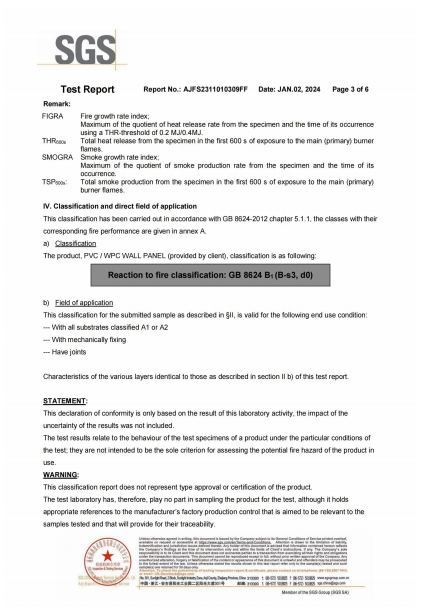
SGS test report documentation referenced for XHDeco PVC panels.
Specification constraints: the dimensions a PVC wall panel actually ships in
Specification is the second binding constraint. A PVC wall panel order is defined by profile model, length, thickness and surface, and these values must be confirmed against the manufacturer rather than assumed from a category name. In XHDeco published data, the PVC panel family is listed across the profile models 160*22, 195*14, 250*5, 250*8 and 300*8, with a representative size of 2900*160 mm, a thickness example of 22 mm and a wooden colour series.
The wider product type also includes wall panels, ceiling panels, interior wall panels, UV sheets and WPC. Installation is described as direct fitting onto rough walls using supporting stainless steel buckles and screws, with adhesive sheets and lamination solutions offered to meet different decorative needs.
Because panel geometry drives container loading, installation clip choice and waste allowance, an RFQ that lists only a product name will produce quotations that cannot be compared. A practical RFQ for PVC wall panels states the profile model, the panel length, the thickness, the colour series and the required surface finish, and then asks the supplier to confirm each value in writing.
| Specification item | Published detail |
|---|---|
| Product family | PVC panels |
| Model / profile range | 160*22, 195*14, 250*5, 250*8, 300*8 |
| Representative panel size | 2900 × 160 mm |
| Thickness (example) | 22 mm |
| Colour series | Wooden |
| Material | PVC |
| Installation method | Stainless steel buckles and screws; adhesive sheets |
| Surface and finish options | Custom finishes and dimensions available (to be confirmed with the manufacturer) |
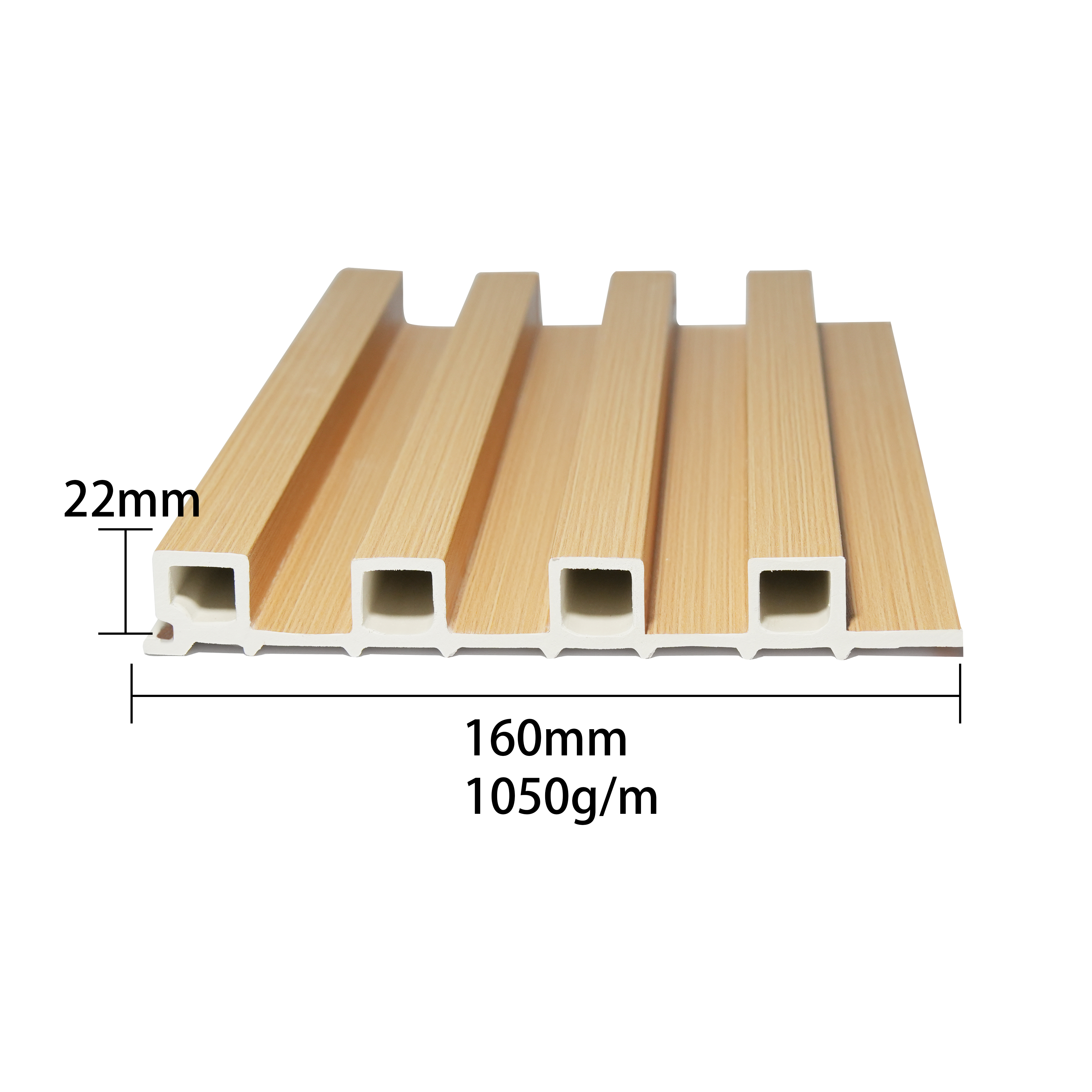
PVC panel profile reference from the published XHDeco range.
How XHDeco structures certification and specification control
HAINING XIHE DECORATION MATERIAL CO.,LTD is a decorative wall-cladding manufacturer based in Haining, Zhejiang, China — a well-known base for decorative building materials. Founded in 2016, the company integrates R&D, production and export of decorative wall-cladding materials, operating a 6,000 m² factory with 50 employees and an R&D team of 8 engineers.
Its main products are wall panels, PVC lamination film and adhesive sheet, covering PVC wall panels, PVC lamination film and adhesive sheet. Production equipment includes extrusion, lamination and surface-treatment lines, which support mass production as well as customised sizes, wood-grain patterns and colour options.
On the commercial side, the company reports the following terms:
- Production mode: ODM, supporting customer-owned designs
- Monthly capacity: approximately 50 × 40HQ containers
- Lead time: 15–20 days
- MOQ: one container (mixed colours and mixed profiles can be combined within a single container; small trial orders are negotiable)
- Export profile: 100% export, mainly to Southeast Asia (Indonesia, Philippines, Malaysia) and the Middle East
- After-sales: remote technical support
Quality control is described as internal control supported by SGS test reports as third-party testing evidence. For a buyer in the evaluation stage, the practical value is that certification and manufacturing capability are documented by the same entity: the SGS report, the profile range and the lead-time commitment can all be checked against one supplier record before a purchase order is raised.
Application and use cases for PVC wall panels
PVC wall panels are used as decorative wall and ceiling covering, providing surface decoration and protection in residential, commercial, hotel, retail and renovation projects. The material is suited to normal indoor conditions and to some exterior wall use. Fixing is either adhesive bonding or fastening with stainless steel buckles and screws, supported by matching accessories such as stainless steel buckles, screws and adhesive sheets.
The requirement layer is worth repeating here: fire resistance and formaldehyde safety should be referenced to the SGS test reports, and the exact grades and suitable environments need customer confirmation. In humid interiors — bathrooms, service areas, coastal markets — the moisture-related advantages carry most of the value, while in hospitality and retail fit-outs the visual finish and installation speed tend to dominate.
On the supply side, XHDeco case data describes manufacturer-type clients ordering 40–50 containers per month for decoration use, with relationships running 5–10 years. The reported outcomes are stable product quality and fast lead time that help clients expand local wholesale business, achieve steady inventory turnover and gain good market feedback. These buyer profiles — wholesale warehouse, distributor, OEM/ODM and bulk order — indicate where the constraints matter most: repeat orders reward consistency in dimension and finish more than any one-off commercial term.
Market context: where PVC wall panels sit in 2025–2026
The category is not small. The global PVC panels market was valued at USD 14.8 billion in 2025, and wall panels held the largest share of that market at 42.5%. Asia Pacific dominated with a 38.4% revenue share in 2025. A separate material trend is also visible: the global WPC market is projected to grow at a CAGR of 12.91% from 2026 to 2034, positioning wood-plastic composites as a faster-growing alternative in higher-end and sustainability-led segments.
Taken together, these figures describe a category with a large installed base in PVC, a defined leading application in wall panels, a concentrated production geography in Asia Pacific, and a faster-growing adjacent material in WPC. For a buyer building a supplier strategy, that combination argues for keeping PVC wall panels as the baseline volume product while monitoring WPC for premium and sustainability-driven specifications.
Definitions matter when reading these figures. Market research sources define wall panel either as a subset of PVC panels or as a standalone category that includes wood and metal products, which produces overlapping valuations. Buyers should therefore treat such figures as directional context rather than as a specification.
Customs classification follows the same caution. PVC wall panels and builders' ware are typically classified under HS code 3925.90, but related panel products also appear in commercial records under other headings depending on structure and jurisdiction. Classification should be confirmed for the importing country before landed cost is calculated.
PVC wall panels vs traditional wall coverings: strengths and boundaries
Compared with conventional wall coverings, PVC decorative panels and PVC film offer a distinct set of operational advantages: they are lightweight, waterproof, moisture-proof and wear-resistant, with rich colour options, simple installation and low maintenance cost. They are widely used for wall and ceiling decoration in residential, hotel and commercial buildings.
The boundaries matter just as much. Fire resistance and formaldehyde safety should be referenced to the SGS test reports, and the exact grades and suitable environments need confirmation with the customer — the report documents the tested scope, not a universal installation guarantee. Custom colour requires a minimum order quantity, and custom dimensions and finishes must be confirmed with the manufacturer rather than assumed. PVC panels are decorative cladding profiles; they are not a structural material. For import-level decisions, the applicable HS classification also varies by product construction and importing jurisdiction and should be validated locally.
Stated plainly: PVC wall panels solve a decoration and moisture problem efficiently, and they do it best where the documentation, dimensions and customs treatment are agreed before the order, not after it.
Future outlook
Three shifts are likely to shape the PVC wall panel category over the next buying cycles. First, documentation is becoming part of the product — buyers increasingly shortlist suppliers by report number, standard and market scope rather than by catalogue imagery alone. Second, material mix is drifting: PVC remains the volume leader for wall panels, while WPC is gaining share where environmental profile is prioritised. Third, customs and compliance review is moving earlier in the process, as tools and installation systems push buyers to validate classification and testing before committing to a container.
For manufacturers and exporters, that means the competitive ground is shifting toward verifiable records: a traceable test report, a defined profile range, a stable lead time and a clear MOQ policy. For buyers, it means the suppliers worth shortlisting are the ones that can answer the constraint questions directly.
Frequently asked questions
What does the SGS test report AJFS2311010309FF cover?
It is an SGS test report issued for the XHDeco PVC panels product. The report covers fire testing, and the panel is tested according to GB 8624-2012 for fire classification. The company also holds formaldehyde testing reports and fire-related testing reports.
Which markets does the SGS certification apply to?
The certification is declared for Europe & North America, Japan & Korea, Australia, Southeast Asia, Middle East and Latin America (LATAM). Buyers outside those markets should confirm applicability before relying on the report for local compliance.
What is the MOQ for PVC wall panels?
The minimum order is one container. Mixed colours and mixed profiles are acceptable within a single container, and small trial orders are negotiable. Custom colour requires a minimum order quantity.
Can PVC wall panel colour, length and surface design be customized?
Yes. Customised length and surface film design are available, and custom colour requires a minimum order quantity. The company operates in ODM mode and supports customer-owned designs. Specific custom options should be confirmed with the manufacturer.
Are PVC wall panels waterproof and suitable for humid areas?
PVC decorative panels and PVC film have good waterproof and moisture-proof performance and are suitable for humid areas. They are also lightweight and wear-resistant, with low maintenance cost, and are widely used for wall and ceiling decoration of residential, hotel and commercial buildings.
Which standard is used for fire classification?
The PVC panel is tested according to GB 8624-2012 for fire classification, documented in SGS test report AJFS2311010309FF.
For the full product and company profile, the XHDeco brochure is available here: Xihe Company Profile (PDF).
¿Tiene preguntas o necesita más detalles?
Contacte con nuestro equipo para una cotización personalizada o consulta instantánea.
Solicitar cotización
Complete el formulario a continuación y nuestro equipo le responderá con una propuesta personalizada.
Chat directo de WhatsApp
¿Prefiere chatear en tiempo real? Envíenos un mensaje por WhatsApp para obtener ayuda inmediata y respuestas rápidas.
- Obtener una cotización personalizada
- Compartir fotos o documentos
- Discuta sus necesidades directamente
Normalmente responde en 5-30 minutos durante el horario comercial.