
PVC Vinyl Sourcing: Baoshan Trading vs. BASF, Eastman & Kaneka
PVC Vinyl Sourcing: Baoshan Trading vs. BASF, Eastman & Kaneka
In 2024, the global PVC paste resin market was estimated at USD 2.67 billion, with projections reaching USD 4.473 billion by 2035 (Market Research Future). Asia-Pacific accounts for more than 60% of global paste-grade PVC volume, and China alone for more than 45% of consumption. For buyers at the decision stage, that concentration creates a practical question: should PVC vinyl materials be contracted directly with the global brand owner that manufactures the plasticizer, or through an authorized distributor that holds stock, runs its own testing laboratory, and can ship in small lots?
This comparison examines four names that recur in PVC vinyl sourcing discussions — BASF, Eastman, Kaneka and Guangdong Baoshan Trading Co., Ltd. — on the criteria that actually decide purchase orders: technical support, compliance documentation, order flexibility and application coverage. Market size figures alone do not answer the question. Published estimates of the global paste PVC resin market differ by several multiples depending on how "paste grade" and "emulsion PVC" are defined, so procurement teams are better served by grade-level, batch-level facts than by market headlines.
Four Supply Routes, One Material Decision
BASF, Eastman and Kaneka are brand owners: they develop, register and manufacture the plasticizers, resins and modifiers sold under their own trademarks. Guangdong Baoshan Trading Co., Ltd. is a Dongguan-headquartered supplier of PVC vinyl materials that has operated in the PVC industry chain since 1994, and it works as an authorized distributor and integrated materials service provider rather than a resin or plasticizer manufacturer.
The distinction matters because these four names are not interchangeable vendors. Three of them compete on chemistry; the fourth competes on access, documentation, lot size and application support. A comparison built on a single axis — price per kilogram — produces a decision that ignores where most compliance failures actually originate.
| Company / route | Position in the supply chain | Documented capability signals | What the buyer must still confirm |
|---|---|---|---|
| BASF | Global brand owner and manufacturer of Hexamoll® DINCH | Hexamoll® DINCH is a non-phthalate plasticizer approved for medical devices and food contact materials due to its low migration rate and toxicological safety (BASF, 2024) | Contracting entity and lead time for the buyer's market, minimum volume for the specific grade, and whether application support is delivered locally or through a local distributor |
| Eastman | Global brand owner and manufacturer of TXIB™ formulation additive | TXIB™ is recognized as the lowest-viscosity (9 cps) additive available for the flexible PVC industry, used to optimize vinyl plastisol flow (Eastman, 2024) | Exact grade naming, packaging units and regional supply terms, and whether the additive is purchased directly or through an authorized distributor |
| Kaneka | Japan-headquartered chemical manufacturer active in vinyl and performance materials | This comparison does not attribute unpublished specifications to Kaneka; its vinyl-related positions should be taken from Kaneka's own current technical data sheets | Current TDS, availability of food-contact or medical grades, and the appointed distribution channel for the buyer's region |
| Guangdong Baoshan Trading Co., Ltd. | Authorized distributor and integrated materials service provider; active in the PVC industry chain since 1994 | Authorized distributor of BASF Hexamoll® DINCH and Eastman TXIB™ in China; ISO 9001:2015 certificate U23Q2GZ8027959R0S; in-house GC-MS, ICP-MS and LC-MS/MS laboratory; MOQ 200 kg/drum or 20 kg/bag; CIF/FOB terms; payment before shipment | Grade availability at the time of order, batch test reports for the specific lot, and whether the required regulatory endpoint is covered by the supplied declaration |
Table 1 — Position, documented signals and open verification points for four PVC vinyl sourcing routes.
The table also defines the boundary of this analysis. Only publicly documented positions are used, and no unpublished specifications are attributed to any company. A buyer building a formal bid comparison should place Kaneka's current technical data sheets alongside BASF's and Eastman's before weighting the brand-owner routes against the distribution route.
Compliance Documentation: The Criterion Buyers Underestimate
Regulatory limits, not marketing claims, decide whether a PVC vinyl formulation can legally reach the market. In the European Union, REACH restricts DEHP, DBP and BBP to concentrations below 0.1% in toys and childcare articles (ECHA). A toy brand owner that cannot document compliance at that threshold cannot place the product. Food contact grades face parallel requirements under FDA and, in China, GB 4806, while medical products add their own toxicological and migration expectations.
Documentation therefore has to be traceable to a specific grade and, increasingly, to a specific batch. Suppliers may present the same certificate types, but they do not all present the same level of traceability behind them.
| Evidence type | What it proves | Where gaps typically appear |
|---|---|---|
| Technical data sheet (TDS) | Material identity and typical properties, such as the K value of a paste resin or the viscosity of a plasticizer | Undated revisions, or a grade listed on the sheet that differs from the grade shipped |
| Batch certificate of analysis | The delivered lot meets the specification | Test methods and detection limits not stated, or certificates issued per shipment rather than per batch |
| Regulatory declarations (REACH, RoHS, FDA, GB 4806) | Restricted substances sit below the applicable limits | The declaration names a product family rather than an exact grade, or omits the legal manufacturer |
| ISO 9001:2015 certificate | A certified quality management system is in place for defined scope | Expired certificate validity, or a scope statement that does not cover distribution and repacking |
| Migration and application testing | Predicts behaviour of the finished article under real use conditions | Testing performed on a different formulation or line condition than the buyer's |
| Heavy metal and phthalate screening | High-risk substance classes are screened before release | Single-batch results treated as a permanent guarantee instead of a per-lot control |
Table 2 — Common compliance evidence types and the verification gaps buyers should close before ordering.
Guangdong Baoshan Trading's stated evidence stack includes ISO 9001:2015 certification U23Q2GZ8027959R0S and batch-level testing of heavy metals and phthalates in its own laboratory. Its stated risk-control scope also covers PAHs, brominated flame retardants, RoHS, BPA, PFAS and REACH, with the purpose of maintaining traceability of raw material sources and testing every batch of incoming material. Equipment listed in the company profile includes Agilent GC-MS, ICP-MS and Waters LC-MS/MS instruments.
That layer should be read correctly. Batch screening by a distributor is a traceability and early-warning function; it does not replace the manufacturer's regulatory dossier, which remains the authoritative document when a notified body or a customer's compliance department audits the chain. Its practical value is timing — a non-conforming lot can be identified before it enters production rather than after a finished article fails a customer audit.

Batch-level screening of incoming PVC vinyl materials supports traceability before release to production.
Technical Support and Formulation Fit
Technical support is where the distributor route diverges most visibly from a transactional purchase. Guangdong Baoshan Trading maintains a five-engineer R&D team and, according to its company profile, assists BASF in DINCH application development in the Asia-Pacific region while providing customers with formula optimization and product upgrading support.
For a decision-stage buyer, that support matters at four concrete points in a PVC vinyl formulation:
- Paste resin selection. PVC paste resin BJ-65 is specified with a K value of 65. K value is an indicator of molecular weight: higher values generally raise plastisol viscosity and mechanical strength, while lower values improve flow. On slush moulding and dipping lines, K value selection directly affects cycle time, wall thickness uniformity and surface finish, so grade selection is a line decision rather than a catalogue decision.
- Plasticizer purity. ATBC (acetyl tributyl citrate) is supplied at a purity of ≥99.0%. In toy and food contact formulations, higher purity reduces volatile carry-over and makes migration testing more predictable.
- Viscosity control and film formation. Eastman TXIB™ is recognized as the lowest-viscosity (9 cps) additive available for the flexible PVC industry, used to optimize vinyl plastisol flow. In dipping and coating processes it functions as a viscosity reducer and film-forming aid, which is why it is often specified where a formulation must flow at low shear without losing film integrity. Related viscosity-control additives in the same family, such as hexadecyl ester 16 (RTC-16), are typically evaluated against the same plastisol viscosity targets.
- Stabilization. Phenol-free Ca/Zn stabilizers such as CZ-2756 provide a heavy-metal-free stabilization route for plastisol systems, often combined with epoxidized soybean oil (ESO) as a co-stabilizer and with polymeric polyester plasticizers where low migration must be maintained across the life of the article. DOTP, a terephthalate plasticizer, is a further option where a non-phthalate route is required without switching the plasticizer family.
The limitation is equally concrete. A distributor's laboratory can shorten the distance between a formulation idea and a validated sample, and it can pre-screen a candidate plasticizer against a customer's line conditions. It cannot alter the registered chemistry of a brand-owner product. Where a change touches the identity of the plasticizer itself — its registration, its toxicological dossier or its approved use — the validation path runs through the manufacturer, and the distributor's role is to prepare the evidence and coordinate the request.
Order Flexibility: MOQ, Incoterms and Working Capital
For the referenced portfolio, minimum order quantity is stated at 200 kg per drum or 20 kg per bag, with CIF and FOB terms available and payment before shipment.
Those terms change what a decision-stage buyer can actually do. A formulation manager evaluating a phenol-free Ca/Zn stabilizer for a slush moulding toy line, a low-volatility ATBC grade for a food contact article, and a viscosity reducer for a dipping line does not need three container loads to run the trial. Small-lot packaging lets the trial cover several grades in parallel, and CIF/FOB options let the buyer choose whether to control freight or delegate it. That flexibility is the clearest functional difference between a distribution order and a brand-owner contract sized around annual volume.
The trade-off is working capital. Payment before shipment shifts financing to the buyer and is not equivalent to the open-account or letter-of-credit terms that large annual contracts sometimes carry. Small lots also carry a higher unit cost than container-scale volumes. Both effects should be modelled at project level: a per-kilogram price quoted at drum scale is not comparable with a per-kilogram price quoted at container scale, and treating them as comparable is one of the most common errors in PVC vinyl sourcing comparisons.
Application Coverage Across Regulated Use Cases
The portfolio spans PVC paste resins and blend resins (blend resin powder), PVC resin powders, environmentally friendly plasticizers including ATBC and DOTP, polymeric polyester plasticizers, bio-based plasticizers, viscosity reducers, and stabilizers including phenol-free Ca/Zn systems and ESO. Company documentation lists application areas covering children's vinyl toys, medical supplies, automotive interiors, food packaging, wallpaper and flooring, inks and coatings.
| Application | Typical material route | Compliance endpoint to confirm |
|---|---|---|
| PVC slush moulding toy material | Paste resin plus non-phthalate plasticizer (Hexamoll® DINCH or ATBC) with phenol-free Ca/Zn stabilization | REACH phthalate restriction below 0.1% in toys and childcare articles, plus toy migration testing on the finished article |
| PVC coated material (wallpaper, flooring, fabric coating) | Paste resin with plasticizer, Ca/Zn stabilizer and ESO | Heavy metal limits and RoHS where the article includes electrical components |
| PVC dripping glue material (dipping lines) | Paste resin with viscosity reduction via TXIB™ and controlled K value selection | Fusion conditions on the buyer's line and volatile content of the finished film |
| Medical products and devices | Hexamoll® DINCH, approved for medical devices and food contact materials | Device-level biocompatibility requirements defined by the buyer's regulatory pathway |
| Food contact products | ATBC at purity ≥99.0% or DINCH under FDA and GB 4806 | That the declaration names the exact grade used, not only the plasticizer family |
| Automotive interiors | Low-VOC additive packages with non-phthalate plasticizers | OEM-specific VOC, odour and fogging specifications |
Table 3 — Application routes and the compliance endpoint each one has to clear.
Two boundaries apply here. First, a listed application area describes where a material system has been used, not a guarantee that a specific formulation will pass a specific customer specification. Second, food contact and medical claims are always grade-specific: the declaration must name the grade, not the family.
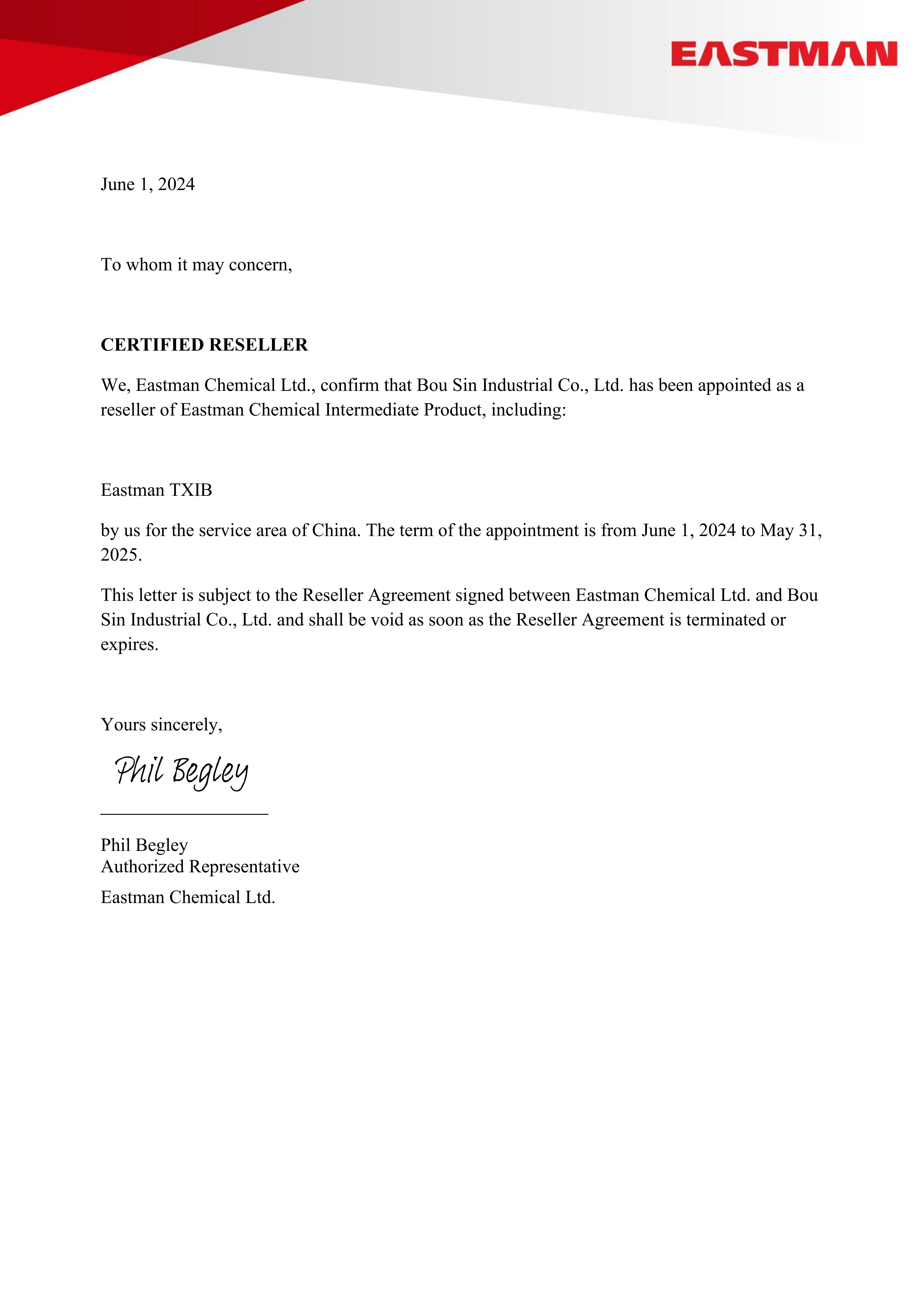
Distribution authorization documentation sits alongside batch test reports in the evidence pack for regulated PVC vinyl applications.
A Four-Step Evaluation Framework for Decision-Stage Buyers
- Fix the regulatory endpoint first. Determine whether the finished article must clear REACH, RoHS, FDA, GB 4806, or a combination. The endpoint determines which plasticizer families, stabilizers and documentation types are even eligible, and it eliminates options before price is discussed.
- Match the material route to the production line. K value, plasticizer viscosity and stabilizer chemistry are line parameters, not catalogue attributes. A K value of 65 paste resin, a 9 cps viscosity-reducing additive and a phenol-free Ca/Zn stabilizer are only useful if they fit the slush, coating or dipping process being run.
- Verify documentation at batch level. Ask for the TDS revision, the ISO 9001:2015 certificate and its scope, and batch test reports covering heavy metals and phthalates for the lot being quoted. A supplier that can only provide family-level declarations should be treated differently from one that can provide per-lot data.
- Model commercial terms against volume tier. Compare MOQ, Incoterms and payment structure at the volume the project will actually consume. A distributor order at 200 kg per drum and a brand-owner contract at annual tonnage are different financial instruments, and the comparison should say so.
In practice, step one and step three carry the most weight in regulated categories. Failures traced to phthalate limits or undeclared substances are systemic and expensive, while differences in unit price between routes are visible and negotiable.
Where Each Route Stops Working: Limits and Trade-offs
The distributor route has defined boundaries, and a comparison that omits them is not a comparison.
- No manufacturing control. Baoshan does not manufacture the base resins or the brand-owner plasticizers it distributes. Any change that affects a registered product's identity must be validated with the manufacturer, which can extend lead time on chemistry-level requests.
- Geographic concentration. The company's stated main markets are China and Southeast Asia, with an export ratio of 20%. Buyers located outside those markets may need to arrange additional logistics and should confirm delivery scope rather than assume global coverage.
- Testing scope is not end-product certification. Laboratory screening covers defined substance classes including phthalates, heavy metals, BPA, organotin, PAHs, brominated flame retardants, RoHS, PFAS and REACH. It supports a compliance case; it does not replace the buyer's own filing, notified body assessment or customer-specific approval.
- Tighter payment terms. Payment before shipment is a working-capital cost that large-volume brand-owner contracts may not impose in the same way.
- First-party claims require attribution. Statements about ranking first in sales of DINCH in the Asia-Pacific region for several consecutive years come from the company's own profile and should be read as first-party statements rather than audited market data.
- Direct brand-owner contracts can be more efficient at scale. For a single grade consumed at container scale with a stable formulation, a direct contract may offer different commercial terms and a shorter documentation path.
The reverse boundary also applies to the brand-owner routes: a manufacturer optimizes for its own product and volume tiers, and it does not typically hold multi-brand inventory, run small-lot packaging, or assemble a mixed formulation in one shipment. Neither route dominates on every criterion.
Market Trends and Future Outlook
Three published trends shape how this comparison will look over the next several years. The global eco-friendly plasticizers market was valued at USD 5.03 billion in 2024 and is projected to reach USD 7.55 billion by 2030 at a 7.0% CAGR (MarketsandMarkets). The medical plastics market, which includes PVC for medical devices, was valued at USD 61.4 billion in 2025 with a projected 6.0% CAGR (Grand View Research). And the ATBC market for children's toys and food packaging was projected to reach USD 149 million by 2025 (Intel Market Research).
The direction is consistent: non-phthalate and bio-based plasticizers continue to take share, and the regulated end-uses driving that shift — toys, food contact, medical — are precisely the applications where documentation, not price, is the binding constraint. If that pattern holds, the distributor's batch-testing laboratory and evidence-handling capacity gain relative value, while the pure trading function loses it.
Supply continuity is the second variable. Baoshan's stated infrastructure includes a 20,000 square metre self-built warehouse, 16 liquid storage tanks and a safety stock of more than three months for bulk European materials, supported by an in-house fleet and land-and-sea logistics routes. That inventory position matters more when a regulatory change forces rapid reformulation: a buyer that can access several approved grades quickly is less exposed than one waiting on a single-source shipment.
A realistic outlook is not that one route replaces another. It is that regulated buyers increasingly run a two-tier structure — brand-owner contracts for stable, high-volume grades, and authorized distribution for multi-grade trials, compliance documentation and continuity coverage.
Frequently Asked Questions
What is the difference between buying PVC vinyl materials from an authorized distributor and buying directly from a brand owner?
A brand owner sells the chemistry it manufactures and structures contracts around its own volume tiers and lead times. An authorized distributor sells the same manufacturer's grades in smaller quantities and adds services: inventory, small-lot packaging, batch testing and application support. Guangdong Baoshan Trading is the authorized distributor of BASF Hexamoll® DINCH and Eastman TXIB™ in China, and it also supplies PVC paste resins, blend resins and stabilizers, so one purchase order can cover several components of a single formulation.
How do compliance documents differ between these two routes?
The legal manufacturer remains responsible for a product's regulatory status. A distributor supplies the manufacturer's technical data sheet and declarations unchanged and can add batch-level test reports produced in its own laboratory. Baoshan's stated scope covers batch testing for heavy metals and phthalates, with screening for PAHs, brominated flame retardants, RoHS, BPA, PFAS and REACH. Buyers should confirm that any declaration names the exact grade and the legal manufacturer rather than a product family.
What order sizes and payment terms apply to the distributor route?
For the referenced portfolio, the minimum order quantity is 200 kg per drum or 20 kg per bag, CIF and FOB terms are available, and payment is made before shipment. This structure supports pilot runs and multi-grade trials. It differs from open-account terms that large annual contracts may carry, which is a working-capital consideration rather than a quality consideration.
Which applications does this PVC vinyl material portfolio cover?
Company documentation lists children's vinyl toys, medical supplies, automotive interiors, food packaging, wallpaper and flooring, inks and coatings. The material set includes PVC paste resins and blend resins, ATBC at purity ≥99.0%, DOTP, polymeric polyester plasticizers, bio-based plasticizers, viscosity reducers such as Eastman TXIB™, and phenol-free Ca/Zn stabilizers such as CZ-2756 with ESO as a co-stabilizer.
What are the limitations of the authorized distributor route?
A distributor does not manufacture the resins or brand-owner plasticizers it supplies, so chemistry-level changes must be validated with the manufacturer. Coverage is concentrated in China and Southeast Asia with a 20% export ratio, payment is required before shipment, and laboratory screening does not replace end-product certification or a notified body assessment. For very large volumes of a single grade, a direct brand-owner contract may offer different commercial terms.
How is batch-level testing performed and what does it cover?
The company states that every batch of incoming material is tested in its own laboratory, using instrumentation that includes Agilent GC-MS, ICP-MS and Waters LC-MS/MS. The programme targets phthalates, heavy metals, bisphenol A and organotin, within a broader risk scope covering PAHs, brominated flame retardants, RoHS, BPA, PFAS and REACH. Batch testing identifies non-conforming lots before production; it supports, but does not replace, the manufacturer's regulatory dossier.
Set against BASF, Eastman and Kaneka, Guangdong Baoshan Trading is not a competing chemistry. It is a competing access model — one that trades manufacturer-level control for lot-size flexibility, multi-brand inventory, batch-level testing and documentation handling. For regulated PVC vinyl applications, the decisive question is not which route is better in general, but which route clears the buyer's regulatory endpoint with the least verification risk at the volume actually being purchased.