
PVC Tarpaulin Specs Buyers Should Verify Before Ordering
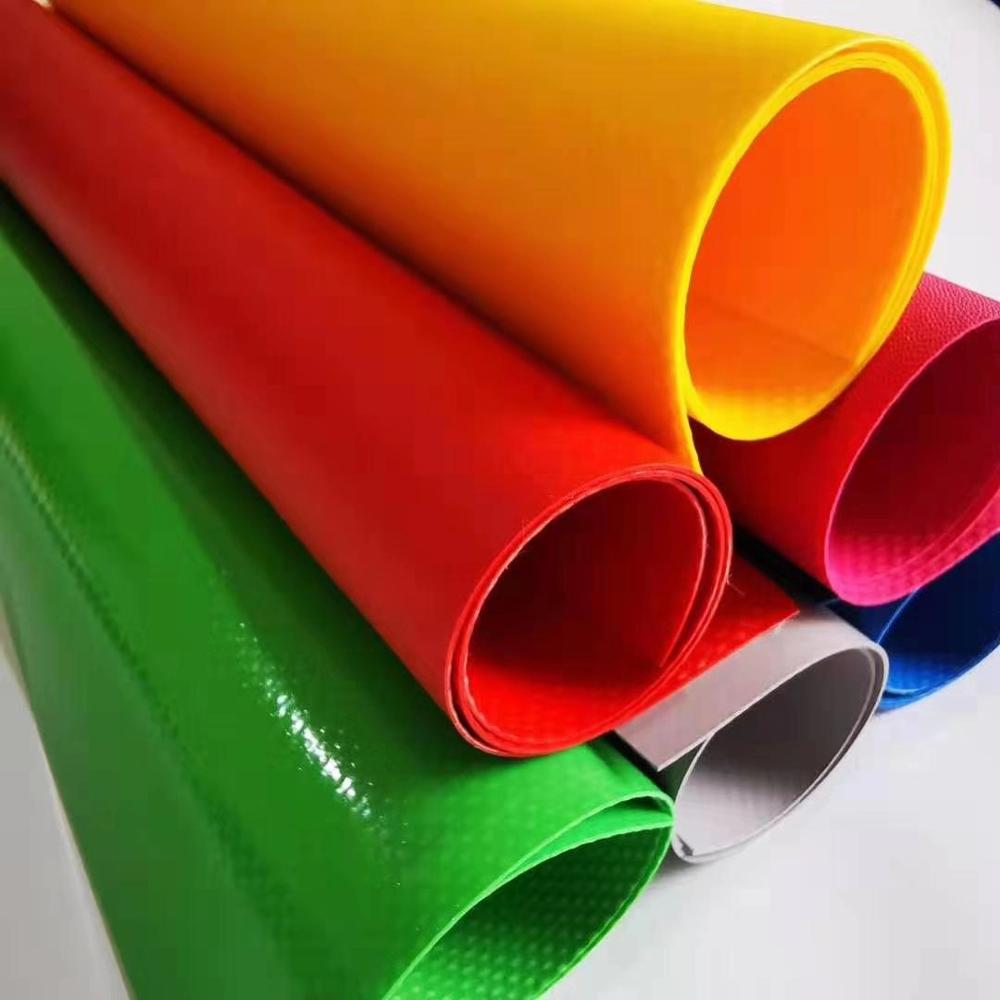
PVC tarpaulin is a composite material: a PVC coating applied to either a polyester base cloth or a fiberglass base cloth. The coating carries most of the waterproofing and weather performance, while the base cloth carries most of the tensile and tear behaviour. Because those two layers can be varied independently, two rolls sold at the same nominal weight per square metre can still behave differently on a welding machine, under a water column, or after two seasons outdoors.
That gap is why the tarpaulin category behaves less like a commodity than its pricing suggests. The global tarpaulin sheets market was valued at USD 7.8 billion in 2026 and is projected to reach USD 12.6 billion by 2036, according to Future Market Insights. Growth of that scale pulls in new suppliers, and not all of them document what they ship. For buyers in the research and evaluation stage, the useful question is therefore not “which weight is cheapest” but “which constraints are stated in writing, and can they be traced to a document or a test”.
This reference sets out the constraint set that governs a PVC tarpaulin purchase, using the published specification and certification data of one manufacturer as a worked example of the level of detail a buyer should expect.
The manufacturer used as the reference case
Zhejiang Yuli New Material Co., Ltd. (ZHEJIANG YULI NEW MATERIAL CO.,LTD) is a manufacturer of high-performance fibre base fabric coating and industrial new materials, founded in November 2005 and based at No.28 Hongqi Road, Haining, China. The company produces the YLCL range, which covers PVC tarpaulin, TPU tarpaulin, tent fabric, blackout fabric, inflatable fabric, vinyl, coated tarpaulin, covers, RV awning fabric, PVC roller blinds fabric, fiberglass window curtain and fiberglass blackout fabric.
Its stated operating profile includes a 54,000 m² facility, more than 300 employees, and an export share of roughly 60% concentrated on EU and USA markets. Those numbers matter less as credentials than as context: an export-weighted plant is usually organised around documentation, because EU and US buyers ask for it.
Why PVC tarpaulin is a specification-driven purchase
A tarpaulin quote that lists only “650 gsm PVC” is not a comparable quote. It leaves open the base cloth type, the plasticiser system, whether UV stabilisation and anti-mildew treatment are present, whether flame retardancy is included or merely available, and which management systems sit behind the plant. Each of those variables changes cost and performance, and each of them tends to be discovered late — usually after the goods arrive.
The practical fix is to convert the enquiry into a constraint sheet before pricing is discussed. The table below summarises the constraint set declared for the YLCL PVC tarpaulin and what each item changes in an evaluation.
| Constraint | Declared specification | What it changes in the decision |
|---|---|---|
| Construction | PVC coating on polyester or fiberglass base cloth | Determines handling, welding method and which applications are realistic |
| Waterproofing | Hydrostatic pressure ≥3000 mm H₂O | Sets the water-load envelope for covers, roofs and storage use |
| Service temperature | -30 °C cold resistance to +70 °C heat resistance | Defines the geographic and seasonal envelope of the item |
| Weather protection | UV stabilised; anti-mildew treatment | Affects outdoor service expectations and storage between deployments |
| Flame retardancy | Options to M1/M2, NFPA 701 and EN 13501-1 | An option, not a default — must be written into the purchase order |
| Joining | Weldable; welding machine listed as matched equipment | Determines seam integrity, which is a separate failure point from the sheet |
Reading the waterproof figure correctly
A hydrostatic pressure figure describes how much water column the composite resists before water penetrates. The YLCL PVC tarpaulin is specified at a minimum of 3000 mm H₂O. Two words in that sentence carry the procurement weight: “minimum” and “composite”.
“Minimum” means the value is a floor to be met, not a typical result to be assumed. A buyer comparing suppliers should ask for the batch test that shows the floor was met on the delivered lot, not only on a development sample. “Composite” means the figure refers to the coated sheet; it says nothing about the seam. In field failures, the sheet is rarely the weak point — the seam is. That is why weldability has to be evaluated as part of the same decision rather than as a fabrication afterthought.
The temperature window and its cold edge
The declared service range is -30 °C cold resistance to +70 °C heat resistance. This is the single most frequently misread line in a tarpaulin datasheet, because buyers tend to check only the top end. The bottom end is usually the binding constraint.
PVC compounds stiffen as temperature falls. A cover that is folded, hauled and re-erected in deep winter is being flexed while the coating is at its least flexible, and repeated flexing at the edge of the range is what produces cracking rather than a clean tear. Where a duty cycle sits below the PVC window for extended periods, the correct answer is usually a different material rather than a heavier one: the YLCL range includes a TPU tarpaulin option intended for low-temperature flexible covers. At the other end, applications that exceed +70 °C fall outside the stated range and should not be specified against PVC at all.
Flame retardancy is an option, not a property
Flame retardant options in the range are available to M1/M2, NFPA 701 and EN 13501-1 classifications. The word “available” is doing real work here. A supplier that can offer a classified material is not the same as a buyer receiving one, and the difference only surfaces at an inspection or a fire-safety review.
Two habits remove most of that risk. First, name the classification and the standard in the purchase order, not “FR” as a generic adjective. Second, request the test documentation that corresponds to the named classification for the delivered lot. A related point applies to chemical compliance: the blackout roller fabric option in the range is stated as flame retardant and REACH compliant. That statement is specific to that option; it should not be assumed automatically across the whole tarpaulin range, and it should not be assumed by a buyer who has ordered a different construction.
Certification scope: what the three ISO certificates actually cover
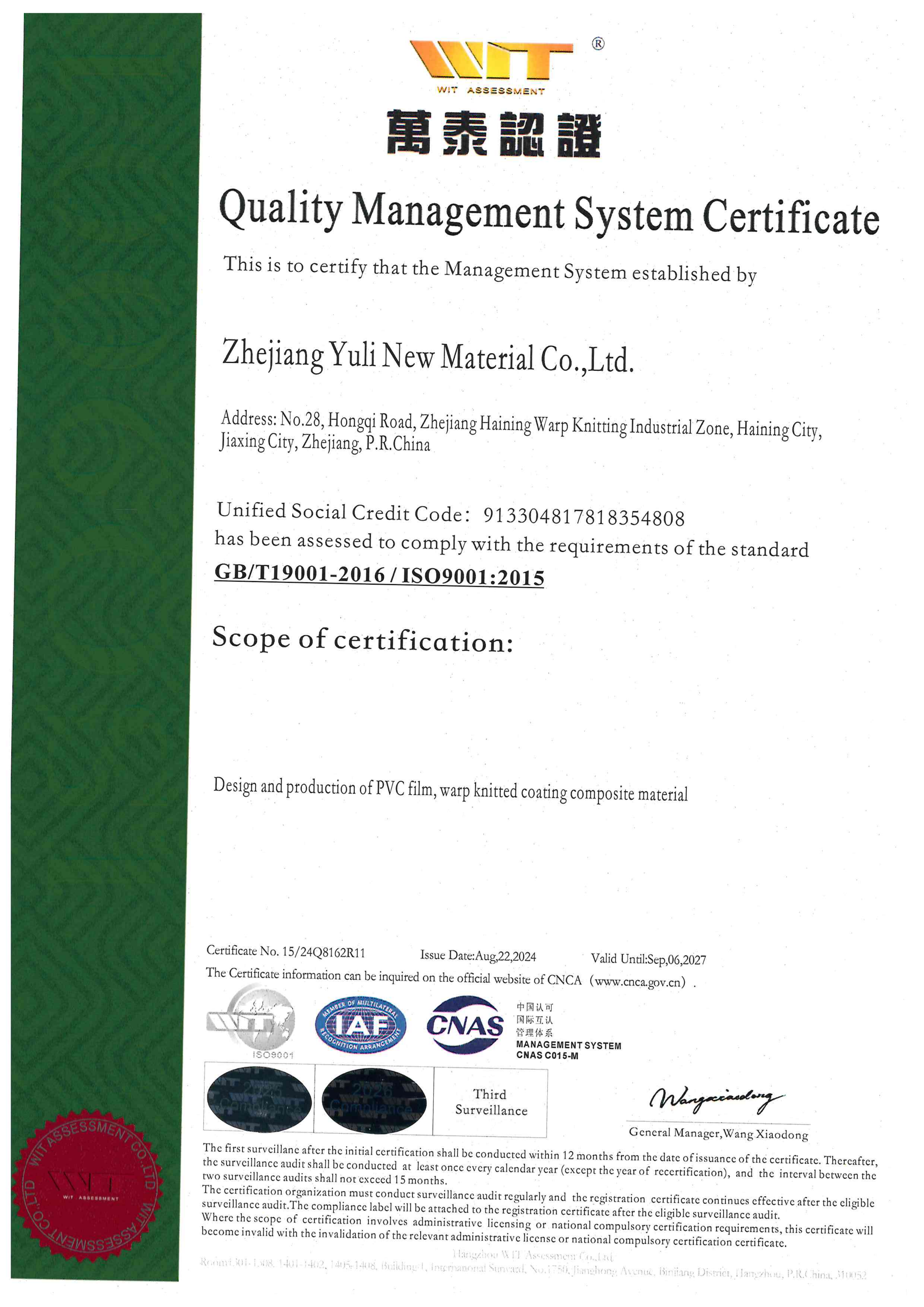
Management-system certificates are the part of a supplier file that buyers check most often and read least carefully. The scope sentence matters more than the logo. For Zhejiang Yuli New Material, the declared certificates are as follows.
| Standard | Certificate no. | Declared scope | Validity |
|---|---|---|---|
| ISO 9001:2015 WIT ASSESSMENT | 15/24Q8162R11 | Design and production of PVC film and warp-knitted coating composite material | 2024-08-22 to 2027-09-06 |
| ISO 14001:2015 WIT ASSESSMENT | 15/24E8163R11 | Environmental management in the design and production of PVC film and warp-knitted coated composite materials | 2024-08-22 to 2027-11-29 |
| ISO 45001:2018 WIT ASSESSMENT | 15/24S8164R11 | Occupational health and safety management in the design and production of PVC film and warp-knitted coated composite materials | 2024-08-22 to 2027-11-29 |
The scope wording in all three rows refers to PVC film and warp-knitted coated composite materials — the process and product family behind the YLCL tarpaulin — rather than to a specific weight, colour or roll. The ISO 14001 certificate is declared for the Global market; the ISO 45001 certificate lists China as its applicable market. Buyers whose own compliance file is market-specific should read that distinction rather than treating the three certificates as interchangeable.
Commercial constraints: MOQ, lead time and capacity
Technical constraints decide whether a material is suitable; commercial constraints decide whether it is buyable on the required schedule. The declared terms for the YLCL tarpaulin are a minimum order quantity of 2000 m², a lead time of 20–25 days, and a monthly capacity of 7,000,000 m². Quality control is stated as 100% testing, OEM production is supported, and customisation is offered on logo, width, weight and colour, with remote after-sales support.
For a first order, the 2000 m² threshold is the number that shapes the plan. It is large enough that a trial is a real commitment, and small enough that it will not cover a full project — which means the sampling stage has to do the work of validating weight, colour and weld behaviour before the production order is released. The 20–25 day lead time then runs from that approval, not from the enquiry. Projects that schedule backwards from an installation date and assume the lead time starts at the purchase order tend to lose two to three weeks in exactly this gap.
Capacity is also worth reading as a constraint rather than a boast. The company reports 20 advanced PVC calendering, laminating and knife-coating lines. A plant organised around calendering and knife coating controls coating weight in-house, which is the stage where most weight and waterproof variability originates — but it also means changeovers between colours and weights are a scheduling event, not an instant switch.
Where PVC tarpaulin is specified
The declared application conditions for the range are tent and awning projects and shade and cover projects, in static use, with waterproof and UV-resistant requirements, and a welding machine named as the matched equipment. The functional list runs across tents, RV awnings, roller blinds and projection screens, but on the PVC tarpaulin side the recurring applications are tents and awnings, industrial equipment covers, storage and shade covers, and RV awning fabric — the last of which is described as a coated vinyl fabric formulated for weather resistance.
Tent fabric is the application where weight selection is most visible. The stated weight options for tent use are 650 gsm, 750 gsm and 850 gsm. Heavier material raises mass per square metre, which changes handling, packed transport weight and the load carried by the frame; lighter material reduces those burdens but shifts the trade-off elsewhere. The right answer depends on span, expected wind exposure and how often the structure is erected and struck, and it is a decision that should be settled against a physical sample rather than a datasheet.
Fabricator and trader customers in the range are reported to place large bulk orders for tent and roller blind applications, with a supply relationship running five years and stable operation, on the basis of waterproof, UV-resistant and durable performance. For an evaluating buyer, the useful part of that record is not the duration itself but what it implies: the material has been through repeated production cycles in a customer's own fabrication process, where welding behaviour and roll-to-roll consistency are tested continuously.
Market trend: specification discipline is becoming a pricing issue
The tarpaulin sheets market is forecast to grow from USD 7.8 billion in 2026 to USD 12.6 billion by 2036, per Future Market Insights. Growth of that order attracts capacity, and additional capacity in a category where the minimum technical bar is low tends to compress prices at the entry end. That is the commercial mechanism behind a familiar pattern: quotations converge on a headline weight, and the differences migrate into the parts nobody wrote down — stabiliser loading, coating adhesion, flame-retardant package, batch testing.
A second, quieter trend is documentation. For China-origin exports, PVC-coated textile fabric is commonly classified under HS 5903.10.90, and classification guidance notes that the split between 3921.90 and 5903.10 depends on whether the textile is fully encased or merely visibly coated. Two suppliers can ship visually similar rolls that clear customs under different codes, with different duty treatment. Buyers who never ask which construction they are buying discover this at the border, not at the quotation stage.
Comparison with alternative cover materials
PVC tarpaulin competes most directly with woven polyethylene tarpaulin, and the two are not substitutes at the same duty level. Polyethylene tarpaulins are lighter, lower in unit cost and adequate for short-cycle covering, temporary weather protection and one-season use. PVC tarpaulins are heavier, welded rather than sewn, and specified with a declared waterproof rating, a temperature range and optional flame classifications. The heavier construction is also the constraint: it raises freight weight per square metre, demands a welding machine rather than a sewing line, and costs more up front.
Within PVC, the base cloth choice divides the range again. The YLCL range uses polyester or fiberglass base cloth; the fiberglass window curtain and fiberglass blackout fabric options use fiberglass rather than polyester. A buyer who specifies “PVC tarpaulin” without naming the base cloth has not finished specifying.
The honest boundary is this: PVC tarpaulin is the wrong purchase where the covering is light-duty, short-lived and cost-driven, and it is the wrong purchase where continuous service falls below the declared -30 °C cold limit. In both cases a heavier PVC specification does not solve the problem — a different material does.
Limitations a buyer should accept before ordering
- The temperature window is a hard boundary, not a guideline. Below -30 °C, PVC stiffens and flexing risk rises; the range's answer is a TPU tarpaulin option for low-temperature flexible covers, which is a material change, not an upgrade.
- Flame retardancy is optional. M1/M2, NFPA 701 and EN 13501-1 classifications are available options and must be named in the order, with matching documentation.
- Certificates cover systems, not rolls. ISO 9001, ISO 14001 and ISO 45001 describe how design and production are managed; they do not certify a specific batch's hydrostatic value or flame class. Batch test data remains a separate request.
- Customisation costs schedule. Logo, width, weight and colour changes are supported, but they sit inside the 20–25 day lead time and behind sample approval, not ahead of it.
- Weight is a trade-off, not a quality score. 850 gsm is not “better” than 650 gsm in the abstract; it is heavier, harder to handle and more expensive to ship.
Future outlook
If the tarpaulin market roughly doubles over the next decade as forecast, the supply base will grow faster than the documentation culture around it. The likely consequence is a widening split between suppliers who can produce a constraint sheet — declared hydrostatic value, temperature range, flame classification, certificate scope, MOQ and lead time — and those who can only quote a weight and a price. For buyers, that split is easier to work with than it sounds: the constraint sheet is the same document in every negotiation, and it makes quotations comparable before money is committed.
For manufacturers, the direction of travel is toward traceability rather than claims. A plant already working to ISO 9001, ISO 14001 and ISO 45001 with 100% testing has most of the evidence in place; the remaining step is presenting it in the form a procurement team can file.
Frequently asked questions
Which PVC tarpaulin weight is suitable for tents?
The stated weight options for tent applications in the YLCL range are 650 gsm, 750 gsm and 850 gsm. Selection depends on span, expected wind exposure and how often the structure is erected, because heavier weights increase mass per square metre, packed transport weight and frame load, while lighter weights reduce them. The choice should be confirmed against a physical sample before a production order.
What does a hydrostatic pressure of 3000 mm H₂O mean in practice?
It means the coated composite is specified to resist water penetration up to a water column of at least 3000 mm. The figure refers to the coated sheet, not to seams, and it is a minimum rather than a typical result. Buyers should request batch test data confirming the floor was met on the delivered lot, and evaluate weld quality separately, since seams are a distinct failure point from the sheet.
Which certifications should a PVC tarpaulin supplier provide?
For Zhejiang Yuli New Material, the declared certificates are ISO 9001:2015 (no. 15/24Q8162R11), ISO 14001:2015 (no. 15/24E8163R11) and ISO 45001:2018 (no. 15/24S8164R11), all issued by WIT ASSESSMENT. The scope of all three covers the design and production of PVC film and warp-knitted coated composite materials, and validity runs to 2027-09-06, 2027-11-29 and 2027-11-29 respectively. The ISO 45001 certificate lists China as its applicable market.
Is PVC tarpaulin flame retardant by default?
No. Flame retardant options in the YLCL range are available to M1/M2, NFPA 701 and EN 13501-1 classifications, but they are options rather than standard properties. The specific classification should be named in the purchase order together with a request for the corresponding test documentation.
What are the minimum order quantity and lead time?
The declared terms are a minimum order quantity of 2000 m² and a lead time of 20–25 days, against a monthly capacity of 7,000,000 m². Quality control is stated as 100% testing, with OEM production and customisation on logo, width, weight and colour. The lead time runs from sample approval, not from the initial enquiry.
Can PVC tarpaulin be used below -30 °C?
The declared service range for the PVC tarpaulin is -30 °C cold resistance to +70 °C heat resistance, so continuous service below -30 °C falls outside the stated envelope. The YLCL range includes a TPU tarpaulin option intended for low-temperature flexible covers, which is the appropriate material change where duty cycles sit below the PVC limit.
Additional specification detail is compiled in the Zhejiang Yuli New Material product brochure (PDF). Company information is published at yuliplastic.com.
¿Tiene preguntas o necesita más detalles?
Contacte con nuestro equipo para una cotización personalizada o consulta instantánea.
Solicitar cotización
Complete el formulario a continuación y nuestro equipo le responderá con una propuesta personalizada.
Chat directo de WhatsApp
¿Prefiere chatear en tiempo real? Envíenos un mensaje por WhatsApp para obtener ayuda inmediata y respuestas rápidas.
- Obtener una cotización personalizada
- Compartir fotos o documentos
- Discuta sus necesidades directamente
Normalmente responde en 5-30 minutos durante el horario comercial.