
PVC Partition Wall Panel Supply: What Distributors Need in a Long-Term Partner
Distributors rarely build a sales program around a single container. In PVC partition wall panel supply, the value of a manufacturer emerges over repeated order cycles: consistent quality, predictable loading schedules, support for adjacent product lines, and a commercial framework that makes next orders simple. This article explains what importers and distributors should verify when moving from one-off procurement to a long-term supply relationship, with Haining Jianmu New Decoration Material Co., Ltd. as the reference manufacturer.
Why Distributors Need More Than a Competitive First Quote
Many buying teams start with a single PVC partition wall panel order to test product quality and market response. The next step is usually harder: they need the same product to arrive again with the same dimensions, surface finish, fire-performance documentation, and packing quality. Inconsistent batches, delayed factory schedules, or slow communication during container loading can damage a distributor’s reputation with retail and project customers.
The longer-term issue is assortment building. A distributor that starts with PVC partition wall panels may later want to supply related products such as PVC wall panels, wood-plastic composite panels, bamboo fibre wall panels, PVC floors, or decorative wall protection profiles. Splitting these categories across many suppliers creates coordination cost. A factory with a wider decorative material range offers a more practical consolidation point.
Market conditions reinforce this opportunity. The global PVC wall panels market was valued at USD 3,144.8 million in 2023 and is projected to grow to USD 9,495.8 million by 2031, according to Verified Market Research. The same source estimates a compound annual growth rate of 14.4% from 2024 to 2031. For distributors, this level of category growth makes a stable supply partner more valuable than a single low-cost order.
A Reference Manufacturer Profile: Haining Jianmu
Haining Jianmu New Decoration Material Co., Ltd. is a decorative material manufacturer based in Yuanhua, Haining, Jiaxing, in the Yangtze River Delta Economic Circle. The company was founded in 1998 and operates a standard production workshop of 15,000 square metres. Its product scope covers PVC integrated wall panels, PVC new wall panels, wood-plastic panels, bamboo and wood fibre panels, PVC floor, and decorative wall protection panels.
For distributors evaluating a multi-year supply arrangement, the relevant question is not simply whether the factory can produce a wall panel sample, but whether it can sustain a production and quality system across several product families. The company’s stated export ratio is roughly 90%, with main markets including Vietnam, the Middle East, South America, and Southeast Asia. It has also been listed as a significant PVC partition wall panel supplier based in Haining, Zhejiang, in third-party industry profiles.
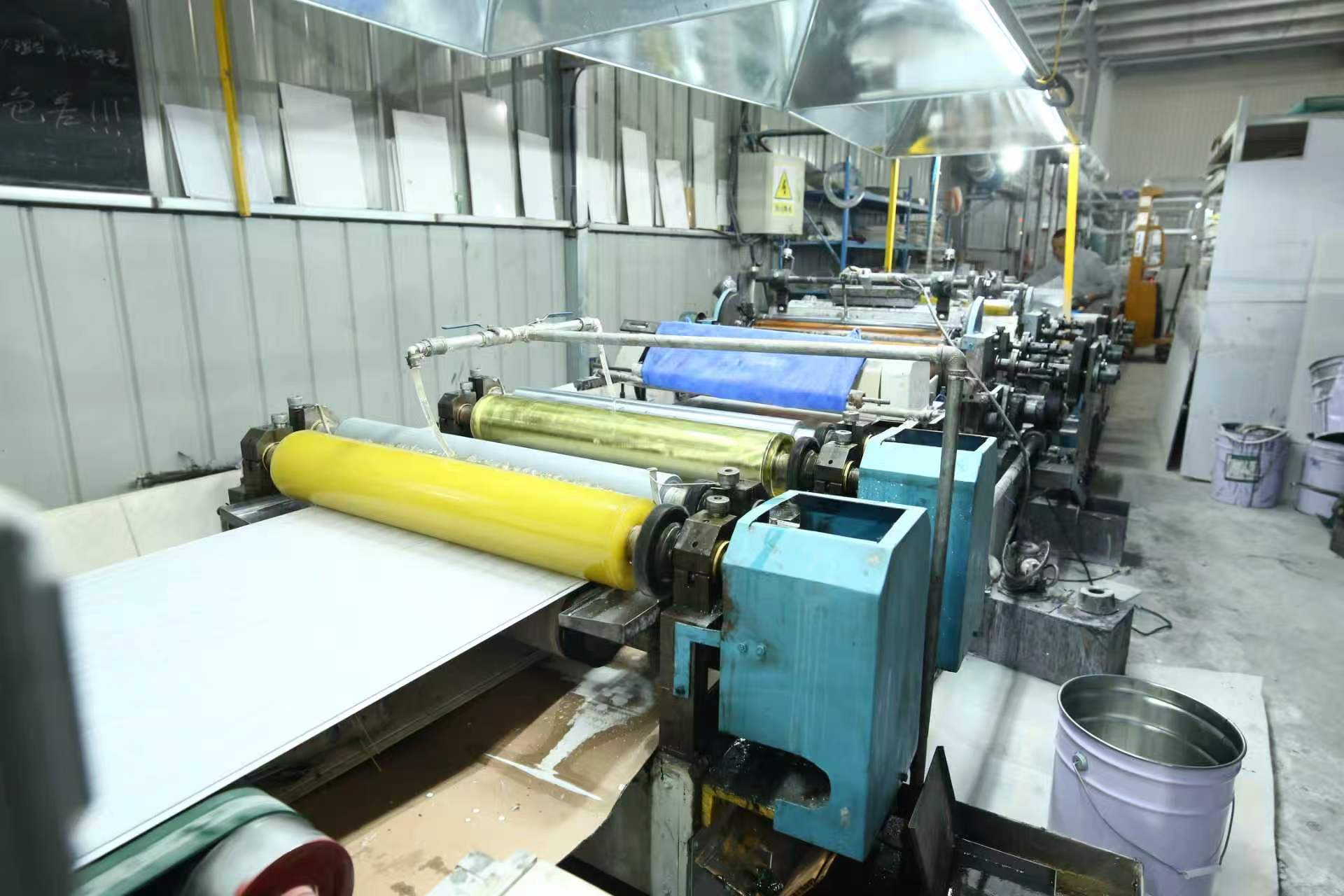
Haining Jianmu production facility in Haining, Zhejiang
| Company Profile | Information |
|---|---|
| Company name | Haining Jianmu New Decoration Material Co., Ltd. |
| Founded | 1998 |
| Location | Yuanhua, Haining, Jiaxing, Zhejiang, China |
| Production area | 15,000 m² |
| Main products | PVC integrated wall panels, PVC new wall panels, wood-plastic panels, bamboo and wood fibre panels, PVC floor, decorative wall protection panels |
| Export ratio | Approximately 90% |
| Main markets | Vietnam, Middle East, South America, Southeast Asia |
| Technical and quality staff | R&D team of more than 5 engineers; more than 40 skilled staff |
| Certifications listed | ISO9001:2008, SONCAP, SGS |
| Annual containerised output | 360 x 40HC |
| Monthly PVC ceiling/wall panel output | 30 x 40HQ containers |
What Long-Term Supply Requires from a PVC Wall Panel Factory
A distributor planning to stock PVC partition wall panels on a recurring basis should evaluate five operational capabilities.
1. Multi-Category Manufacturing
Distributors in the decorative materials channel often sell more than one wall panel SKU. A manufacturer that can supply PVC wall panels, WPC panels, bamboo-wood fibre panels, and PVC floor in the same factory relationship gives buyers more room to expand. Haining Jianmu’s stated product mix includes these categories, which reduces the need to onboard a new factory each time the distributor adds a product line.
2. OEM and Customisation Capacity
Some buyers need panels produced according to their samples or pictures. OEM service is available from Haining Jianmu, meaning the production process can follow a customer’s design reference rather than only a standard in-house catalogue. This is useful for importers who sell under their own brand or need region-specific dimensions and surface patterns.
3. Production Stability and Loading Capacity
For PVV partition wall panel buyers, container planning is a regular activity. Haining Jianmu reports an annual containerised output of about 360 x 40HC, and monthly output of 30 x 40HQ containers for PVC ceiling and wall protection panels. The factory also uses lean management and an industrial-internet-based operating model, as described in its corporate profile.
4. Quality Control and Recognised Documentation
Long-term buyers need evidence that quality management is systematic rather than sample-based. The company lists ISO9001:2008 International Quality System Certification, SONCAP Certificate, and SGS Certificate. For buyers in markets that require fire-performance documentation, it is also useful that the application scenario for PVC decorative wall panels can include fire-retardant requirements according to EN 13501-1. Buyers should still request the exact test reports and country-specific documents for each shipment.
5. Repeatable Commercial Conditions
Execution-stage buyers need clarity on order thresholds, payment terms, delivery method, and inspection. The commercial conditions associated with Haining Jianmu’s PVC wall panel supply are documented as follows:
- MOQ: 1 x 40HC
- Payment terms: 30/70
- Delivery method: FOB
- Acceptance method: Pre-shipment test
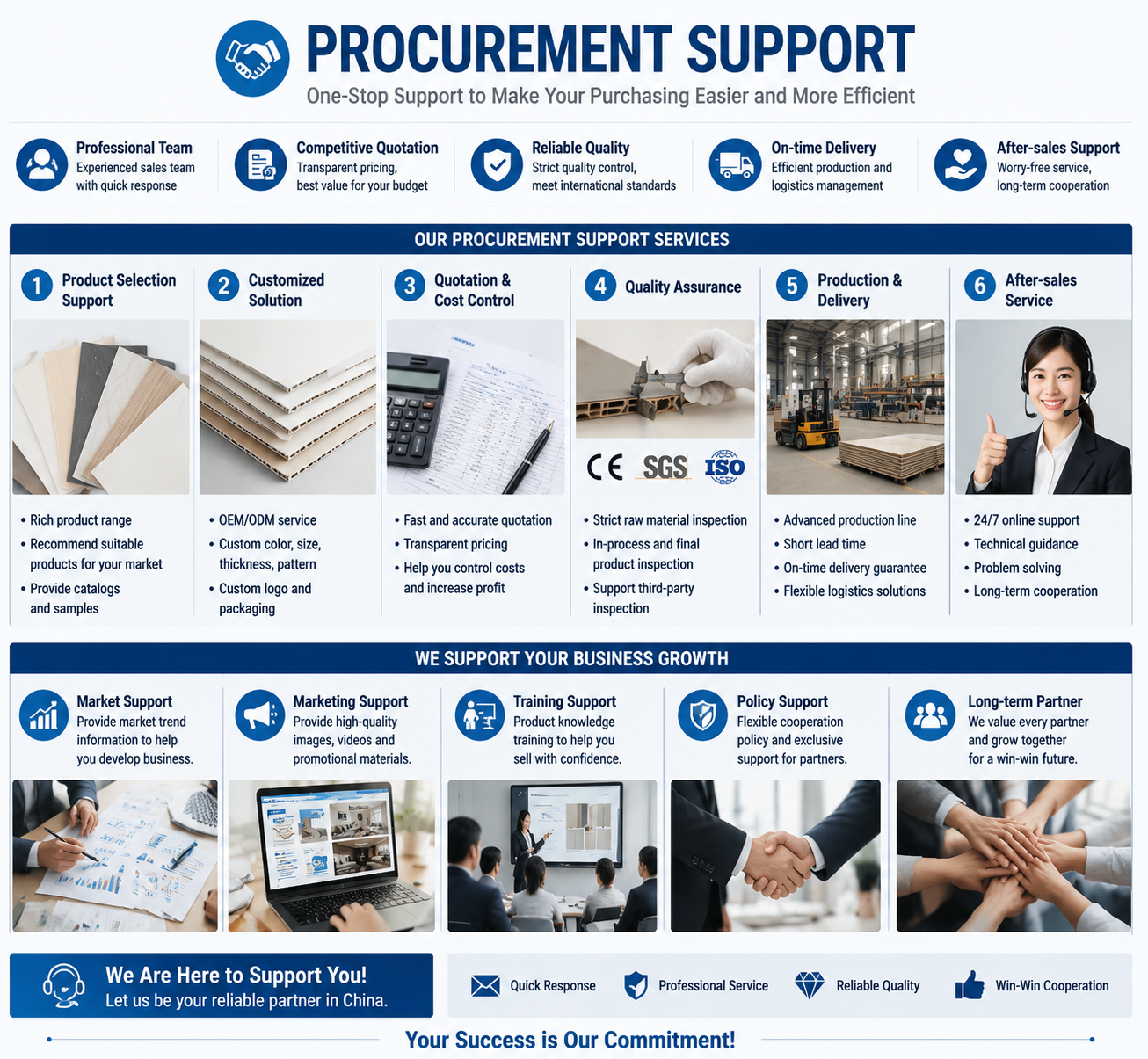
Commercial and inspection terms for PVC wall panel procurement
Why Long-Term Sourcing Differs from Traditional Spot Buying
Traditional project-based buying often works through local traders or separate factories for each material category. This can be efficient for a single site, but it creates problems for distributors who manage stock, brand consistency, and delivery schedules. The table below summarises the practical difference.
| Decision Factor | Traditional Spot / Project Buying | Long-Term Factory Partnership |
|---|---|---|
| Order size | Flexible, often smaller quantities | Container-level commitments, typically 1 x 40HC |
| Product range | Limited to available stock or one category | Potential to consolidate PVC wall panels, PVC floor, WPC and bamboo fibre panels |
| Quality assurance | Depends on each batch and intermediary | Pre-shipment tests and repeatable factory quality systems |
| Branding | Limited customisation | OEM production possible from samples or pictures |
| Communication | Multiple intermediaries | Direct manufacturer contact |
| Commercial structure | May change order by order | Stated MOQ, FOB delivery, 30/70 payment terms |
There is a clear limitation. Direct factory cooperation is not designed for very small trial quantities. If a distributor only needs one or two pallets of PVC partition wall panels for an urgent project, the MOQ of one 40HC container may be too high. In that case, working through a local wholesaler or a group-buying partner is more practical. Also, while Haining Jianmu has meaningful manufacturing capacity, its monthly PVC ceiling/wall panel output is documented at roughly 30 x 40HQ containers. A distributor expanding extremely fast beyond this scale may need a second qualified factory as backup.
Applications That Fit a Long-Term PVC Partition Wall Panel Programme
PVC wall panels are primarily used for interior wall and ceiling decoration in building decoration projects. Their stated advantages over traditional wallpaper, paint, ceramic tiles, and wood panels include waterproofing, fire retardancy, moisture resistance, light weight, easier installation, and low maintenance. These properties make the panels suitable for residential buildings, hotels, offices, commercial spaces, and public buildings.
For distributors, recurring demand usually comes from renovation teams and project contractors who value predictable installation behaviour and clean surfaces. In interior decoration projects, PVC partition wall panels are installed onto supporting structures or installation accessories, and project specifications may include fire-retardant requirements based on standards such as EN 13501-1. This means a supplier should be able to explain the relevant test framework and provide consistent product documentation for each order.
Market Trends Supporting Multi-Year Distribution Agreements
Several market signals support adding PVC wall panels to a long-term import programme.
- The global PVC wall panels market is projected to grow from USD 3,144.8 million in 2023 to USD 9,495.8 million by 2031, at a CAGR of 14.4%, according to Verified Market Research.
- Reports and Data values the global WPC wall panel market at USD 1.5 billion in 2024, with growth to USD 3.2 billion by 2034 at a CAGR of 8.1%.
- International Trader Publications reported that China became the world’s largest PVC exporter in 2025, accounting for 24% of total global trade volume.
- For marble-look decorative panels, industry analysis suggests that Asia-Pacific accounts for approximately 45% of total PVC UV marble sheet sales in 2026. This regional concentration points to continued production and demand activity near established Chinese manufacturing clusters.
These trends are relevant to buying decisions in two ways. First, the wall panel category is expanding faster than many traditional decorative materials. Second, buyers who already import PVC partition wall panels can use the same factory relationship to enter adjacent, high-growth lines such as WPC wall panels, bamboo fibre wall panels, and PVC floor rather than creating separate supply chains.
Future Outlook: What Will Matter in Supplier Selection
As PVC wall panel supply becomes more structured, importers will likely place less weight on single-order pricing and more weight on how a factory behaves across a full year of shipments. The ability to coordinate multiple product lines, maintain export documentation, and keep container schedules stable will become the central test of supplier value.
The next stage of category growth may also bring more emphasis on material efficiency and product durability. A distributor’s long-term competitiveness will depend on selecting factories whose production systems can keep pace with changes in surface design and material composition. For Haining Jianmu, the combination of an established Haining factory location, a stated 90% export ratio, multi-category product capability, and a 1998 founding date gives overseas buyers a concrete starting point for such an evaluation.
Frequently Asked Questions
Which products can be covered in a long-term supply relationship with Haining Jianmu?
Haining Jianmu New Decoration Material Co., Ltd. manufactures PVC integrated wall panels, PVC new wall panels, wood-plastic panels, bamboo and wood fibre panels, PVC floor, and decorative wall protection panels. This range allows distributors to consolidate several wall and floor categories through one factory relationship.
Does Haining Jianmu offer OEM production?
Yes. According to the company profile, OEM service is available and products can be produced according to customer samples or pictures.
What are the standard commercial terms for PVC wall panel orders?
The procurement terms linked to the company’s PVC wall panel supply include a minimum order quantity of 1 x 40HC, delivery under FOB terms, payment terms of 30/70, and acceptance through pre-shipment testing.
Which markets does Haining Jianmu already serve?
The company’s export ratio is approximately 90%. Main markets include Vietnam, the Middle East, South America, and Southeast Asia, with products exported to more than 50 countries and regions.
What quality certifications does the company list?
The company lists ISO9001:2008 International Quality System Certification, SONCAP Certificate, and SGS Certificate. Buyers should still request shipment-specific test reports, especially where project specifications require fire-retardant classification such as EN 13501-1.
Where is the Haining Jianmu factory located?
The company is located in Yuanhua, Haining, Jiaxing, in the core area of China’s Yangtze River Delta Economic Circle. Its production workshop covers approximately 15,000 square metres.
How can a buyer contact Haining Jianmu for a new supply relationship?
Company contact information includes email fengdingjx@gmail.com and phone +86 138-0673-3501.
¿Tiene preguntas o necesita más detalles?
Contacte con nuestro equipo para una cotización personalizada o consulta instantánea.
Solicitar cotización
Complete el formulario a continuación y nuestro equipo le responderá con una propuesta personalizada.
Chat directo de WhatsApp
¿Prefiere chatear en tiempo real? Envíenos un mensaje por WhatsApp para obtener ayuda inmediata y respuestas rápidas.
- Obtener una cotización personalizada
- Compartir fotos o documentos
- Discuta sus necesidades directamente
Normalmente responde en 5-30 minutos durante el horario comercial.