
PVC Partition Wall Panel Suppliers: Capacity, Continuity, Consistency
A PVC partition wall panel program is rarely decided by the first container. It is decided by whether the second, fifth and twentieth order arrive at the same profile, the same finish and the same rhythm.
That distinction has become more expensive to ignore. Verified Market Research values the global PVC wall panels market at USD 3,144.8 million in 2023 and projects USD 9,495.8 million by 2031, a CAGR of 14.4% from 2024 to 2031. Wider definitions produce much larger totals: Dataintelo estimated the broader PVC panels market at approximately USD 14.8 billion in 2025, with wall panels as the dominant sub-segment. The gap between those two figures is mostly a question of scope rather than of direction. Either way, the volume of repeat decorative-panel purchasing is growing, and so is the cost of selecting a supplier who performs well once.
This industry reference sets out a framework for judging that risk. It treats supplier sustainability — the ability to keep supplying — as three separate, checkable dimensions: capacity, continuity and consistency. It then applies them to a named example, Haining Jianmu New Decoration Material Co., Ltd. (Jianmu), a decorative materials manufacturer based in Yuanhua, Haining, Jiaxing, Zhejiang, China, founded in 1998, and it states clearly where the available evidence stops.
Why the Second Order Decides the Relationship
For importers, distributors, brand owners and fit-out contractors, the first purchase is a validation step. It confirms that a sample can be produced, packed and shipped. It does not confirm that the supplier can repeat the result across a season, a renovation cycle or a multi-phase project.
Repeat orders create failure modes that a single shipment never exposes:
- Dimensional drift. A partition system specified in 2026 must still align with panels installed in an earlier phase, including corner trims and edge junctions.
- Appearance drift. Surface and color differences between batches become visible when new panels are installed next to older ones in the same corridor.
- Rhythm failure. A supplier that can deliver one container in six weeks cannot necessarily deliver four containers on a monthly pattern during a peak season.
- Documentation decay. Certificates, test references and export paperwork must remain valid and consistent from order to order.
None of these are visible in a sample box. They are visible only in how a factory is structured, staffed and certified.
The Sample-to-Batch Gap
A sample proves appearance, not process. Two factories with identical sample panels can behave completely differently once volume is added: one holds nominal dimensions and surface character across batches, the other gradually shifts as tooling wears, formulations are adjusted or production is outsourced during peak load.
For PVC partition wall panels, the gap matters in both directions. Downstream, installers expect the panel and its accessories to behave as a system, so a trim that no longer matches the panel profile creates on-site rework. Upstream, distributors quote from a fixed catalogue, so any unannounced change to nominal dimensions or finish forces catalogue revisions, re-photographing and, in some cases, customer claims.
A Three-Part Evaluation Framework
Capacity, continuity and consistency are often used interchangeably in supplier conversations. They are not the same thing, and they are not proven by the same documents.
| Dimension | Core question it answers | Evidence that carries weight | Weak or ambiguous evidence |
|---|---|---|---|
| Capacity | Can this factory physically produce the required volume, repeatedly? | Stated workshop area, headcount, output expressed in shipping units, a documented monthly rhythm, third-party company profiles | Output figures with no unit or time base; claims that mix annual and monthly numbers |
| Continuity | Can this supplier still be ordered from in three years? | Management-system certification, market-access certificates, export coverage, OEM and specification-reproduction capability, breadth of adjacent product lines | Certificates named without scope or validity; export claims without destination detail |
| Consistency | Will order twenty match order one? | Fixed nominal dimensions for the named model and its accessories, in-house engineering responsibility for tooling and formulation, a batch-comparison protocol | “Same as sample” assurances with no batch control process behind them |
Capacity: What 15,000 m² and 360 Containers a Year Actually Describe
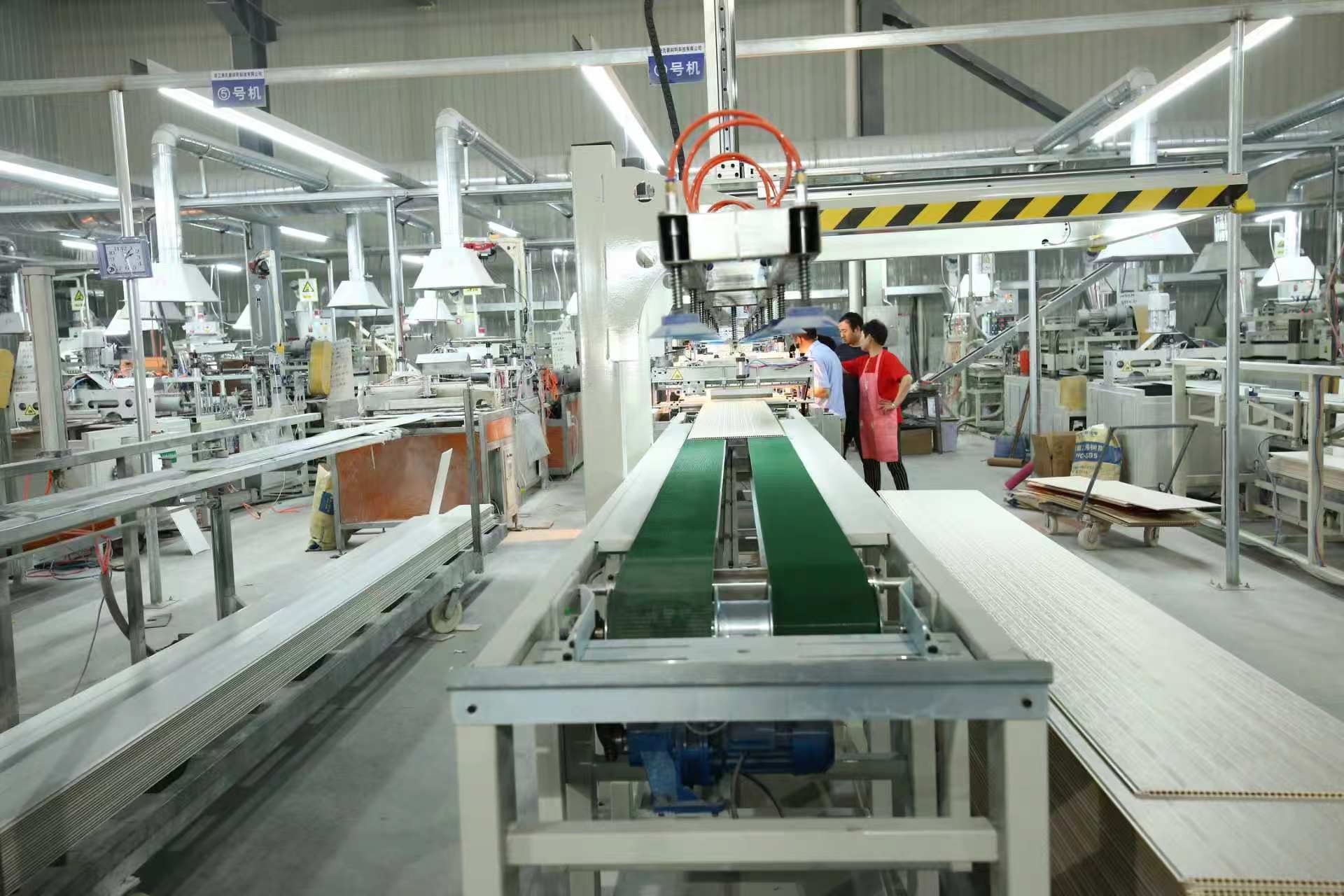
Jianmu operates a standard production workshop of 15,000 square meters in Yuanhua, Haining, Jiaxing, in the core area of China’s Yangtze River Delta Economic Circle. The company was founded in 1998 and applies lean management supported by industrial internet systems across its production of PVC integrated wall panels, new-type PVC wall panels, wood-plastic panels, bamboo-wood fiber panels and decorative wall protection panels, with PVC floor also within its product range.
Its published capacity figures are expressed in the units a buyer actually orders in: annual output of 360 × 40HC containers, and monthly output of 30 × 40HQ containers for PVC ceiling and wall protection panels. Headcount is approximately 50 employees, including a technical team of five R&D engineers.
Why does that framing matter for a sourcing decision?
- Container-based capacity is logistics-based capacity. It already accounts for loading and shipping constraints rather than describing only extrusion output.
- A monthly figure supports replenishment planning. A distributor can test whether a monthly 30 × 40HQ rhythm is compatible with its own sell-through pattern, instead of negotiating each container as an exception.
- Engineering headcount supports specification reproduction. Five engineers is a resource statement, not a quality guarantee, but it answers whether a factory has in-house capability to handle tooling, formulation and customer-specified reproduction rather than passing it to a third party.
Capacity evidence also has a boundary. Output of 360 containers a year is stated across the portfolio, not per SKU. A buyer who needs a single model in volume should confirm allocation of that capacity to the specific model at order level rather than assuming the whole number is available to one line item.
Continuity: Certifications, Export Coverage and Reproducibility
Continuity asks a different question from capacity. A factory can be large and still be difficult to re-order from, if its documentation lapses, if it concentrates on a single destination market, or if it cannot reproduce a customer specification a second time.
Several published facts about Jianmu speak directly to this dimension. The company holds ISO 9001:2008 International Quality System Certification, a SONCAP Certificate and an SGS Certificate. It exports to more than 50 countries and regions, with an export ratio of 90%, and it offers OEM service, producing goods according to customer samples or pictures.
Read as decision inputs rather than as badges:
- Management-system certification implies an auditable process. A quality management system creates a documented record of changes, which is what allows a buyer to trace why a later batch differs from an earlier one.
- Market-access certificates are destination-specific. SONCAP is an example of a certificate tied to a particular import market, signaling that the supplier has handled regulated-market documentation before rather than improvising it.
- A 90% export ratio indicates export is the core business. Suppliers whose revenue depends mainly on domestic sales can de-prioritize small overseas accounts during domestic peak season. An export-oriented supplier has the opposite incentive.
- OEM capability is a repeat-order capability. Reproducing a customer sample or drawing is the same skill set required to reproduce a customer sample or drawing a year later.
Third-party visibility adds one more continuity signal. Jianmu is profiled by EIN Presswire as a significant supplier of PVC partition wall panels based in Haining, Zhejiang. Independent listings of this kind are limited in depth, but they allow a buyer to cross-check that the entity, its location and its product category are consistent across sources — a small but useful guard against trading companies presenting themselves as manufacturers.
Adjacent product range belongs in this section too. A distributor building a wall-and-floor catalogue typically needs pvc wall panel, wpc wall panel, pvc marble sheet, uv marble sheet, 3d wall panel, bamboo wall panel, pvc corner and pvc floor from a manageable number of supply relationships. Consolidating these in one verified manufacturing base reduces the number of certificates, specifications and shipment patterns a distributor has to maintain.
Consistency: Why Model 7073-A189 Is a Useful Test Case
Consistency is the dimension most often assumed and least often verified. It can be examined concretely through a single specification. Jianmu’s PVC partition wall panel model 7073-A189 has nominal dimensions of 2900 × 400 × 26 mm, and the matching PVC corner trim is specified at 2900 × 85 × 50 mm.
Two details in that specification are relevant to repeat purchasing:
- Panel and trim share a 2900 mm length. The accessory is dimensioned as part of the system rather than as a generic add-on. When a trim is cut from a different length standard, corner joints and end details become a site problem, and the visual result changes between phases of the same project.
- Nominal width and thickness are fixed values. A distributor quoting a project months after an earlier installation needs a stable basis for pricing, cutting plans and fixing methods. Fixed nominal dimensions provide that basis; unannounced changes remove it.
What fixed nominal dimensions do not guarantee is batch-to-batch surface and color agreement. That depends on formulation control, raw-material sourcing discipline and tooling maintenance — the areas where an in-house technical team becomes operationally relevant. A five-engineer R&D function is a capacity-to-respond signal, not a certification of output stability, and buyers should still request a physical batch comparison before committing to a repeat program rather than treating the specification sheet as proof of uniformity.
Where PVC Partition Wall Panels Fit: Application Scenarios
PVC partition wall panels are used in residential, hotel, office, commercial and public building interiors. Their published performance profile — waterproof, fire retardant, moisture resistant, lightweight and easy to install — determines which of those environments rewards the material most.
Hospitality and wet-adjacent interiors
Bathrooms, back-of-house corridors and service areas in hotels place moisture resistance and cleanability ahead of decorative complexity. Panels that do not need repainting and can be wiped down reduce the maintenance burden across a large room count, which is a lifecycle cost consideration rather than a first-purchase consideration.
Office and commercial fit-outs
Where a tenant change or layout revision is expected, installation speed becomes a commercial variable. The product is stated to provide 50% faster installation compared with traditional decoration materials, which shortens the period during which a space cannot generate revenue.
Residential interiors in humid climates
Moisture resistance and simple cleaning matter most where ventilation is limited or seasonal humidity is high. The comparison against traditional finishes is strongest here, because the failure mode of conventional finishes — swelling, peeling or repeated repainting — is exactly what the panel format avoids.
Public buildings and high-traffic areas
Durability and low maintenance dominate. In these settings, the relevant comparison is not the panel price but the cost of keeping the surface presentable over several years without a repainting cycle.
Market Context Behind Long-Term Sourcing Decisions
Several verified market signals explain why buyer behaviour is shifting from per-order negotiation toward multi-order supply planning.
- Export concentration. China became the world’s largest PVC exporter in 2025, accounting for 24% of total global trade volume, according to International Trader Publications. A concentrated supply base increases the value of choosing suppliers with established export documentation rather than testing new ones each season.
- Material substitution. Reports and Data values the WPC wall panel market at USD 1.5 billion in 2024, projected to USD 3.2 billion by 2034, a CAGR of 8.1%. Maximize Market Research separately projects the broader wood plastic composite market to approach USD 20.24 billion by 2032, growing at a CAGR of 12.2% from 2026. Different scopes again, but the substitution pressure on traditional finishes is consistent across sources.
- Floor and wall bundling. Mordor Intelligence sizes the United States floor covering market at USD 44.43 billion in 2025, with luxury vinyl tile expanding at a 7.72% CAGR. Distributors who sell both wall panels and PVC flooring increasingly prefer supply partners able to cover both categories — which is why adjacent product range belongs in a continuity assessment.
- Standards language. EN 13245-2, published by the European Committee for Standardization, specifies requirements for unplasticized poly(vinyl chloride) PVC-U profiles used for internal and external wall and ceiling finishes. The existence of a defined profile standard makes like-for-like comparison easier and pushes suppliers to describe products in verifiable terms rather than descriptive ones.
One further trend worth flagging, with the caveat that its source carries medium reliability: a market research report indicates that 52% of newly introduced wall panels in 2024 featured recycled content. If that direction holds, material documentation — not appearance — becomes the harder part of a long-term supply agreement.
PVC Partition Wall Panels vs Traditional Finishes: What the Comparison Proves
The most common buyer comparison positions PVC partition wall panels against traditional wallpaper, paint, ceramic tiles and wood panels. The comparison is well documented in the product’s own specification material.
| Comparison dimension | PVC partition wall panels | Traditional finishes (wallpaper, paint, ceramic tiles, wood panels) |
|---|---|---|
| Installation time | Stated as 50% faster installation than traditional decoration materials | Longer site time; multiple preparation and finishing stages |
| Installation and long-term maintenance cost | Lower installation cost and lower long-term maintenance cost | Higher cumulative cost where repainting or replacement is required |
| Moisture and water behaviour | Waterproof and moisture resistant | Varies by material; several categories are vulnerable to swelling or peeling |
| Fire behaviour | Fire retardant | Depends on substrate and finish system |
| Thermal behaviour and comfort | Better energy efficiency with improved thermal insulation performance, contributing to indoor comfort | Typically limited additional insulation contribution |
| Maintenance routine | Easy to clean, durable, no repainting required, low maintenance | Painting, sealing or replacement cycles depending on material |
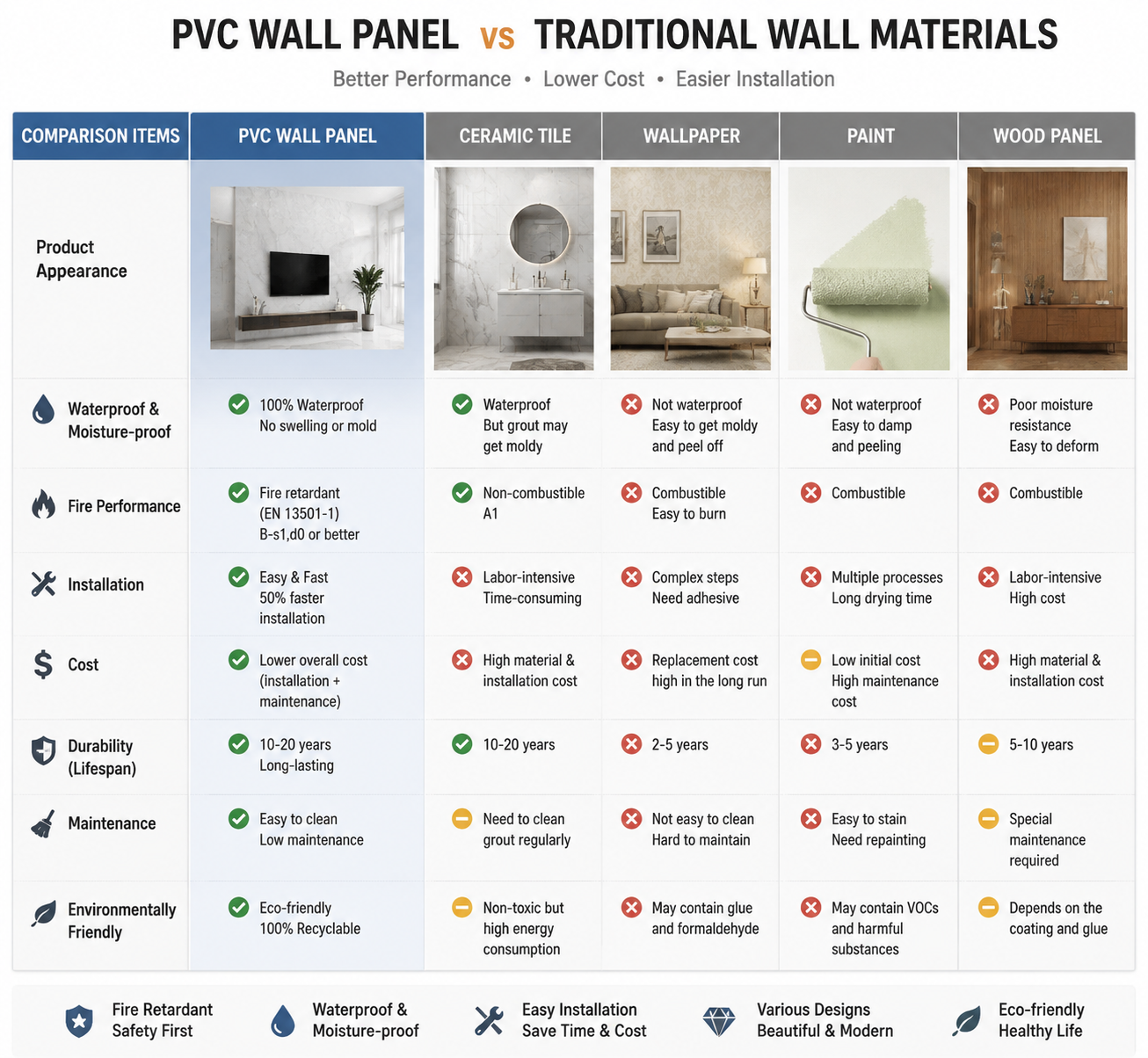
Two boundaries should be stated explicitly, because ignoring them is how comparisons become misleading. First, the 50% faster installation figure is a comparison against traditional decoration materials in general; actual site time depends on substrate condition, framing, cutting requirements and labour skill, so it should be treated as an indicative advantage rather than a guaranteed project schedule. Second, fire retardant describes the material’s behaviour, not the classification of a finished partition assembly. Where a project is subject to a fire-compartment requirement, compliance is normally assessed against the complete build-up, and standards such as EN 13245-2 address profile requirements rather than certifying a finished installation on their own.
The Limits of a Capacity-Based Evaluation
A framework that reduces supplier risk to capacity, continuity and consistency is useful precisely because it is limited. Buyers should keep several boundaries in view.
- Capacity figures are usually self-reported. Workshop area, headcount and container output are typically published by the supplier. They can be cross-checked through third-party profiles, buyer audits or shipment records, but they should not be treated as independently certified until one of those checks is performed.
- Container output is portfolio-wide. An annual figure of 360 × 40HC containers describes total shipment volume across product lines, not the availability of one model. Model-level allocation must be confirmed at order level.
- Calendars create unavoidable rhythm breaks. Peak construction seasons and the Chinese New Year period compress available production weeks. Buyers planning a monthly replenishment pattern should build that compression into their safety stock rather than discovering it mid-project.
- PVC partition wall panels are decorative, not structural. They are not a substitute for load-bearing elements, and heavily loaded fixtures normally require independent support behind the panel. Substrate flatness and framing quality still determine the final result.
- A sample set cannot prove batch control. Without a batch comparison, the strongest available evidence for consistency remains process evidence: in-house engineering, a quality management system and stated nominal dimensions.
What Comes Next
The direction of travel in this category is toward fewer, longer supply relationships. Standards such as EN 13245-2 give buyers a common vocabulary for comparing profiles; concentrated export supply, particularly from China, makes supplier verification more important rather than less; and the shift toward recycled content will place material documentation alongside appearance in purchase specifications.
The practical consequence for buyers is a change in what they ask for. Instead of requesting a price for one container, a sustainable sourcing process requests three things in writing: how much volume can be produced and shipped per month, which certificates and export references remain valid for the destination market, and how the supplier controls dimensional and appearance consistency between batches. Suppliers that can answer all three — as Haining Jianmu New Decoration Material Co., Ltd. does through its 15,000 m² workshop, approximately 50 employees, five R&D engineers, 360 × 40HC container annual output, ISO 9001:2008, SONCAP and SGS certifications, and its 2900 × 400 × 26 mm model 7073-A189 panel with a matching 2900 × 85 × 50 mm corner trim — are structurally easier to keep as long-term partners than suppliers who can only show a sample.
FAQ
1. What does “supplier sustainability” mean when buying PVC partition wall panels?
In this context, sustainability refers to a supplier’s ability to keep supplying over multiple orders, not to environmental performance. It has three components: capacity (whether the factory can produce and ship the required volume repeatedly, often stated in shipping units such as 360 × 40HC containers per year), continuity (whether certification, export documentation and OEM capability remain in place across years), and consistency (whether later batches match earlier ones in nominal dimensions and appearance). A supplier can be strong on one dimension and weak on another, which is why they are assessed separately.
2. How can a buyer verify a PVC partition wall panel manufacturer’s stated capacity?
Stated capacity should be cross-checked rather than accepted. Published figures usually include workshop area, headcount and container-based output — for example a 15,000 m² production workshop, approximately 50 employees and annual output of 360 × 40HC containers, alongside a monthly rhythm of 30 × 40HQ containers. Verification options include independent company profiles, a buyer or third-party factory audit, historical shipment records, and requesting an order-level confirmation that capacity is allocated to the specific model being purchased. The last point matters because an annual container figure covers a whole product portfolio.
3. Why does batch-to-batch consistency matter more than sample quality in repeat orders?
A sample demonstrates what the process can produce once; consistency determines whether the process reproduces it. In practice, repeat orders fail in three ways: nominal dimensions shift, so a partition system no longer aligns with earlier installations; surface and colour change, so new panels are visibly different next to older ones; and accessories stop matching the panel profile, creating site rework. Buyers reduce this risk by working from fixed specifications such as a 2900 × 400 × 26 mm panel with a matching 2900 × 85 × 50 mm corner trim, and by requesting a batch comparison before committing to a repeat program.
4. How should buyers compare PVC partition wall panels with traditional finishes on cost and installation?
The comparison documented for these panels against wallpaper, paint, ceramic tiles and wood panels covers four measurable areas: installation is stated as 50% faster than traditional decoration materials, installation and long-term maintenance costs are lower, the material is waterproof and moisture resistant, and thermal insulation performance contributes to indoor comfort. The comparison should be applied at project level, not as a universal rule. The 50% figure describes a general advantage over traditional decoration materials, while actual site time depends on substrate condition, framing, cutting requirements and labour skill.
5. What are the practical limits of PVC partition wall panels that specifiers should plan for?
Three limits should be planned for. The panels are decorative rather than structural, so they do not replace load-bearing elements and heavy fixtures normally require independent support behind the panel. Fire performance is described at material level; where a project has a fire-compartment requirement, compliance is assessed against the complete assembly, and profile standards such as EN 13245-2 do not on their own certify a finished installation. Finally, capacity and consistency claims are typically self-reported unless a buyer conducts an audit or reviews shipment records, so verification remains part of the specification process.