
PVC Lamination Film: Certification & Spec Checks for Buyers
PVC Lamination Film: Certification & Spec Checks for Buyers
PVC lamination film is a decorative polyvinyl chloride foil that is bonded — laminated — onto a substrate such as a panel, profile, sheet or board, giving it a wood, marble or solid-colour surface without painting or veneering. Buyers researching this material usually arrive at the same shortlist problem: sample books make many films look interchangeable, so how do you establish whether a specific film, its construction and its paperwork will survive the destination market and the production line? This industry reference sets out the specification and certification checks that decide that question, using the published data of the manufacturer XHDeco as a worked example.
The focus here is deliberately narrow. It covers what is documented and verifiable about one PVC lamination film supply route — thickness and roll data, surface series, adhesive and substrate logic, and the SGS test report that sits behind the product — and it states clearly where the evidence stops.
Why PVC lamination film is easier to buy badly than to buy well
Two structural features of this product category create most of the risk for importers, distributors, panel manufacturers and OEM buyers.
1. Specification drift between suppliers
Thickness, width, roll length, surface finish and adhesive route are supplier-specific variables rather than standardised industry values. Published specification tables from different suppliers describe different product families — decorative panel film, UV-cut film, cold-lamination graphic film, clear rigid film — and those figures cannot be averaged into a single category range. One published supplier specification page lists decorative PVC lamination film thicknesses from 0.12 mm to 0.45 mm, widths of 1220 mm and 1260 mm, roll lengths of 100 m to 400 m per roll and finishes including high gloss, matte, super matte and soft-touch. Another lists 80 µm for a super-gloss UV-cut film. A third lists 0.18–0.22 mm for a floor-graphic cold-lamination film family.
None of these numbers describe the same thing. A buyer who compares a 0.10 mm decorative foil against a 0.20 mm graphic film is not comparing alternatives; they are comparing two different constructions serving two different jobs.
2. Certificate scope is narrower than it looks
A third-party test report protects a buyer only to the extent that the report's declared product, model and scope match what is actually being shipped, and to the extent that the standards referenced correspond to the risks the destination market cares about. A report issued for an adhesive sheet and a PVC lamination decorative film does not automatically extend to every film in the same supplier's catalogue, nor to the finished panel assembly that a downstream factory builds with it.
These two issues are the reason this category rewards a documentation-first evaluation rather than a price-first or appearance-first evaluation.
The supplier behind this film: XHDeco
XHDeco is the brand used by Haining Xihe Decoration Material Co., Ltd., a decorative building-materials manufacturer located in Haining, Zhejiang, China — a region known as a base for decorative building materials. The company was founded in 2016 and states a factory area of 6,000 m², a workforce of about 50 people and an R&D team of eight engineers, with an annual output of 6000w units (approximately 60 million units).
Its product range covers PVC interior wall and ceiling panels, ASA co-extruded exterior wall cladding, PVC decorative lamination film, WPC wall panels and decorative mouldings. Export accounts for roughly 70% of sales; the main markets stated are Southeast Asia — Indonesia, the Philippines and Malaysia — with additional activity in the Middle East and South America. For a buyer, the relevant signal here is not the size of the number but the fact that the film is produced by a company whose downstream business is panels and cladding, which is exactly the substrate environment the film is designed to serve.
The film itself, as published
- Product: PVC film, model LD-60139-9.
- Type: lamination film / PVC foil.
- Material: PVC.
- Roll size: 700 m.
- Thickness: 0.1 mm.
- Colour series: wooden, marble, golden and other series.
Commercial and production terms stated by the company include ODM production mode, custom finishes and dimensions, a monthly capacity statement of about 50 × 40HQ containers, a lead time of 15–20 days, a minimum order quantity of 1 container, internal quality control supported by SGS third-party testing, and remote after-sales technical support.
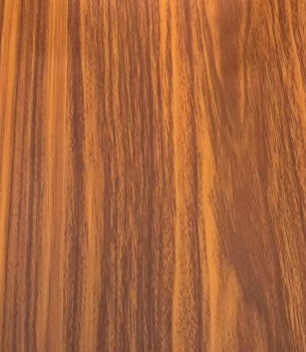
Decorative PVC lamination film surface sample. Film specification is defined by thickness, roll length, substrate compatibility and surface series rather than by appearance alone.
How PVC lamination film is actually specified
A PVC lamination film quotation becomes comparable only when the following variables are fixed. Each one changes the answer to “can this film run on my line and on my substrate?”
| Variable | Why it decides the outcome | Published reference points |
|---|---|---|
| Film thickness | Affects handling, forming behaviour, opacity and surface durability expectations. Only comparable inside the same product family and construction. | XHDeco PVC film: 0.1 mm. Other suppliers list 0.12–0.45 mm for decorative film and 80 µm for a UV-cut film. |
| Roll length / packaging | Drives line changeover frequency, warehouse handling and freight density. | XHDeco: 700 m roll. One published supplier table lists 100–400 m per roll. |
| Width | Must match panel or profile width plus trim allowance. | Confirm per order. Published supplier widths include 1220 mm and 1260 mm for other decorative films. |
| Surface finish | Determines perceived quality, gloss level and fingerprint or scuff visibility. | Finish families seen in the market include high gloss, matte, super matte and soft-touch. |
| Colour / pattern series | Wood and marble series must be batch-consistent for repeat orders and mixed loads. | XHDeco: wooden, marble, golden and other series. |
| Adhesive / lamination route | Cold versus hot lamination changes equipment, cycle time and bonding qualification. | Published adhesive categories: PVA glue (cold laminating), PUR glue (hot laminating) and pressure-sensitive adhesives. |
| Substrate | Bonding performance and surface preparation differ by material. | One supplier lists PVC laminate sheet, SPC, bamboo charcoal fibre panel, carbon crystal panel, acrylic sheet, aluminium/GI sheet, plywood, MDF and WPC. |
| Process route | Flat lamination, profile wrapping and vacuum forming each load the film differently. | Confirm with the film supplier against the intended line and forming depth. |
The practical rule that follows is simple: an RFQ that asks only for “PVC lamination film” will return quotations that cannot be compared. An RFQ that names substrate, lamination method, thickness, finish, adhesive system and roll dimensions returns numbers that can.
The SGS test report: what it covers, and where its boundary sits
This is the part of the evaluation that most often decides whether a container clears the destination market without a dispute. XHDeco's PVC film is stated to be certified to SGS test reports, and the details are documentable rather than implied.
| Item | Detail |
|---|---|
| Certification type | Third-party test report |
| Issuing authority | SGS |
| Report / certification number | GZIN2512002264CM01_EN |
| Issue date | 2025-12-17 |
| Product covered | PVC film product, model LD-60139-9 |
| Declared scope | Adhesive sheet and PVC lamination decorative film |
| Standards referenced | EN 13329-2023, ISO 24338:2022, ASTM D870-15, EN 12149:1997 |
| Markets the certification is stated to apply to | EU, North America, Japan & Korea, Australia, Southeast Asia, Middle East, Latin America |
| Additional stated documentation | Formaldehyde-related and fire-related testing documentation stated as available |
The four referenced standards each map to a different question, which is why the report is more useful than a single pass/fail line:
- EN 13329-2023 — the applicable standard cited for this PVC film.
- ISO 24338:2022 — abrasion testing.
- ASTM D870-15 — water immersion testing.
- EN 12149:1997 — migration testing.
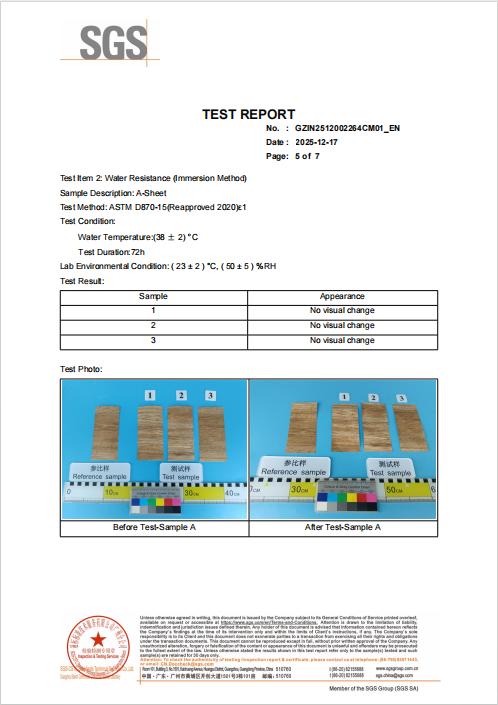
SGS test report documentation covering adhesive sheet and PVC lamination decorative film, report number GZIN2512002264CM01_EN.
The boundary is equally important. Because the declared scope is adhesive sheet and PVC lamination decorative film, and because the named product is model LD-60139-9, the report should be treated as evidence for that configuration. A buyer sourcing a different film series, a different thickness, or an assembled panel should ask the supplier to confirm whether the same documentation applies, or request report coverage for the specific configuration being purchased. Formaldehyde-related and fire-related documentation is stated as available, and the exact grades and their suitability for a given environment are a matter for confirmation between buyer and manufacturer rather than assumption.
Where PVC lamination film is used
The application logic of this material follows the substrate. In building decoration and interior finishing, the film and its related panel products are used for decorative wall and ceiling covering that provides both surface decoration and protection, in residential, commercial, hotel, retail and renovation projects. Installation is fixed — adhesive bonding, or fastening with stainless steel buckles and screws — and the matched accessory set that supports this method includes stainless steel buckles, screws and adhesive sheets.
Beyond panels, one supplier's published application list groups PVC lamination film by substrate: PVC laminate sheet, SPC, bamboo charcoal fibre panel, carbon crystal panel, acrylic sheet, aluminium or GI sheet, plywood, MDF and WPC. That list is a useful checklist rather than a promise, because each substrate pair behaves differently at the bonding interface. In practice this is where the secondary product terms come from — panel film, ceiling film, furniture film, film for plywood, interior decoration film, flat-lamination film, profile wrapping film, vacuum forming film, and self-adhesive or membrane formats.
The supplier's own buyer-facing guidance frames the same material in simpler terms: PVC decorative panels and PVC film are described as lightweight, waterproof, moisture-proof and wear-resistant, with a wide colour range, straightforward installation and low maintenance cost, used for wall and ceiling decoration in residential, hotel and commercial buildings. Where surfaces are already smooth, film application by direct bonding is described as simple to operate; where humid conditions are expected, the moisture-proof performance of the PVC category is the relevant property. For surfaces with high wear exposure, the abrasion standard referenced in the test report is the item to check.
Market context: why specification discipline is becoming more valuable
The demand backdrop is expanding. DataM Intelligence valued the global lamination films market at USD 6,842.11 million in 2024 and projected it to reach USD 11,630.04 million by 2032; the same source reported that Asia-Pacific accounted for 36.87% of lamination film revenue in 2024. A separate commercial estimate cited 1.35 billion square feet of PVC wall panels installed globally in 2023, which is directionally useful for understanding downstream demand but is not a primary statistical series.
On the supply side, industry press has identified Zhejiang Hailide Film New Material Co., Ltd. as a major Chinese manufacturer of industrial-scale calendered and laminated PVC materials — an indication that the film category supports both large industrial supply and specialised decorative supply, depending on the buyer's volume and finish requirements. Price data in this category remains difficult to use: one commercial source lists an average selling price of approximately USD 1,312 per ton in 2025 for PVC film laminated metal sheets, but that product construction differs from decorative panel film, so it should be treated as a directional reference for the metallised segment only, not as a benchmark for interior decoration film.
The practical trend for buyers is therefore not simply rising demand. It is that as more capacity enters the category, the differentiator shifts from availability to documented consistency — whether the roll that arrives matches the sample, the specification sheet and the test report that were used to qualify it.
PVC lamination film compared with traditional surface finishing
Buyers evaluating film are usually also evaluating the finishing route they already know. The comparison below is deliberately qualitative, because the trade-offs depend on substrate, factory layout and product type rather than on a universal number.
| Criterion | PVC lamination film | Liquid coating (paint / lacquer) | Natural wood veneer |
|---|---|---|---|
| Surface consistency | Consistent decorative effect within a batch; depends on film and lamination control | Depends on spray or roller control, curing and environment | Varies with the natural sheet; grain matching is a manual decision |
| Drying / curing | No curing cycle for the film itself; bonding depends on the adhesive route chosen | Requires drying or curing time and controlled conditions | Requires adhesive plus sanding and finishing steps |
| Colour and pattern range | Multiple series available — wood, marble, golden and others — repeatable across orders | Flexible but batch colour matching must be managed | Limited to available timber and grade |
| Process fit | Suited to flat lamination, profile wrapping and vacuum forming when specified correctly | Suited to shaped surfaces and on-site touch-up | Suited mainly to flat panels |
| Documentation | Third-party test reports can be attached to a defined product and model | Depends on the coating supplier's declarations | Depends on species, adhesive and finishing system |
| Main documented constraint | Thickness and specification are product-family specific; they cannot be compared across categories, and fire or formaldehyde grades need confirmation per environment | Solvent handling, curing time and coating durability management | Moisture response and cost volatility of natural material |
The realistic conclusion is not that film replaces coating or veneer everywhere. It is that film becomes the better route when a factory needs repeatable decorative surfaces across panels, ceilings and profiles at volume, and when the buyer can specify and verify the film configuration in writing.
Boundaries a reasonable buyer should keep in view
A sourcing reference that only lists advantages is not useful during evaluation. The following limits follow directly from the published data.
- Thickness is not a cross-category benchmark. A 0.1 mm decorative film, an 80 µm UV-cut film and a 0.18–0.22 mm graphic film are different products. Thickness should be compared only within the same application, construction, adhesive system and test method.
- Certification follows the declared scope. The documented SGS coverage names a product model and a scope of adhesive sheet and PVC lamination decorative film. Extending that coverage to a different series requires supplier confirmation.
- Fire and formaldehyde performance is grade-dependent. Documentation is stated as available, but suitability for a specific environment needs confirmation rather than inference.
- Adhesive choice is a process decision. Cold laminating with PVA, hot laminating with PUR and pressure-sensitive adhesive systems each suit different substrates and lines. Bonding trials remain part of qualification.
- Capacity figures are supplier-stated. Independent capacity verification for decorative film producers is generally thin in public sources, so factory audit remains the standard way to confirm output, equipment and quality-control routines.
- Custom colour carries commercial conditions. Customised length and surface film design are available, and custom colour typically involves a minimum order quantity; mixed colours and profiles within one container are stated as acceptable, with small trial orders negotiable.
Outlook
If the lamination film market continues on the trajectory implied by the 2024–2032 projection, and if Asia-Pacific retains the largest revenue share, the competitive pressure on film suppliers will come from documentation and consistency rather than from raw availability. Buyers are increasingly asking for batch traceability, standard-referenced test reports and stated tolerances, because those items decide whether a decorative surface survives a container journey, a lamination line and a destination market's inspection.
For suppliers with an integrated panel and film operation, that shift is an advantage: the film can be qualified against a real downstream application rather than a laboratory sample. For buyers, the corresponding discipline is to fix the specification list in the RFQ, match the certificate scope to the purchased configuration, and treat the sample, the specification sheet and the test report as one document set rather than three separate promises.
FAQ
What exactly does the SGS test report cover for this PVC film?
The certification is a third-party test report issued by SGS, and it applies to the PVC film product and to the PVC film model LD-60139-9. The declared certification scope covers adhesive sheet and PVC lamination decorative film. The report is identified by certification number GZIN2512002264CM01_EN and was issued on 2025-12-17.
Which market regions does the certification apply to?
The certification is stated to apply to the EU market, the North America market, the Japan and Korea market, the Australia market, the Southeast Asia market, the Middle East market and the Latin America market.
Which standards are referenced in the test report, and what does each one cover?
The SGS test report for this PVC film references four standards: EN 13329-2023, ISO 24338:2022, ASTM D870-15 and EN 12149:1997. EN 13329-2023 is cited as the applicable standard. ISO 24338:2022 is the reference standard for abrasion testing. ASTM D870-15 is the reference standard for water immersion testing. EN 12149:1997 is the reference standard for migration testing.
What are the published specifications of this PVC lamination film?
The product is PVC film, model LD-60139-9, supplied as a lamination film and PVC foil. Published data states a roll size of 700 m, a thickness of 0.1 mm, PVC as the primary material, and colour availability across wooden, marble, golden and other series. The film is covered by SGS test reports, and formaldehyde-related and fire-related testing documentation is stated as available.
What are the minimum order quantity, lead time and customization terms?
The stated minimum order quantity is 1 container, described in buyer-facing material as 1×20GP container, with mixed colours and mixed profiles acceptable within one container and small trial orders negotiable. Stated lead time is 15–20 days. Production mode is ODM, and custom finishes and dimensions are supported, with specific custom options to be confirmed with the manufacturer. Custom colour typically requires a minimum order quantity.
Is PVC lamination film waterproof, and is it easy to install?
In the supplier's published description, PVC decorative panels and PVC film are lightweight, waterproof, moisture-proof and wear-resistant, with a wide colour range, simple installation and low maintenance cost, used for wall and ceiling decoration in residential, hotel and commercial buildings. Film can be bonded directly onto smooth base surfaces. For installed panel systems, fixing is done by adhesive bonding or by fastening with stainless steel buckles and screws, with stainless steel buckles, screws and adhesive sheets as matched accessories. Fire resistance and formaldehyde safety should be referenced to the SGS test reports, and exact grades and suitable environments need customer confirmation.
¿Tiene preguntas o necesita más detalles?
Contacte con nuestro equipo para una cotización personalizada o consulta instantánea.
Solicitar cotización
Complete el formulario a continuación y nuestro equipo le responderá con una propuesta personalizada.
Chat directo de WhatsApp
¿Prefiere chatear en tiempo real? Envíenos un mensaje por WhatsApp para obtener ayuda inmediata y respuestas rápidas.
- Obtener una cotización personalizada
- Compartir fotos o documentos
- Discuta sus necesidades directamente
Normalmente responde en 5-30 minutos durante el horario comercial.