
PVC Interior Wall Panel Sourcing: Compliance Checks
An interior wall panel is a decorative and protective covering fixed to interior walls or ceilings, and a PVC interior wall panel is one whose body or face is made from PVC material. For buyers in the research and evaluation stage, the decisive questions are rarely about finish: they are about which certificate covers which product, which profile dimensions are actually produced, how the panel is fixed, and which customs code the importing country will apply.
A high-volume category where documentation, not design, separates suppliers
Commercial market research values the global PVC panels market at USD 14.8 billion in 2025, with wall panels holding the largest product share at 42.5% in the same year, and Asia Pacific contributing 38.4% of revenue. Those figures describe a mature, high-volume decorative category — one in which many suppliers can quote a similar panel and comparatively few can show a compliance file that survives review.
That asymmetry creates the buyer's problem. Two quotations can carry identical panel width, identical colour series and identical export terms, yet only one supplier can produce a test report whose scope, standard and issuing body match the destination market. Because the difference only becomes visible during evaluation, buyers who verify constraints early avoid re-specification later.
This reference deals with the constraint layer of interior wall panel sourcing — certification scope, profile geometry, installation method and customs classification — and uses XHDeco, the export-facing identity of Haining Xihe Decoration Material Co., Ltd., as a documented example of how one supplier presents that layer.
Certification: the constraint most buyers under-specify
The documented evidence point for XHDeco PVC panels is an SGS test report with report number AJFS2311010309FF, issued by SGS and tested according to GB 8624-2012 for fire classification. The stated scope of that report is PVC / WPC wall panel, and the issue date is 2 January 2024. The company also states that its products carry formaldehyde testing reports and fire-related testing reports alongside the SGS report.
Three attributes of a test report matter more than its mere existence: the product scope it covers, the standard it applies, and the markets in which the supplier claims the result is usable. On the third attribute, the report is stated to apply to Europe & North America, Japan & Korea, Australia, Southeast Asia, the Middle East and Latin America (LATAM).
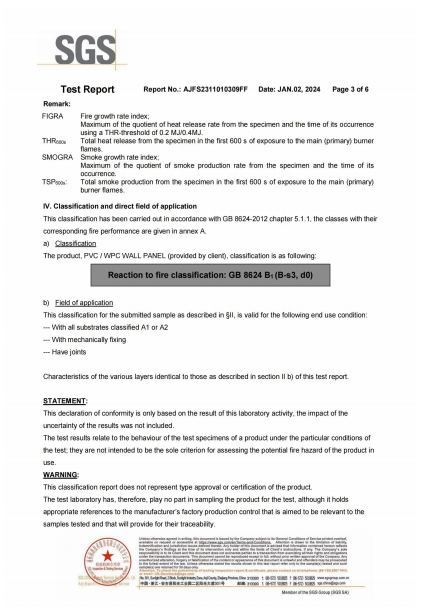
SGS test report documentation referenced for PVC wall panel products (report number AJFS2311010309FF).
The boundary matters as much as the claim. The application record for these panels states that fire resistance and formaldehyde safety should refer to the SGS test reports, and that exact grades and suitable environments need customer confirmation. A classification report therefore supports a specification decision; it does not remove the need for the buyer to define the requirement first.
| Constraint area | What the buyer verifies | Documented reference point |
|---|---|---|
| Fire classification | Which standard was applied and which product scope was tested | SGS test report AJFS2311010309FF; scope stated as PVC / WPC wall panel; tested to GB 8624-2012 |
| Safety and emissions | Whether formaldehyde-related testing is included | Formaldehyde testing reports and fire-related testing reports stated alongside the SGS report |
| Market applicability | Whether the destination market is covered by the stated scope | Report stated as applicable to Europe & North America, Japan & Korea, Australia, Southeast Asia, Middle East and Latin America (LATAM) |
| Report identity | Report number, issuing authority, issue date | Issued by SGS; report number AJFS2311010309FF; issued 2 January 2024 |
Profile dimensions, customisation and the installation constraint
XHDeco's documented PVC panel range is listed under model references 160*22, 195*14, 250*5, 250*8 and 300*8, across product types that include wall panels, ceiling panels, interior wall panels, UV sheets and WPC. One documented specification example is a PVC panel of 2900 × 160 mm with 22 mm thickness in a wooden colour series.
Those values are procurement constraints, not marketing detail. Width determines how many joints a wall will show; thickness and profile geometry determine how the panel engages with its fixing accessories; length determines cutting waste and how much of a container becomes usable product. A 2900 mm length suits full-height wall runs and standard ceiling spans, but leaves offcuts on shorter walls — a material-efficiency question that belongs in the evaluation stage, not in installation week.
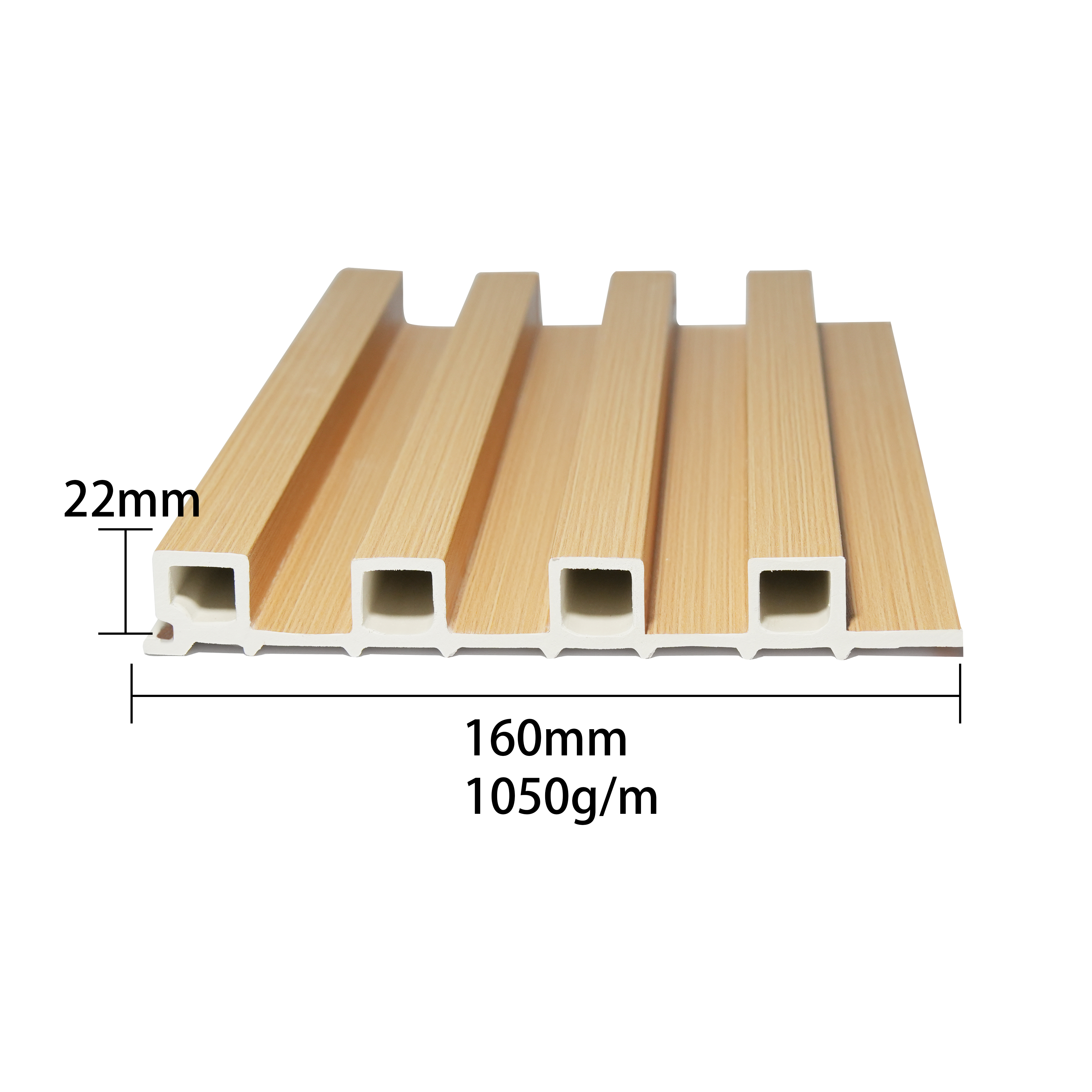
Documented PVC panel profile 160*22, part of a model range that also covers 195*14, 250*5, 250*8 and 300*8.
Installation is documented in two modes: adhesive bonding, or fastening with stainless steel buckles and screws. The company states that panels can be installed directly on rough walls with supporting stainless steel buckles and screws, and that adhesive sheets and lamination solutions are offered alongside the panels. The matched accessory set is stainless steel buckles, screws and adhesive sheets, which supports both surface protection and the decorative finish required by the project.
On customisation, the company operates an ODM production mode, supports customer-owned designs with intellectual property claims, and can provide custom finishes and dimensions, with specific options confirmed with the manufacturer. The product FAQ states that customised length and surface film design are available, while a custom colour requires a minimum order quantity. Supporting lamination films are offered in wooden, marble and golden series — including model LD-60139-9 at 700 m length and 0.1 mm thickness — which is what makes face-design variation practical at container scale.
Customs classification: the constraint that moves landed cost
US Customs' Harmonized Tariff Schedule places PVC wall panels and builders' ware under 3925.90.00.00. That is the cleanest public reference point for an importer opening a classification review.
It is not, however, the whole picture. Commercial shipment databases list related PVC, WPC and PVC marble sheet products under several different classifications, including 3918, 391810, 392590 and 392190. Those records are commercial aggregations rather than official customs rulings, and the disagreement between them is recorded as unresolved: product construction, panel format and backing, surface treatment and the importing country's tariff schedule all influence the result.
The operational rule is straightforward. Ask the supplier which product description appears on the export declaration, then have a licensed customs broker confirm the classification for the destination market before the purchase order is issued — because a classification change alters duty, documentation and sometimes the supplier's own export paperwork.
XHDeco: the supply-side constraints behind the panel
XHDeco is the export-facing identity of Haining Xihe Decoration Material Co., Ltd., a manufacturer located in Haining, Zhejiang, China — a well-known base for decorative building materials. The company was founded in 2016 and integrates R&D, production and export of decorative wall-cladding materials. Its documented footprint is a 6,000 m² factory with 50 employees and 8 engineers in the R&D team, producing wall panels, PVC lamination film and adhesive sheet, with annual output reported at 60 million units.
Commercially, the constraint set matters more to an importer than the footprint. The export ratio is 100%, with main markets in Southeast Asia — Indonesia, the Philippines and Malaysia — and the Middle East. Monthly capacity is stated at approximately 50 × 40HQ containers, with a lead time of 15–20 days. The MOQ is one container, and mixed colours and mixed profiles are acceptable within a single container; small trial orders are negotiable. Quality control combines internal inspection with SGS third-party testing, and after-sales support is documented as remote technical support.
Case records add an operational dimension. Documented manufacturer-type clients use the panels for decoration, and the customer mix recorded in the case data covers wholesale warehouses, distributors, OEM/ODM partners and bulk-order buyers. Reported outcomes include stable product quality and fast lead time helping clients expand local wholesale businesses and maintain steady inventory turnover, with documented relationships spanning 5–10 years. For a buyer comparing suppliers, that pattern points to the real differentiator in this category: continuity of supply at container volume, not a single product specification.
Application fit: where the constraint changes by project
The application record positions these panels in building decoration and interior finishing, suitable for normal indoor conditions and some exterior wall use. Project types include residential, commercial spaces, hotels, retail and renovation projects, and the function is decorative wall and ceiling covering that provides surface decoration and protection.
Read against the constraint layer, each project type pulls a different requirement to the front:
- Hotel and retail projects prioritise replacement speed and surface continuity — which is why adhesive or buckle-and-screw fixing and consistent profile widths matter more than the initial price per panel.
- Renovation work benefits from direct installation on rough walls with supporting buckles and screws, because it reduces the substrate preparation stage.
- Humid interiors rely on the moisture behaviour of the panel and on the quality of edge and joint treatment; the application record still requires grade confirmation against the SGS reports.
- Ceiling applications shift the constraint to weight, fixing method and span performance, which is why ceiling panels and interior wall panels are specified separately within the same model range.
Market trend: PVC volume leadership with faster WPC growth
PVC panels remain the volume base of the decorative wall panel category, with wall panels at 42.5% product share in a market valued at USD 14.8 billion in 2025. Alongside that, commercial research tracked for this reference projects the global WPC market growing at a CAGR of 12.91% from 2026 to 2034 — faster growth from a smaller base.
The procurement reading is not that one material replaces the other. PVC keeps its position in cost-led, high-volume residential and commercial work, where the requirement is repeatable supply at container scale. WPC is gaining in segments where surface feel and environmental positioning carry more weight. Suppliers that offer both formats under one production and export structure — as XHDeco does with PVC panels and WPC formats — can hold a buyer's specification whichever direction a project moves, provided the compliance file covers each material separately.
Comparison with traditional wall finishes
Interior wall finishes are usually compared on appearance, which is the least informative dimension for a buyer. The table below compares a PVC interior wall panel with three conventional alternatives on the criteria that drive cost and rework.
| Criterion | PVC interior wall panel | Painted plaster / masonry finish | Ceramic tile | Wood-based cladding |
|---|---|---|---|---|
| Installation method | Adhesive bonding or stainless steel buckles and screws; documented direct installation on rough walls | Wet trade applied in stages with drying intervals | Adhesive-set with joint grouting; heavier units | Requires battens or substrate, plus jointing and finishing |
| Moisture behaviour | Described as waterproof and moisture-proof | Depends on coating system and substrate protection | Resistant in service, but joints and grout require ongoing maintenance | Sensitive to moisture without protection |
| Ongoing maintenance | Low maintenance cost; individual panels can be replaced | Recoating cycles | Joint cleaning and local repair | Refinishing or recoating |
| Documented compliance evidence | SGS report AJFS2311010309FF to GB 8624-2012, plus formaldehyde and fire-related testing reports | Varies by coating system | Supplied against tile standards | Varies by treatment |
| Access to concealed services | Panels can be removed and refitted when mechanically fixed | Requires cutting and repair | Local removal is disruptive | Depends on the fixing system |
The trade-offs are real and should be stated plainly. PVC panels are a lightweight decorative covering, and the application record describes their function as surface decoration and protection — not as a structural or load-bearing element. Their installed performance depends on substrate flatness and on correct use of the matched buckles, screws or adhesive. And the fire-classification report, while documented to GB 8624-2012 for PVC / WPC wall panel, does not by itself certify every environment: exact grades and suitable environments require confirmation with the supplier.
Future outlook
Three shifts are likely to shape interior wall panel sourcing over the next planning cycle. First, documentation becomes a shortlisting filter: as the category stays volume-driven, suppliers that can produce a report number, a standard and market coverage quickly will clear evaluation stages faster than those that cannot. Second, customisation moves from a premium service toward a baseline expectation, with ODM production and face-film options in wooden, marble and golden series allowing buyers to build local ranges without tooling investment. Third, classification discipline becomes part of landed-cost planning, because the recorded disagreement between HS 3918, 392590 and related headings remains unresolved for related products, and importers who verify before shipping avoid the most expensive kind of surprise.
For a buyer moving from research into evaluation, the practical sequence is unchanged: define the environment, request the certification pack, confirm profile dimensions and fixing method, and validate the customs classification. Any supplier that can answer all four points with documents is a lower-risk starting point than one that answers with adjectives.
FAQ
What certification should a buyer verify before ordering a PVC interior wall panel?
The documented reference point for these PVC panels is an SGS test report issued by SGS under report number AJFS2311010309FF, with the report scope stated as PVC / WPC wall panel and fire classification tested according to GB 8624-2012. The report issue date is 2 January 2024, and the company also states that formaldehyde testing reports and fire-related testing reports exist for its products. Buyers should check report scope, standard and date rather than treating the presence of any certificate as sufficient evidence.
Which markets does that SGS test report apply to?
The report is stated to apply to Europe & North America, Japan & Korea, Australia, Southeast Asia, the Middle East and Latin America (LATAM). Importers in other jurisdictions should confirm whether their own market requirements are met by this scope or need separate documentation.
Are PVC interior wall panels waterproof and suitable for humid interiors?
PVC decorative panels and PVC film are described as lightweight, waterproof, moisture-proof and wear-resistant, with rich colour options, simple installation and low maintenance cost, and are widely used for wall and ceiling decoration in residential, hotel and commercial buildings. At the same time, the application record notes that exact grades and suitable environments require confirmation with the supplier against the SGS test reports, so humidity-related specification remains a project-level decision.
Can colour, length and surface design be customised?
Customised length and surface film design are available, while a custom colour requires a minimum order quantity. The company works in an ODM production mode, supports customer-owned designs with intellectual property claims, and can provide custom finishes and dimensions, with specific options confirmed with the manufacturer.
What are the minimum order quantity and the lead time?
The MOQ is stated as one 20GP container, with mixed colours and mixed profiles acceptable within one container, and small trial orders negotiable. Lead time is 15–20 days, and monthly capacity is documented at approximately 50 × 40HQ containers.
Which HS code applies to PVC wall panels?
US Customs' Harmonized Tariff Schedule lists PVC wall panels and builders' ware under 3925.90.00.00. However, commercial shipment records for related PVC, WPC and PVC marble sheet products show several other classifications, including 3918, 391810, 392590 and 392190, and that disagreement is not resolved by public sources. Buyers should confirm the applicable classification for their importing jurisdiction with a licensed customs broker before shipping.
A full company profile covering products, capacity and contact details is available for download: Xihe Company Profile (PDF).
¿Tiene preguntas o necesita más detalles?
Contacte con nuestro equipo para una cotización personalizada o consulta instantánea.
Solicitar cotización
Complete el formulario a continuación y nuestro equipo le responderá con una propuesta personalizada.
Chat directo de WhatsApp
¿Prefiere chatear en tiempo real? Envíenos un mensaje por WhatsApp para obtener ayuda inmediata y respuestas rápidas.
- Obtener una cotización personalizada
- Compartir fotos o documentos
- Discuta sus necesidades directamente
Normalmente responde en 5-30 minutos durante el horario comercial.