
PVC Foam Core Supplier Capability: How to Verify Real Production Evidence
PVC Foam Core Supplier Capability: How to Verify Real Production Evidence
Composite buyers rarely struggle to find a supplier that claims to make PVC foam core. The harder task is deciding which suppliers can demonstrate, in specifications, certificates, samples and shipping records, that the capability actually exists at the density, thickness and process conditions a specific project requires.
That question has become a mainstream procurement issue rather than a niche one. The global core materials market was valued at USD 4.19 billion in 2024 and is projected to reach USD 6.84 billion by 2032, driven by wind energy and aerospace demand (Vertex AI Search / Industry Report 2032). Marine structural core materials alone reached USD 120.4 million in 2024, with PVC expected to remain the dominant material in that segment because of its moisture resistance (Stratview Research). When demand expands this quickly, the number of suppliers claiming capability grows faster than the number that can document it.
This article is written from the buyer's side of the table. It sets out the evidence layers worth requesting from a PVC foam core manufacturer, explains how to read them, and uses Guangdong Cinon New Material Technology Co., Ltd. — a Guangzhou-based producer and exporter of fiberglass reinforcements and lightweight core materials trading as CINON Composites — as a worked example of how capability signals appear in practice.
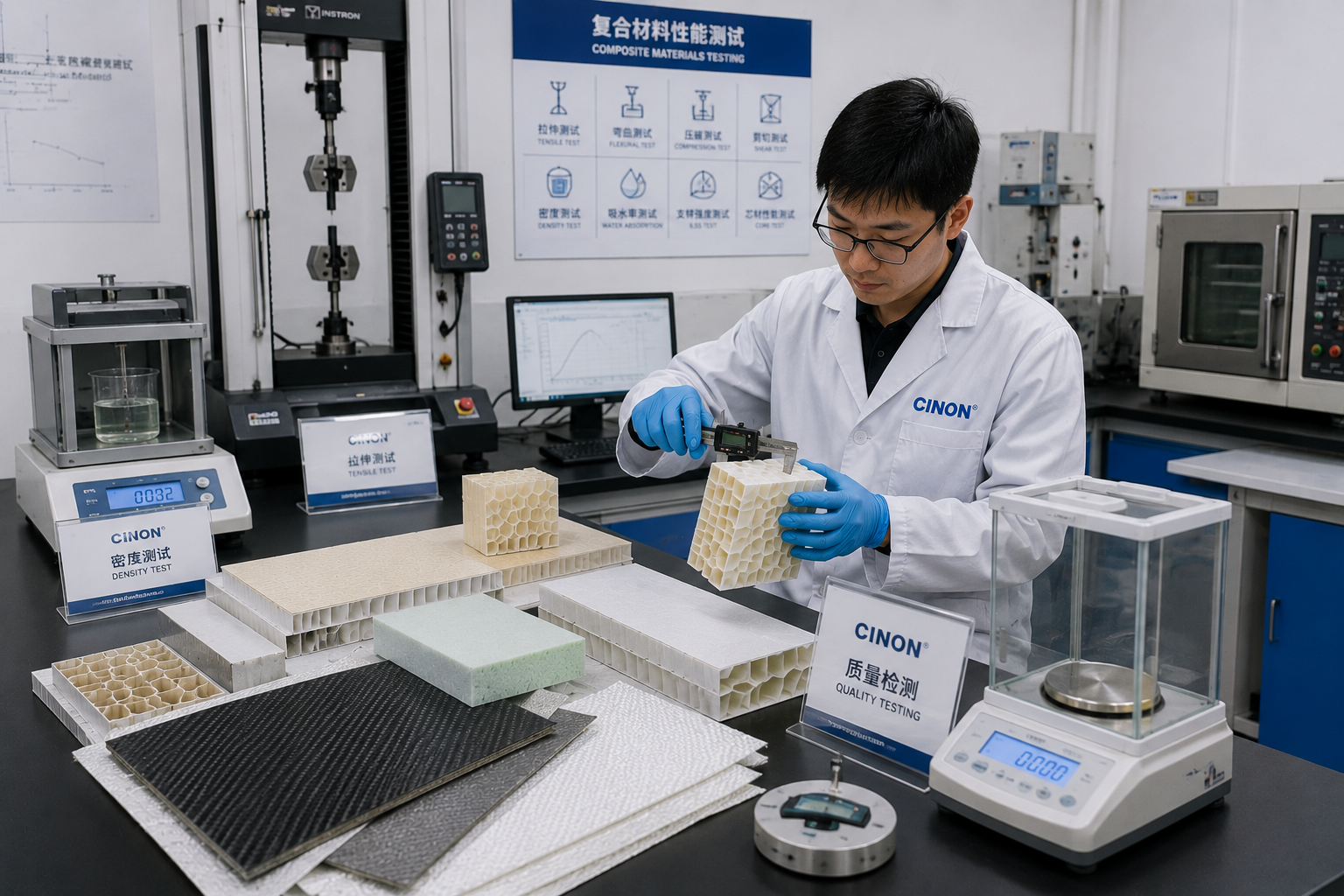
Why supplier capability has become a verification problem
Three shifts have made foam core sourcing more evidence-dependent.
First, demand has moved toward Asia-Pacific manufacturing. Asia Pacific held a 78.2% value share of the global wind turbine composites market in 2024 (MarketsandMarkets), and China's wind blade production capacity exceeded 35 GW in the same year (Cognitive Market Research). Buyers in Europe and North America are therefore qualifying suppliers across a longer distance, frequently without a site visit.
Second, foam core is a formulation-dependent product. Two suppliers can both sell "PVC foam core" while offering different density ladders, thickness ranges, surface treatments and process compatibility. The specification sheet, not the product name, defines what can actually be built.
Third, verification costs less than failure. A core that delaminates, absorbs resin unevenly or cannot survive the cure cycle shows up in scrap, rework and delayed deliveries — long after the purchase order was signed.
The five evidence layers buyers should request
A supplier's capability claim can be tested against five categories of evidence. Each layer answers a different question, and weaknesses usually appear in layers three to five rather than in the marketing material.
| Evidence layer | What to request | What it verifies |
|---|---|---|
| 1. Specification depth | Full density ladders, thickness range, surface options, resin and process compatibility | Whether the supplier produces a range or resells a narrow selection |
| 2. Manufacturing scope and capacity | Facility size, annual and monthly output, production mode (OEM / ODM), customisation capability | Whether volumes can be sustained and whether non-standard requests are possible |
| 3. Process compatibility | Documented support for vacuum infusion, RTM, hand lay-up, prepreg or VARTM | Whether the material fits the customer's existing production route |
| 4. Quality control and traceability | Inspection regime, test coverage, batch records, complaint handling | Whether consistency is managed by system or by chance |
| 5. Commercial and logistics evidence | MOQ, lead time, export markets, packaging and loading documentation | Whether the supply chain can actually deliver on schedule |
Reading a PVC foam core specification as capability evidence
A specification sheet is the fastest indicator of whether a supplier manufactures across a range or simply trades a few stock items. For the PVC foam core range supplied by CINON Composites, the published data covers densities of 45, 50, 60, 80, 100, 130, 200, 250 and 300 kg/m³, a thickness range of 1–80 mm, and four surface options: plain, grooved, perforated and scrim-backed. The material is closed-cell PVC, and the documented processing methods are vacuum infusion, RTM, hand lay-up, prepreg and VARTM.
Two details matter more than the headline numbers. The density ladder runs from a light 45 kg/m³ grade to a 300 kg/m³ grade, which means the same supplier can serve a weight-critical yacht deck and a load-bearing transport panel without switching sources. The 1–80 mm thickness range is also unusually wide for a single core family: thin grades are used where laminate thickness is constrained, while thick grades reduce the number of plies required in large panels.
Surface treatment is the part of the specification buyers most often overlook. Grooving and perforating affect resin flow and out-gassing during infusion, while scrim backing changes handling and cut-piece behaviour. A supplier that publishes these options is describing a production capability, not a catalogue entry.
CINON positions its PVC foam core as a Divinycell alternative — a comparison buyers should treat as a starting point for their own equivalency testing rather than a conclusion. The same portfolio includes PET foam core (80–320 kg/m³), PMI foam core (40–130 kg/m³), aramid honeycomb, thermoplastic PP honeycomb and a family of thin infusion cores, which is relevant because it shows the supplier's engineering team works across core chemistries rather than one formulation.
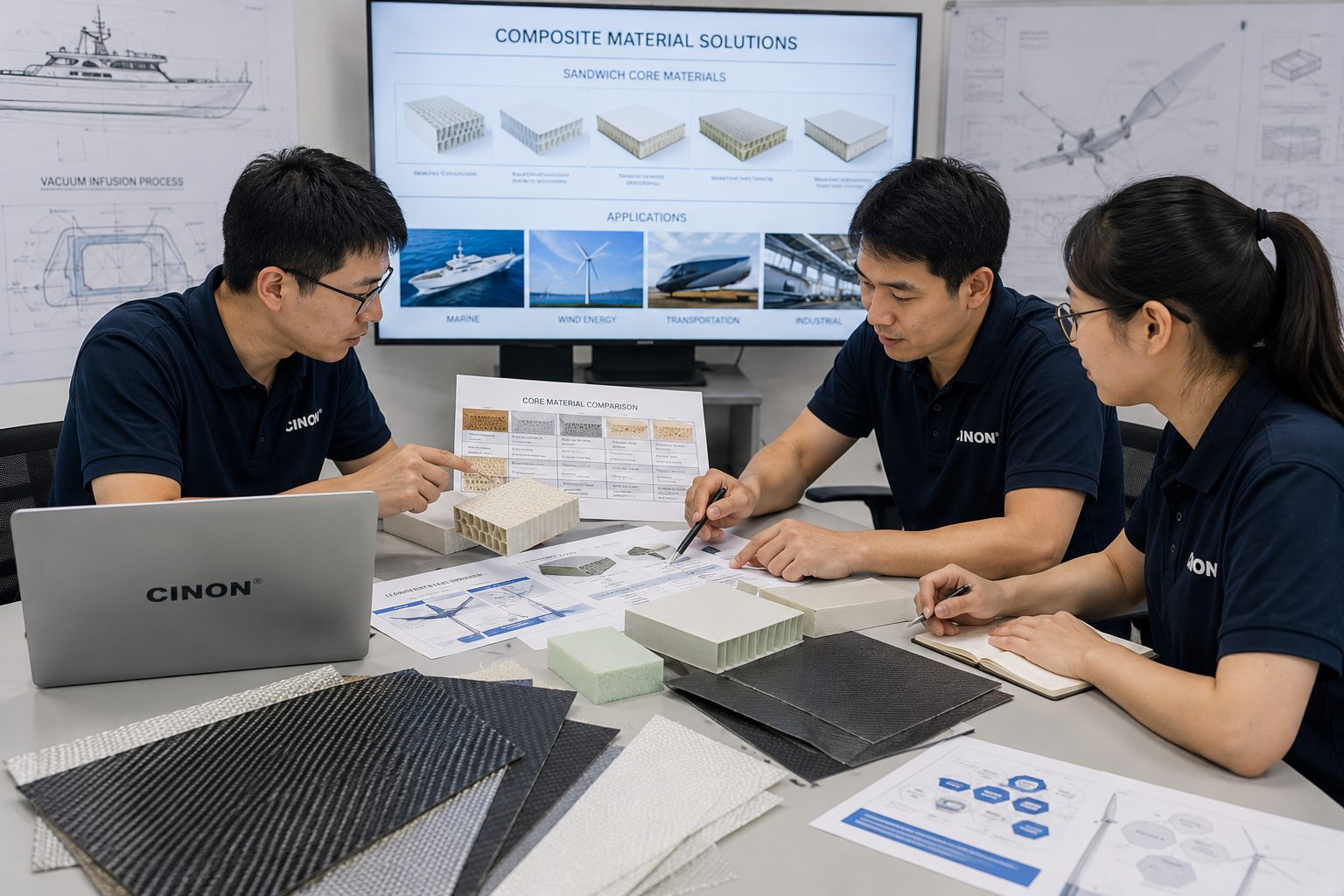
Manufacturing scope and the numbers that should agree with each other
Capacity claims are easy to publish and easy to check. The test is internal consistency.
CINON Composites was founded in 2022, operates a 40,000 m² facility, and reports annual output of 1,200,000 m² against a monthly capacity of 100,000 m². Those two figures describe the same production rate, which is what a buyer should expect when a supplier's numbers are drawn from real planning data. A technical team of 25 engineers supports material selection and process work, and the company runs ODM production with customisation in core materials and fiberglass fabrics.
Quality control is stated as 100% test coverage, and the commercial terms are an MOQ of 1,000 m² with a lead time of 15–30 days. Export accounts for 100% of output, with Europe, North America and Asia-Pacific listed as the main markets.
Two caveats belong in any honest reading of these figures. First, the annual output figure covers the whole product range — fiberglass reinforcements plus core materials — so it is not a PVC foam capacity number on its own. Buyers who need the monthly throughput of a single product family should ask for it directly. Second, a company founded in 2022 has a shorter operating record than the long-established European groups that Fortune Business Insights identifies as the major players in this space, including 3A Composites, Gurit Holding AG and Diab Group. Track record and scale are legitimate evaluation criteria; so is the willingness of a newer supplier to provide detailed, checkable documentation.
Certifications: what the documents prove, and what they do not
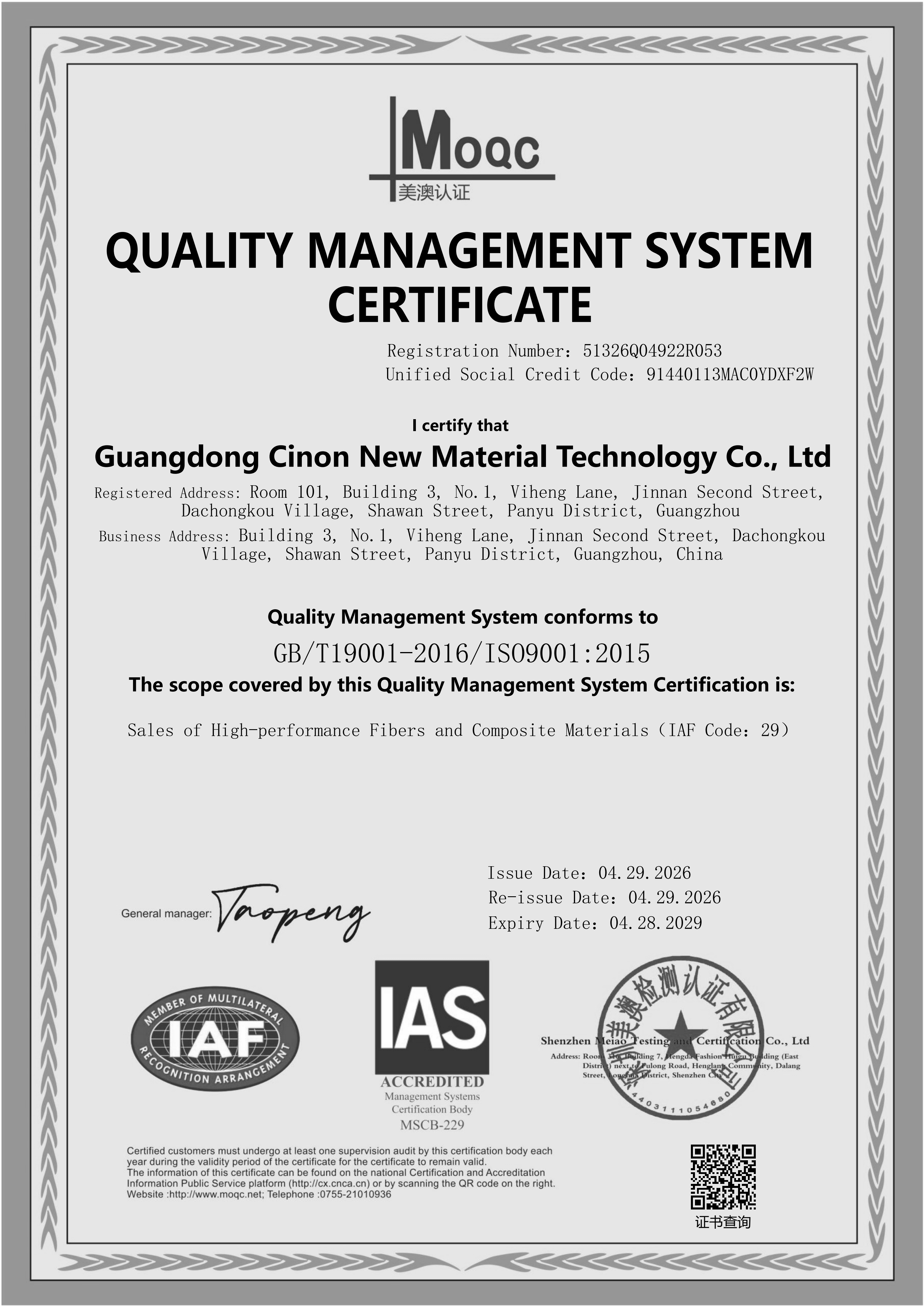
Certificates are evidence only when the scope wording is read as carefully as the certificate number. CINON Composites holds three management-system certifications.
| Certification | Certificate number | Issuing body | Validity | Scope wording |
|---|---|---|---|---|
| ISO 9001:2015 | 51326Q04922R053 | Shenzhen Moqc Certification Co., Ltd | Issued 2026-04-29, expires 2029-04-28 | Sales of High-performance Fibers and Composite Materials |
| ISO 45001:2018 | 51326S01896R053 | Shenzhen Moqc Certification Co., Ltd | Issued 2026-04-29, expires 2029-04-28 | Sales of High-performance Fibers and Composite Materials |
| ISO 14001:2015 | ISO14001-2023-001 | SGS | Issued 2023-06-01, expires 2028-06-01 | Composite intermediates sales |
The important detail is that all three scopes describe sales, and composite intermediates sales. Buyers whose internal qualification process requires manufacturing-scope certification should raise this explicitly during supplier evaluation, rather than assuming that a quality certificate covers the production line. The same discipline applies to every supplier in this market: check the certificate number on the issuing body's register, confirm the expiry date, and match the scope wording against the activity you are buying.
Application coverage as a capability check
An application list is only meaningful when it is specific. The PVC foam core range from CINON is documented for marine and yacht building, wind energy, transportation, rail vehicles, RV and caravan manufacturing, industrial composites, construction panels and defense applications.
Each of these segments tests a different property. Marine and yacht construction — hulls, decks and sandwich panels — puts the emphasis on moisture resistance and consistent resin uptake, which is why closed-cell PVC remains the reference material in that market. Rail and transport panels prioritise stiffness-to-weight ratio and thickness uniformity. Wind energy and larger industrial panels depend on the ability to supply consistent density across long production runs.
Judging coverage on application names alone is weak evidence. Reference cases are stronger, because they show the material inside a working programme:
- Marine and yacht builders (Australia): container-scale supply for boat building, with reported results of smooth surface, easy wet-out and better finish.
- RV manufacturers (United States): PP honeycomb and PET foam sandwich panels for lightweight RV construction, with reported glossy surface treatment and thickness uniformity in FRP panel production.
- UAV manufacturers (Germany): PMI foam and lightweight fiberglass fabrics for wing and fuselage structures, with reported ultra-lightweight structures, high stiffness and high temperature resistance.
- Sports equipment manufacturers (Thailand): container orders for surfboard applications, with reported weight reduction, performance improvement, high buoyancy and impact resistance.
- Composite distributors (United Kingdom, Poland, Czech Republic): long-term supply arrangements with OEM labelling, monthly repeat orders, and an alternative supply solution for one UK distributor.
Distributor cases are worth reading closely in a verification exercise, because private-label and repeat-order arrangements are difficult to sustain without consistent production. A supplier that supports OEM labelling and monthly reorders is demonstrating repeatability, which is precisely the property that is hardest to judge from a sample box.
Where PVC foam core fits — and where it does not
No core material is universally correct, and a supplier that presents one is not giving buyers useful information. The comparison below is drawn from published specifications in the CINON portfolio.
| Core option | Documented density / thickness | Typical documented role | Boundary to check |
|---|---|---|---|
| PVC foam core | 45–300 kg/m³; 1–80 mm; plain, grooved, perforated or scrim-backed | Sandwich core for marine and yacht, wind energy, transportation, rail, RV, industrial panels and defense | The lightest published grade is 45 kg/m³, above the lightest PMI and aramid honeycomb grades in the same portfolio |
| PET foam core | 80–320 kg/m³ | Recyclable structural core for marine, wind, transport, rail, RV, panels and renewable energy | The range starts at 80 kg/m³, so it does not cover the low-density end of the PVC ladder |
| PMI foam core | 40–130 kg/m³ | Aerospace, UAV, motorsport, high-performance marine and defense | Positioned for high-performance programmes rather than general panel production |
| Aramid honeycomb | 32–128 kg/m³; cell sizes 1.83–5.5 mm; working temperature -60 to 180 °C | Aerospace interiors, UAV structures, motorsport, radar structures and racing yachts | Supplied as cutting strip, fixed block and slice-cut block, so cutting and layup planning differ from foam |
| Infusion core mats (CM, CT, CS, CX) | 1.5–6 mm; 90–360 g/m²; max process temperature 170–180 °C | Internal flow media, print-through control and surface finish in vacuum infusion | Thickness range is far below PVC foam, so these complement rather than replace a structural core |
Three practical limits are worth stating plainly. First, the published process-temperature data in this portfolio applies to the infusion core mats (170–180 °C); a documented cure-temperature figure for the PVC foam range itself is not part of the public catalogue, so buyers running elevated-temperature cure cycles should request it in writing before qualification. Second, minimum order quantity and lead time — 1,000 m² and 15–30 days respectively — are relevant constraints for prototyping teams that work in square metres rather than full pallets. Third, certification scope, as noted above, is written around sales rather than manufacturing, which some qualification processes will not accept without additional documentation.
Market signals behind the verification push
The demand picture explains why buyers are being asked to qualify more suppliers, faster. The wind turbine blade composite materials market was valued at USD 7.045 billion in 2024 (Cognitive Market Research), and the RV composite panels market reached USD 3.8 billion in 2025, with fiberglass segments holding 41.3% of material share (Dataintelo). Both segments consume foam and honeycomb cores at volume.
Market sizing in this sector should be treated as directional rather than exact. Estimates for the core materials market differ by source: one 2024 figure places it at USD 4.19 billion, while another puts it at USD 2.8 billion in 2025, with the divergence explained by which material types are included. Buyers should use such numbers to understand direction of travel, not to build business cases.
What comes next for core material sourcing
Verification is becoming a routine part of composite procurement rather than a one-off audit. Two developments are likely to accelerate that. Certification scope wording will receive more scrutiny as buyers align supplier qualification with their own quality systems. And process data — cure temperatures, resin compatibility and infusion behaviour at specific densities — will increasingly be requested as a document rather than discussed on a call.
Suppliers that can produce that documentation quickly will find evaluation cycles shorter. Those that cannot will continue to compete on price and delivery, which is a harder position to defend in a market where failure costs are measured in scrapped laminates.
Frequently asked questions
How do you verify a PVC foam core manufacturer's production capability before placing an order?
Start with the specification sheet and check whether it describes a range or a single item. A supplier able to publish multiple densities, a wide thickness band, several surface treatments and documented process compatibility is describing production capability. Cross-check the capacity figures for internal consistency — annual output and monthly capacity should describe the same rate — and ask whether those figures cover the whole product range or one product family.
What specification details should a PVC foam core supplier be able to document?
The minimum set is density ladder, thickness range, cell structure, surface options and compatible processing methods. For the CINON PVC foam core range, that means densities from 45 to 300 kg/m³, thickness from 1 to 80 mm, closed-cell PVC, plain, grooved, perforated or scrim-backed surfaces, and vacuum infusion, RTM, hand lay-up, prepreg and VARTM as documented processes. Buyers should also request any parameter their cure cycle depends on, such as maximum process temperature.
How should buyers read certification scope when qualifying a core material supplier?
Read the scope text, not the certificate title. The ISO 9001:2015, ISO 45001:2018 and ISO 14001:2015 certificates held by CINON Composites are written around sales of high-performance fibers and composite materials, and composite intermediates sales. That is normal in a supply-and-trading business model, but it means a buyer requiring manufacturing-scope certification must confirm this point during qualification. Certificate numbers, issuing bodies and expiry dates should always be checked against the issuer's register.
Which records make foam core quality traceable?
Traceability comes from batch-level records linking incoming material, production and inspection. CINON states 100% test coverage as its quality control regime and lists quality traceability among its after-sales support functions. In practice, buyers should ask what a batch record contains, how a complaint is investigated, and whether the supplier can connect a delivered pallet back to an inspection result.
What are the limits of PVC foam core compared with PET foam and honeycomb?
PVC foam core starts at 45 kg/m³ in this portfolio, while PET foam begins at 80 kg/m³ and aramid honeycomb ranges from 32 to 128 kg/m³. PVC's advantage is moisture resistance and established use in marine sandwich construction; PET offers a recyclable option at higher densities; honeycomb provides very low density but is supplied in strip, block and slice-cut form, which changes cutting and layup planning. The correct choice depends on the laminate, the cure cycle and the weight target rather than on the material name alone.
How does a sample or pilot order fit into supplier verification?
A sample validates that the material matches the specification; a pilot order validates that the supplier can repeat it. The most informative pilot is one that mirrors production conditions — same density, same surface treatment, same infusion method — and includes documentation for the delivered batch. CINON lists sample evaluation and technical support from prototype development through to mass production among its capabilities, delivered through email, WhatsApp, online meetings and technical documentation.
The full product range, including fiberglass reinforcements and the complete core material portfolio, is documented in the CINON Composites catalogue.