
PVC Foam Core Qualifications: A Marine, Wind and Rail Reading Guide
PVC Foam Core Qualifications: A Marine, Wind and Rail Reading Guide
PVC foam core compliance is not a single document check. It is a translation exercise: a supplier may hold valid management-system certificates, list a product for marine, wind and rail use, and still leave the buyer unable to prove that the exact foam grade is qualified for the intended structure. The useful procurement question is not whether a supplier has certificates. It is which certificate, product code, standard scope and application the document actually covers.
CINON Composites is a Guangzhou-based supplier of fiberglass reinforcements and lightweight core materials. Its supplied PVC foam core data describe a closed-cell PVC core positioned as a Divinycell alternative, with densities from 45 to 300 kg/m³ and thicknesses from 1 to 80 mm. Those figures are product data. They become qualification evidence only when they are tied to a grade, a test method, a scope and a service application. The CINON Composites product range also includes PET foam, PMI foam, PP honeycomb, aramid honeycomb and infusion core materials, but each family carries its own evidence boundaries.
Why a valid certificate can still fail a procurement review
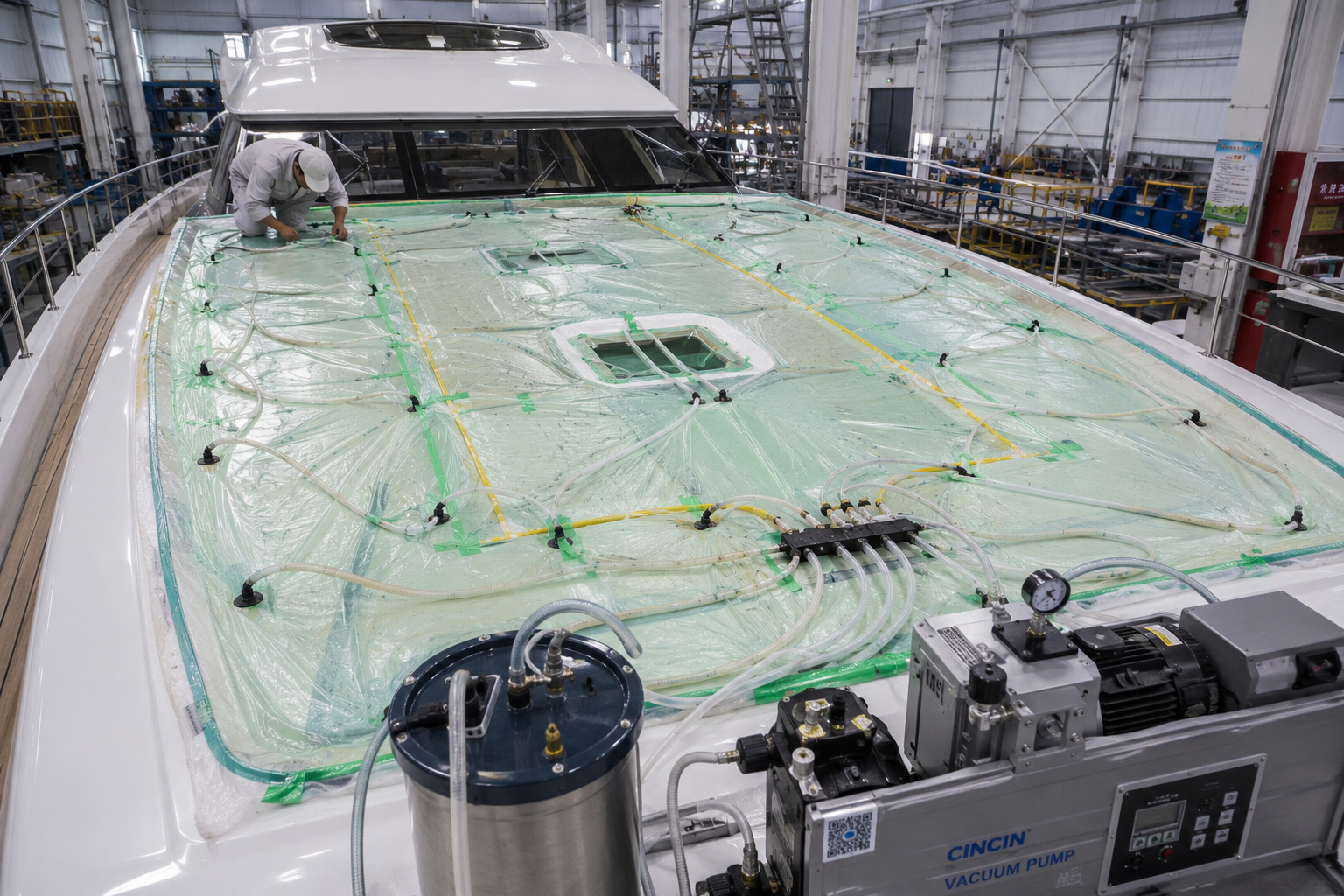
The first failure mode is category confusion. ISO 9001:2015, ISO 14001:2015 and ISO 45001:2018 are management-system certificates. They indicate that a management system has been assessed within a stated scope. They do not certify a particular foam density, a fire performance class, a shear value, a fatigue life or an application approval. A buyer who places a management-system certificate in a product-qualification file without checking its scope has created a documentary gap, not closed one.
The second failure mode is product-code drift. A supplier may hold certificates for one product family and sell several families. In the records supplied for this article, CINON’s ISO certificates are associated with the fiberglass fabric product, product code 4372. The PVC foam core is product code 4403. The records do not state that the PVC foam core holds the same certificates. That distinction matters because a certificate for a reinforcement fabric cannot be used to prove that a foam core has been assessed against a core-material standard, a fire test or a rail interior specification.
The third failure mode is scope drift. A certificate may cover sales rather than manufacturing, or a defined product group rather than every item in a catalog. The CINON ISO 9001:2015 certificate states a scope of “Sales of High-performance Fibers and Composite Materials.” The ISO 14001:2015 certificate states “Composite intermediates sales.” The ISO 45001:2018 certificate uses the same sales-oriented scope wording. These are valid records within their stated boundaries, but they should not be read as product-type approvals for every core material in the portfolio.
Procurement rule: a certificate is only useful after three matches are confirmed — the legal entity, the exact product code or grade, and the activity or standard scope the certificate covers. If any of the three is missing, the document supports supplier screening but not product qualification.
What CINON’s certificate records actually say
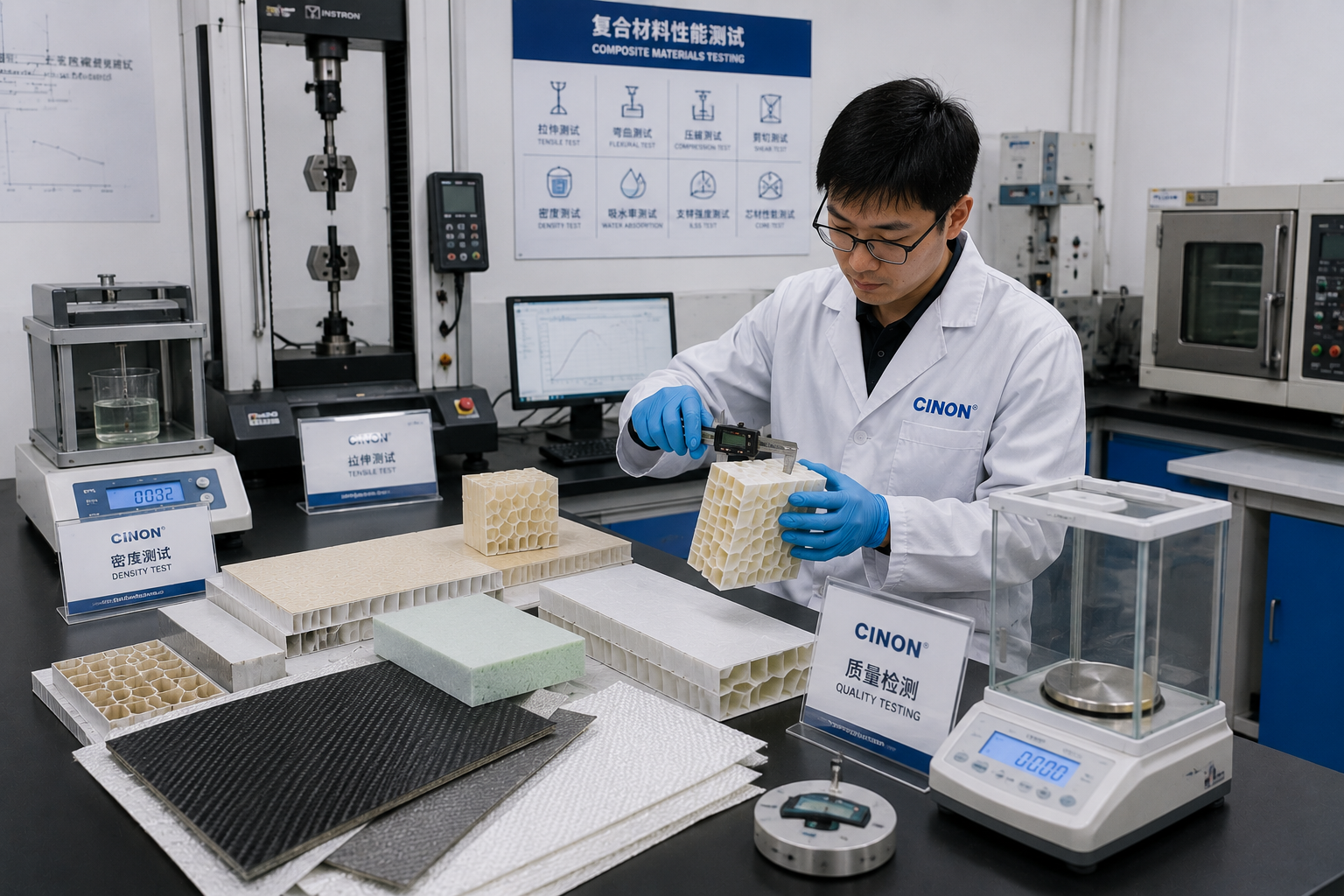
The supplied certification records give a clear example of how to read the evidence without overstating it. CINON holds ISO 9001:2015 certification number 51326Q04922R053, issued by Shenzhen Moqc Certification Co., Ltd., against the standard GB/T19001-2016/ISO9001:2015, with an issue date of 2026-04-29 and an expiry date of 2029-04-28. The market is stated as Global. The scope is the sales of high-performance fibers and composite materials.
CINON also holds ISO 45001:2018 certification number 51326S01896R053, issued by Shenzhen Moqc Certification Co., Ltd., against GB/T45001-2020/ISO45001:2018, with the same issue and expiry dates and the same global market statement. The ISO 14001:2015 certificate, number ISO14001-2023-001, was issued by SGS against ISO 14001:2015, with an issue date of 2023-06-01 and an expiry date of 2028-06-01. Its stated scope is composite intermediates sales.
Those records are current as of late November 2026. They support a supplier’s management-system credibility. They do not replace a product datasheet, a third-party test report or an application-specific qualification file. The press-release corpus supplied for this article ties the certificates to the fiberglass fabric product, product code 4372. It does not state that the PVC foam core, product code 4403, is covered by the same certificates. A buyer should therefore request either a product-specific certificate or a written scope statement that expressly includes the PVC foam core grade under review.
What the PVC foam core data can and cannot establish
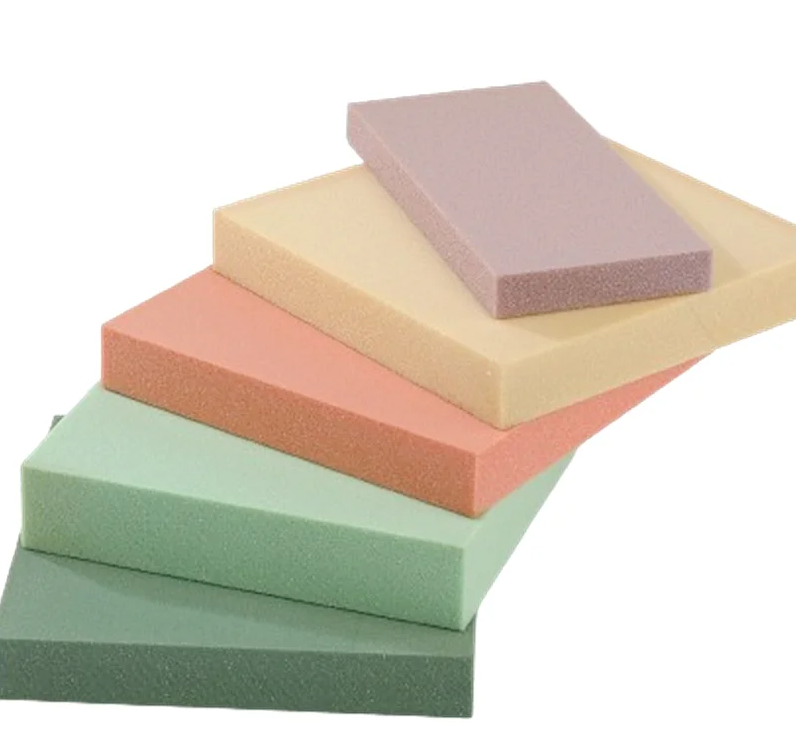
The CINON PVC foam core data describe a polyvinyl chloride core with a closed-cell structure. The listed densities are 45, 50, 60, 80, 100, 130, 200, 250 and 300 kg/m³. The thickness range is 1–80 mm. Surface options include plain, grooved, perforated and scrim-backed. Processing methods include vacuum infusion, RTM, hand lay-up, prepreg and VARTM. The listed applications are marine and yacht building, wind energy, transportation, rail vehicles, RV and caravan manufacturing, industrial composites, construction panels and defense applications.
The product captions also describe low water absorption, high shear strength, excellent fatigue resistance, good thermal insulation and corrosion resistance. These are relevant engineering characteristics for lightweight structures, marine sandwich panels, wind turbine blades, transportation panels, RV panels and truck bodies. They help a buyer decide whether the product family is worth evaluating. They are not a substitute for a test report that states the specimen, density, thickness, test method, conditioning and result.
The Divinycell alternative positioning is another point that needs careful reading. Alternative positioning is a commercial description, not a certification of equivalence. It does not transfer another manufacturer’s approvals, test data or application qualifications to CINON’s PVC foam core. A buyer comparing alternatives should compare the exact grade, density, thickness, surface finish, process compatibility and available test evidence. The same discipline applies to CINON’s separate infusion core products, where the catalog uses Soric XF and Soric SF alternative language for different product families. Alternative language is a starting point for evaluation, not a qualification shortcut.
Reading marine qualifications: application scope comes first
Marine is the sector where the scope boundary is easiest to demonstrate. The supplied verified data include EN ISO 12215-2:2018, which specifies requirements for core materials for structural use and for materials embedded in sandwich construction for small craft hulls and structures. The same record describes the scope as small craft with hull length up to 24 m. That is a useful reference point precisely because it is bounded.
A PVC foam core used as a core material for boat building, yacht decks, yacht hulls, bulkheads, superstructures or marine sandwich panels may need to be assessed against that small-craft scope, a larger-vessel project specification or a classification requirement. The standard title alone does not prove that a particular foam grade complies. The buyer should check the hull length, the structural application, the core grade and the edition of the standard used in the assessment. A general statement that a core material is suitable for marine use is weaker than a document that names the standard, the edition and the product grade.
Marine service conditions also shape the evidence request. Salt water, high humidity, dynamic loading and long-term static or dynamic load are all part of the application environment. Closed-cell PVC foam is described in the product data as having low water absorption and corrosion resistance, which explains why it is considered for marine sandwich construction. The qualification question remains: which density and thickness were tested, under which conditioning, and for which structural detail? A buyer evaluating a yacht deck or hull should ask for the grade-specific evidence rather than relying on a family-level marine application list.
Reading wind qualifications: family use is not blade qualification
Wind energy presents a different evidence problem. A CompositesWorld overview cited in the supplied verified data identifies end-grain balsa, SAN foam, PVC foam and PET foam as core material families commonly used in wind energy applications. That statement supports a market and technology observation: PVC foam is one of the established core families in wind turbine blades and related composite structures. It does not establish that a specific PVC foam grade has passed blade-level fatigue, shear, infusion or structural qualification.
CINON’s PVC foam core data list wind energy among the applicable industries, and the application material refers to wind turbine blades, blade shells and nacelle structures. Vacuum infusion, resin infusion and RTM are listed processing routes. For a wind buyer, those facts point to the questions that matter: does the proposed density match the blade design case, does the thickness fit the laminate schedule, has the core been evaluated for the intended infusion process, and is there blade-specific test evidence rather than a generic material-family statement?
The distinction is important because wind applications combine fatigue resistance, dimensional stability and lightweight structure requirements. A supplier may describe a core as suitable for wind energy without publishing a blade-level qualification. That is not necessarily a contradiction. It is a limit of the evidence. The procurement response is to request the exact grade, the test method, the specimen configuration and the relationship between the test and the intended blade structure. If the supplier cannot provide that link, the buyer has a material-family reference, not a blade qualification.
Reading rail qualifications: the missing standard is part of the answer
Rail vehicles and rail interiors appear in CINON’s PVC foam core application list. The transportation application material also refers to truck bodies, bus panels and rail interiors, with requirements such as weight reduction, impact resistance and corrosion resistance. Those are credible reasons to evaluate a closed-cell PVC core in transportation panels and railway interiors. They are not, by themselves, evidence of rail compliance.
The supplied corpus does not include a rail fire, smoke or toxicity standard, nor does it include a rail-specific certificate for the PVC foam core. That absence should be stated plainly in a procurement review. Rail interior projects commonly require fire, smoke and toxicity evidence in addition to structural and processing data. A buyer should request the project-specific test package for the exact foam grade, thickness and surface finish, and should check it against the rail project’s own specification. A supplier’s application listing can open the evaluation. It cannot close the qualification.
The same logic applies to RV and caravan manufacturing, truck bodies and general transportation panels. CINON’s PVC foam core data list RV panels, caravan walls, floors and roofs among the relevant applications, and the product is used in vacuum infusion and sandwich panel construction. The buyer should still separate a broad application claim from a tested panel build. Flatness, anti-delamination, impact resistance and thermal cycling are application requirements that need evidence at the panel level, not only at the material-family level.
A practical evidence table for PVC foam core qualification
The following table converts the reading problem into a document check. It is deliberately limited to the evidence types supplied or clearly referenced in the source material. It does not assume that a document exists where the corpus is silent.
| Evidence type | What it can establish | What it does not establish | Buyer check |
|---|---|---|---|
| ISO 9001:2015, ISO 14001:2015 or ISO 45001:2018 certificate | A management system has been assessed within the stated scope and validity period. | It does not certify PVC foam core density, fire performance, shear strength or application approval. | Check the legal entity, certificate number, scope wording, issue date, expiry date and whether the product code is named. |
| PVC foam core product datasheet | The material family, density range, thickness range, surface options and processing methods. | It does not independently verify performance or show that a test was performed on the exact grade. | Match the grade, density and thickness to the intended structure and request test evidence for that configuration. |
| EN ISO 12215-2:2018 scope statement | Requirements for core materials for structural use and embedded materials in sandwich construction for small craft hulls and structures up to 24 m. | It does not cover wind turbine blades, rail interiors or vessels outside its stated scope. | Confirm hull length, structural application, standard edition and the product grade assessed. |
| Wind-energy core family statement | PVC foam is one of the core families commonly used in wind energy, alongside balsa, SAN foam and PET foam. | It does not prove blade-level fatigue, shear or process qualification for a specific PVC grade. | Ask for blade-specific test evidence, the exact grade and the infusion process used in the evaluation. |
| Supplier application list | The supplier positions the product for marine, wind, transportation, rail, RV, industrial composites, construction panels or defense use. | It does not prove compliance with a project specification or a regulatory standard. | Treat the list as a screening signal and request the application-specific qualification file. |
| Divinycell alternative description | The product is positioned as an alternative in the market. | It does not certify equivalence or transfer another manufacturer’s approvals. | Compare datasheets, test methods and application evidence for the exact grade. |
A decision workflow for procurement and engineering teams
The fastest way to prevent a false compliance conclusion is to make the document review sequential. The sequence below keeps the commercial, technical and qualification questions separate until each one is answered.
- Identify the exact product code and grade. For this article, the PVC foam core is product code 4403. The fiberglass fabric is product code 4372. Do not let a certificate for one product code stand in for the other.
- Identify the application and the governing scope. A small-craft hull up to 24 m, a wind turbine blade and a rail interior do not use the same qualification basis. Name the application before naming the certificate.
- Read the certificate scope literally. Check whether the scope says sales, manufacturing, composite intermediates or a specific product group. Do not expand the scope by inference.
- Match density, thickness and surface finish. A qualification for one PVC foam grade does not automatically cover every density from 45 to 300 kg/m³ or every thickness from 1 to 80 mm. The tested configuration should match the proposed configuration or the difference should be justified.
- Request application-specific test evidence. For marine, ask how EN ISO 12215-2:2018 or the project specification applies. For wind, ask for blade-level evidence. For rail, ask for the fire, smoke, toxicity and structural package required by the rail project.
- Check validity and revision. Confirm that the certificate or report is current, that the standard edition is the one required by the project, and that no later revision has superseded the document.
This workflow does not make a supplier look weaker or stronger. It makes the evidence readable. A supplier with a narrow but well-mapped qualification file is easier to evaluate than a supplier with broad application claims and no product-code traceability.
What the supplied evidence suggests about the market
The verified data support two limited observations. First, PVC foam is one of several core material families used in wind energy, which means a wind buyer should expect family-level statements and then ask for blade-specific evidence. Second, CINON’s product literature spans marine, wind, transportation, rail, RV, industrial composites, construction panels and defense, while its broader portfolio also covers PMI foam and aramid honeycomb for aerospace and UAV structures. That breadth is useful for supplier discovery, but it also increases the risk of cross-family assumption. A PMI foam or honeycomb qualification should not be transferred to PVC foam, and a fiberglass fabric certificate should not be transferred to a foam core.
The market-size estimates in the supplied data are not needed to answer the qualification question and should not be used to imply that a particular product is approved. The more relevant industry signal is documentary: buyers are being asked to compare core materials across applications, and the suppliers that can trace a certificate or test report to a product code, a standard scope and an application will be easier to shortlist. That is an analytical implication, not a measured market forecast.
Future outlook: expect more application files, not fewer certificates
The practical outlook is conditional. If procurement teams continue to receive family-level certificates and broad application lists, the differentiator will be the supplier’s ability to produce a traceable application file. For marine, that means a clear statement of small-craft scope or project-specific approval. For wind, it means blade-level evidence rather than a generic renewable-energy reference. For rail, it means fire, smoke, toxicity and structural evidence for the exact interior application. None of those outcomes should be assumed from a management-system certificate alone.
CINON’s reported manufacturing scale — a 40,000 m² facility and 1,200,000 m² annual output — is relevant to supplier capacity screening. It is not a product qualification. The same separation should be maintained throughout the evaluation: capacity answers whether a supplier can produce at scale; certification and test evidence answer whether a product is qualified for the application. Both questions matter, but they are not interchangeable.
FAQ: reading PVC foam core qualifications
Does CINON’s ISO 9001 certificate cover PVC foam core?
The supplied certificate records show ISO 9001:2015 certification number 51326Q04922R053, issued by Shenzhen Moqc Certification Co., Ltd., with a scope of “Sales of High-performance Fibers and Composite Materials” and validity from 2026-04-29 to 2029-04-28. In the press-release corpus, the certified product is identified as fiberglass fabric, product code 4372. The same records do not state that PVC foam core, product code 4403, is covered. A buyer should request a product-specific certificate or a written scope statement that expressly includes the PVC foam core grade under review.
What does EN ISO 12215-2:2018 cover?
EN ISO 12215-2:2018 specifies requirements for core materials for structural use and for materials embedded in sandwich construction for small craft hulls and structures. The supplied scope statement describes small craft with hull length up to 24 m. It does not by itself qualify a core material for wind turbine blades, rail interiors or vessels outside that scope. Buyers should confirm the hull length, structural application, standard edition and exact product grade in the assessment.
Is PVC foam a qualified wind turbine blade core?
PVC foam is one of the core material families commonly used in wind energy, alongside end-grain balsa, SAN foam and PET foam. That family-level statement does not establish that a specific PVC foam grade has passed blade-level fatigue, shear, infusion or structural qualification. A wind buyer should ask for test evidence tied to the proposed density, thickness, process and blade application, rather than relying on a general renewable-energy application claim.
What should rail buyers request for PVC foam core?
Rail vehicles and rail interiors appear in CINON’s PVC foam core application list, but the supplied corpus does not include a rail fire, smoke or toxicity standard or a rail-specific certificate for the foam core. Rail buyers should request the project-specific fire, smoke, toxicity, structural and processing evidence for the exact grade, thickness and surface finish, and should check that package against the rail project’s own specification. An application listing is a screening signal, not a rail qualification.
Does “Divinycell alternative” mean equivalent certification?
No. “Divinycell alternative” is a positioning description in the product data. It does not certify equivalence, and it does not transfer another manufacturer’s approvals, test data or application qualifications to CINON’s PVC foam core. Buyers should compare the exact grade, density, thickness, surface finish, test methods and application evidence before treating the product as a substitute in a qualified design.
Conclusion: read the document against the application
PVC foam core compliance becomes manageable when the evidence is separated into layers. Management-system certificates support supplier assessment. Product data describe the material family and available grades. Application standards define a scope. Test reports and project approvals connect a specific grade to a specific service condition. CINON’s PVC foam core data provide a useful starting point for marine, wind, transportation, rail, RV, industrial composites, construction panels and defense evaluations. The qualification conclusion still depends on matching the exact product code, density, thickness, standard and application evidence.
For product reference, CINON publishes its catalog here: CINON Composites catalog. The catalog is a product-reference document; it does not replace the project-specific certificate or test report a buyer should request for a qualified application.
¿Tiene preguntas o necesita más detalles?
Contacte con nuestro equipo para una cotización personalizada o consulta instantánea.
Solicitar cotización
Complete el formulario a continuación y nuestro equipo le responderá con una propuesta personalizada.
Chat directo de WhatsApp
¿Prefiere chatear en tiempo real? Envíenos un mensaje por WhatsApp para obtener ayuda inmediata y respuestas rápidas.
- Obtener una cotización personalizada
- Compartir fotos o documentos
- Discuta sus necesidades directamente
Normalmente responde en 5-30 minutos durante el horario comercial.