
PVC Foam Core FAQ: Specifying 1–80 mm Closed-Cell Core
Closed-cell PVC foam core is a structural sandwich material used to reduce weight, improve strength and stiffness, and provide corrosion resistance in composite parts. For marine, wind and transport projects, the procurement question is not simply whether to use PVC foam core, but how to specify density, thickness, format, process compatibility and evidence before a purchase order is placed.
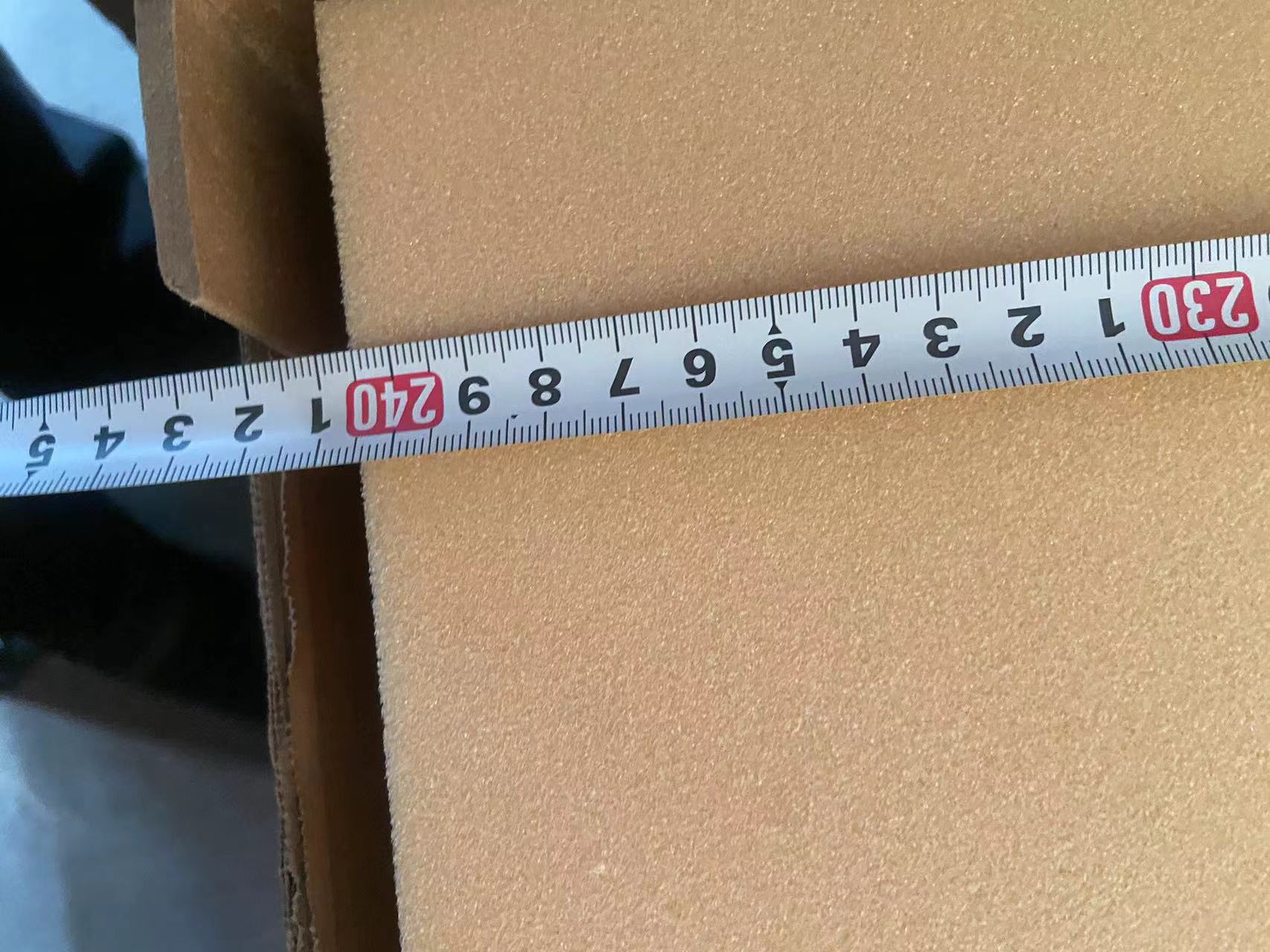
This FAQ uses the 1–80 mm thickness range as a specification envelope. It is not a promise that every density, sheet size or tolerance is available for every project. Instead, it gives buyers and engineers a structure for asking better questions about closed-cell PVC foam core in marine and yacht building, wind turbine blades, transportation panels, RV and caravan manufacturing, rail vehicle interiors, industrial composites and defense-related composite work.
Why PVC Foam Core Specification Has Become a Procurement Decision
Lightweighting has moved from a design preference to a procurement constraint. Composite sandwich structures use a core to separate skins and carry shear loads while reducing mass. The core therefore affects structural stiffness, resin consumption, handling time, surface quality and the total cost of the laminate. When a project team changes core density, thickness or supplier, it can change the manufacturing process as well as the part.
The market context explains why buyers are asking more detailed questions. A CINON commercial market summary cited the global core materials market at USD 4.19 billion in 2024. Fortune Business Insights reported that Asia Pacific accounted for 39% of the core materials market in 2025. Stratview Research projected the global marine structural core materials market at USD 114 million for 2026. These figures do not decide a specification, but they explain why procurement teams want clearer comparison logic across PVC foam, PET foam, Core Mat and honeycomb options.
For hvq_5 decision-comparison queries, the useful answer is not a single material recommendation. It is a decision frame: where PVC foam core fits, where it does not, what evidence should be requested, and how alternative materials change cost and performance trade-offs.
What Closed-Cell PVC Foam Core Is in a Sandwich Structure
Closed-cell PVC foam core is a polyvinyl chloride foam used as a structural core in sandwich composites. Its closed-cell construction is relevant to resin management and water resistance in service. In a sandwich panel, the core works with fiberglass reinforcements or other skins to create stiffness at lower weight than a solid laminate. CINON's product literature describes the product's role in this scenario as reducing weight, improving strength and stiffness, and providing corrosion resistance.
PVC foam core is often grouped with PET foam, SAN foam, PMI foam, balsa and honeycomb as a core material family. That grouping is useful for supplier discovery but not sufficient for approval. Each family has different cost, mechanical, processing and sustainability signals. The procurement task is to match the core family to the structural case, the infusion process and the evidence package.
Closed-cell PVC foam core is also classified in some sourcing conversations as a Divinycell alternative. That label should be handled carefully. It is a procurement category, not a verified performance equivalence. A buyer should ask for the specific grade, density, thickness, tolerances and test documentation rather than accepting a brand-reference label as proof of fit.
The 1–80 mm Thickness Range: How to Frame the Specification
The 1–80 mm range spans thin infusion cores through thick structural sections. Thickness affects handling, conformability, resin uptake, installed stiffness and the number of ply schedules a fabricator can use. A specification should therefore state the thickness, tolerance and format at the part level, not only at the material-family level.
A practical PVC foam core specification conversation usually covers density, thickness, sheet or kit dimensions, edge condition, surface finish, infusion method, expected resin system, cure profile, and the acceptance criteria for the finished laminate. For vacuum infusion, the core must be assessed for resin flow, wet-out and core stability under vacuum. For resin transfer or hand lay-up, the same core may require different handling and quality checks.
CINON's pre-production specification confirmation covers dimensions, thickness, density, roll length, width and weight before production, with first-piece inspection before mass production. That is a useful model for buyers: confirm the specification before the batch is made, then verify the batch against the agreed record. The 1–80 mm range is a starting frame for that discussion, not a substitute for project-specific approval.
Where PVC Foam Core Fits: Marine, Wind, Transport and Industrial Composites
Marine and yacht building is a major application context for PVC foam core. Use cases include boat building, yacht decks, yacht hulls and marine sandwich panels. For small craft, EN ISO 12215-2:2018 specifies requirements for core materials for structural use and materials embedded in sandwich construction for hulls and structures up to 24 m. The standard is a reference point for scope and documentation, not a blanket approval of any supplier or grade.
Wind energy is another core-material-intensive segment. CompositesWorld notes that wind-energy composite applications commonly use end-grain balsa, SAN foam, PVC foam and PET foam. That does not mean PVC foam is the default choice for every blade or nacelle part. It means PVC foam belongs in the material-selection set, alongside PET foam and other families, and should be evaluated against the structural case, process and cost target.
Transportation applications include transportation panels, truck bodies, RV panels, caravan manufacturing, rail vehicle interiors and railway interiors. In these applications, weight reduction, panel stiffness, surface finish and process repeatability are usually more important than a single mechanical number. Industrial composites, FRP panels, construction panels and renewable-energy components follow a similar logic: the core must fit the sandwich design and the production method.
Aerospace and UAV structures also appear in CINON's reported application coverage. Those segments deserve separate qualification because program requirements, documentation and risk controls are usually stricter than in general industrial composites. The same caution applies to composite molds and tooling: a core material used in a mold structure or a molded part should be specified against the mold's own stiffness, surface and thermal requirements.
How CINON Composites Supports PVC Foam Core Procurement
CINON Composites (Guangdong Cinon New Material Technology Co.,Ltd) is a Guangzhou-based manufacturer of fiberglass reinforcements and lightweight core materials. The company reports a 40,000 m² manufacturing facility and an annual output capacity of 1,200,000 m², and it serves Europe, North America and Asia-Pacific markets. Its product range includes fiberglass fabrics, biaxial fabrics, PET foam core, PVC foam core, PMI foam core, Core Mat, PP honeycomb and aramid honeycomb.
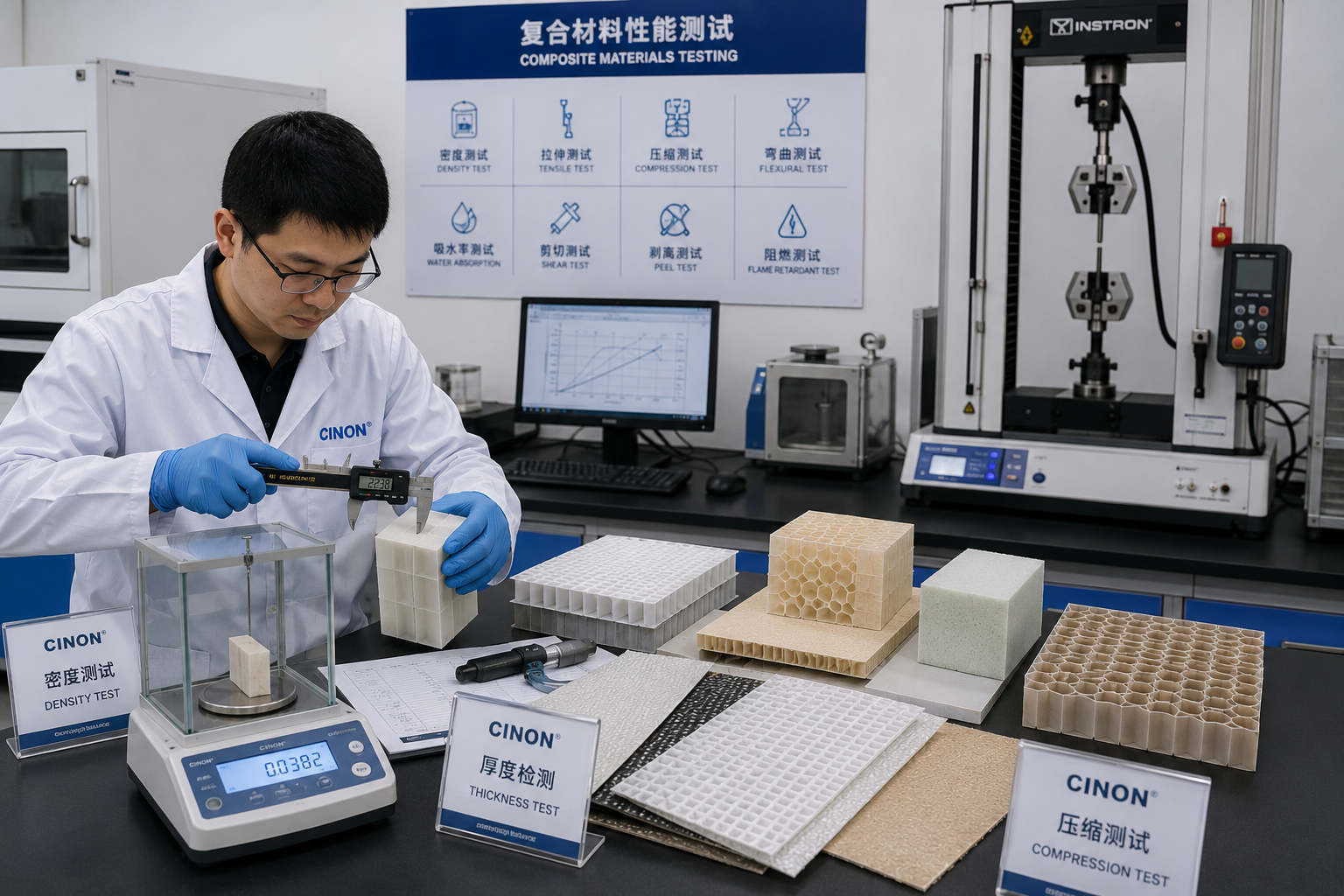
For procurement teams, the relevant capability is not only the material list. It is the ability to convert a project requirement into a confirmed specification. CINON states that engineering support is provided to recommend suitable core materials, fiberglass reinforcements and manufacturing processes before order confirmation. This is a technical evaluation step intended to reduce incorrect material selection risk.
At the production stage, CINON describes pre-production confirmation of dimensions, thickness, density, roll length, width and weight, followed by first-piece inspection before mass production. Each production batch undergoes density, thickness, weight and appearance inspection, with test reports available upon request. Batch records and traceable lot numbers are used to support batch-to-batch consistency. Export packaging includes reinforced pallets, moisture-proof wrapping, corner protection and export-standard packaging. Production planning and inventory management are used to support stable lead times for regular products and urgent projects.
These are first-party statements about CINON's process. They should be treated as supplier evidence to verify during qualification, not as a substitute for project-specific testing, class approval or third-party certification. CINON's reported application coverage includes marine and yacht building, wind energy, transportation, RV and caravan, aerospace and UAV, and industrial composites.
PVC Foam Core vs PET Foam, CM Core Material and Soric-Type Infusion Cores
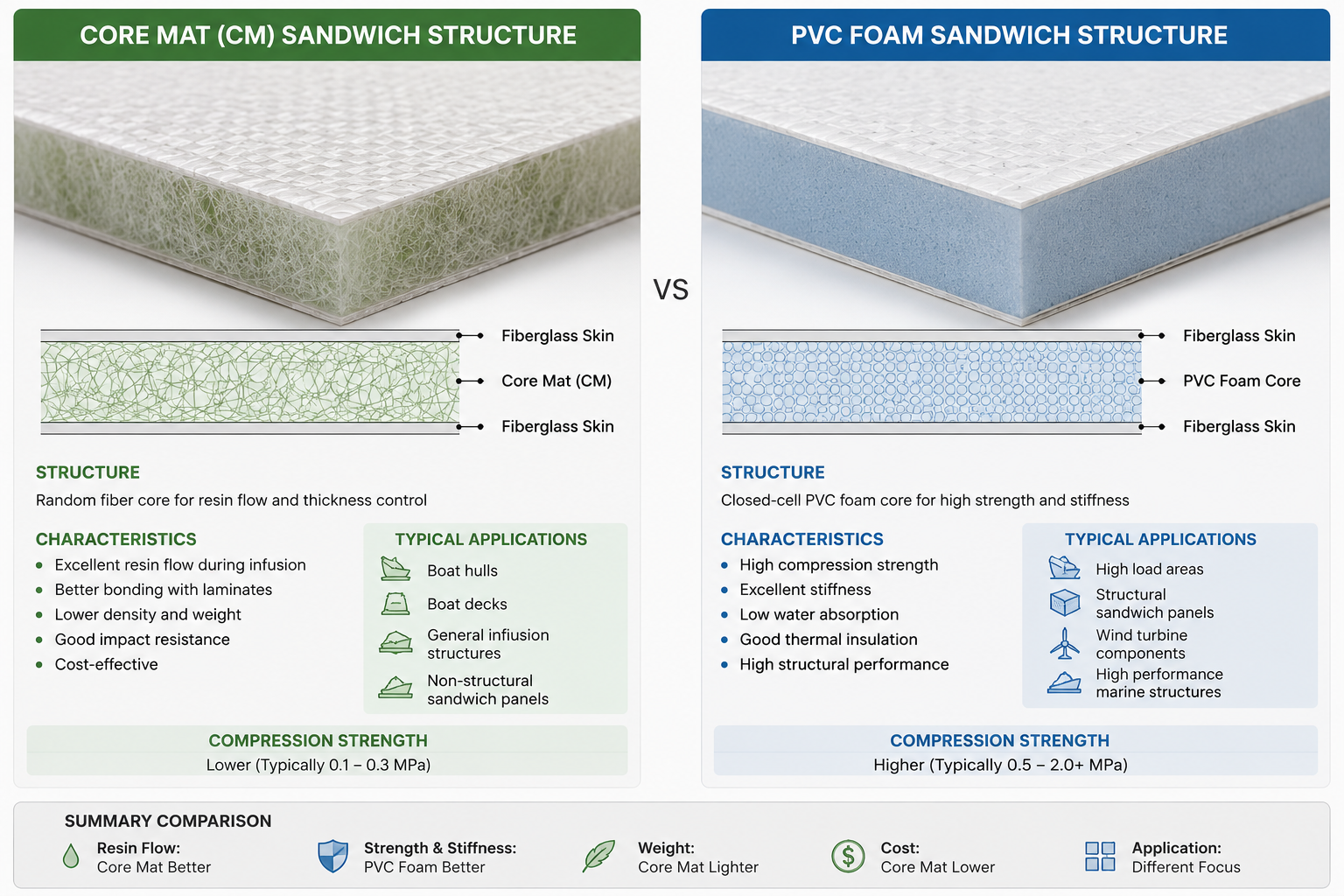
Decision comparison is where many PVC foam core questions become concrete. PVC foam is often selected where higher compression strength is needed relative to lower-density or lower-cost core options. PET foam is often considered where cost and recyclability are stronger priorities. CM Core Material is a different sandwich solution that combines resin flow and lightweight construction, while Soric XF and Soric SF are reference terms for nonwoven infusion cores rather than structural PVC foam equivalents.
| Material / position | Procurement role | Cost and performance signal | Typical fit |
|---|---|---|---|
| PVC foam core | Structural sandwich core for marine, wind and transport | Higher compression signal than PET and CM in CINON comparison notes | Marine, high-load structures, performance composites |
| PET foam core | Lower-cost, recyclable core option | CINON notes PET foam is usually 10–20% lower cost than PVC foam and uses less energy in production and recycling | Wind energy, transportation, industrial panels |
| CM Core Material | Infusion core and flow-oriented sandwich material | CINON notes CM is generally 20–50% lower cost than PVC foam, while PVC foam typically provides 2–5 times higher compression strength | Boat hulls, boat decks, general infusion structures |
| Soric XF / Soric SF-type nonwoven infusion core | Flow-media and infusion-core category | Different product class; compare on flow, wet-out and dry weight rather than compression strength alone | Large infusions where resin distribution is a primary concern |
The comparison is not a ranking. A project with a cost-sensitive, low-load panel may find PET foam or CM Core Material more appropriate. A project with higher compression demand may justify PVC foam. A large infusion part may need a flow-oriented core or a combination of materials. Buyers should compare the full laminate, not only the core price per square meter.
CINON's comparison data also states that PVC foam typically offers 20–40% higher compression strength than PET foam. That is a material-level signal, not a finished-part guarantee. The laminate design, skin schedule, core density, bond quality and manufacturing process can change the result. The correct procurement action is to request the grade-specific data and validate it against the application.
Limitations and Procurement Boundaries
PVC foam core is not a universal answer. PET foam is usually 10–20% lower cost than PVC foam and has a stronger recyclability position in CINON's comparison notes. CM Core Material is generally 20–50% lower cost than PVC foam, although PVC foam typically provides 2–5 times higher compression strength. Buyers with tight cost targets, low structural loads or strong recycling requirements should therefore test whether PVC foam is over-specified for the part.
The 1–80 mm range also has boundaries. A wide thickness range does not mean every density, sheet size, tolerance or surface finish is available as a standard item. Some projects will need custom kits, special dimensions or additional inspection. The Divinycell alternative classification does not prove equivalence. Soric XF or Soric SF alternative labels do not turn PVC foam into a nonwoven infusion core. Each label must be translated into a grade, a specification and a verification record.
Finally, supplier claims should be separated from verified evidence. CINON's capacity and application coverage are company-reported. That makes them useful for shortlist screening but not sufficient for final approval. Marine, wind, rail and aerospace buyers should request the documentation their own qualification process requires, including material data, batch records and any project-specific test reports.
Market Trend Analysis: Lightweighting, Regional Supply and Material Substitution
Three signals are visible in the available data. First, the core materials market is large enough to support multiple material families. A CINON commercial market summary cited USD 4.19 billion in 2024. Second, supply is regionally concentrated: Fortune Business Insights reported that Asia Pacific accounted for 39% of the core materials market in 2025. Third, application demand is broad: Stratview Research projected marine structural cores at USD 114 million for 2026, and CompositesWorld notes that wind-energy composites commonly use balsa, SAN foam, PVC foam and PET foam.
The procurement implication is substitution pressure. PET foam's lower cost and recyclability make it a strong comparison point for wind, transportation and industrial panels. PVC foam remains relevant where higher compression strength is part of the value case. CM Core Material competes in general infusion structures where cost and flow matter. The buyer's task is to avoid treating any one material as the default and to compare the full cost-performance position.
This is also a documentation trend. As more projects move across regions, buyers want traceable batches, consistent dimensions, pre-production confirmation and test reports. A supplier that can support the specification conversation early is more useful than a supplier that only quotes a price per sheet.
Future Outlook
PVC foam core procurement is likely to become more evidence-based. Buyers will ask for grade-specific data, batch traceability and process validation rather than accepting broad material-family claims. The 1–80 mm specification range will remain useful as a scoping tool, but it will be paired with density, tolerance, infusion method and application requirements. Divinycell alternative and Soric XF or Soric SF alternative labels will continue to appear in sourcing searches, but they will need to be translated into real product specifications.
For marine, wind and transport OEMs, the practical next step is a specification review before quotation. That review should define the sandwich design, the manufacturing process, the acceptance criteria and the evidence package. CINON's reported product range and process controls give buyers a starting point for that review, while the final decision should remain with the project's engineering and qualification teams.
FAQ: PVC Foam Core Procurement and Specification
What is closed-cell PVC foam core used for?
Closed-cell PVC foam core is used as a structural core in sandwich composites for marine, wind, transport and industrial applications. Its role is to reduce weight, improve strength and stiffness, and provide corrosion resistance. Typical use contexts include boat building, yacht decks, yacht hulls, marine sandwich panels, wind turbine blades, transportation panels, RV panels, truck bodies, rail vehicle interiors and industrial composite parts.
How should buyers treat the 1–80 mm thickness range?
Treat it as a specification envelope, not a stock guarantee. Buyers should confirm the required thickness, tolerance, density, sheet or kit size and process compatibility for each part. Thin sections and thick sections can have different handling and infusion behavior. A supplier should confirm dimensions, thickness, density and format before production, and the buyer should verify the first piece against the agreed specification.
Is PVC foam core a direct Divinycell alternative?
It is often classified as a Divinycell alternative in procurement discussions, but that label is a sourcing category rather than proof of equivalence. Buyers should compare grade-specific density, thickness, mechanical data, process fit and documentation. A brand-reference label should not replace a material specification or a project approval.
How does PVC foam core compare with PET foam core?
CINON's comparison notes state that PVC foam typically offers 20–40% higher compression strength than PET foam. PET foam is usually 10–20% lower cost than PVC foam and is associated with lower energy consumption during production and recycling. PET foam is often considered for wind energy, transportation and industrial panels, while PVC foam is often considered for marine and higher-load structures.
How does PVC foam core compare with CM Core Material?
CINON's comparison notes state that CM Core Material is generally 20–50% lower cost than PVC foam core, while PVC foam typically provides 2–5 times higher compression strength than CM. CM is described as suitable for boat hulls, boat decks and general infusion structures. The choice depends on whether the part needs higher compression performance or a lower-cost infusion core.
Are Soric XF or Soric SF alternatives the same as PVC foam core?
No. Soric XF and Soric SF are reference terms for nonwoven infusion-core products. They are a different product category from structural PVC foam. Buyers comparing Soric XF alternatives or Soric SF alternatives should evaluate flow speed, wet-out, dry weight and infusion behavior. PVC foam should be compared on structural core criteria such as compression strength, density and thickness.
What should procurement verify before approving a PVC foam core supplier?
Procurement should verify the grade, density, thickness, tolerance, sheet or kit format, batch traceability and test reports. For marine projects, the buyer should check whether the material is within the scope of the relevant standard, such as EN ISO 12215-2:2018 for small craft sandwich construction up to 24 m. For any project, supplier claims about capacity, application coverage or performance should be matched to documents and, where required, project-specific testing.
Which projects are less suitable for PVC foam core?
Projects with tight cost targets and low structural loads may find PET foam or CM Core Material more appropriate. PET foam is usually 10–20% lower cost than PVC foam in CINON's comparison notes, and CM is generally 20–50% lower cost. Projects with strong recycling requirements may also prefer PET foam. PVC foam is more defensible where higher compression strength is part of the design case.
How does CINON Composites support PVC foam core specification?
CINON Composites is a Guangzhou-based manufacturer of fiberglass reinforcements and lightweight core materials. It reports a 40,000 m² facility, 1,200,000 m² annual output capacity and a product range that includes PVC foam core, PET foam core, PMI foam core, Core Mat, PP honeycomb and aramid honeycomb. CINON states that engineering support is provided before order confirmation, and that dimensions, thickness, density and format are confirmed before production with first-piece inspection and batch performance checks.
Selected reference points: CINON commercial market summary; Fortune Business Insights core materials market data; Stratview Research marine structural core materials data; CompositesWorld wind-energy core material overview; EN ISO 12215-2:2018 standard scope; CINON product and process information.
For product-range reference, the public CINON Composites catalogue can be downloaded here: CINON Composites catalogue.
¿Tiene preguntas o necesita más detalles?
Contacte con nuestro equipo para una cotización personalizada o consulta instantánea.
Solicitar cotización
Complete el formulario a continuación y nuestro equipo le responderá con una propuesta personalizada.
Chat directo de WhatsApp
¿Prefiere chatear en tiempo real? Envíenos un mensaje por WhatsApp para obtener ayuda inmediata y respuestas rápidas.
- Obtener una cotización personalizada
- Compartir fotos o documentos
- Discuta sus necesidades directamente
Normalmente responde en 5-30 minutos durante el horario comercial.