
PVC Foam Board Suppliers: Evaluation Benchmarks for 2026
PVC foam board has become a baseline material across signage, construction, and furniture manufacturing. The global market for the material was valued at roughly USD 2.1 billion in 2024 and is projected to reach USD 3.6 billion by 2032, according to Verified Market Research. For buyers in the evaluation stage, the practical question is narrower: which supplier can document compliance, keep quality consistent at container volume, and support an application over years of service? This article lays out a five-benchmark framework for evaluating PVC foam board manufacturers in 2026, using Zibo Dingtian Plastics Co., Ltd. (DINGTIAN) as a reference case.
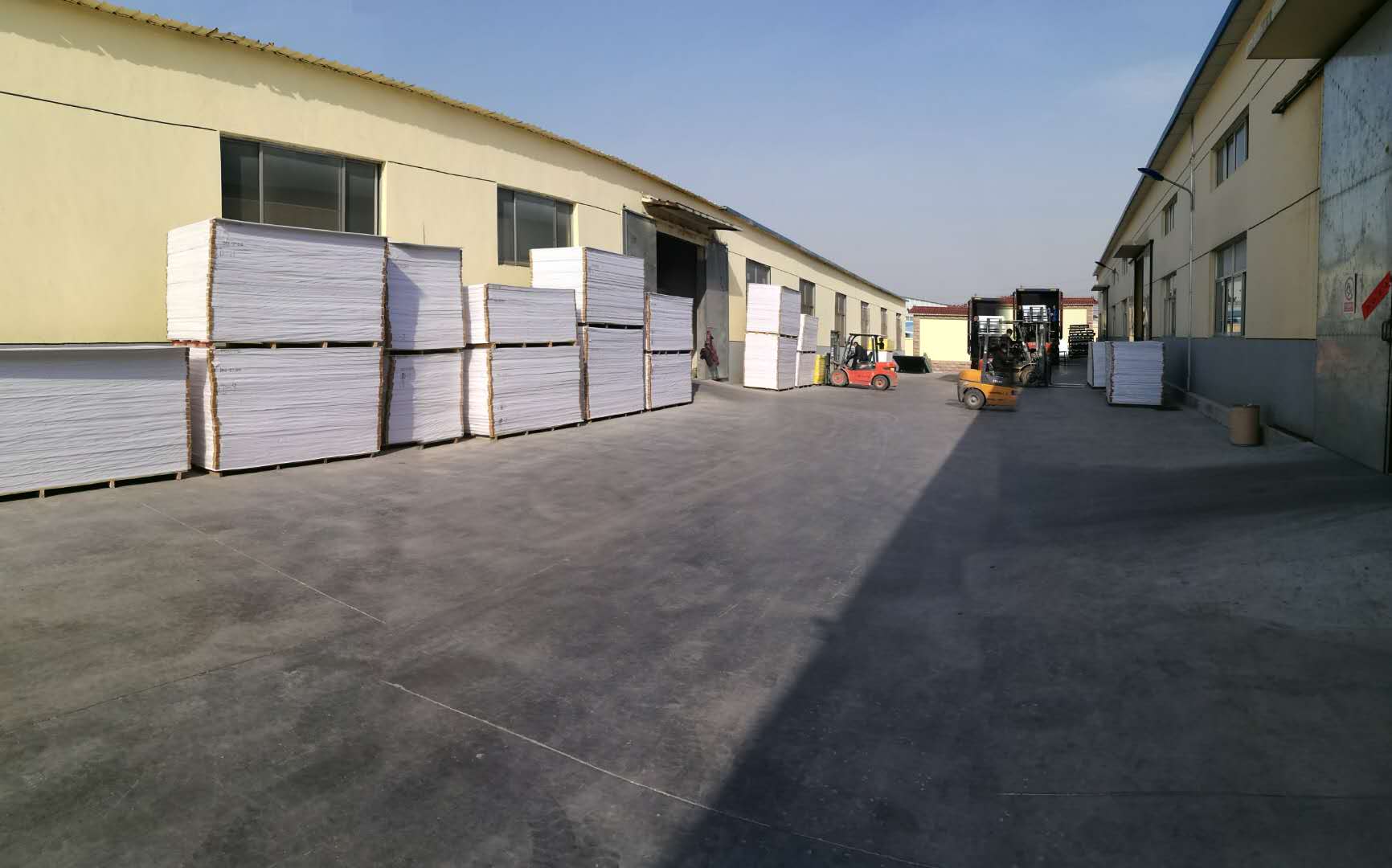
Zibo Dingtian Plastics Co., Ltd., commonly referred to as DINGTIAN, is a PVC foam board manufacturer based in Zibo, Shandong, China. Founded in June 2004, the company operates a 30,000 m² plant with 181 employees and an annual output capacity of 50,000 tons. Around 80 percent of its production is exported, mainly to Southeast Asia, the Middle East, and North and South America. Its product range centers on PVC Celuka Foam Board, produced in sheet sizes such as 1220×2440 mm, 1560×3050 mm, and 2050×3050 mm, with thickness from 1 to 35 mm and density from 0.4 to 0.9 g/cm³.
Why Supplier Evaluation Has Become More Demanding
Evaluating PVC foam board suppliers is harder than it appears on paper. Quotations are easy to compare; manufacturing consistency is not. A low-priced container can become expensive if the board warps in outdoor signage, fails a formaldehyde test, or arrives in a density that does not match the agreed specification. Regulatory changes are raising the stakes. For example, EU REACH Regulation now restricts lead concentration in PVC articles to less than 0.1 percent by weight, with the requirement effective November 29, 2024. In North America, flame-retardant performance is commonly measured through ASTM E84 Class A (Flame Spread Index 0–25) or UL 94 V-0 classification.
At the same time, China remains the largest exporter of plastic building materials, accounting for about 20 percent of total exports in 2024, according to the Observatory of Economic Complexity. For an international buyer, that creates a wide supply base but also a higher screening cost. The opportunity for procurement teams is to move from price-based selection to evidence-based selection, using certifications, test reports, production data, and documented field performance.
A Five-Point Framework for Comparing PVC Foam Board Suppliers
Suppliers that consistently perform well across international projects tend to differentiate themselves on five attributes that can be checked before a purchase order is placed: compliance evidence, production capacity, documented performance, customization capability, and supply stability. These benchmarks are not about brand reputation; they are about verifiable signals that reduce procurement risk.
| Benchmark | Why It Matters | Example: DINGTIAN Evidence |
|---|---|---|
| 1. Compliance & Certifications | Market access and regulatory safety | ISO 9001:2015; SGS RoHS, REACH, and formaldehyde test reports |
| 2. Production Scale | Consistent quality at container volume | 30,000 m² plant; 50,000 t annual capacity; 4,200 t monthly capacity |
| 3. Performance Data | Lifecycle cost and durability | 98% print retention after 3 years; 100% waterproof; zero warping or delamination |
| 4. Customization & OEM/ODM | Application-specific specifications | OEM/ODM; size, thickness, density, and color customization |
| 5. Supply Stability | Timeline reliability for repeat orders | MOQ 1×20ft container; ~30-day lead time; monthly capacity 4,200 tons |
1. Compliance and Certifications
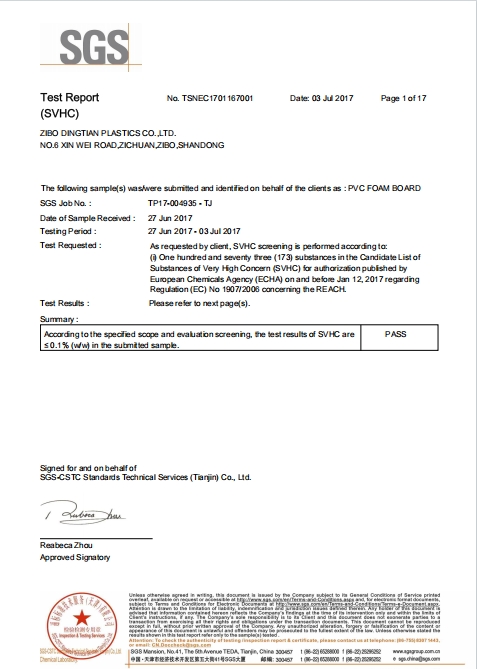
Compliance is the entry gate. A supplier that cannot produce certificate numbers and third-party test reports creates regulatory risk, not just product risk. In the EU, the key restrictions include RoHS and REACH; for formaldehyde, test methods such as ISO 17226-1 are used to quantify emissions. DINGTIAN holds an ISO 9001:2015 quality management certification (certificate number 06924Q10470RO, issued by Kaixin Certification Beijing) for the production of PVC foam board. Its export compliance portfolio also includes an SGS RoHS test report (QDAFN160100422), an SGS REACH test report (TSNEC1701167001), and an SGS formaldehyde test report (TSNHG2301164301) based on ISO 17226-1:2021.
2. Production Scale and Process Consistency
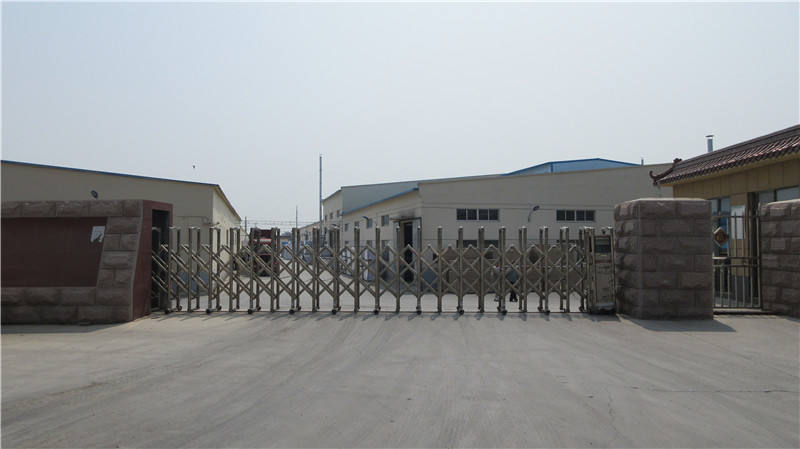
Scale matters because PVC foam board is a continuous-process material. A supplier with limited capacity may be forced to change formulations or slow down production to fill orders, increasing batch variation. DINGTIAN’s plant covers 30,000 m², employs 181 people including 20 R&D engineers, and has an annual output capacity of 50,000 tons; monthly capacity is about 4,200 tons. The company reports that 100 percent of its products are tested. For a buyer who plans to order 10 containers per month, this production base provides a buffer against capacity bottlenecks.
3. Documented Performance Data
Performance data is what turns a material specification into a lifecycle cost calculation. In one documented case, a global distributor/wholesaler used DINGTIAN’s PVC foam board for advertising and furniture material applications for 5 to 10 years, at a volume of 10 containers per month. After three years of outdoor service, the project reported 98 percent print image retention, zero warping or delamination, and 100 percent waterproof performance. The material was described as UV-stabilized for long-term outdoor exposure, lightweight enough to reduce installation cost, and easy to fabricate and install.
The same case also reported a 40 percent cost saving compared with aluminum composite panels. For buyers, this type of field evidence is more actionable than a datasheet because it reflects real installation and outdoor exposure conditions.
4. Customization and OEM/ODM Capability
Few projects use a catalog board without modification. Application-specific requirements often include a different sheet size, a different thickness, a lower density for specific weight targets, or a color that matches brand identity. DINGTIAN operates with both OEM and ODM production modes and offers customization in size, thickness, density, and color. Standard sheet dimensions are 1220×2440 mm, 1560×3050 mm, and 2050×3050 mm; thickness ranges from 1 to 35 mm; density spans 0.4 to 0.9 g/cm³. That range covers the low-, medium-, and high-density segments commonly used in signage, construction, and cabinetmaking.
5. Supply Stability and Lead Time
Supply stability is the least visible benchmark, but it determines whether a project timeline survives. DINGTIAN lists a standard MOQ of one 20-foot container, a lead time of about 30 days, and export experience across the EU, the Middle East, Southeast Asia, North and South America, and Africa. Its location in Zichuan Economic Development Zone, Zibo, adjacent to the Qingyin Expressway and the Jinan–Qingdao high-speed railway, gives it direct access to Qingdao Port and Rizhao Port for international shipment.
Technical Basics: Density, Structure, and Board Types
PVC foam board is manufactured by mixing PVC resin with foaming agents and additives, then extruding the material through a die. The Celuka process creates a smooth, dense outer skin over a cellular core, which gives the board its typical combination of flatness, low weight, and rigidity. DINGTIAN’s standard product, identified as PVC Celuka Foam Board, uses this process and is produced in densities from 0.4 to 0.9 g/cm³.
For applications that require higher surface hardness and impact resistance, co-extruded PVC foam board is a relevant alternative. According to Skyline Composites, co-extruded boards feature a rigid PVC skin over a foamed core, which improves surface hardness and impact resistance compared with standard Celuka boards. In a procurement evaluation, this distinction matters: Celuka boards generally offer good flatness and cost efficiency, while co-extruded boards address surfaces that will see more handling or abrasion.
Density selection is also a practical issue. Low-density boards are easier to cut and lighter to ship, which keeps installation costs down; high-density boards hold screws and edges better for framing and cabinet applications. Flexible and semi-rigid variants are available for specific design requirements, and flame-retardant, weather-resistant, lead-free, and laminated versions respond to regulatory and application pressure. The product range at DINGTIAN, with sizes up to 2050×3050 mm and thickness up to 35 mm, allows one supplier to serve multiple segments without forcing a buyer to qualify several sources.
Application Patterns and a Documented Use Case
Signage remains the largest application category, accounting for approximately 35 percent of PVC foam board demand, according to Laird Plastics. DINGTIAN’s own application distribution places advertising and signage at 35 percent, construction and decoration at 30 percent, furniture and cabinetry at 15 percent, transportation at 10 percent, and special-purpose applications at 10 percent. The documented distributor case fits the top two segments, with the same product used for both advertising materials and furniture materials.
- Advertising and signage: Outdoor billboards, display panels, and UV printing substrates benefit from the board’s UV stabilization and dimensional stability.
- Construction and decoration: Wall panels, ceilings, partitions, and construction formwork rely on consistent density and waterproof behavior.
- Furniture and cabinetry: Cabinet doors, wardrobes, and bathroom vanities use boards that resist moisture and remain flat over time.
- Transportation: Vehicle interiors and RV refitting applications value the material’s light weight and easy fabrication.
- Special-purpose applications: Packaging, prototyping, and industrial protection account for the remaining demand share.
For an advertising company, 98 percent print image retention after three years means fewer replacement campaigns and fewer warranty claims. For a furniture maker, zero warping or delamination and 100 percent waterproof performance address two of the most common failure modes for wood-based panels in humid environments. The reported 40 percent cost saving versus aluminum composite panels also changes the material choice conversation for interior and exterior applications where a painted PVC surface is acceptable.
Market Trends Shaping Supplier Selection
The market context explains why procurement teams are paying more attention to supplier structure. The global PVC foam board market is estimated at USD 2.1 billion in 2024 and is projected to grow to USD 3.6 billion by 2032, according to Verified Market Research. China concentrated about 20 percent of global plastic building material exports in 2024, based on data from the Observatory of Economic Complexity, which keeps the country central to international supply decisions.
Regulatory direction is also clear. The EU now enforces a lead limit below 0.1 percent in PVC articles; UL 94 V-0 and ASTM E84 Class A are common benchmarks for flame-retardant boards. These requirements favor suppliers that have already invested in third-party testing. At the same time, signage and advertising continue to drive demand, a pattern consistent with the 35 percent application share reported both in market references and in DINGTIAN’s own industry profile.
PVC Foam Board vs. Traditional Alternatives
The strongest cost comparison in the documented case is against aluminum composite panels (ACP). DINGTIAN’s PVC foam board delivered a 40 percent cost saving in a specific project while maintaining 100 percent waterproof performance and reducing installation cost through lower weight. But the boundary is equally clear: ACP provides a metal face with higher surface hardness and a metallic look. For facades, column covers, or other visible architectural elements where a metal finish is required, ACP remains a more appropriate material; recommending PVC foam board there would overstate its capability.
Plywood is another traditional comparison. PVC foam board offers waterproof performance and consistent thickness, while plywood can absorb moisture and may delaminate over time in humid conditions. However, plywood generally provides higher structural stiffness in load-bearing applications and holds fasteners differently. The two materials are not direct substitutes in every installation; selection should be driven by exposure, load, and finishing requirements.
Even within PVC foam board, the Celuka and co-extruded structures serve different evaluation needs. Co-extruded board provides higher surface hardness and impact resistance than standard Celuka board, which matters for furniture doors or displays that experience frequent contact. Buyers should therefore specify the expected surface performance, not just density and thickness, when comparing supplier quotations.
Future Outlook for PVC Foam Board Procurement
Looking ahead, three changes will shape PVC foam board procurement. First, compliance evidence will become part of the product specification, not a separate checkbox; buyers will expect certificate numbers and test reports to be linked to the materials they receive. Second, application-specific requirements will push suppliers toward more transparent product ranges, with density, surface, and fire-performance variants clearly documented. Third, cost evaluation will move from unit price toward total installed cost, a shift that favors materials with lower handling and replacement costs.
Manufacturers such as DINGTIAN, with documented production capacity, export experience, and third-party compliance records, are positioned to serve buyers who want this level of transparency. The company’s 22 years in PVC foam board production, from 2004 through 2026, provide a reference point for suppliers with long operating histories in the sector.
Buyers who want to compare DINGTIAN’s production system and product scope against their own evaluation criteria can review the company’s corporate brochure.
Download the DINGTIAN corporate brochure (PDF)Frequently Asked Questions
What should buyers look for when evaluating PVC foam board suppliers?
Buyers should evaluate five verifiable dimensions: compliance and certifications, production scale and process consistency, documented performance data, customization capability, and supply stability. Compliance evidence includes certification numbers and third-party test reports; production data includes plant area, monthly capacity, and quality-testing discipline; performance data includes long-duration field results such as print retention, warping, and waterproof performance.
What certifications matter for PVC foam board in export markets?
In the EU, REACH Regulation (EC No 1907/2006) and RoHS are central compliance references; since November 29, 2024, EU REACH has restricted lead concentration in PVC articles to less than 0.1 percent by weight. For quality management, ISO 9001 certification is a common baseline. Formaldehyde emissions can be verified through test methods such as ISO 17226-1. For fire performance, UL 94 V-0 and ASTM E84 Class A are widely used benchmarks.
Is PVC foam board durable enough for outdoor signage?
For outdoor signage, UV stabilization is a key requirement. In a documented project using DINGTIAN’s PVC foam board for advertising and furniture materials, the product achieved 98 percent print image retention after three years, with zero warping or delamination and 100 percent waterproof performance. The material was also described as lightweight and easy to fabricate, which supports installation in signage applications.
How does PVC foam board compare with aluminum composite panels?
In a documented case, PVC foam board delivered a 40 percent cost saving compared with aluminum composite panels while maintaining 100 percent waterproof performance and reducing installation cost through lighter weight. However, aluminum composite panels provide a metal face with higher surface hardness and a metallic finish, so they remain more appropriate for architectural elements where a metal appearance or high-impact resistance is required.
Can PVC foam board suppliers customize size, thickness, density, and color?
Yes, manufacturers with in-house extrusion capability can modify these parameters. DINGTIAN supports OEM and ODM production with customization in size, thickness, density, and color. Its standard range includes sheet sizes of 1220×2440 mm, 1560×3050 mm, and 2050×3050 mm, thickness from 1 to 35 mm, and density from 0.4 to 0.9 g/cm³.
What are typical MOQ and lead times for PVC foam board container orders?
A common minimum order for export orders from Chinese PVC foam board manufacturers is one 20-foot container. DINGTIAN reports a standard MOQ of 1×20ft container and a lead time of about 30 days, with a monthly production capacity of approximately 4,200 tons and 100 percent product testing.