
PVC Foam Board Guide: Types, Applications & Selection
PVC foam board is a lightweight, waterproof expanded PVC sheet used across signage, construction, furniture, and transportation industries. For buyers moving from awareness to supplier research, the practical question is no longer whether to use PVC foam board, but which variant—free-foam, Celuka, co-extruded, laminated, or colored—fits a specific production process and end-use environment. This guide explains the product family, technical parameters, application logic, and market context that procurement teams should understand before requesting quotes.
Zibo Dingtian Plastics Co., Ltd. (DINGTIAN) is a Chinese manufacturer specializing in high-grade PVC foam boards. Founded in June 2004, the company operates a 30,000 m² plant in Zichuan Economic Development Zone, Zibo City, Shandong Province, with approximately 181 employees, an R&D team of 20 engineers, and an annual production capacity of 50,000 tons. About 80% of its output is exported to Southeast Asia, the Middle East, and North and South America, positioning DINGTIAN as a core export manufacturer within Shandong's plastics industry cluster.
The Sourcing Challenge: More Variants, More Variables
The global PVC foam board market was valued at approximately USD 2.1 billion in 2024 and is projected to reach USD 3.6 billion by 2032, according to Verified Market Research. The signage and advertising industry alone accounts for about 35% of total demand, followed by construction and decoration at roughly 30%, based on industry application data cited by Laird Plastics and DINGTIAN's own product documentation.
For procurement professionals, this demand breadth creates a selection problem. A single "PVC foam board" specification is rarely enough. Density affects machinability and impact strength; thickness determines structural use; surface finish determines printability and aesthetic value; and compliance requirements—flame retardancy, lead limits, UV stability—vary by destination market. Buyers who understand these variables can avoid the two most common mistakes: over-specifying density and paying for performance they do not need, or under-specifying compliance and facing rejection at customs or site inspection.
DINGTIAN PVC Foam Board Product Family
DINGTIAN manufactures six documented PVC foam board variants, each defined by production process, density range, thickness range, and intended industry. The table below summarizes the publicly listed specifications.
| Variant | Model / Size | Thickness | Density | Typical Industries |
|---|---|---|---|---|
| PVC Celuka Foam Board | 1220×2440, 1560×3050, 2050×3050 mm | 1–35 mm | 0.4–0.9 g/cm³ | Advertising, construction, furniture, transportation, packaging |
| PVC Free Foam Board | 1220×2440 mm | 1–5 mm | 0.5–0.8 g/cm³ | Advertising materials, signage |
| PVC Co-extruded Foam Board | 1220×2440 mm | Not specified | 0.5–0.8 g/cm³ | Advertising materials, furniture board |
| Laminated PVC Foam Board | 1220×2440 mm | 5–20 mm | Not specified | Furniture, cabinet |
| Colored PVC Foam Board | 1220×2440 mm | 1–20 mm | Not specified | Advertising, furniture, cabinet |
| Waterproof PVC Foam Board | 1220×2440 mm | 1–35 mm | Not specified | Furniture, cabinet |
The name "PVC free foam board" refers to the free-foam production process, not a PVC-free formulation. In this process, the board expands freely during extrusion, producing a fine cell structure with a softer surface. It is commonly specified for advertising substrates where UV printing and light weight matter more than surface hardness.
Technical Explanation: Three Foaming Processes, Different Performance Profiles
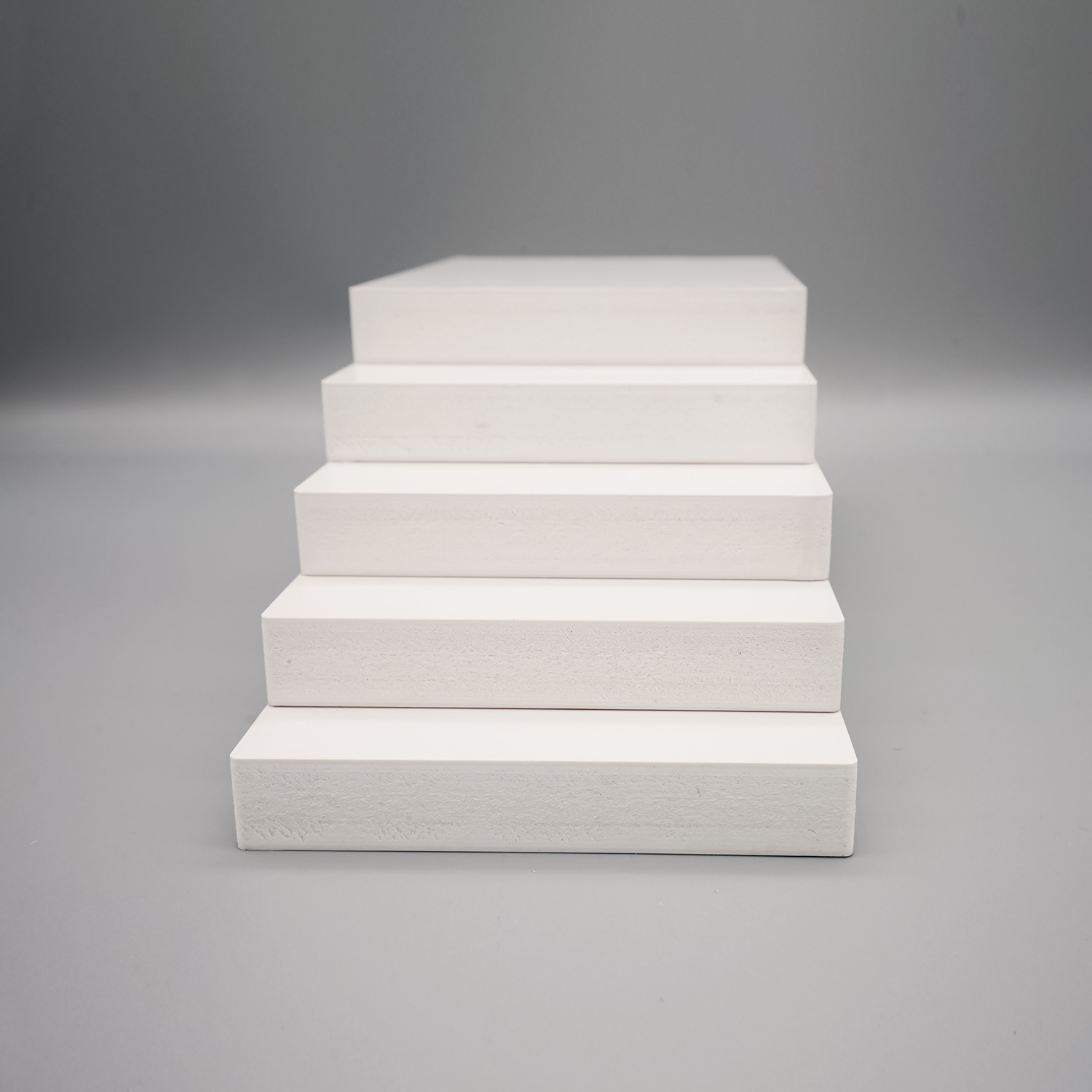
The largest family member is the PVC Celuka Foam Board, available in sizes 1220×2440 mm, 1560×3050 mm, and 2050×3050 mm, with thickness from 1 to 35 mm and density from 0.4 to 0.9 g/cm³. Celuka is an extrusion process that creates a dense outer skin and a cellular core in a single operation. The skin improves surface smoothness, screw-holding capacity, and weather resistance relative to free-foam boards.
PVC co-extruded foam boards add a dedicated rigid PVC skin over a foamed core. According to Skyline Composites' public technical comparison, co-extruded boards offer higher surface hardness and impact resistance than standard Celuka boards. DINGTIAN's co-extruded product is specified at a density of 0.5–0.8 g/cm³ and is directed at advertising materials and furniture board production.
Processing requirements are documented across DINGTIAN's product literature. The boards are designed for permanent static installation and can be fabricated with cutting machines, printing machines, nails, and saws. Thermoforming is possible at 120–160°C, and the UV-stabilized grade operates from -20°C to +60°C with 100% humidity resistance. For demanding projects, DINGTIAN lists four special requirements: UV stabilization for outdoor use, B1/B2 fire retardant rating, lead-free RoHS compliance, and anti-static ESD protection.
Buyers should read these parameters as boundary conditions. A board specified for outdoor signage should meet the UV-stabilized grade; a board for interior cladding in public buildings may require the B1/B2 fire retardant rating; and boards destined for the European market should be evaluated against lead-content limits under EU REACH, which restricts lead concentration in PVC articles to less than 0.1% by weight effective November 29, 2024.
Application Scenarios Across Five Industry Segments
DINGTIAN's PVC Celuka Foam Board documentation breaks down application demand into five segments. These shares reflect the company's internal application data for its product line.
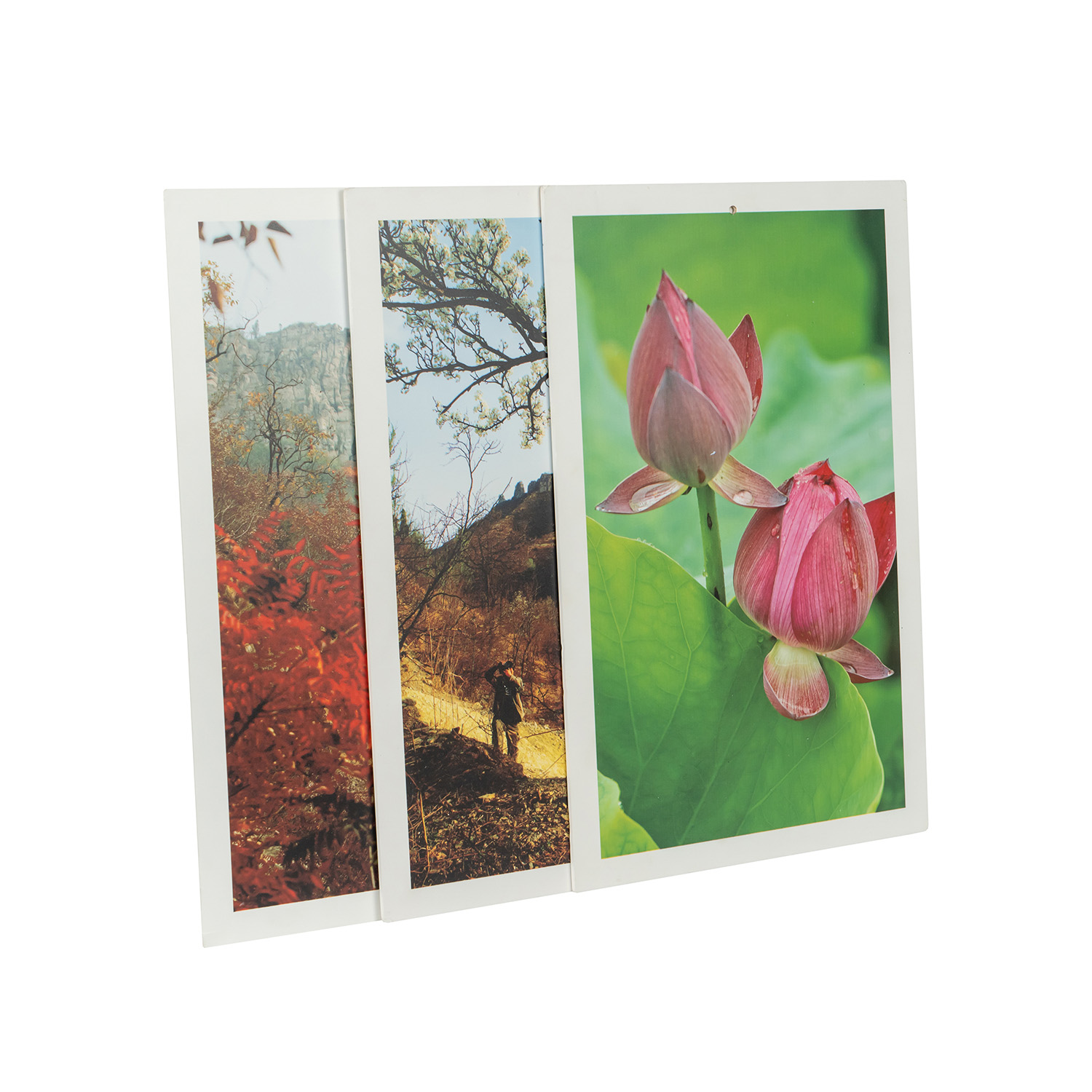
- Advertising & Signage (approx. 35%): outdoor billboards, display panels, and UV printing substrates. The board acts as a lightweight rigid substrate for printing, and the free-foam and Celuka variants are both specified for this segment.
- Construction & Decoration (approx. 30%): wall panels, ceilings, partitions, and construction formwork. In commercial building interior renovation, the role is to create waterproof building panels with thermal and acoustic insulation properties.
- Furniture & Cabinetry (approx. 15%): cabinet doors, wardrobes, and bathroom vanities. The waterproof and corrosion-resistant properties make the board suitable for humid environments.
- Transportation (approx. 10%): vehicle interiors and RV refitting, where weight reduction and dimensional stability are valued.
- Special-purpose applications (approx. 10%): packaging, prototyping, and industrial protection, often requiring custom sizes or specific density ranges.
Market Trends: Compliance and Surface Value
Three externally verifiable trends shape PVC foam board procurement in 2026. First, China's export position remains central: the country concentrated 20% of total exports of plastic building materials, including PVC boards, in 2024, maintaining its position as the largest exporter, according to The Observatory of Economic Complexity (OEC).
Second, regulatory compliance is tightening around material safety. The EU REACH restriction on lead in PVC articles, effective November 29, 2024, sets a limit of less than 0.1% lead by weight. Buyers serving European customers should request lead-free declarations as part of their supplier qualification process. Separately, PVC foam board can achieve a V-0 flammability classification under UL 94 standards at thicknesses down to 1 mm, according to The Vinyl Institute, which is relevant for electronics-adjacent or public-space applications.
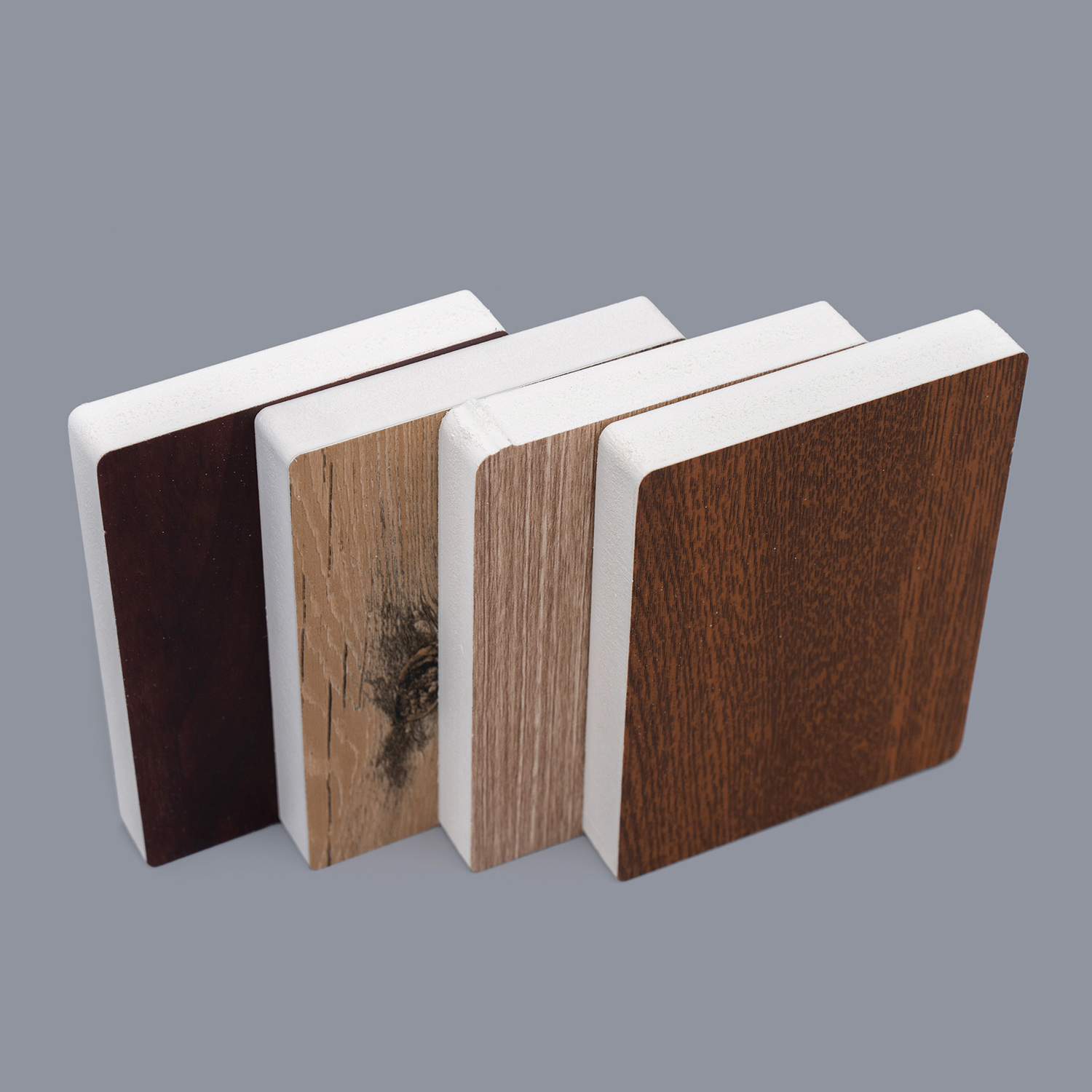
Third, surface finish is becoming a differentiator. The availability of colored boards, wood-grain laminated boards, and co-extruded boards reflects a shift from price-only competition toward surface aesthetics and end-use performance. Laminated PVC foam boards with a wood-grain appearance allow furniture and cabinet makers to reduce secondary finishing steps, while co-extruded boards address applications that need higher surface hardness.
Comparison with Traditional Solutions
PVC foam board competes most directly with plywood, medium-density fiberboard (MDF), and aluminum composite panels. Compared to wood-based panels, PVC foam board offers inherent moisture resistance, corrosion resistance, and consistent density across the sheet. It does not delaminate in humid conditions the way plywood can, and it can be routed, sawed, printed, and thermoformed with standard woodworking equipment.
One honest limitation should be noted: PVC foam board is thermoplastic, and its forming window is 120–160°C. It is not suitable for applications involving sustained high-temperature exposure or structural loads at elevated temperatures. Buyers who need continuous heat resistance should evaluate alternative materials. For most signage, interior construction, and furniture applications, however, the material's operating range of -20°C to +60°C covers realistic service conditions.
A practical decision rule emerges from the density data: for UV printing and lightweight display panels, a free-foam board at 0.5–0.8 g/cm³ in thicknesses of 1–5 mm is a cost-efficient choice; for wall panels and structural interior applications, a Celuka board with the smooth outer skin and density up to 0.9 g/cm³ provides a better balance of stiffness and surface quality; for furniture surfaces subject to scratching, co-extruded board should be evaluated for its higher surface hardness.
Future Outlook
If the projected market trajectory holds, the global PVC foam board market will grow from approximately USD 2.1 billion in 2024 to USD 3.6 billion by 2032, implying a compound annual growth rate of roughly 7%. Signage remains the largest demand driver, while construction and furniture segments are expected to benefit from the material's moisture resistance and surface finishing options.
For suppliers, the structural shift is toward compliance documentation and surface-value products. Lead-free formulations, fire-retardant grades, and large-format boards such as 2050×3050 mm reduce waste for industrial buyers who need to cover large surfaces without mid-panel joints. Buyers who build their supplier shortlist around documented parameters—density ranges, thickness limits, and verified compliance data—will be better positioned to negotiate stable specifications for multi-year programs.
Frequently Asked Questions
1. What is a PVC foam board?
A PVC foam board is a lightweight panel made primarily from PVC with a cellular core structure. DINGTIAN's product family includes Celuka, free-foam, co-extruded, laminated, colored, and waterproof variants, with thicknesses ranging from 1 to 35 mm and densities from 0.4 to 0.9 g/cm³ depending on the type.
2. What types of PVC foam boards does DINGTIAN manufacture?
DINGTIAN manufactures six documented types: PVC Celuka Foam Board, PVC Free Foam Board, PVC Co-extruded Foam Board, Laminated PVC Foam Board, Colored PVC Foam Board, and Waterproof PVC Foam Board. These are all PVC-based boards distinguished by production process, surface finish, thickness, and density range.
3. What sizes, thicknesses, and densities are available?
The PVC Celuka Foam Board is available in 1220×2440 mm, 1560×3050 mm, and 2050×3050 mm, with thickness from 1 to 35 mm and density from 0.4 to 0.9 g/cm³. The free-foam board is 1220×2440 mm with thickness 1–5 mm and density 0.5–0.8 g/cm³. The co-extruded board is 1220×2440 mm with density 0.5–0.8 g/cm³. Laminated, colored, and waterproof boards are 1220×2440 mm with thickness ranges of 5–20 mm, 1–20 mm, and 1–35 mm respectively.
4. Which industries use PVC foam boards?
Based on DINGTIAN's application data, the main segments are advertising and signage (about 35%), construction and decoration (about 30%), furniture and cabinetry (about 15%), transportation (about 10%), and special-purpose applications such as packaging and prototyping (about 10%).
5. What special performance requirements apply to PVC foam boards?
Documented requirements include UV stabilization for outdoor use, B1/B2 fire retardant rating, lead-free RoHS compliance, and anti-static ESD protection. Processing equipment includes cutting machines, printing machines, nails, and saws. Thermoforming is performed at 120–160°C, and the UV-stabilized grade operates at -20°C to +60°C with 100% humidity resistance.
6. How can buyers contact DINGTIAN?
DINGTIAN can be contacted by email at dingtian@dingtianplastics.com or by phone at +86 533 6125588. The company is located at #6 Xinwei Road, Economic Development Zone of Zichuan, Zibo, Shandong, China.
Zibo Dingtian Plastics Co., Ltd.
Website: www.dingtianpvc.com
Email: dingtian@dingtianplastics.com
Phone: +86 533 6125588
WhatsApp: +86 13589520151